sharpener
-
Posts
1492 -
Joined
-
Last visited
-
Days Won
1
Everything posted by sharpener
-
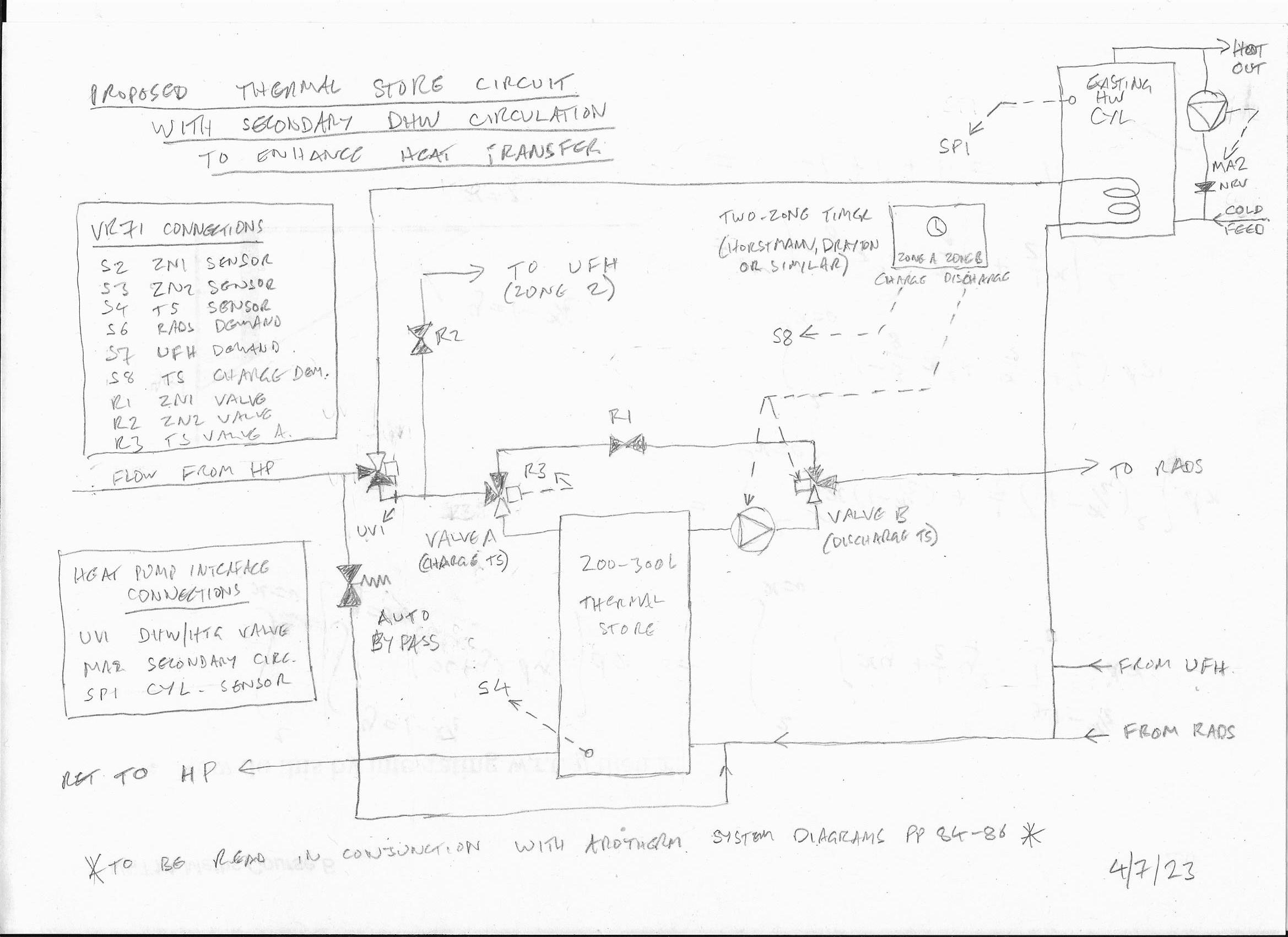
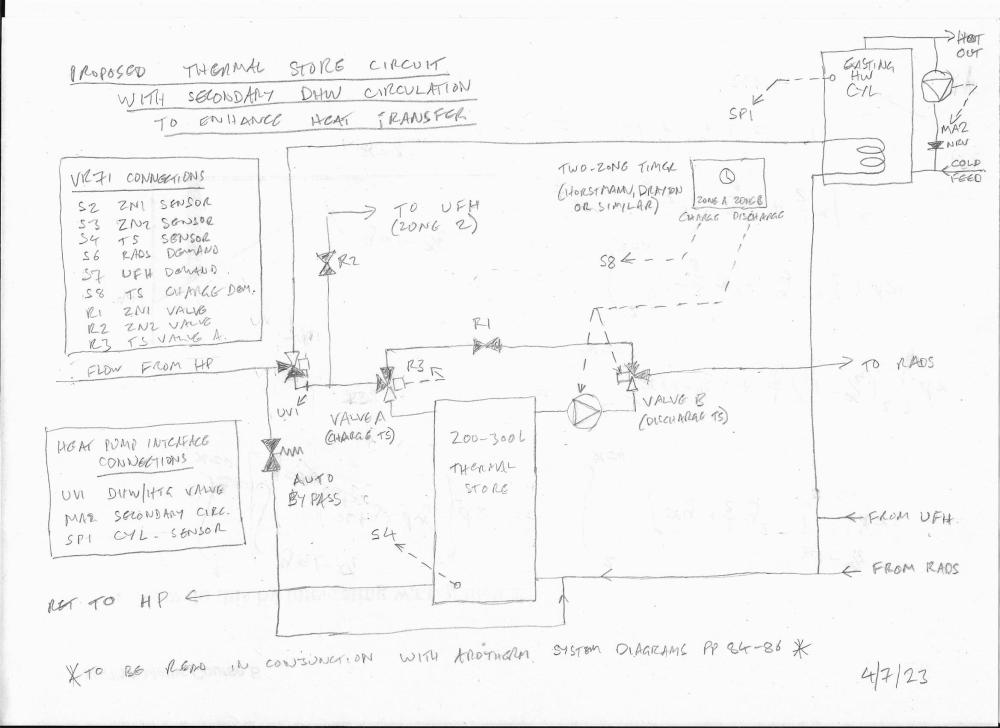
1. As discussed elsethread here is the proposed diagram for a Thermal Store in conjunction with an Arotherm Plus. I don't know if there is an approved Vaillant way of doing this (as distinct from a Buffer) but I haven't been able to find one. Perhaps there is more in the documentation for installers. The idea is to charge up the thermal store using off-peak electricity in the small hours and free PV in the daytime, and use it to heat the rads in the master bedroom for an hour morning and evening when electricity is much more expensive. Calcs show heating a 210l cyl by 12 deg will store 3kWh which is enough to heat the bedroom, and this could save about 360kWh of electricity per year. Referring to the diagram below: Normally the two 3-port valves A and B are in the straight-through (black) position and the rad zone is controlled by valve R1 as per the normal arrangement in the Vaillant schematics. To charge up the TS the 3rd party programmer sends a demand signal to the VR71 where it is programmed as Zone 3, this activates Valve A and the flow is diverted into the store. To discharge the TS through the radiator circuit the programmer actuates Valve B and the pump next to it directly to feed the rads. The HP can be on or off during this. In normal operation all the return flows (including the auto bypass) would pass through the lower part of the tank so it would also act as a volumiser. 2. Recirculation of DHW on the secondary side You might recall I have done some tests which indicate that the heat transfer is likely to be increased by a factor of 2 by circulating the bulk water in the DHW using a small bronze pump e.g. https://www.pumpsukltd.com/lowara-ecocirc-pro-15-1-65b-bronze-circulator-1-230v.html. This will mean a heat transfer rate of about 6 kW; the Arotherm Plus can turn down to 6kW so it will not need to cycle on and off. This would be much easier to implement than a replacement cylinder or fitting a heat exchanger. Getting the existing cylinder out from above the airing cupboard would require a lot of structural work. We can live with the longer reheat time as the tank will be heated during the afternoon and in the small hours when we are not using the hot water anyway. If we have a lot of visitors there is also the 3kW immersion which we can run off the PV diverter. Would appreciate all sensible comments!
-
Is there a no-frills R290 heat pump?
sharpener replied to sharpener's topic in Air Source Heat Pumps (ASHP)
Yes, it is long and thin, originally two barns. The upstairs layout is Master Bedroom, Guest Bedroom/Study1, Boxroom/Study2, Guest Bedroom 2 all in a row, with 6 wireless TRVs. By default if it is nice outside and no-one has come to stay then only the MB gets turned on at all. We have seriously considered in very cold weather living in the kitchen/dining room where the AGA is, and not heating the other end of the house at all. The AGA flue runs up inside the MB and also the boxing round it feeds into the MVHR system which helps further. Downstairs there are four zones of UFH each with their own hardwired thermostat, plus the two rads I have added in the living room with their own wireless TRVs. If sunny there is quite a lot of solar gain so it does not need much heat until after dark. Some simplification of controls is perhaps feasible. Installer C expressly quoted for separate stats upstairs and downstairs but we defo need something finer grained than that. As explained above zoning into the E barn and W barn would make at least as much sense. The other proposals were altogether very vague about controls. I get all the stuff about long and low - the AGA, UFH and stone walls provide a natural setback level everywhere and then with the controllability we now have we can spot heat the rooms only as and when we come to use them. OK this is a boiler replacement philosophy, which is where I began. -
Is there a no-frills R290 heat pump?
sharpener replied to sharpener's topic in Air Source Heat Pumps (ASHP)
What counts as a "new" heating system for the purposes of Part L? If you are doing a like-for-like gas boiler replacement then surely you are not expected to recalculate the emitters for 55C and upgrade all the rads at the same time. Why should changing the heat source to an HP affect this? Does that somehow make it more "new"? -
Is there a no-frills R290 heat pump?
sharpener replied to sharpener's topic in Air Source Heat Pumps (ASHP)
This. Describes my situation exactly. Honeywell Evohome took a long time to get working (because there are no diagnostics to show which (defective) wireless TRV is calling for heat) but I am not going to scrap it now and install a new Vaillant ambiSense controller and new valves throughout at £81-28 a pop. Just tried to ring Installer A at 1205 on a working day. Biggish firm but just rings out, can hear it divert (twice), no recorded message or answering m/c or anything. BTW1 I see the Heat Pump Installer Network has been set up specifically to train everyday plumbers as HP installers but looks in the very early stages ATM. Investors include EDF BTW2 I see also that Freedom Heat Pumps are now owned by Certas (the oil distributor who were forced to divest themselves of BoilerJuice after an anti-competitive outcry) - notice a pattern here? BTW3 I think I have worked out why my cyl has 15mm F&R, the piping is so short it might have starved the rad circuit if done in 22. Is S-plan so both can be on at once. A turn-down valve might have been more useful (and cheaper than all the 22-15 reducers). -
Is there a no-frills R290 heat pump?
sharpener replied to sharpener's topic in Air Source Heat Pumps (ASHP)
Interesting post on an earlier exhibition in Frankfurt by Graham Hendra, some further comments much in line with the thoughts of @JamesPa here. All of which inclines me to wait until some more of these R290 machines hit the market. Will still require a change of attitude on the part of MCS installer hierarchy though to design for flow temps higher than 45C. Part L allows 55C for retrofit but even that does not really make best advantage of the higher temps achievable IMO. -
Sounds good, could you post a link pse?
-
Is there a no-frills R290 heat pump?
sharpener replied to sharpener's topic in Air Source Heat Pumps (ASHP)
Yes, swimming pool suppliers sell special "pH builder" but this is just sodium bicarbonate (as above), however I use food grade as after the UV sterilizer it is potable water, though we do in fact have a separate mains supply for drinking water taps in kitchen and bathrooms. NaHCO3 will not increase pH above 7.5, however much you put in (sodium carbonate is much stronger but then there is a chance of overdosing). I make up a stock solution and then run it through a small dosing pipe into the 5000l underground tank and rely on the incoming rainwater to mix the contents which is a bit hit and miss. "Experts" have suggested various alternatives but they are mostly expensive (automatic dosing pumps) or bulky (5' high reaction vessels) or both. SWW just add NaOH at their treatment works but even that has been known to go catastrophically wrong! Favoured approach now is the combination of calcite (slow reacting) with 10% magnesite (fast but too strong to use on its own) in a filter bag round the bottom of the incoming 4 in pipe. Getting it there will be the problem as it is riveted in place as part of the tank construction, they were supposed to send me a bag which could be lowered down the inside of the pipe but it is too big and has a rigid plastic frame. If I can achieve consistent results higher than pH 7.0 I might think about a PHE. However we have had pinhole leaks and a totally failed s/steel spring in a pressure reducing valve in the past. OSO wanted >£150 for a replacement valve group but I managed to find a bare cartridge on the web, only £40 and a much easier job to fit. So now you know. Another project in itself. After consumables and replacement parts not much saving. We inherited the system, it was very badly engineered by the original contractor and I have installed a new tank and re-done much of the treatment plant. Also the (Chinese made) Stuart Turner jet pump has been very unreliable and ST will not help under warranty as they cannot repair them and regard them as disposable. I have just built a new one out of bits of two others, the plastic impeller shroud had a big crack in it. if it fails again I will fit a DAB as at least you can get spare shaft seals etc for those. -
Is there a no-frills R290 heat pump?
sharpener replied to sharpener's topic in Air Source Heat Pumps (ASHP)
The 15mm is less than 2m each way so using the trusted flow calculator it looks OK. Though what possessed the original installer to do that beats me. I have yet another spare pump so it would only require a few fitttings to sort out. Glad to know that MCS installers will contemplate fitting a PHE, I will add it to my list of questions. It could go in the utility room directly below the tank with pumped F+R on the DHW side. Reheat time is not an issue. Snag in my case is that the source of the DHW is harvested rainwater, according to this web page the pH needs to be 7.5 or more to avoid corrosion of the copper brazing. Raw pH is about 5.3 from dissolved atmospheric CO2 and despite treatment with NaHCO3 I can't get it above 7.0. I was going to try a mix of calcite and dolomite based media next but they sent it with the wrong size of filter bag so it is in the all-too-difficult pile ATM. -
Is there a no-frills R290 heat pump?
sharpener replied to sharpener's topic in Air Source Heat Pumps (ASHP)
Hardly "happy", involves a lot of unneccesary work at my expense IMO! Will re-visit the heat loss calcs to see if could get away with the Cool Energy or Grant 10kW nominal units which might also be easier to integrate with the controls I already have. Distribution splits 4 ways from boiler location: UFH, 1st floor rads to W, ditto to E (all in 22mm), cylinder coil (15mm!!). Thanks for link re noise, will follow it up. -
Is there a no-frills R290 heat pump?
sharpener replied to sharpener's topic in Air Source Heat Pumps (ASHP)
True. But was waiting for DNO approval before splashing out £270 on planning application. Will apply for "Vaillant 12kW or smaller" installed i.a.w. MCS noise standards. It provides a reason for applying for express PP without disclosing possibiity of not using an MCS installer. Forgot to mention that Installer B wants to replace entire UFH manifold. There are some old streaks from leaking joints long since tightened. Needs a new blending valve, is all. You are surprisingly taciturn tonight @JamesPa <g>, not like you to be short of a comment or three on the physics of it all! -
Is there a no-frills R290 heat pump?
sharpener replied to sharpener's topic in Air Source Heat Pumps (ASHP)
Most of the time the only need for water at 55C is to heat up the rads in the master bedroom for an hour morning and evening, a 300l tank would I calc be enough for this, charged up while we heat the DHW as well using cheap/free electricity. I don't think we will get away entirely without a buffer to stop short-cycling and provide the defrost energy. Then the additional cost of expanding it to a 300l TS is not very great, I already have the pump so it could be done with two extra 3-port valves and a couple of relays. I'm of two minds if it is worth the added complication though. The £3.5k for the iVT10 is before VAT. The performance is a bit marginal, my design case is A-0.2/W55 which with a bit of extrapolation from the table below looks like the output might be in the range 10 to 10.5kW. I have in the past tried to get more detailed figures from CoolEnergy, but it's perhaps worth another go. When sent my floor plans they quoted for the bigger IVT-18, inc VAT that would be £5640 and like the Stiebel Eltron it uses R410a. Anyone got any thoughts on other budget HPs like Warmflow, Trianco, Riello?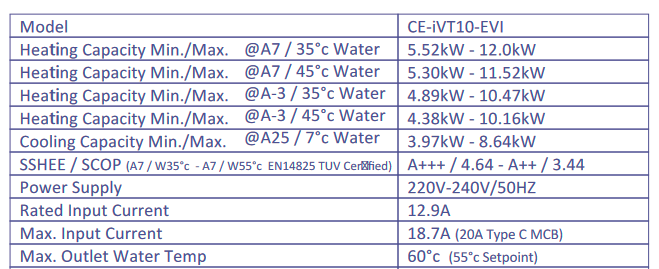
-
Is there a no-frills R290 heat pump?
sharpener replied to sharpener's topic in Air Source Heat Pumps (ASHP)
So I have just got DNO approval for a Vaillant Arotherm + 12kW, and now received three quotes via the Vaillant find-an-installer process. Tried similar Daikin process but it has fizzled out. Have not pursued Good Energy option. Results in round number terms: Installer A. Says Vaillant 12kW is not powerful enough, quoted for a Stiebel Eltron WPL 25 ACS at £17800 including labour plus £2000 "installer margin"(?). Design based on flow temp 55C. Originally suggested existing rads would be adequate, when queried would install 7 new rads for an extra £1900. Includes new 300l cylinder in utility room with 100l buffer. Mentions 10-40 l/min flow setter. Excludes removal of oil boiler from site. The Stiebel Eltron is much deeper front to back and needs more space behind it so would stick out 300mm further from the wall. Also uses R410a which is obsolescent. Bottom line after BUS: £14700, subject to a further pre-installation technical survey. Installer B. Would fit Vaillant 12kW for £16000. Design based on flow temp 45C (AIUI mandatory for new bldgs but not for retrofit). Says 11 new rads needed at an additional cost of £2700 installed (including 1 in utility and 3 in shower rooms which I do not want and would be difficult to get pipe runs to) Includes new cylinder where current one is and 100l buffer in utility room Would want to take up half the landing floor as wants to replace main F&R to rads with 28mm Bottom line after BUS: £13700, fixed price valid for 30 days. Installer C. Would fit Vaillant 12kW for £27000 bugetary price Design based on flow temp 45C. Includes 8 replacement rads and much new pipework in 28mm including to the cylinder coil(!) Includes 300l cylinder in existing space and 120 litre buffer with auto bypass and antifreeze valves Some items are un-necessary (e.g. new concrete base and soakaway) but I cannot see them being competitive. Bottom line after BUS: £22000 bugetary price D. DIY Option I can get the basic HP for a discounted price of £6800 inc VAT. I would then envisage doing the following fit a large buffer tank/heat store to enable me to charge it up using off-peak in the small hours and free PV in the daytime, <£1000 re-use the existing cylinder but fit a destratification pump to improve the heat transfer ~£250 fit 7 new rads, possibly with the assistance of recommended local plumber £1000-2000 depending do the wiring under an existing Building Notice and the remaining plumbing myself allow ?£1500-2000 for feet, pipework, valves, basic controls etc etc Bottom line £10550 - £12050 Pros: I get the system I want Higher efficiency/more energy saving Less disruption Less waste Cons: Savings on capital outlay are modest, about £3k at most (no VAT exemption or BUS) Am on my own if the design proves unworkable Poorer warranty conditions Plan: Contact installer B, see if they are amenable to taking out the 4 rads I think are not necessary and maybe this will also remove need to upgrade feed to 28mm. If I go ahead using them then keep the old cylinder so I can add it later as a thermal store at near zero cost. I would welcome any contributions on any of the above! -
Is there a no-frills R290 heat pump?
sharpener replied to sharpener's topic in Air Source Heat Pumps (ASHP)
I imagine that is because of the flammability of R290 despite R454b's worse GWP. -
Is there a no-frills R290 heat pump?
sharpener replied to sharpener's topic in Air Source Heat Pumps (ASHP)
Went to the Installer Show at the NEC yesterday, lots of interesting stuff. You can still catch it tomorrow. Many more HP companies have got their newly-developed R290 models now on test and will be bringing them to market late '23 to early '24. Among these I talked to were Grant (will be made by Chofu), Toshiba (branded as Carrier), Panasonic, Trianco. Nothing surprising technically but I imagine as the technology penetrates there might be a bit more competition on price. Stiebel Eltron are pursuing a different route and have chosen to go with R454 as a replacement for R410a. Their 15kW machine is incredibly chunky to look at! Ebac have their new British designed and made 5 and 9kW R32 machines (based on Mitsi compressors) with a test house currently, and are working on a bigger inverter to expand range to ?14kW. Will sell direct from factory. Was highly impressed talking to their Head of Development. Another thing which caught my eye were several manufacturers of pipe fittings designed to be pressed/swaged/crimped rather than using grab rings a la Tectite. Apparently public contracts are now calling for these. Rothenberger man was very proud that his battery-powered on-site press was under £1000(!). So I think I will stick to Tectite for my (longer) replacement radiators, don't fancy the large number of Yorkshire fittings involved. Have now had three quotes for MCS HP installation, none very satisfactory, will post details separately in a short while. -
Local BC have been happy to sign off my installation of a Battery ESS to IET CoP and Part P, a lot more stuff to get your head round there. Yes re D1/D2, on the existing (1996) tank the tundish is more than 600mm below the valve(s) but I will obvs fix that if I do any work on it. My thinking also, it's not a classic Y-plan setup, and fails shut. 2-port valve is I agree necessary when upgrading Y-plan to UVC as here. For an HP I can't see that a 2-port valve gives any better protection so IMO has no benefit and not required with usual HP config. Irrespective of whether the HP could raise the water to 100C in the first place, that is your first point of protection so now you have three. Anyone got any further thoughts on the "non-self-resetting" requirement though? Typical UVC package has non-self-resetting overtemp stat (separate from the service thermostat) which also interrupts the supply to the valve. But not shown on HP schematics, where the service stat is a thermistor temp sensor in a pocket and the valve is supplied indirectly via the HP controller.
-
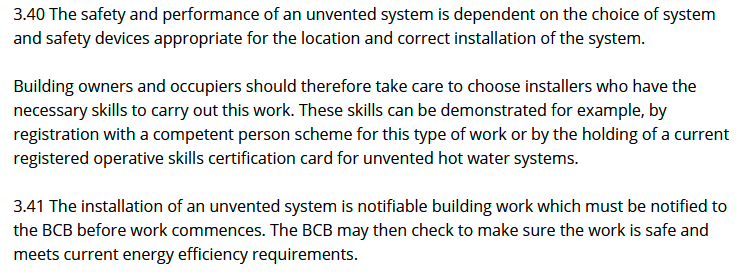
Can you provide a reference for this @Jenki? On looking here I can read the following But i cannot find here or in the subsequent paragraphs a specific requirement for a two-port valve. A three-port valve which defaults to CH will meet the requirement in para 3.31 for it to fail-safe in the absence of an electrical supply. However neither type of valve will meet the requirement for a non-self-resetting safety device so how is that achieved in practice? My unvented tank has got this feature, but only for heating via the immersion heater, not via the boiler and coil. BTW it would seem that a G3 certificate is not mandatory provided you have the "necessary skills" and notify Building Comtrol before starting the work (as under) and on completion of commissioning (para 77):

-
ASHP for a flat - (A2A; grants)
sharpener replied to magnayn's topic in Air Source Heat Pumps (ASHP)
Hmm, let me see if I have got this right... If the HP and parts cost £7500 you either pay £9k inc VAT for supply-only, or a min of £5k of installation on top and no VAT so £12k5 in total. A penny less and you have to pay a shade under £15k inc VAT. Conversely if the installation costs are only £2917 then even with the VAT due the total is also £12500. So there is a "dead zone" of installation costs between £2917 and £5000 where the endprice is in fact disadvantageous to you. And I am sure that is one reason why installation never costs less than £5k though I can think of others. -
Eh? You have conflicting requirements, the UFH will want a low temp and WC, the bathroom rads and cylinder high temp and no WC. So how about programming the rads to come on mornings and evenings 30 mins before you are going to want to use the bathrooms and heat the DHW at the same time? (Works well with our gas boiler.) IIRC Grant recommends S-plan setup so that would be easy to do. This will help prevent short-cycling under low load too.
-
Yes. I had a capacitor fail too, on my Villavent MVHR heat exchanger drive motor (rotary wheel type). Was in a hurry to get it fixed ahead of visitors coming so cost me £150 for a new motor. But for under £10 I got a new capacitor (well tbf three capacitors in parallel to make up the right value) from Farnell so now I have a spare motor if it happens again. If that is all that is keeping your Genvex from the scrapheap it is a feasible DIY job. When you say it blows a fuse do you literally mean that or is it tripping a breaker and if so is it on overcurrent or earth leakage? Of course now the unit exists, the ozone layer and global warming threats only really come into play when the thing reaches the end of its life.
-
Nor with micro-hydro schemes but the EA make a fuss about them too.
-
Enclosure or longer piping run for split ASHP system
sharpener replied to Jonshine's topic in Air Source Heat Pumps (ASHP)
It doesn't really stack up at all. AFAIR the MCS text just calls for a "fence or wall". The only test is visual: A brick or block wall would probably give 10dB but I doubt a fence would in reality. Depends a bit on construction but a fence made of thin strips of wood for visual screening is light enough to vibrate with the incident sound and re-radiate it from the back. Like a drumskin. But it is still a "fence". OTOH any reasonably constructed wall will be sufficiently massive and rigid so it will neither be excited by the incident sound nor flexible enough to re-radiate it. Neither will stop reflections. Walls are good reflectors precisely because they are rigid and have no internal friction. Ditto springy materials with low damping like hardwood and sheet metal. So the ideal materials are a combination of e.g. rockwool or fibreboard type materials which use their internal friction to turn the incident sound into heat, and rigid masses which don't conduct or radiate. Hance my past success with chipboard lined with fibreglass insulation. Cf also construction of loudspeaker cabinets. IIRC there was a noise consultant on here but can't remember his handle, it would be good if he could join this discussion. I am only an amateur now but I did work in the recording studio equipment business for a few years and have done a lot of sound in theatres.
-
Enclosure or longer piping run for split ASHP system
sharpener replied to Jonshine's topic in Air Source Heat Pumps (ASHP)
Found it here, thanks to @RichardL for posting it! -
Enclosure or longer piping run for split ASHP system
sharpener replied to Jonshine's topic in Air Source Heat Pumps (ASHP)
Mass is your friend in the world of soundproofing! -
Enclosure or longer piping run for split ASHP system
sharpener replied to Jonshine's topic in Air Source Heat Pumps (ASHP)
Well done, you are on a roll today @DanDee Looks well constructed and the attenuation is quite impressive. With 16 pages of documentation and all the custom sized individual panels and seals no wonder they cost £4k and are a foot bigger than the HP on all sides. I would have thought you could copy the basic layout (which is very similar to the thing I once built round a motor-generator set) and make one yourself out of chipboard lined with the self-adhesive acoustic mat from Amazon. With a roofing felt cover it should last quite a few years. The Arotherm + come with AV mounts as a standard accessory. Looks as though if I get the 12kW model I will need a plain full screen hence my interest but a fence panel should suffice. As a two-fan unit it is a lot higher and one of these total enclosures would look truly massive. BTW do you have a link to the specimen Planning Application someone kindly posted here? Or maybe it was on another site. EDIT: Snap! The Stratocell Whisper FR looks like the basic material which is made into the acoustic fence panels listed upthread. Would be useful to put on the wall behind the HP. Can you then count it as one reflecting surface (the ground) and not two for MCS calcs do you think? -
Joule Aero not working with diverter
sharpener replied to Judith's topic in Air Source Heat Pumps (ASHP)
Yes, in the diagram compare 65 which is the system thermostat and has a single prong with 64 which is the immersion heater and has a folded element (and usually a separate single probe which is its own thermostat).