


sharpener
-
Posts
1492 -
Joined
-
Last visited
-
Days Won
1
Everything posted by sharpener
-
Where is the element located @SteamyTea ? Very strange. Perhaps the energy density (power/surface area) at the coil surface is not high enough to set up meaningful circulating currents. For a traditional immersion heater it is much higher (shorter length, smaller diameter) so probably more effective at this. Does the immersion eventually heat the whole tank, or not @Radian ? All in all it seems to be good evidence that stirring the tank during heating might be helpful in getting the most stored hot water in the least volume. Luckily my 210 indirect OSO tank has both immersion and coil near the bottom so I have never had any reason to question any of this. Surplus PV most days.
-
Is there a no-frills R290 heat pump?
sharpener replied to sharpener's topic in Air Source Heat Pumps (ASHP)
Yes, there is one bedroom wall dry-lined with plasterboard over sheepswool, hope I can find the receipts as they will require documentation. Don't have continuous records of actual consumption unfortunately. Last time I did a calc based on actual oil usage I got 6kW averaged over a 24hr period, from which I think a reasonable size of HP is 12 - 15kW, it agrees with the total rad output (rated at 70C flow) of 15kW, though at 65C and with zoning I think the max load at any one time is well under 10kW. FWIW this cheat sheet comes up with a 13 -17 kW HP for a house of the same size, age and construction. Another worry is that an HP drawing over 32A and/or with any kind of boost heater (inc AIUI an ordinary immersion in a new tank) will require my supply fuse to be uprated. Found a useful EPC surrogate (from the EST - but oddly not on their own w/site) at Dansk Bank (and other banks). It foresees a saving of £18/yr from an expediture of £444 on further loft insulation, so an even worse investment than my own calcs predicted. Changing the few remaining incandescent bulbs (in storerooms and cupboards) will be a lot easier to do. It seems brownie points are also attached to PV and fortunately I have a lot! It would be nice to find a fully reverse-engineered matrix from the official software so I know what weightings are attached to the various factors in the EPC assessment, but so far I have not discovered one. Will post a proper update w/c 22 May when I have got two visits fixed up now. -
Is there a no-frills R290 heat pump?
sharpener replied to sharpener's topic in Air Source Heat Pumps (ASHP)
Thanks for that, my Czech is improving by leaps and bounds now. First time I have seen CoP plotted as a function of compressor speed. Looks like 2.0 is what I will get from the 12kW unit providing HW as @JamesPa predicted. I will be silent about the intermittent use of the property, as AFAIR that requires a significant uplift in capacity, can't immediately find it in the rules linked to above. OTOH it says no uplift if you use the -1.6 design temp so that might actually be better. The other issue is the EPC and the loft insulation. At B & Q prices it will cost ~ £500 (plus labour) to double the existing 150mm over 100 sq m, this will save about 20W/K. So multiplying that by 1641 deg-days x 24 hours gives me about 800kWh/year which is about £60 at current oil prices i.e. a payback of ~9 yrs so NBG even if the house were occupied full time during the winter. Based on your experience can you give me a quick precis of the other main lies I will have to tell? I expect as well as the cylinder he will want to rip out the 8 Honeywell wireless zone valves and my home-made internet control box too! -
Is there a no-frills R290 heat pump?
sharpener replied to sharpener's topic in Air Source Heat Pumps (ASHP)
The solar immersion is set to 55 and now we have doubled the available PV to 7kW the heating coil is only used when there is a shortfall e.g. if we have visitors. The oil boiler is set to 65C (its lowest setting) and the tank stat for the motorised valve set to 50 so that the PV has priority. Both the above give an entirely adequate HW supply. Over the years I have put extra rads in the master bedroom (undersized) and the living room (to get faster warmup) and with the boiler at 65 the output from the rads is now fine except for the landing where they are known to be rather small. In the living room there is also UFH, which we do not use much now there are rads installed there. This might change with the HP, I have no idea what flow temp is really required as the mixing valve is currently stuck at full but yes 35C would be a reasonable guess. I am expecting an "interesting" site visit from a Vaillant installer in 10 days time. Today we went through the "why do I need a new cylinder" ritual on the phone. He wants to restrict the flow temp to 55 "because the CoP is poor at higher temps". Their so called spec sheet doesn't have proper CoP information and not even the SCOP for temps over 55 so I don't know where this comes from. (The MCS rules state "4.2.5 When installing a domestic hot water cylinder to work with a heat pump, the heat pump shall be rated for 55oC", I assume this is intended to be a minimum not a maximum.) As you point out the DHW is only a small fraction of the duty anyway. I see the installer has to agree the recovery time with the client, in my case 3 hours would be fine (i.e. an input of ~3 kW) I want to have 65 available for the rads as well, though with WC it will not be needed most of the time, the 99% OAT for us is only -0.2C and the 99.6% is -1.6. So I can see I will have to keep most of my thoughts to myself if I am going to get a quote out of them! -
Is there a no-frills R290 heat pump?
sharpener replied to sharpener's topic in Air Source Heat Pumps (ASHP)
Yes, the Grant/Chofu look easy to interface to my exising controls and would do everything I want except the flow temperature - because they are R32 not R290 - which unfortunately is the dealbreaker. -
Is there a no-frills R290 heat pump?
sharpener replied to sharpener's topic in Air Source Heat Pumps (ASHP)
Thanks for the pointer @JohnMo. You were fortunate, none on ebay now, Beneath Heat selling just a DHW tank. Their main business is UFH components, I suspect they use ebay to sell unwanted items bought for specific projects not as a general sales outlet. Would want to use a volume Maxa importer, for reasons of backup and warranty, but it seems there isn't one ATM. So it seems this was a blind avenue. Still looking for something cheaper (and ideally less heavy!) than the Vaillaint Arotherm plus. Got someone coming to quote for that now, we shall see... -
Is there a no-frills R290 heat pump?
sharpener replied to sharpener's topic in Air Source Heat Pumps (ASHP)
The company history here says 2023 introduction of R290 but no product information on their website, however there is a catalogue released in ?March at the ISH fair in Frankfurt, domestic monobloc range covers 6 - 18kW in two frame sizes but I can't find a sales outlet anywhere, and @Post and beam wasn't able to either for the R32 models. Maybe they are supplying them as white-label to Viessmann. -
Is there a no-frills R290 heat pump?
sharpener replied to sharpener's topic in Air Source Heat Pumps (ASHP)
Can anyone tell me who makes the Viessman Vitocal 150-A high temperature range? As I recall the 100-A is made by Maxa but I can't find any R290/high temp products on the Maxa web site. -
Yes I read that but I wasn't expecting the same treatment. The GE site survey is now £50 virtual or £100 on-site. However the main issue AIUI is that you need an EPC that doesn't recommend loft insulation in order to get the BUS money. Am wondering about topping up the areas near the loft hatches(!), the whole loft is 100 sq m and because of the c1840 roof truss design much of it is not readily accessible.
-
Trying to make more progress I have booked the EPC survey now and contacted GE again. GE won't refund their own survey fee if I cancel because the EPC recommends cavity wall or additional loft insulation. They helpfully(!) add that the current standard for loft insulation is 270mm. I suppose mine is 150 - 200mm, but because the loft now has MVHR ducting running all over it it would be a complete pain to fit more, and I doubt it would provde worthwhile savings given the barn conversion has solid stone walls anyway. So two questions spring to mind about the EPC survey: Do I get any credit for the MVHR system? How do I discourage the surveyor from making an adverse finding that will disqualify me from the BUS grant?
-
Yes, I bought a 4-way DIN enclosure to house a meter and an SPD, the terminal space is so cramped I had to use 4 x 4mm^2 links rather than 16mm^2 like the meter tails.
-
Kingspan Aero max ashp compatible control unit options?
sharpener replied to JOATMON's topic in Air Source Heat Pumps (ASHP)
However it seems you need their advanced controller KHP0008 to set a LWT other than 55 deg (p8) or change any other default settings. -
Yes, we had a Shureflow 12V freshwater pump on our Rival 32, and following the line of thought about leisure applications I looked at ch pumps for caravans, touring or static, and came across this which looks better made than some of the chinese imported stuff. But quite expensive so maybe the answer would be a normal bronze pump with the valves almost shut. ATM I am killing time while still chasing Daikin installers and waiting a callback from GE so I can see if they will do a survey without an EPC, as you mentioned elsethread.
-
You are right. Brain fade! So they must exist, but a further search has drawn a blank. From the pic here it looks like a miniature immersed rotor ch pump (unless that is only an artist's impression). There are various 12V 100C bronze/plastic pumps on amazon but I wouldn't want them near my hw tank. I don't know why the pumps sold for secondary hw loops are so big, the pump doesn't need to handle the main hw demand. You don't need to move 4m^3/hr just to keep the pipework hot and they consume a significant amount of power running 24/7, though I notice in passing some now incorporate timers.
-
I think this must be a yes for 3 separate reasons, because (i) with the PHE you will achieve just as good heat transfer as a "heat pump" cylinder would give, but the stirring will (ii) improve it further with turbulence round the coil (if left in circuit) and (iii) improve the CoP by keeping the temperatures low for as long as possible assuming their thermodynamics are correct. The downside is de-stratifying the tank so not being able to draw off water that is properly hot during the heating up phase. In my case this is of no consequence as the times when it is best to heat the water are quite distinct from the times when I want to use it. I can imagine this would apply to many people. Still haven't been able to find the small pump that Mixergy use. But theirs is on the primary circuit, whereas if I fit one to stir my existing tank I will have to have a bronze one.
-
Ecodan 11.2kw PUZ-WM112VA-BS - Noise Levels
sharpener replied to Kevin77's topic in Air Source Heat Pumps (ASHP)
Glad you are making progress without paying the £350! It seems at least the installers are confident they have done nothing wrong. Others have decried the CoolEnergy "return to base" warranty terms, but shipping a unit back still cheaper than calling Mitsi out to one supposedly under warranty. -
Ecodan 11.2kw PUZ-WM112VA-BS - Noise Levels
sharpener replied to Kevin77's topic in Air Source Heat Pumps (ASHP)
Well your contract is with the installers not Mitsi so it is for them to get them to come out (and pay the £350 if that is what is required). Can you tell them you will start a Section 75 chargeback, which may jog them into action? Presuming of course you have put at least some of the payments to date on a credit card. Or was it a self-install, in which case do the same to whoever supplied you with the unit? -
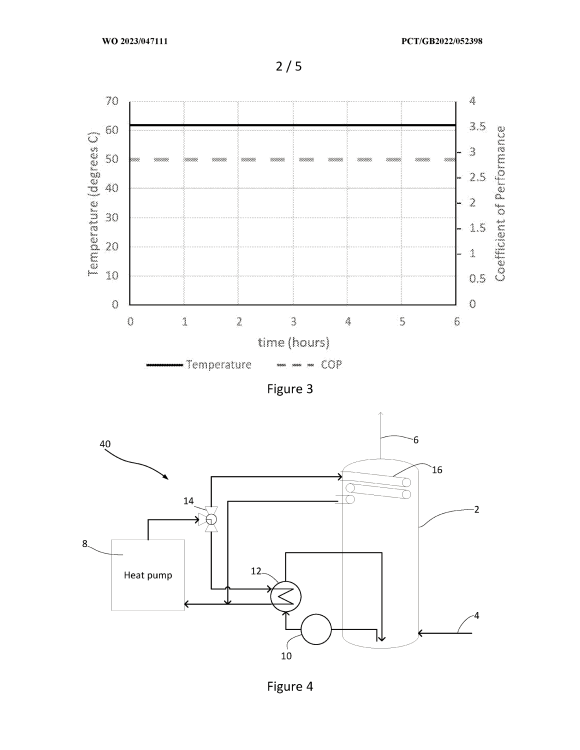
Thanks for the link, very useful explanation. They obviously envisage using this two-regime technique in an improved add-on kit for existing tanks too, which may interest @JamesPa. As the full text although worth reading is very repetitious I am including the key bit below (my emphasis, it explains why circulating the water in an existing tank with an externally-fitted pump is a good idea). Pictures taken from espacenet: Figure 2 shows a graph illustrating a first example for optimising the COP of the heating. In this example the flow rate of (cold) water into the heat exchanger is selected to enable the most efficient heat transfer. Generally, the higher the flow rate the better the COP is; this can be explained by the higher flow rate producing a turbulent boundary layer further into the heat exchanger, with the turbulent boundary layer providing more efficient heat transfer than the laminar boundary layer. Other factors affect flow speed too; for example for a large plate exchanger a lower flow speed can produce the same heat transfer as a smaller plate exchanger with a higher flow speed. The flow speed may be reduced or increased in dependence on performance of the heat source (be it e.g. seasonal variability or heat pump capability), but for maximum COP the flow speed is generally maintained as high as safely and conveniently available. The COP associated with heating water at 20 °C is around 3.5 whilst the COP associated with heating water at 60 °C is lower, for example 2.9. In this example water in the tank is permitted to heated up gradually, and the COP gradually drops as the tank is heated. In this example, the average COP is 3.2 for complete heating of the tank. Figure 3 shows a second example where the water is not permitted to heat up gradually, but instead the flow rate of cold water into the heat exchanger is selected to bring the water to the desired use temperature of 62 °C in a single pass through the heat exchanger. Here the COP associated with heating water is 2.9 throughout, and if this is used for complete heating of a tank’s worth of water, then the COP remains 2.9 throughout.

-
Assuming the HP can deliver water at 50C irrespective of the inlet temp (which it seems to be capable of in Boost mode, where the water makes a single pass through the HP) then according to Wikipedia it is inversely proportional to delta T between the cold source (the air) which is constant, and the HP outlet water which as above is also constant. What we are missing is an expression which takes into account the water temp at the inlet to the HP which will either (in Boost mode) be constantly cold or (in max efficiency mode) rise slowly as the water is recirculated and the tank as a whole heats up. Clearly the heat input to the water is deltaT x flow. Does this HP (and indeed ASHPs for space heating) A. control the flow so as the body of the tank heats up and deltaT becomes less the flow rate increases to maintain constant power, or B. maintain a constant flow in which case the deltaT will remain constant so the outlet temp will not be 50C but will be less to begin with and rise as the tank heats up. Can someone point me to the appropriate theory for this? My undergraduate thermodynamics is very rusty now.

-
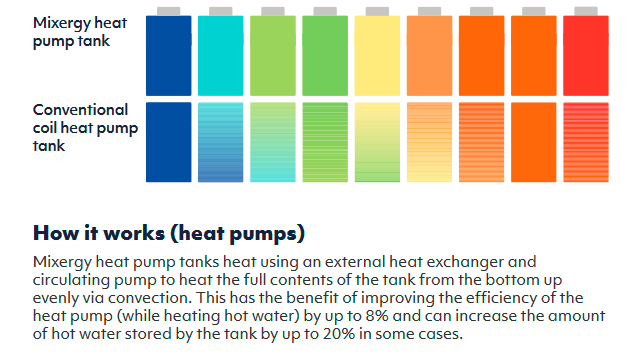
Yes confusing isn't it. The bottom picture in yr earlier post is from this Mixergy news article and shows the "conventional approach" with the refrigerant coil wrapped around the cylinder which Mixergy are at pains to say they do not use. The key to achieving stratification is to have the flow circulating at only the rate at which the water can be heated. Notice how small the circulating pump is in the picture. If they can be obtained readily it would be the ideal pump for adding to a conventional cylinder - with or without a heat exchanger - as discussed by @JamesPa and me in the other thread. <The Stratos instantaneously heats hot water which is drawn from the bottom of the cylinder and returns it back to the top to achieve very quick reheat times. Alternatively, a flow path back to the bottom of the cylinder allows the system to achieve the highest possible COP on a full reheat cycle.> from this Mixergy seem to think that for the best CoP the optimal strategy is to return the hot water to the bottom of the tank. I had been debating which was the best approach but don't understand why this is better than having the coldest water descending slowly to the take-off point as in their Boost mode (which achieves a CoP of between 2 and 3), maybe someone can elucidate?
-
It's clear from the pictures in their own literature that there is very little stratification in the heat pump version of the standard Mixergy tank:
-
Is there a no-frills R290 heat pump?
sharpener replied to sharpener's topic in Air Source Heat Pumps (ASHP)
See also https://www.wired.com/2008/02/new-and-improve/. I particularly like the description of surrealism. -
Is there a no-frills R290 heat pump?
sharpener replied to sharpener's topic in Air Source Heat Pumps (ASHP)
Having been on many factory visits in the UK, W and E Europe and S Korea I would guess that making the metaiwork and most of the components (compressor, valves, HX, cut and bent pipework, pcb etc) is highly automated, but final assembly would be a manual process, probably on an assembly line like automotive with different stages done at different workstations equipped with power screwdrivers and other power tools. Ending up with fill and final test on an instrumented test rig. That is how they do vaguely similar products with lots of different electromechanical bits, like washing machines which are bigger volume than HPs. Happy to be proved wrong if someone has a link to an HP factory on youtube. -
Grease filter kitchen extract
sharpener replied to Oz07's topic in Mechanical Ventilation with Heat Recovery (MVHR)
In our kitchen above the cooker we have a 125mm extract point as part of our Villavent/Systemair MVHR system. We use bonded acetate fibre sheet which is sold by the metre in John Lewis upholstery dept for padding cushions and sofas. We cut it to a template and sew the edges to form a "hat" which goes above the automatic fire damper mechanism. Although we do very little frying it collects a black layer of miscellaneous grot and needs changing every six months. We also put discs of the same material in the bathroom extracts, they collect a lot of towel fluff and need changing once a year. As a result the ductwork stays very clean and we only need to change the filters in the central plant every 3 years. -
Is there a no-frills R290 heat pump?
sharpener replied to sharpener's topic in Air Source Heat Pumps (ASHP)
Interesting research on R290 reported here. @markocosic would be pleased with the small quantities of refrigerant, only 10g/kW which seems amazingly low. They envisage commercial HPs using only 15g/kW. Meanwhile Bosch have announced their R290 offering (but only up to 6.7 kW) and a new factory in Poland. But I am not holding my breath for large-scale heat pump manufacturing in the UK whatever BEIS thinks. German industry has been moving steadily into Eastern Europe ever since the Wall came down, the combination of a good level of skills and comparatively low labour rates is irresistible.

