


sharpener
-
Posts
1492 -
Joined
-
Last visited
-
Days Won
1
Everything posted by sharpener
-
ASHP Modulation split dwelling
sharpener replied to jamesdiyer's topic in Air Source Heat Pumps (ASHP)
A full 200l tank of water takes about 9 kWh. For 9 people you should allow 9 x 45l so at least twice that. With a 12kW HP it would spend 1 1/2 hours in 24 heating the water which is a big dent in the heat avail for space heating. Gonna take a v long time. -
ASHP Modulation split dwelling
sharpener replied to jamesdiyer's topic in Air Source Heat Pumps (ASHP)
Did that include any allowance for heating the DHW? It can have a material effect on the sizing depending on # of occupants and usage pattern. Also an MCS installer may insist on changing the tank, what have you currently got and importantly what is the coil surface area? -
ASHP Modulation split dwelling
sharpener replied to jamesdiyer's topic in Air Source Heat Pumps (ASHP)
Lots of ways to do this. If the pipe runs are suitable a two port valve is simplest, could power from a Shelley or similar wireless gadget to save a long/difficult wiring run. Set up as a separate Circuit on the Vaillant controls, can then have its own time/temp schedule. Or wireless zone valves or TRVs on the rads, Tado are probably better than my Honeywells (could hardly be much worse!). -
Lead water pipe dispute with Scottish Water
sharpener replied to stamas01's topic in General Plumbing
I have used DIY tests from Simplex Health, they despatch promptly and there is a wide range available which are relatively easy to use (helps if you have done some wet chemistry). The lead test is very sensitive. Have also used an independent consultant but he sent the tests off to somewhere else and didn't really give me the advice I was looking for (low pH in my rainwater system). If you have hard water I would not worry but as you are in Scotland you might have a problem, OTOH if so they probably treat it with polyphosphate - which is what causes the scum on your tea if you suffer from that(!). -
ASHP Modulation split dwelling
sharpener replied to jamesdiyer's topic in Air Source Heat Pumps (ASHP)
You don't say what emitters you have got on your wood-fired boiler system which would be useful info. My initial thought is not to try and size an HP for the full duty for the reasons you state. As @JamesPa says, if Floor 3 is indeed above Floor 2 you may find depending on the construction of the floor that is is heated from below anyway. Maybe plan to heat the core from the HP and in extreme low OAT either run the fireplace, or if necessary add an A2A HP for Floor 3 later. The problem may be in convincing an MCS installer to size it like that, bc to get the BUS grant it must be designed to heat the whole house from the HP and installed by an MCS installer. I eventually got mine to adjust their assumptions a bit, their initial quote for my 200 sq m barn conversion was for a Stiebel Eltron 15kW unit. Here is some data for the Vaillant Arotherm Plus 12kW which is what I am now planning to fit. Water temp 40 - 45C. Other tables available here. You will see the modulation ratio varies with air temp from 25 to 50%, that is pretty typical. Mitsubishi publish similar tables, but they are hard to find for low end products. Avoid Samsung, they quote a wide turn-down ratio but use hot gas bypass to achieve it which wrecks the efficiency. The Vaillant spec is quite generous and it actually puts out 12.5 kW at your -7C. As you can see from the table below it will even do 14.7kW at OAT = -2 if your emitters are sized for W = 30 - 35C. There is also a 10kW version of this HP but it is the same mechanically with the output restricted by limiting the compressor speed to 85 rps so not much cheaper and the ratio is worse.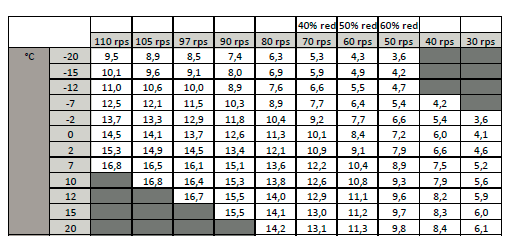
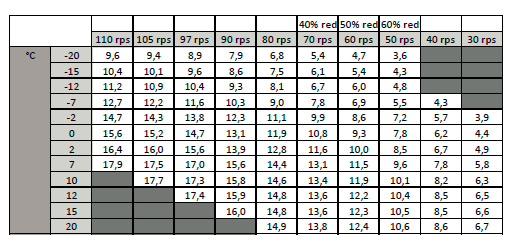
-
The magnet causes the two switch blades in a sealed glass capsule to be attracted to one another so completing the circuit. As others have pointed out it is not a type of switch really suited to controlling a load like a pump. I would add with the pump running measure the voltage across the switch, and between the neutral at the pump and a neutral on a different circuit. Report back with the results of the tests upthread suggested by me and @Temp, then we can help further.
-
Have just talked to Hydratech, very timely enquiry. They are in the process of formulating a fluid for protection to -5C which will be more economical, equivalent to Fernox HP-5C. Should be available in the next few months and keenly priced against the competition. May be also produced in an EG version based on their DTX reduced toxicity product. Clearly one to watch for those in temperate climes.
-
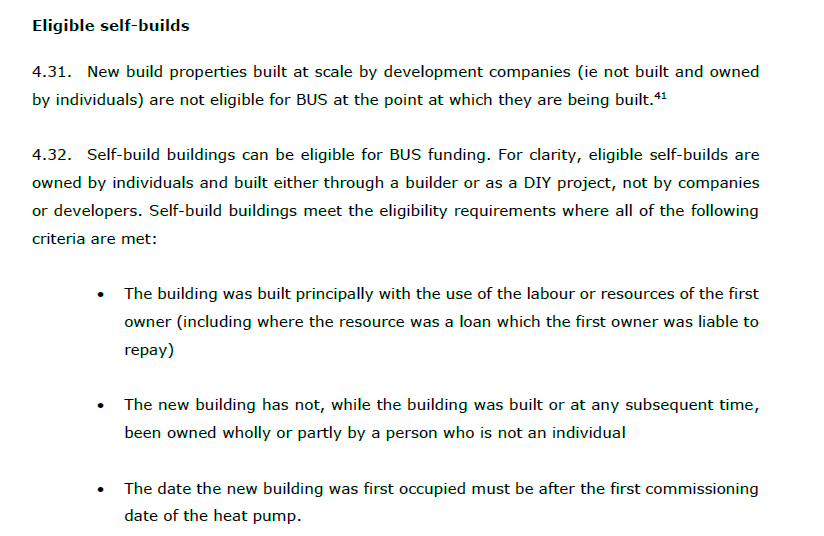
Here's a list of those claiming an interest. Of those I think only Michael Fabricant is a chartered engineer, though there was one on the opposition benches as well at one point. Not sure you could say he was a serious engineer, Therese Coffey is not a serious anything but still makes the list. Fitting the UFH and rads beforehand for example, my quote has got £1800 in it for rads alone (not a newbuild). Maybe installing the cylinder and pipework too, not sure exactly how "installing a heat pump" is defined. OFGEM guidance for property owners has the following, which seems to positively encourage self-builders to contribute their own labour.
-
Yes probably not the issue here, assuming the OP can get 1 l/min out of the tap which is not a lot, that flow switch is quite sensitive. Though I once had a problem with the pump controller not turning off reliably on my pressurised rainwater circuit. Couldn't find any fault with the flow switch so changed the enire controller, but it turned out the underlying issue was a cracked plastic impeller shroud in the jet pump hence not generating sufficient pressure in the first place. Stuart Turner is a long established brand but the pump in question is just imported rubbish with their name on it. Have had no end of trouble and am on my third, though managed to swap the shroud from one that had a failed shaft gland (ST do not stock spares as they regard the pumps as non-repairable!)
-
Presumably you have checked on the LA web site what written objections the neighbours have made? This will give you pointers to the likely tone of the site meeting and give you a chance to prepare your rebuttals.
-
+1 Still need to diagnose the 20V drop. If confirmed that represents a lot of power being dissipated in a reed switch.
-
This. Is this a new installation or has it been working OK for many weeks/months? Maybe there is a bad connection upstream of the switch causing the apparent voltage drop. Try measuring the voltage across the switch not between the live and neutral, does that measure 20V? A remote possibility is your neutral connection is getting pulled up by resistance in the circuit somewhere else. The data sheet shows this is a reed switch rated at 3A. Without qualification I would suspect that is for a resistive load, and designed for a control circuit not an inductive load like a pump, though the list of applications does include them.
-
Sounds very fishy to me. I would want to be represented, have you a trusted friend, relative or colleague you could ask to attend on your behalf? Or one of the professionals involved on yr side, planning consultant, surveyor, architect?
-
Compression fitting upstream of stopcock
sharpener replied to JohnMartin68's topic in General Plumbing
I would have thought unless a very long run that would be the least of the probs, usually it is the bath tap that needs the best flow - and for the hot the supply to the h.w. tank, do you have an unvented/pressurised setup (or planning to fit one)? -
Compression fitting upstream of stopcock
sharpener replied to JohnMartin68's topic in General Plumbing
How old do you believe this to be? Modern plastic pipe is blue MDPE and 20 or 25mm O/D, you need different fittings for it. I would try not to disturb the plastic pipe connection. AFAIR 1/2 inch and 15mm pipe are interchangeable for all practical purposes, but 3/4 in and 22mm are not quite and you certainly need different Yorkshire fittings for them, maybe also a special olive like you need for 3/8 to 10mm. But if the bush is marked 22 then it's a reasonable assumption that 22mm pipe would be OK in its place. I doubt it is non-removable but even if so it will probably be jammed on the pipe anyway. So at worst you would need a spare cap nut and new olive. Most compression fittings have standard BS pipe threads, but I have in the past come across some ?Pegler? with finer threads, the nuts usually have 8 flats though not the six which you have got. Dribble some easing oil around it the night before. Clean the nut and fitting with fine steel wool but don't leave any debris behind. -
Good thinking. I once re-negotiated a pension transfer based on an uplift agreed in a letter I had kept, whereas the company had no record of it, or so they said. I read in yesterday's Economist that an AI chatbot at Air Canada had in 2022 invented an entirely fictitious bereavement policy, but the courts have now ruled that the airline must nevertheless bear the cost of implementing it.

-
If there is a leak at the connection to the meter it's likely it has been there all along so they might be sympathetic to a request to re-visit past bills based on measured future usage. If to your advantage also try getting them to backdate this to the date the meter was originally fitted not the date they started billiing you on usage. But I wouldn't start down this route until you see what they say after the inspection. OTOH I am pretty sure the WB strained a lead/copper joint when they changed our meter, but they would not acknowledge it even though there was damp and mould behind our kitchen units. In the end I put a strip of inner tube over the pinhole leak, held in place with a jubilee clip. It fixed the problem and was like that when we sold the house some years later.
-
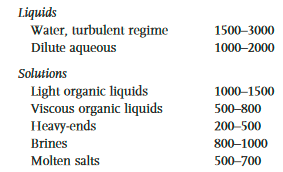
Mfrs data sheet says "The minimum recommended ‘in-use’ concentration of the product is 25% in order to ensure adequate corrosion protection." Whereas for their HP-5c it is only 10% hence the attraction for a large system volume in a mild location. Alphi-11 is slightly more expensive from BES. Both are based on PG so I have no idea in what other ways they differ, from the detailed graphs the Cp and viscosity are very similar - though comparing the graphs is a nightmare as they use different units, and log scales with only one line per decade. As a conjecture the HP-5c is specifically formulated for HPs, whereas Alphi-11 has been around for much longer. When we have been away in the winter I want to be able to re-start the system even if there has been a power cut. Thanks for digging it out. Table 8.2 would seem to be the best fit I would imagine pure glycols fit the description of "viscous organic liquids" but in the dilutions used in HP systems I would expect them to behave more like "light organic" or "aqueous solutions" so a reduction of 2/3 to 1/2, maybe that's where you got it from?
-
See upthread in this post. @JamesPa has researched this topic thoroughly over many months.
-
Well yes, fractionally for EG, but the thermal mass of the circulating fluid is small compared to the thermal mass of the house so won't affect the time constant of heating the house. For PG the heat capacity per litre is actually slightly more, see upthread. I doubt it. Conductivity through the bulk fluid is not important bc (i) the rate of heat transfer in the outdoor unit is limited by the surface area of the HX not the bulk conductivity and (ii) it is being stirred all the time by turbulent flow which the design of the HX is engineered to encourage. Edit: that is what the ribs on the HX plates are for. I am pretty sure they are effective (I have done some HX design for Baxi and others). The plate spacing on the refrigerant side and water side is different bc the properties of the two fluids are different (though how they optimise it for both heating and cooling I do not know!). I would be interested to read the paper that @RobLe cites if it can be found. 2x worse dT strikes me as a lot, if true another reason for using 10% PG which is less viscous.
-
I think that's for ethylene glycol though these tables have a value of 3.95 which is not quite as bad. For propylene glycol there is an increase in density which is several times the (small) reduction in specific heat, so on a heat capacity per litre it actually gets better with increasing concentration. The tables in the links use a variety of intervals for both concentration and temperature (in both C and F) so are not easy to interpret but that is my tentative conclusion. I think the only material effect is the increased viscosity, for 25% EG this is about 2x and for 10% PG is <1.5x at 80F so the latter will be easier to pump, and provided there is sufficient head available it will merely result in an increase in pumping power, which will mostly end up inside the house anyway. Seems odd that PG can be used down to 10% whereas EG cannot be used at less than 25% bc of fouling. Perhaps it is because EG is a better substrate for biological growth. I will pursue this with Hydratech next week to see if they offer a direct equivalent to the Fernox product (as those are notoriously expensive).
-
This makes it the responsibility of the water co as far as your property boundary see your water company's website. Yes it would seem less likely to be a problem at your end of the pipe. Normally they will come out quite quickly and free for a first look so just ask them to do that. If they then determine it is in the Supply Pipe on your side of the boundary they will quote you or you can repair it yourself. (If you have an old lead pipe they will replace it f.o.c. if you remove any lead inside your house at the same time.)
-
My concern is what happens in a power cut. Can't rely on the house battery to be fully charged. If you mean this stuff then the min conc is 25% so more expensive overall. That was the attraction of the Fernox HP-5c.
-
What is the point of the fake valve? Who is it intended to kid? Some further digging shows that Fernox HP-5C may be more economical, it can be used at a dosage as low as 10%, this protects down to -4C and has a specific heat of 4.15 at 55C. It is based on propylene glcol, but at a low conc. maybe the viscosity is not too bad. From the graphs it seems to be less viscous than 25% of Fernox HP-EG, which is the lowest allowable conc. of their ethylene glycol product. Cheapest I have found is here, still costs about £8/l though and I will need ~40 litres.
-
Do I need to plasterboard the lofts
sharpener replied to Chanmenie's topic in General Construction Issues
Our Building Inspector was more concerned that there was the correct ventilation space between the insulation and the slates/flat roof to prevent condensation in the voids.

