


Crofter
-
Posts
3484 -
Joined
-
Last visited
-
Days Won
11
Everything posted by Crofter
-
I don't think there's any reason not to, other than the extra cost.
-
I think the idea is that you have a gravel hardstanding and sit the Puraflo on that. But you'd really have to start talking to SEPA.
-
For external cladding? 🤔
-
I would have a good look around your local suppliers. The only roofing battens I was able to buy were either stained green from pressure treatment, or died blue. The latter were shocking quality, left dye running everywhere and split the moment a screw went near them. My own cladding is larch from a local sawmill. Half the price of a builders' merchant.
-
Wow design without blowing budget
Crofter replied to Stonehouse's topic in New House & Self Build Design
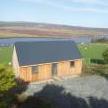
Lots of the ideas in this thread revolve around sight lines. For good reason. Lining up sight lines doesn't necessarily cost anything but can really change the feel of a place. It's one of the things that makes a bespoke design different to an off the shelf one. My own build was done to a tight budget (about £20k for 50m², plus groundworks/services). Here's some of the decisions I made to keep the budget in check whilst retaining what I think is a pretty nice finish: -My favourite tip is to avoid small windows. Consolidate all your glazing in to a few huge windows. Non opening if possible. You will get a much lower cost/m² with much better thermal properties. It's an absolute win-win. I was really surprised by how cheap a huge non opening 3G window was. -I'm also a big fan of bamboo flooring. I'm not up to date with prices but about five years ago it was half the price of decent oak, and much sturdier. -you don't need solid oak skirtings and door linings. I went with MDF which was a fraction of the cost and also much easier to fit. Need to screw the skirting to the wall, or messed up amitre? Just fill and paint afterwards. - larch and corrugated steel make very cost effective finishing materials, quick and easy to work with. - it's not necessary to spend big money on kitchens and bathrooms. I've seen people spend more on a kitchen tap than my whole bathroom cost. I went secondhand for all my kitchen appliances, but bought good brand names (Bosch and Siemens). They've outlasted the cheap brand new stuff I bought in my other house. -
It wasn't a cost decision, although the 50mm solvent weld that I used is really cheap too. The decision behind it was that I could run the SVP up the outside wall within the depth of the battens for the timber cladding. Means it's completely hidden from view yet external to the house in case of any leaks, and no AAV needed.
-
It wasn't particularly cheap. Back in about 2016 I paid around £7k by the time the septic tank and Puraflo was installed. The company would not do a supply-only deal so it was about the only part of the entire build which had to be handed over to someone else.
-
From memory, a treatment plant would only allow me to reduce the size of the soakaway. The Puraflo let me almost completely eliminate it.
-
I'm not aware of Scottish regs allowing for anything other than 110mm. It seemed complete overkill for a single toilet on the ground floor.
-
I installed a Puraflow system. Comprises conventional septic tank, pump chamber, then the clever bit which is the Puraflow unit itself. A big plastic tub filled with peat moss fibres and some piping. The effluent is pumped around that and trickles down through the peat moss, which allows for aerated breakdown, and what emerges from the holes in the bottom is fit to discharge to ground or watercourse. The system was designed in Ireland where high water tables are a very common problem.
-
Yes I'm not recommending it as a solution to other people. And I was a bit wary of it to start with. The backup option would have been an AAV on the rodding eye, but that seemed like extra complication. I was really loathe to install a big clunky soil stack on a fairly visible elevation.
-
Btw, talking about soil pipes, when I was building the cottage I learned that the 110mm standard stack is mandated for anything from a single WC up to four bathrooms. I found it hard to imagine that a single toilet could generate so much of a vacuum that it needed a 110mm vent. So I didn't fit one. I wasn't bound by building regs and this was one of the only places where I deviated deliberately. I used a 50mm pipe instead, which meant I could run it hidden behind the larch cladding. Five years on and it's working perfectly.
-
I'm a bit surprised about the freezing comments. The only place where there should be standing water is in the traps, and surely they are all inside the building?
-
I've been looking in to this too. My background is off grid low voltage systems so my first thought was to go that route. But I think grid tie actually makes more sense. AFAIK your options are: - panels, battery, and LV heating element - panels, battery, inverter, AC heating element - panels, grid tie inverter, solar diverter, AC heating element. It seems that you can't skip the battery if you want to go off grid, you need it as a sort of buffer to keep the system running. The last option is the one I'm going to go with. Grid tie inverters aren't much more expensive than off grid ones, and it simplifies things hugely to be able to use the existing AC heating element in the tank.
-
I'm aware that this could be a risk. Trying to get an idea of what would actually happen in practice. I'm assuming that if I modify the system to add E/W panels, but keep the peak output within the original limit, I should be ok?
-
I'm not actually planning on sticking with a 2kw system. Just want to get the MCS cert so that I can get export, then I'll add additional panels later. Partly this is due to cost savings, and partly because I may need to do some work on my roof first. I've run numbers and should be able to get around 747kwhr/yr per installed KW, on a S-facing ground mount. Mixing it up a bit to include the E/W house roof gives me an average of 675kwhr/yr per kw.
-
I'm planning the cheapest possible MCS installation. Ground mount would be preferred, because my roof is E/W and also my roof (on the older house) isn't in the best condition. Of course panels are so cheap that I'm not sure how much I will save by skimping on them, even at MCS prices. But for sake of argument let's say 2kw. With a 3.68kw inverter installed for future proofing.
-
I'm trying to get an idea of the basic starting price for an MCS system. So far I don't have anything to compare with. I know it will vary enormously by specification and location, but for a small ground mounted system do you think ~£5k is realistic?
-
I'm not sure my guests will appreciate me turning things on and off remotely! I could maybe get away with it for the DHW but that would be on a diverter anyway.
-
My situation is maybe a bit unusual/complex. I've got two properties and would like to add PV to both, if I can afford it. First house: 70s bungalow with storage heaters and direct UVC. Currently used as a holiday let, mostly in summer. Bills included in rental so no incentive for guests to save energy. I'm planning to install A2A heating and perhaps PV with a diverter to the tank. Our longer term plans involve moving in to this house ourselves. Second house: 43m² holiday cottage (see my profile pic) used exclusively for short term lets, again mostly summer. High standard of insulation. Direct UVC. Again, thinking of PV+diverter to heat the tank. Because we aren't currently living in either house, we can't rely on managing loads etc. Whatever I install has to be hands-off and idiot proof. Being eligible for export is appealing because at least I'm guaranteed some sort of return. But if it doubles the cost of the project, then maybe not.
-
Which I'd be fine with, but it means no export.
-
Not having much luck finding someone who covers Skye
-
I'm specifically trying to determine the lowest cost MCS installed system. Panels are basically free these days. So why pay somebody else to source and install them? Of course the MCS guys can maybe get the panels even cheaper than I can, despite their profit margin.
-
Hypothetically... if I were to get a small/minimal ground mounted S-facing PV system installed by an MCS contractor, in practise could I later add extra panels facing E/W? I'm assuming that my export payments would be limited to whatever the original installation had, but with the extra panels I would get a longer generating day. And (how long is a piece of string) what kind of cost would a minimal system be?
-
That immersion looks good but it's really really expensive. I'm thinking the Cool Energy DiverTech will do the job at a third of the cost.
