tuftythesquirrel
-
Posts
90 -
Joined
-
Last visited
Everything posted by tuftythesquirrel
-
Gas Boiler Modulation
tuftythesquirrel replied to tuftythesquirrel's topic in Boilers & Hot Water Tanks
Sorry, only just saw this. Visio for the piping diagrams and Nanocad v5 (free) for electrical drawings. Never paid for any CAD software🤣 -
Which set point are they talking about?
tuftythesquirrel replied to Radian's topic in Boilers & Hot Water Tanks
Hiya, would it be possible to tell me which of the Ideal boilers this is? I looked at the LOGIC SYSTEM manual but couldn't see this arrangement. Thanks. -
SEG - safe for now?
tuftythesquirrel replied to Drellingore's topic in General Alternative Energy Issues
Sorry, thought you had splashed out on a drone😁 -
SEG - safe for now?
tuftythesquirrel replied to Drellingore's topic in General Alternative Energy Issues
Sorry, have you got a better picture? -
@PeterW @Rehan Saeed We had a quote from NuHeat for 250m2 UFH in screed, NuHeat were £8k for parts. Went with the Underfloor Shop, all Emmeti parts were just under £3k plus excellent service. John Guest were even sillier at £11k.
-
Ha, yes I was a Draftsight convert and believed all the hype about it being your product and free - then they went to paid platform only 🥵 Now moved to NanoCAD 5, it quite old but stable and free, can't tell much difference between this and my old Draftsight or 2D Autocad.
-
Nope. I just priced up the basic Input and Output modules for the (my) project. No development software, servers, touch switches, touchscreens etc. Totals below: DI x 312 DO x 150 Dimmer x 50 AI x 24 AO x 4 Sorry forgot to mention the Idratek system has a built in webserver for the interface, so you could just use a few cheap Android phones with an internet browser for touchscreen (or a wall mounted tablet). Pros Cost of software and hardware, no expensive interfaces required Triac outputs (silent and longer lasting than relays) All in one network module for Temperature/Humidity/Light/Motion Built in webserver for user interface via browser Backup server easy to implement Superb support Cons No indication on digital input signals Analogue input resolution only 8 bits User terminal/interface (DFP-H02) looks dated No Loxone/KNX/Modbus/MQTT interfaces
-
I went through a similar process some time ago, pricing up different options. I found the price of the KNX and Loxone hardware staggering. I had a quote from Loxone who appeared to want to know the floor area to help them calculate the price, even though I gave them an I/O list. Unfortunately the quote was presented as a single liner, so I had no idea where the money was being spent e.g. software, hardware, configuration. In the same way as I would decline professional services if the fees were based on the cost of my build, I wasn’t quite sure how the floor area correlated to the electrical hardware. I stumbled on a company called Idratek and priced their hardware up alongside the Loxone and KNX. See below for the results. MyKNXStore…. Binary Input 8-fold, 4SU MDRC, Contact Inputs £260 (£33/chan.) Binary output 8-fold £339 (£42/chan.) Analogue input 8-fold £174 (£42/chan.) Analog Actuator 4-fold, 2SU, MDRC, 0-10V, In-/Output shiftable £181 (£45/chan.) Dimmer DME 2 T KNX, 2-fold £212 (£106/chan.) Loxone…. DI Extension - 20 digital in £317 (£16/chan.) DO Extension - 14 relay out £375 (£27/chan.) AI Extension - 4 analogue out £206 (£62/chan.) AO Extension - 4 analogue out £252 (£76/chan.) Dimmer Extension - 4 dimmer out £514 (£128/chan.) Idratek ODI-002 Digital in 8 general purpose £46 (£6/chan.) QRI-002 Digital out 4 x 4A fused SPNO relays £83 (£21.chan.) QTI-001 Digital out 4 x 1A ZC Triac noiseless switching channels £83 (£21/chan.) QAI-002 Analogue in 4 analogue input channels £46 (£12/chan.) QAI-002 Analogue out 4 analogue input channels £46 (£12/chan.) QLD-003 4 channel trailing edge dimmer £118 (£30/chan.) The price of the interface modules for my system, ignoring any CPU, server hardware and not using any flashy touchscreen interfaces and so on. KNX £23,084 Loxone £17,234 Idratek £6,858 I haven’t used the Loxone or KNX development environments but what I know about the Idratek system is…. I’ve had the software running for around 6 months (free trial version) with very few issues. You can program it not to use the server and use a lower level protocol where the modules communicate directly, bypassing the server. It seems easy to configure and you can always ask them questions. See below for pros and cons. Not sure how the support would work with KNX, with third party hardware modules and someone else’s software. Loxone also said they were going down the approved installer path but the shop is still online. Pros Cost of software and hardware, no expensive interfaces required Triac outputs (silent and longer lasting than relays) All in one network module for Temperature/Humidity/Light/Motion Backup server easy to implement Superb support Cons No indication on digital input signals Analogue input resolution only 8 bits No Loxone/KNX/Modbus/MQTT interfaces
-
Gas Boiler Modulation
tuftythesquirrel replied to tuftythesquirrel's topic in Boilers & Hot Water Tanks
@Gus Potter Hi Gus, Thanks for the reply and you’ve made some excellent points. You’re not the first person to say keep it simple. @SteamyTea And I do spend part of my working life saying to others (usually younger graduate engineers), this is a great multilayer communications strategy, but do you think the plant electricians are going to be able to understand this? I do think this software solution is simple, but let me explain. I’ve been contemplating which way to go regarding the automation for some time. My background is in industrial automation. Back in the 80’s people (engineers, factory managers etc.) decided that having a massive electrical cabinet with 1000’s of interconnected devices coupled with a mass wiring, out of date, inaccurate drawings was a bad thing and that a software solution was a good thing. So all the devices became 2 wire (L/N or +/-) and everything was interconnected in software. It became easier to maintain and make modifications. It took a few years to get the electricians on board, but that’s how went. It’s kinda gone the same way in the automotive world. My Morris 1000 had very few, if any ECU’s. A new car has (probably) dozens. And yes, you now need a diagnostics computer instead of a screwdriver. From my own perspective, the moment that I started on a scheme where the thermostat is connected to the zone valve, then the zone valve open limit is connected to call the boiler, I would have time travelled back to the 80’s. I appreciate that is where your average home owner currently and maybe heating engineer sits. However, once you start to say, oops, not one thermostat, actually twelve. And they all have to be hardwired back to the plant room 15m away. Oh and I need domestic hot water to take priority over the central heating. Oh and I need setback temperatures if the rooms are unoccupied. Oops, so need to fit motion sensors to the rooms to do this. Ah, with the motion sensors I can also turn the lights off – but which lights and when. How do I connect four lights to one motion sensor without adding a relay or two. Ha, wouldn’t it be great if I could turn on some ambient lighting in the evening. But then I need light sensors. Then the Light sensors need to work with the motion sensors connected to multiple lights. I also somehow have to adjust the light sensor’s sensitivity on a crappy little potentiometer up in the ceiling. The whole thing spirals out of control. Hopefully you might see where I am coming from. I think the home automation software solution could be simpler. Great point regarding who is going to fix it. I thought that myself. Our neighbour has an ASHP. Installed by persons nameless. No pipework diagrams. No electrical drawings. No operating instructions. Three companies have tried to fix it, failed and walked away. So no home automation system but still problematic. Similarly in my world, any house we have ever lived in, when investigating any problem the plumber usually says “I wonder where that pipe goes” and the electrician “I wonder where that cable goes”. Mostly due to a total lack of information. So to make your good self consider buying my home, I did this…. I have piping diagrams that show every component (valve, motor, sensor etc.) and the components are identified with tags. I’ve got electrical schematic drawings (30 x A3 sheets) that show every switch, valve, light, motor etc. all labelled, all connected to the automation system. So for example, if you had an issue with a light in the bedroom, it might be labelled B1H02 (Bedroom 1, light 2). In the automation software you just go CTRL+F (Find) “B1H02”. It will then locate it the light. You can then look for the “connections” to the light and see it is connected to switches “B1S02” and “B1S03”. On the electrical schematic and in the software, the switch will be identified “B1S03 – Bedside Switch” and so on. So then each switch can be tested in turn to see where the issue is. A non-electrical person can change the switch since it is ultra low voltage. I’m hoping my wife might be able to do this, without calling an electrician. Though to be fair, I haven’t asked her yet. I’ve also got a construction document (in Google Docs.) where the components are identified. For example if you want an automatic air vent, the Google Doc will have a hyperlink to the supplier I bought it from. I’ve also got a Software User Manual. It shows the homeowner how the basic features are configured and how to operate the system. Mostley, heating and lighting. And a few basic fault finding tips. …. would that convince you, Gus? We’ve tried to fit as much insulation as is physically possible – on a very, very neglected 1950 hall. Roof - 0.12 W/m²K, 150mm of Kingspan Quadcore composite sheet Walls - 0.145 W/m²K, 200mm EPS external wall insulation system (EWI Store) Floor – 0.09 W/m²K, 200mm PIR/Celotex insulation, UFH and 60mm Cemfloor screed (as the finished floor) Heat load at -2, 4.5kW, Area 350m2 I’ve seen your self-made manifolds before and fair do’s amazing. KISS in a nutshell. Flushed and pressurised our manifolds using mains water to 3 bar before screeding, so tick for me. I am well aware of the story of the Americans spending millions to get a pen to write in space – the Russian’s used a pencil. @JohnMo pointed out @Jeremy Harris Jeremy Harris's UFH journey where all the clever UFH stuff got binned. Two guys far more capable than me have come to the same conclusion. I really still do think I may do the same. However, when I make that decision, I won’t have to rewire a single item – I can just change the control software. I don’t think we are a million miles apart – we just have different ideas of simple! A bit like being down the pub, I seem to have meandered off topic a little and forgotten completely about boiler modulation 😆 -
Gas Boiler Modulation
tuftythesquirrel replied to tuftythesquirrel's topic in Boilers & Hot Water Tanks
http://www.idratek.com/products/catalogue/plh-001/ -
Gas Boiler Modulation
tuftythesquirrel replied to tuftythesquirrel's topic in Boilers & Hot Water Tanks
Thanks, good point regarding delta T equating to constant power. -
Gas Boiler Modulation
tuftythesquirrel replied to tuftythesquirrel's topic in Boilers & Hot Water Tanks
Unfortunately that boat has sailed and I've already embarked on a house automation system. In each room I can put a temperature/humidity/light/motion sensor (for £80) which is a lot cheaper than a smart thermostat. That will control heating, lighting, humidity and security, so easy to detect lack of occupancy and apply setback temperatures and so on. 24/7 logging of all data and events etc. Therefore, everything can be controlled from a central location with all functionality implemented in software. Having a few valves and sensors hardwired to a boiler and means I would have idea what's happening or has happened and why is not the way I wanted to go. Not everyone's choice I admit and sorry but my background is in factory automation and I find it difficult to justify any other way. -
Gas Boiler Modulation
tuftythesquirrel replied to tuftythesquirrel's topic in Boilers & Hot Water Tanks
I think that might be the case. We already have a Gledhill 300L unvented cylinder with a 25kW coil. I wasn't going to very low temps but just trying to prove that when I do go to ASHP we can keep the equipment we have. -
Gas Boiler Modulation
tuftythesquirrel replied to tuftythesquirrel's topic in Boilers & Hot Water Tanks
@TempI thought that the Delta T function for the pump did that i.e. pump speed varies to keep the flow and return temperature difference the constant. No TRV's on our UFH but I think the principle still applies. Also I thought the modulation meant at a large setpoint - actual temperature difference the boiler would be producing more power than with a small one. Maybe both of these things control the burner. -
Hello, Sorry this is a bit long, but I though folks would have a bit more time over the holiday period 😁 Could someone explain how gas boiler modulation works in my case. I understand the principle, for example, if you have an Opentherm interface/thermostat and you have a room setpoint of 21C, if the room temperature is 15C, the boiler burner might be operating at 100%, whereas when the room temperature has risen to 19C the boiler burner might have reduced to 10%. I appreciate there is a limit to how much modulation can be achieved e.g. 10:1. I want to implement priority DHW and low temperature heating and also use weather compensation, as recommended by the following nice chaps, Adam Chapman (Heat Geeks), Nathan Gambling (BetaTalk), Kimbo (Heating Academy Northampton), Richard Burrows (Mid Wales Plumbing & Heating Supplies) and others. The aim being to reduce the boiler return flow temperature to maximise the condensing effect. I have a home automation system, that will be controlling an Alpha E-Tec 20S gas system boiler (24kW). The house is all UFH, via 4 manifolds. I have a separate CH buffer tank and DHW cylinder (both unvented). I want to apply separate weather compensation to both the tank temperatures. That is, in winter they will be hotter than in summer, though at different temperatures. I will need to experiment with the amount of compensation required. I have temperature/humidity/motion/light sensors fitted to all rooms and outside the building as part of the automation system. It also has temperature sensors fitted to the CH and DWH tanks. I have 2 relays connected to the boiler to select the CH and PDHW modes. The boiler parameters have separate CH and DHW parameters. e.g. the boiler output for CH can be set much lower than DHW. The boiler has a weather compensation feature using a NTC thermistor, but this changes the flow temperature. So this doesn’t help me in applying different setpoint temperatures to the tanks. In CH mode, the boiler output can be set to 25% of the rated 27kW. I can limit the CH flow temperature. I can also run the boiler pump in delta T mode to keep the flow and return temperature differential constant. So these features are already causing boiler modulation by turning the output down and will aid boiler condensing, but… Am I correct in saying that because I am using relays and not Opentherm that the boiler won’t fully modulate? PS Piping and electrical drawings attached. Visio-Piping Diagrams v0.59.pdf 2172_029.pdf
-
Nice one @JohnMo For my own benefit, how do you calculate the boiler efficiency?
-
@Radian Interesting, could you tell me what sort of interface modules you use to drive the 240VAC valves and pumps in the system? TIA
-
How big is your plant room?
tuftythesquirrel replied to LnP's topic in New House & Self Build Design
Thanks, it's still a work in progress. I'll leave the tours for my wife - I prefer being on the tools ☺️ -
How big is your plant room?
tuftythesquirrel replied to LnP's topic in New House & Self Build Design
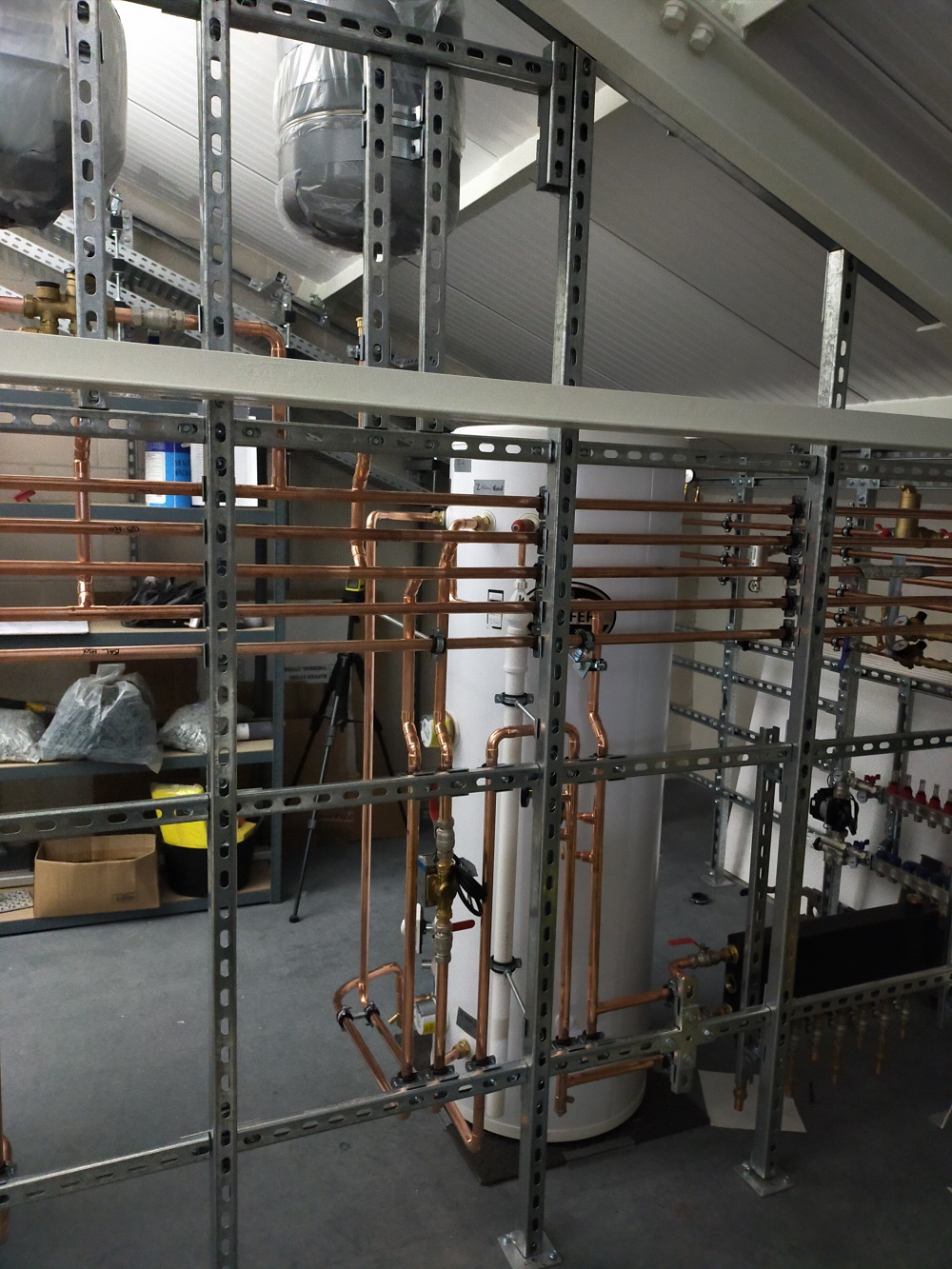
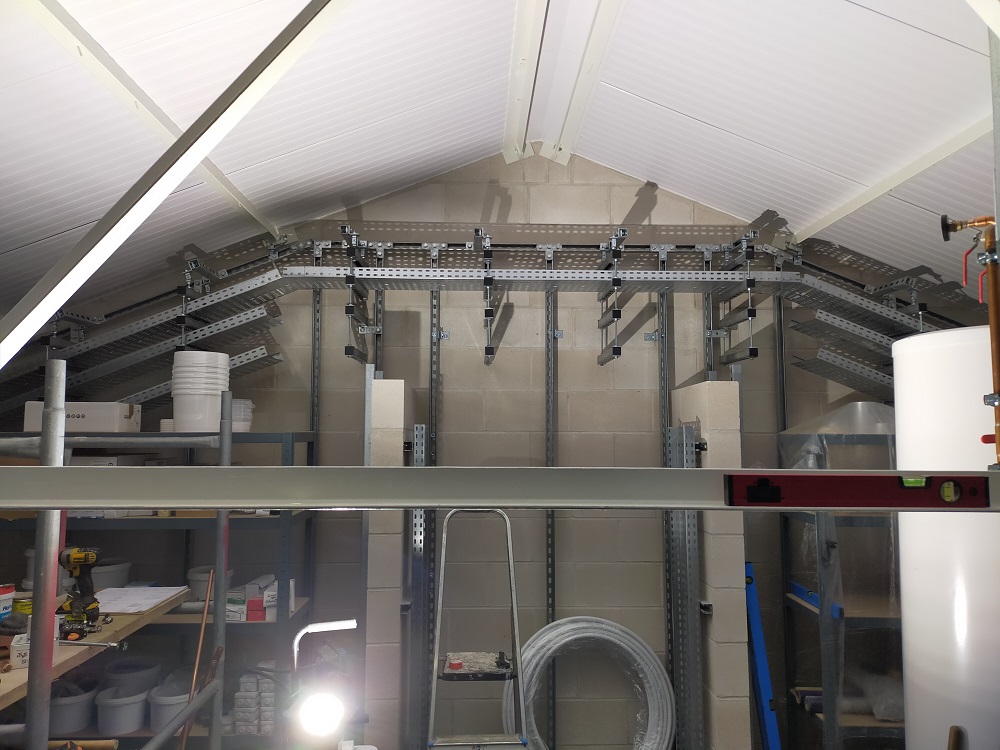
We are quite luck in the sense that we have an upstairs plant room that is about 53m2 (9.5mx5.6m). It was designed to be right in the centre of the house, so wiring, plumbing and MVHR runs are radial in nature, hopefully keeping the length of runs minimised. The area was completely clear so I’ve created some skeletal walls from unistrut, with traywork to carry the wiring, plumbing and ventilation. This saved drilling holes in the plastered walls, which is my airtight barrier and the architectural brickwork. Plus if you have to move anything, you aren’t left with an unsightly hole. I’ve also started to create some partition walls (out of unistrut). It also means you have access to both side to run cables etc. I’ve only got the plumbing in so far, but it seems to be working out quite well (see pics). I don’t see why it wouldn’t work out in a smaller area.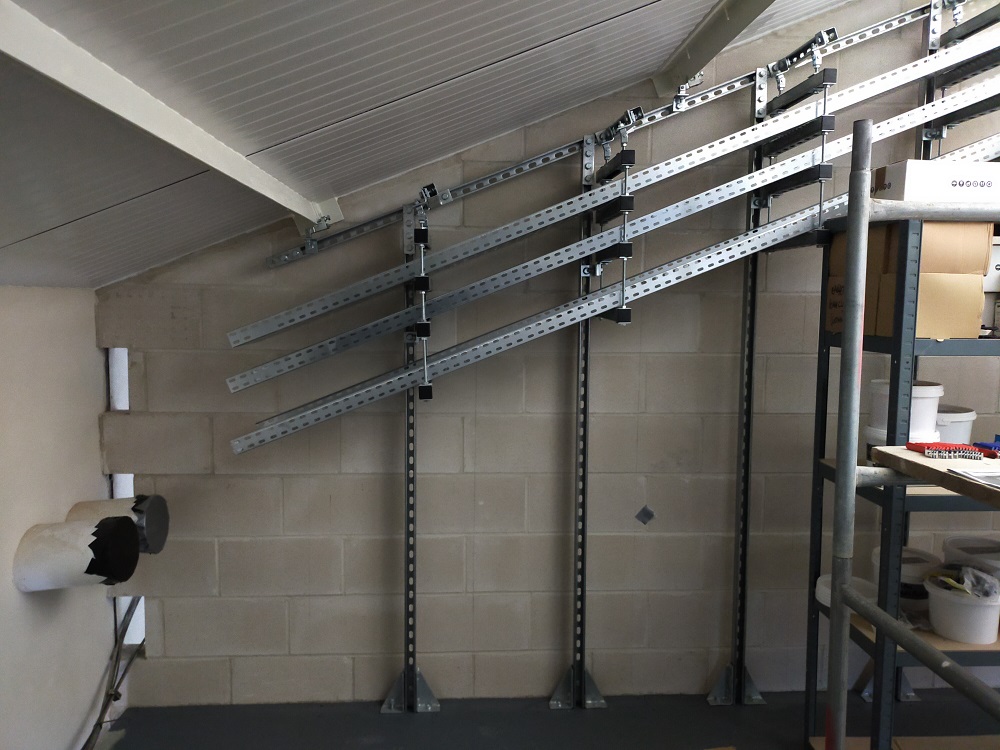
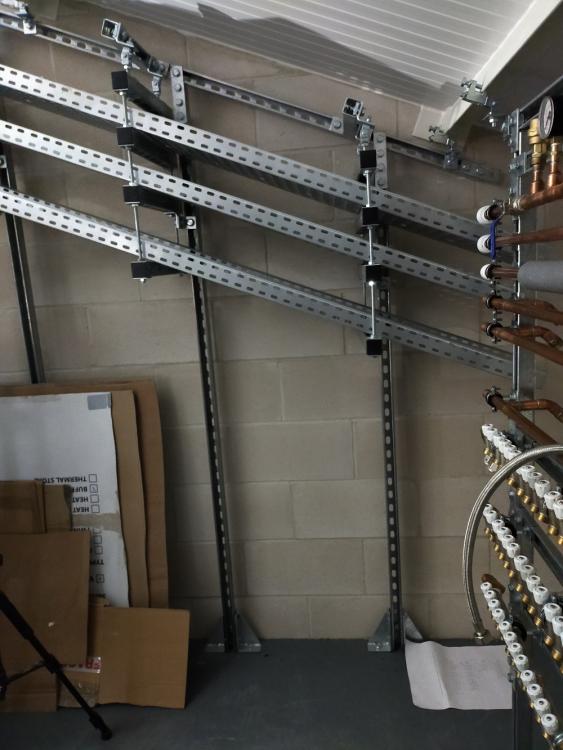
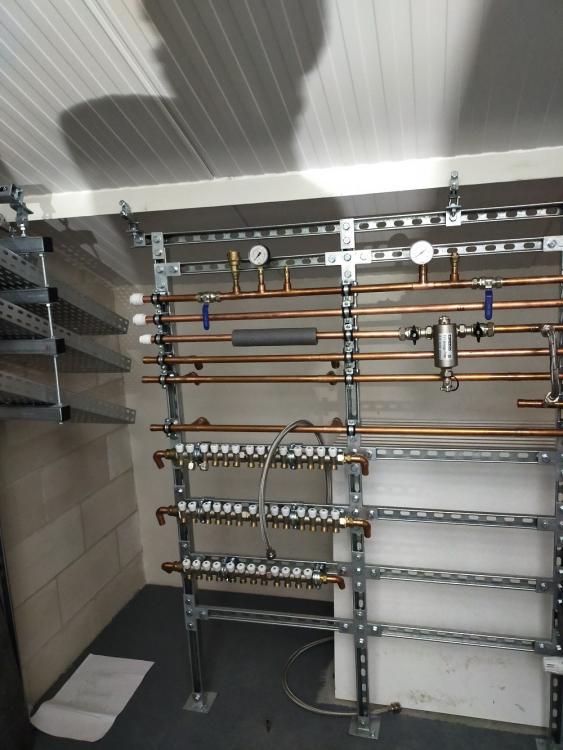
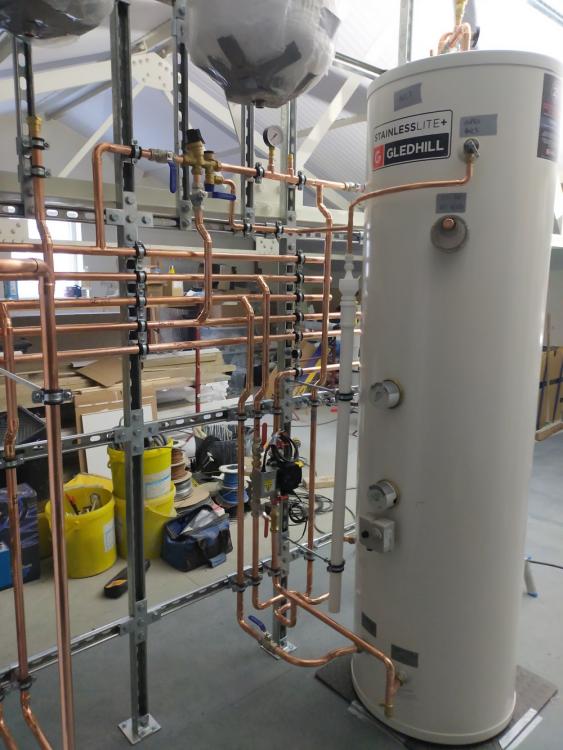
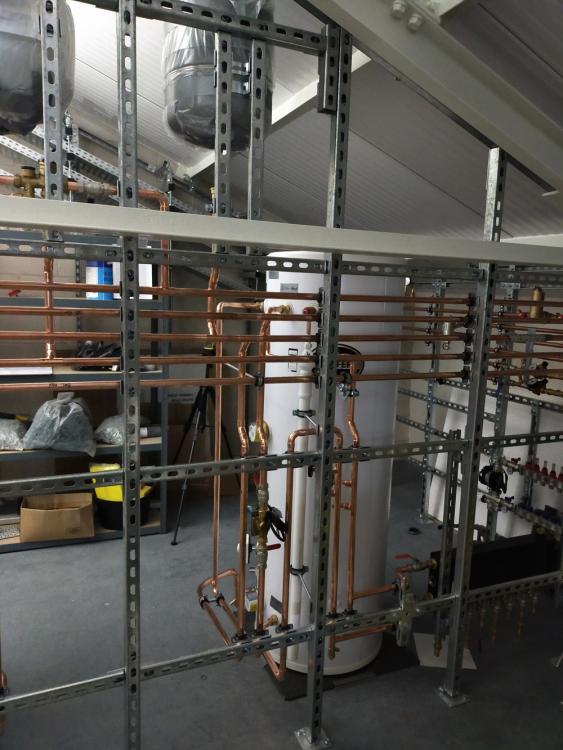
-
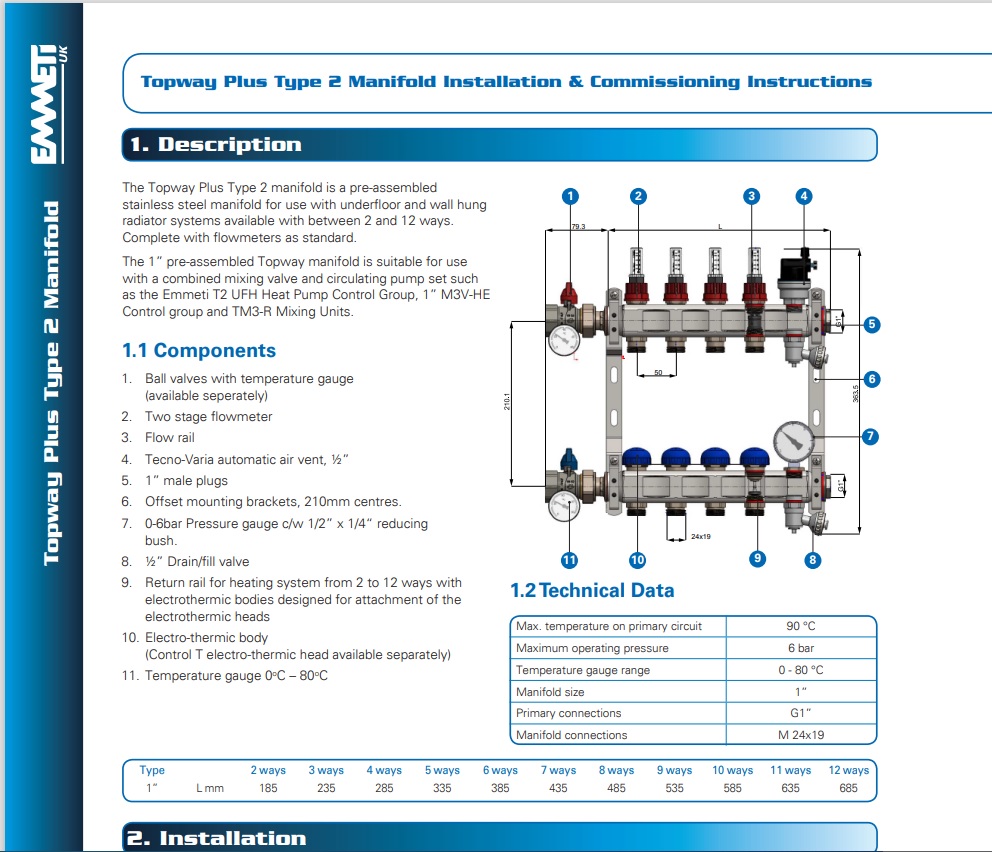
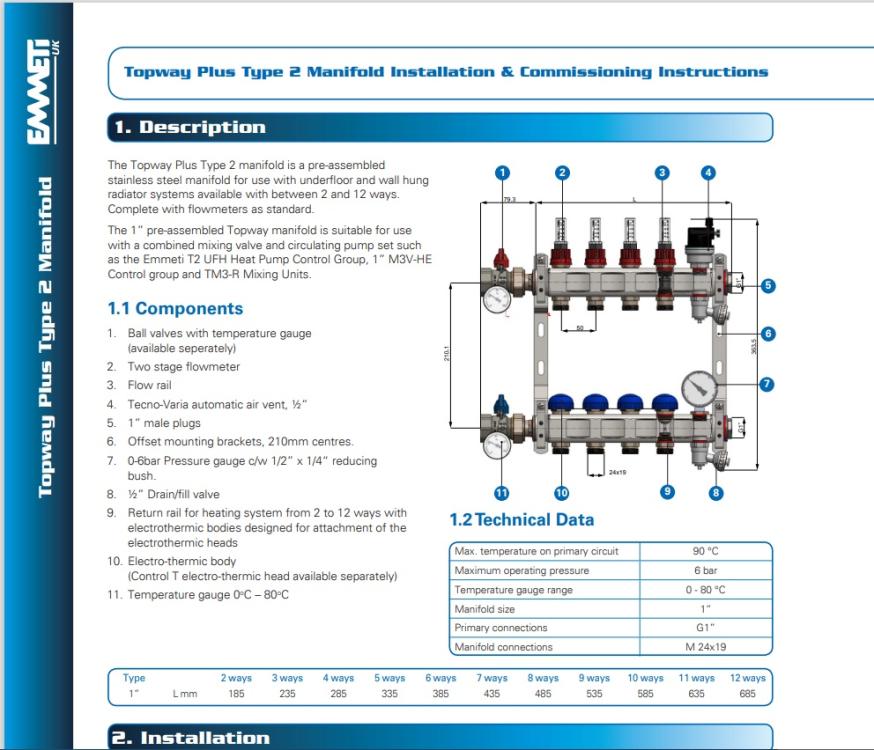
Hello, I have installed my underfloor heating system and specified Emmeti Topway Plus Type 2 Manifolds. I fitted my 16x2 pipe with the connectors that came with the kit. I assumed that these were Eurocone connectors. I have now bought some Emmeti Multiplex Manifolds for my house hot and cold water distribution. I will be using 15x2mm PB pipe. These have the same type connectors. In my ignorance, I bought some Eurocone connectors and they don’t fit. I have attached the data sheets for each product. They show a 24x19mm connection for both manifolds. Whereas a Eurocone connector is apparently ¾” BSP. The connectors appear to be an Emmeti product called Monoblocco, which hardly anyone seems to stock. Has anyone come across these connectors? I’m not quite sure why Emmeti have re-invented the wheel with a very similar connector, when most of the other UFH manifolds seem to use Eurocone fittings. Thanks.

-
Cost comparisons - Aluminimum Clad Windows
tuftythesquirrel replied to DavidG's topic in Windows & Glazing
Just chipping with my own experience. We have 60 m2 of window area. 7 doors and 21 windows. We were getting quotes in mid to end of 2020, for tripled glazed, Alu-Clad windows from the usual suspects, Internorm, Velvac, Rational and Idealcombi to name a few. I prepared a window schedule with dimensions, so they all had the same specification. They all priced at a similar point, e.g. £35-40K. Then the fun began. My neighbour who had Internorm fitted, showed me his quote, from the same person at the company, going to our (same) post code. He was given 43% discount on the list price, we got 18%. A difference of around £10k. We spoke to Idealcombi to update our quote and they said they could give us an additional discount of 35%. A difference of £13K. We then spoke to some of the other companies and told them the situation. They then replied “oh, we can match that”. We went with Idealcombi since they were the first to offer the discount without being asked. They have also been very good with a warranty claim. Ultimately we paid around £430 per square metre – not fitted. It was also incredibly convoluted. We skipped the £800+Vat measurement fee and did it ourselves. We would ask (using the schedule) please make W1, 100mm wider and W5, 200mm taller. They actually, made W1, 200mm wider and W5, 100mm taller and so on. We had 17 quotes before they got it spot on. I’m from an engineering background, so specifying everything and checking that the supplier conforms is second nature. It’s laborious but don’t leave anything to chance. We also installed them ourselves. Me, with no building experience and a bricklayer/stonemason who was with us for the build. We made our own mounting brackets out of 5mm galvanised bar, because the manufacturers 3mm brackets looked a bit frail. We know a Velvac installer and we were looking at our kitchen windows, he said to me “we would put four brackets on those, two either side, how many did you use?”. “Ten” I replied. I think they will be strong enough! So in my humble opinion, the whole thing is a bit of game. All the quotes we had (every one) had a margin of at least 35-40% that could be sacrificed if necessary, to get the order, on which they were presumably making an acceptable margin. At least use a per square metre baseline price, so you can evaluate the true cost. There’s such a massive variation. I’ve seen doors at the NSBRC centre in Swindon that were £5k+VAT. Ours were around £900 and passive house rated. Good luck.- 65 replies
-
- 5
-

-
- comparison
- cost
- (and 1 more)
-
@TriassicHi, Made my own a while ago. Wanted to convince myself that my 690m3/h unit was big enough to do the job. So with my 750m3 house, running at 0.5ACH (Scottish Regs.) the unit will be running at just over 50%. When I asked our BCO whether we need a calibrated instrument to fill in the self cert. sheet (F1 - Appendix C Completion checklist and commissioning sheet) he looked at me as if I was talking Klingon! MVHR Design v0.11 Google Sheet as XLS.xlsx
-
@Redbeard I believe that a regular boiler is also referred to as a heat only boiler, so I don't think is a combi and would need a hot water tank of some description.
-
Heating System Critique
tuftythesquirrel replied to tuftythesquirrel's topic in Boilers & Hot Water Tanks
Hi @JohnMo, I've sort of been through this on a long iterative process/adventure🤣 Our posi-joists are probably not up to supporting the weight concentrated into a single tank. I've been going round this loop for a while and still not quite sure a thermal store would do the job in terms of ultimate performance. They also seemed to work out considerably more expensive, but I was never quite sure why. What solution did you use for hot water if you sized the boiler quite small to suit the heating demand? -
Heating System Critique
tuftythesquirrel replied to tuftythesquirrel's topic in Boilers & Hot Water Tanks
Hi @JohnMo, Thanks for the reply. It was really helpful to get feedback from someone actually living in a property, with real life experience and data. I did my own (very) rough calculation based on the total areas for the whole building, rather than a room by room as is the normal convention, so I will re-check them. We are in a detached house, so heat loss in every direction and its nothing like the perfect form factor for a passive house. I didn’t have a quote from a professional heating engineer that didn’t specify a boiler power anything less than 30kW, one even went a high as 40kW. When I did start asking a few questions, all of them admitted they had only ever fitted combi-boilers and radiators into a bog standard spec. semi. Yes, but I wanted some storage for and solar PV or battery power. The entire UFH system holds about 180 litres, so with 2 x 300 Litres, at least I can buffer the energy in the tanks to use separately later. I totally agree with the principle of going as small as possible, but my concern was then with the hot water demand and recovery time. We have 4 bedrooms, but will operate as a B&B so the likelihood of people taking simultaneous showers in succession is high. I spoke to a couple of tank manufacturers and they all said their specifications were produced using water temperatures of 80C. So my 300 litre tank could produce 225 litres of water before the tanks temperature dropped to 45C. They said if the tank temperature was 65C, the tank would only produce 135 litres. Since I want to operate at a lower temperature (60C) to improve the boiler condensing effect, the point at which the boiler will required is therefore earlier. Just wonder how you have found this. It was the underfloorshop.co.uk. Excellent service and support and the most economic quote I had as well. Yes, I thought that about the heat output as well, but I was always going to have to do some experimentation regarding the operating flows and temperatures. However, I was really encouraged by your figures and hopefully my extra pipe in the floor can bring the temperatures down quite low as well. The feedback was encouraging knowing that we have hopefully gone in the right direction. The number of times that “professionals” tried to talk us out of the level of insulation we wanted was quite disturbing. Once again thanks for your input.