Sparrowhawk
-
Posts
607 -
Joined
-
Last visited
Everything posted by Sparrowhawk
-

New member - stuck for what to do next to warm the house
Sparrowhawk replied to Sparrowhawk's topic in Introduce Yourself
We had 25-45mph winds yesterday and they were hitting out house front-on. You could hear the wind rushing through the warm-roof sections. This gave me an idea... would opening a window on the back of the house depressurise it like a blower test? The answer was a resounding "Yes". I have no idea what pressure difference that created (anyone want to guess?) but it revealed air leaks I didn't know about. I wish I had a way to quantify the flow. While each draught was small, the flow under the shut door of each room was sizeable, and was the way I measured the relative draughtiness of each. Some highlights starting upstairs: Front bedroom Coming up under the flooring in the bay window and at the flooring cutbacks in the corner of the bay window My wife says her feet get freezing sitting there Through the crack in the ceiling direct from the loft (less than 0.5mm wide) Plug sockets Suspect the "strips of shame" round the double glazing are all leaking through hairline gaps around the frame. Caulked a lot of them but... For the size of flow under the door, must be more leaks (under the floor?) Bathroom No unknowns here, extractor fan, waste pipes under the floor, and a little from the aging double glazing Bedroom in the newest extension I thought I'd got this pretty airtight but opening a Velux in the room showed leaks under the skirting board all round the room (starts to explain why in windy weather dust blows across the laminate flooring towards the middle of the room) plug sockets eaves storage (these leaks were known; I've foamed everything but can't get it airtight. The garage is also underneath) A room at the back that spans the 1920s house and the first extension via a gap knocked in the old rear wall When opening the Velux window in this room... Enough coming in from the eaves storage (which I lovingly taped and foamed in 2020) to make the loose MDF board move back and forth!! Under the floor around radiator pipes and cracks between flooring and walls. Significant volume of air. With the cracks I couldn't feel with my hand, but a flame would flicker every time a gust passed over the house Plug sockets Heading downstairs, I taped the cloakroom extractor fan shut and then went straight to the dining room which is hard to get warm. I shut the doors into the hallway and lounge, and taped a dust sheet over the opening into the kitchen. To create the pressure difference I opened an 80cm x 55cm window. The results: Masses of air from kitchen Much air under door into hallway Bigger Much around doors lounge (but didn't block under lounge door into hallway, so skewed test) A little coming out under skirting boards - I've sealed some already It was impossible to keep the dust sheet taped over the kitchen entrance. Here's a picture of it filling like a sail with the draught coming in via the kitchen. The kitchen has a concrete floor and no heating built in and is always cold. I found a few air leaks: Kitchen extractor fan. A massive known problem. The louvred vent outside does nothing to stop air blowing in Door to garage. It's got a brush strip at the bottom and is not sealing well Minor (in comparison) leak near the hinges of the UPVC side door. Most annoyingly, a stream of air from behind the kickboards under the fitted units. I found one airbrick; need to see if there's others. I taped up the extractor fan (a balancing act on steps as the wind whistled up the narrow gap between us and the next house) and it reduced the flow from the kitchen to dining room maybe by half. Dust sheet still filled like a sail but not as much. So... we got a few heat retention problems. Plug sockets and skirting boards are easy wins. I don't know where to start with the wind blowing through the first floor floor void. I'm guessing t's going to need floors up or ceilings down, and then taping joist ends and insulation adding to slow down whatever wind still gets in? All in all I had MASSIVE fun doing this testing 😀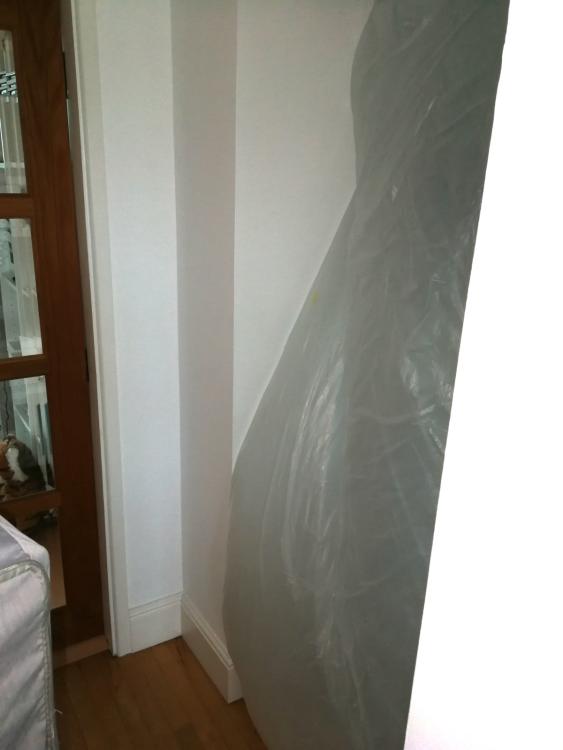
-
New member - stuck for what to do next to warm the house
Sparrowhawk replied to Sparrowhawk's topic in Introduce Yourself
300mm in the side extension, I added a 200mm top up before the winter. The ventilation remains good. In the 1920s part of the house (most of the loft) it's still 100mm. There was woodworm when we moved in 3 years ago which we had treated, and I've kept the joists visible so I can see if it comes back. No signs of return, so I am thinking about adding a 200mm top up next year. I have not, but there is one 6 inch square hole in the floor stuffed with glass fibre where the central heating pipes go down, and I will pull that out and take a look. It does, we are lucky this 1928 house had cavities. What that does mean is that the rooms in the extensions have an open cavity wall as an internal wall, because they pierced the original rear wall of the house instead of removing it. That is excellent advice. When they extended the house the roof starts at floor level in the upstairs rooms, and they shoved 50mm PIR between the new joists. It stops before the loft - I'm guessing below the joist or beam that is across the top of the old walls and blocks the top of the cavity, as no PIR is visible from the loft. I'm not sure if that's a good interface but that's a bit of the house I hope not to touch! Will do, thanks! -
New member - stuck for what to do next to warm the house
Sparrowhawk replied to Sparrowhawk's topic in Introduce Yourself
I confess I don't understand ACH vs infiltration rate, and I'm wondering if I should have used an ACH of '7' rather than '1.5' which doubles the figure again. So I've kept it at 1.5 and also tried 0.5 as well below. Something else for me to read up on! Thank you both, so glad you've sense-checked my data! I went back through the lounge details and I'd set the internal walls to have -2C on the other side. Correcting for that it now says 2737W/9344 BTU is required. Leaving out doors & the bay window, the data I'm using is now: Room Wall material UValue Adjacent °C Dimensions Floor Bare Boards on Joists, Airbrick 2+ Sides 0.82 -2 °C 24.18m2 Ceiling Timber Joists, Boarding 19mm, Plasterboard 13mm 1.62 10 °C 24.18m2 Wall 1 Brick 105mm, Air Gap 50mm, Heavy Concrete Block 100mm (+ 13mm Plaster) 1.3 -2 °C 6.2m × 2.55m (15.81m2) Wall 2 12.5 mm plasterboard, timber studding, 12.5 mm plasterboard 1.7 18°C 3.9m × 2.55m (4.54m2) Wall 3 13 mm lightweight plaster 105 mm brick, 13 mm lightweight plaster 1.69 18 °C 6.2m × 2.55m (14.21m2) Wall 4 105 mm brick, 50 mm airspace, 100 mm dense concrete block, 13 mm dense plaster 1.77 -2 °C 3.9m × 2.55m (4.99m2) (Wall 1 & Wall 4 differe because I don't know the actual construction so hedged my bets. Most of wall 4 is bay window glass) Reducing the ACH from 1.5 to 0.5 reduced the heat loss requirement by another 500W. -
That has been my suspicion. If the "good news" comes from those with a vested interest in selling it - I am doubtful. A reason for posting here as a sanity check, as sitting in a 15C I start to soften and think "well maybe they're right and it would be okay" Yes that's horrific. Different to the 'green goo' issue with some cables. Thanks for posting, it's good to hear from someone who has seen the problem first hand.
-
New member - stuck for what to do next to warm the house
Sparrowhawk replied to Sparrowhawk's topic in Introduce Yourself
I grew up near a birds of prey centre and regularly visited so I have a soft spot for them, and have become accustomed to birds will do what they will do. I have much less sympathy with cats. -
New member - stuck for what to do next to warm the house
Sparrowhawk replied to Sparrowhawk's topic in Introduce Yourself
Thanks @SteamyTea! Is there a guide I've missed on this forum? I've seen old car radiator fans mentioned as suitable - are there any others? When I removed a 'strip of shame' (plastic gap-fillers between the wall and window frame) around the double glazing I discovered that not only was it open to the cavity behind them, but the double glazing hadn't been foamed into place with flexible foam/any foam at all. I can imagine there are hundreds of air leaks round there. -
New member - stuck for what to do next to warm the house
Sparrowhawk replied to Sparrowhawk's topic in Introduce Yourself
Thanks Marvin. I have learned an expensive lesson there. The noise reduction was maybe worth it (less sound of rain thundering on the Velux windows) but I won't be doing it again in a hurry. AIM and APE are great acronyms. AIM will be my goal, and I am celebrating the slight condensation we now get on windows as a sign that the airtightness is better than it was 2 years ago. As an aside on PV the roof isn't particularly suited, as it's hipped and the south facing aspect has a gable over the bay window which breaks it up and shades one side. I calculated 16 years for payback in September, which is longer than we plan to live here (esp if the house remains stubbornly cold!) -
New member - stuck for what to do next to warm the house
Sparrowhawk replied to Sparrowhawk's topic in Introduce Yourself
I plan to have the radiators replaced as we cannot bleed a few of them (either rusted shut or won't re-seal after bleeding), or they have no fins. I'd love to do a re-plumb however with engineered or laminate flooring in most rooms it would be an expensive exercise to lift and replace the flooring as well. I have got myself confused over flow temperatures and what to use. I've done the calculations for 3 rooms so far and assuming the worst-case of -2C outside and 20C (or even 18C) inside, I can't find radiators big enough for an average flow temp of 45C (boiler output 55/return 35). I guess that's what weather compensation is for so the boiler then runs at 70/50 on those unusually cold days. So which temperature should I use for radiator sizing so that for most of the year I can run on low(er) flow temperatures? As a check on my workings, for the lounge which currently has a 110x70cm double and a 155x55cm double radiator in the bay window, after entering the wall/window construction I have calculated Air Changes (assumed) 1.5 Room Temperature 21 °C Delta-T 24 Heat Loss Requirement 4114 W / 14047 BTU Floor Dimensions 6.2m × 3.9m (24.18m2) Height 2.55m At delta T of 50 it's just possible to get big enough radiators in the same places as the current ones to meet that heat loss requirement. A modern Stelrad double 110x70cm is 2212W and a 1400x450 is 1919W. I can increase the height of one (and maybe raise the bay window windowsill to do the other) but how do I account for lower boiler temperatures at other times? -
New member - stuck for what to do next to warm the house
Sparrowhawk replied to Sparrowhawk's topic in Introduce Yourself
That is my fear that it is uneconomical to do anything about it. We have a cavity (filled with electrical cables) and all air bricks vent the cavity so in effect we have single-block-width solid walls around our property. I'm currently doing one using Stelrad Stars which has many different types of wall construction programmed in but doesn't do well with half-conventional ceiling half-warm-roof rooms and other unusual construction. If there's better software I'm all ears and will pay for it, as Stars is a pain to use. -
Not this time, it means I've put it off until I can line up all the bits (e.g. builder to sort the vents, and prob advise how to block the top of the cavity or do it for me, unless that's a job for the insulation installer; decide who to believe about cables). The cold spell has made it much more pressing. I've just grabbed the manual for the cooker out to check. It's a ceramic hob Rangemaster that should use max 32A but recommends a 45A breaker. So that could be 10kW. This second fuseboard/link would be the one an EV charger goes on in a few years, so that's what - another 7kW? So... maybe? Replacing with a bigger cable would be the easiest way. I get why the previous owners had it put in this way as they'd just had a new engineered wood floor laid in the room between the fuseboard and the new one and didn't want to take it up, but under the floor would have been more sensible and I'd reroute it this way if I could.
-
New member - stuck for what to do next to warm the house
Sparrowhawk replied to Sparrowhawk's topic in Introduce Yourself
Thanks Mike that's awesome to hear. No heating engineer I've spoken with has said more than a handwavy "it should save you money" yet. Currently doing my radiator sizing calculations. delta-t 35 will not cut it for the coldest periods, but looks like it'll work nicely the rest of the time. -
I contacted an EPS bead manufacturer to see what they would say. I'll paraphrase so as not to out them but their technical team was of the view that: "The plasticiser serves to make the cables flexible, but once they are installed they no longer need to be bent or moved. Even if the plasticiser leaches out and the cable becomes brittle it'll next be moved when being replaced, at which point if the outer insulation crack the it’s of no consequence." It's the opposite of everything I've read online, but it seems to makes sense. But I'd want an independent view before going ahead. What do people think? In my case I've also got other blockers to cavity wall insulation as blocking the top of our walls with rockwool looks to be impossible without removing the soffits none of our air bricks are sleeved the previous owner had an 80A cable installed up one cavity, across the loft (under the insulation 🙄) and down the other cavity to a fuse box in the extension and I'd not want that surrounded by insulation.
-
New member - stuck for what to do next to warm the house
Sparrowhawk replied to Sparrowhawk's topic in Introduce Yourself
Yes, keen very amateur birdwatcher and enjoying the coastal waders and occasional marsh harrier down here. Are you? I have found Jeremy's threads invaluable, as well as people's assessments of products e.g. Sunamp when thinking "could that be better than replacing our tank like-for-like. It's also appears to be a less... intimidating forum than some of the others with better natured members and fewer spats and general aggro. We shall see if that holds true 😁 Great advice. I shall try and break down the "WTF do I do next?" into intellible bite-sized questions. Always the hardest part with a mind teeming with ideas and aware of the dependencies that "if I start to do this it'll impact this that and the other bit, which means I then need to do that as well and I think I'll have a nice sit down instead and pretend it's warm". I don't think I know what they sound like! We have a local pair and before we started taming the wilderness that was the garden the female used to bring pigeons and eat them under our bushes. On the second day of this cold spell the male snatched a bird off the bird feeder and I've spotted him hanging around on neighbours' roofs keeping an eye out for more snacks. -
Hi everyone, 5+ year reader and finally taken the plunge to join. It's almost 3 years since we bought our house, a 1920's detached house extended twice (late 1990s/early 2000s, the latter extension considerably better quality than the first). I wanted to build a Passivhaus but the impossibility of finding a plot at a sensible price prevented that. We soon discovered this house was cold and draughty and we could see daylight in the eaves storage. Since then I've sealed all the obvious drafts, used a thermal camera to try and find others, had the 3 worst windows replaced with triple glazing (an expensive mistake: I thought it would fix these rooms as the windows weren't airtight but it didn't), but it's still a cold house. Living here during the cold spell that's just ending drove me to join this forum as I'm not sure what to do next. We need a new heating system (25yr old boiler, radiators of same age) which I'm expecting will make the house warmer but won't reduce our gas usage unless I can reduce heat loss. Looking forward to getting stuck in!
-
Same here. Prime candidate for cavity fill but they rewired by dropping everything via cavities, including an 80A cable to the 2nd fuseboard/electric cooker in the extension on the other side of the house. I have an email from a technical manager at an insulation company saying it's not a problem because the cables inside a wall don't move once it's filled with insulation, so if the sheath becomes brittle it doesn't matter... That's one I've joined this forum to discuss in more detail - once I land on the correct section to post on.