


BigBub
-
Posts
54 -
Joined
-
Last visited
Everything posted by BigBub
-
From experience, most LPAs will ask for a 2 or 3 week EoT. Unless you have provided amended particulars that the case officer has advised are necessary to avoid refusal, it is rarely in the interest of the applicant. When you agree to an EoT the LPA do not have to record the application as being decided late, even if they miss the 8 weeks deadline. One main reason you might not want to agree is that you will lose out on the Planning Guarantee which entitles you to a refund of the application fee when a minor application takes longer than 16 weeks to be issued a decision. I've noticed more and more LPAs charging additional fees for applications which are not valid on submission, for example if a drawing was missing a scale bar they would request that it is amended and also that a £60 invalid fee is paid. If they can charge for their time to validate an application, I am thinking to start requesting a fee from the LPA to agree an EoT. I know they will almost always refuse but it would be more to make a point that it's not just their time that is valuable.
-
LPAs playing around with 'validation' timescales?
BigBub replied to Alan Ambrose's topic in Planning Permission
@Alan Ambrose The The Town and Country Planning (Development Management Procedure) (England) Order 2015 (as amended) defines what a valid application is under Article 34, Part 6 which also mentions that a valid application is taken to have been received when the application, and such of the documents, particulars or evidence referred to above as are required to be included in, or to accompany, the application have been lodged with the appropriate authority mentioned in article 11(1) and the fee required to be paid has been paid. When you submit an application via the planning portal, the council receives the application and all documents by email and the fee is transferred over to them. The LPA can not treat the application as invalid until you agree to their change of the description. Refer to the following which mentions that Checking the accuracy of the description of development should not delay validation of an application: https://www.gov.uk/guidance/making-an-application#Changes-to-the-description-of-development -
LPAs playing around with 'validation' timescales?
BigBub replied to Alan Ambrose's topic in Planning Permission
If you submitted an application through the Planning Portal and all required particulars were provided along with the correct fee then the council has to deem the validation date as the date they receive the application, not a date 1 or 2 weeks later when they have processed and registered the application. If they are not doing this then they are manipulating the system -
There is currently a concern amongst many LAs of applicants falsely claiming self-build status in order to avoid BNG. Most, but not all, LAs will require a s106 agreement to secure self-build against a planning application but if the applicant tries to change to a private market dwelling instead after than they can effectively circumvent BNG as it can only be required as a pre-commencement condition. Out of curiosity, which Council are you dealing with and have they added the requirement for a Unilateral Undertaking (UU) to their validation checklist or to a Development Plan Document? If I was in your position I would raise a validation dispute and try to argue that a UU should not be required.
-
You would be surprised at how more council's are putting policies in place to not discuss or allow any amendments to a live application. Lichfield DC have a no householder amendment policy: https://www.lichfielddc.gov.uk/planning-developers-business/planning-fees/6 Southwark Council will charge you a fee to amend a live application, unless you had previously used their pre-app advice service: https://www.southwark.gov.uk/planning-and-building-control/pre-application-advice-service?chapter=4
-
Do we have a right to see planning documents?
BigBub replied to Benpointer's topic in Planning Permission
I would just contact the development management team and ask for copies of the supporting documents that were submitted alongside the discharge of condition application. I am aware of some councils adopting a policy to automatically remove information, other than the decision notice, from applications once 3 years have passed from the decision date. Probably as a measure to save space on their servers. -
Roof replacement in conservation area (no article 4)
BigBub replied to gurnard5's topic in Planning Permission
Would this not fall under Class C - Any other alteration to the roof of a dwellinghouse? Under this class there is no requirement to use similar materials and there is no restriction to being in a conservation area. -
If you haven't started any works then you would want to choose Lawful Development: Proposed Use. One thing to note is that the height measurement of 3m will include the roof lantern that you have shown.
-
Looking at the plans, you are proposing to replace the existing L-shaped extension which goes out 5.8m with a smaller extension which extends out about 2.9m. Assuming your property has PD rights and that the proposed extension is no more than 3m high, you can apply for a Lawful Development Certificate (LDC). The plans you have should be acceptable for a LDC.
-
Do I need planning permission to excavate some earth / rubble?
BigBub replied to dodgems2023's topic in Planning Permission
Just to answer the title of your post, the minor excavations you are proposing would not constitute development and so would not require planning permission. -
Extension via "Prior Approval" in the green belt?
BigBub replied to ShadowZ's topic in Planning Permission
You could remove the existing two-storey rear extension to build the 8m rear extension under Prior Approval. It wouldn't be assessed in relation to the 30% Green Belt limit. -
I don't think there is a 5m rule. It is most likely that having it within 5m of the house would mean that the shed is 2m+ from the rear boundary which is what the planning officer wants.
-
It's a bit of a catch 22 to be honest. Even if you first built the bits under PD that you wanted, those additions would then go towards the 30% calculation and so you may be refused permission for the parts that can't be built under PD if it would exceed the 30% figure.
-
From the original floorplan that OP posted which shows that the garage extends beyond the front of the house and therefore if the extension joins to the garage then it would be beyond the principle elevation. Why is everyone so sure that the garage is an original part of the house for the proposed extension to be under rear and side extension rules? @vik2001 do you know if the garage is an original part of the house or a later addition?

-
Just to make it clear, what you are building is a side extension, unless the garage is an original part of the house or was there before 1948 in which case it would be treated as a rear extension. Planning permission is required for what you are building for two reasons: The extension joins on to the existing garage that is to be converted and as the garage extends out beyond the principle elevation of the house, it does not meet PD rules. As the side extension is within 2m of the boundary, the height of the roof eaves is limited to 3m under PD.
-
From my experience, the Planning portal calculator tends to always get the fee right, assuming you've selected the right categories. Is the new house and the house to be altered on the same site, within the same red line boundary? From my understanding, when an application falls within 2 categories, you will usually pay the higher of the two fees, rather than a combination. I would definitely be directing the council to the mixed development flowchart, and if they still did not agree, I personally would appeal for non-determination after 8 weeks.
-
incorrect scale within submission of .pdf drawing to Planning
BigBub replied to Post and beam's topic in Planning Permission
Open your document in Adobe Acrobat and go to File -> Properties. You should see the Page Size of the document here. You now need to work out the scale factor you need to change from the current paper size to A1 (if it is currently 8.5" x 11" then you need to scale it up by 300.9% to get it to A1 dimensions). Then go to File -> Print and choose Adobe PDF as the printer and set the page size to Custom Scale: 300.9% and print the plan to the now correct paper size. When using the Measuring Tool, you would need to set the scale ratio each time. The exception to this is if your document had an embedded scale, which you normally get when you create a plan in AutoCad etc. -
You've effectively had permitted development rights for extensions (class A), roof alterations/additions (class B and C) and outbuildings (class E) removed. The space around the house is very small so it makes sense why they would not allow for you to add any extensions or sheds/outbuildings without applying for permission.
-
Actually, the 4-year rule has recently been removed from legislation. Now all unlawful developments, including householder related developments, have to go unnoticed for 10 years to then be exempt from enforcement action.
-
I actually remember reading about a case similar to this not too long ago. I have managed to find an article which covered it: https://localgovernmentlawyer.co.uk/planning/318-planning-features/47278-incorrect-plans-a-strict-approach The application was granted on the condition that the development complied with the plans. As the article mentions, the plans showed the development property as having a lower ridge height than the neighbouring properties. But, if it were built to the approved dimensions, the development property would be higher than both, in one case substantially. In the judge's view the plans showing the relationship to the neighbouring properties were not simply illustrative; they were a material part of the planning decision. The plans should have been capable of implementation and they were not. As a result, the whole permission was not capable of being implemented.
-
You probably want to look in to a Prior Approval application under Class ZA - Demolition of buildings and construction of new dwellinghouses in their place: https://www.legislation.gov.uk/uksi/2015/596/schedule/2/part/20/crossheading/demolition-of-buildings-and-construction-of-new-dwellinghouses-in-their-place
-
Garage Development in Greenbelt/Conservation Area
BigBub replied to phykell's topic in Planning Permission
I agree with @kandgmitchell. If you look at the current appeal timescales (https://www.gov.uk/guidance/appeals-average-timescales-for-arranging-inquiries-and-hearings) you'll see that the average Householder appeal is taking 22 weeks at present. -
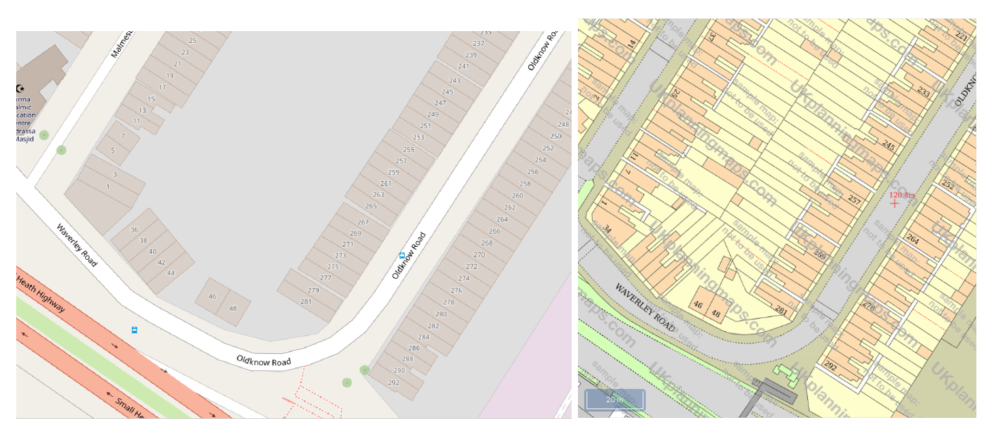
Whilst you could use Open Street Maps to produce a site location plan, many Council's will require the location plan to use an up to date OS map. The OS maps are much more accurate and detailed than Open Street map, and will also generally show the site boundary which is not really shown on Open Street map. See comparison picture. There is the INSPIRE Index Polygons spatial dataset which you can download and add on to QGIS on top of Open Street maps though which helps show site boundaries based on freehold property registrations.
-
Submitting two alternative applications is actually a recognsied thing. Alternative developments on the same site If different proposals for full or outline permission, or for approval of a reserved matter, are all submitted simultaneously, by or on behalf of, the same applicant, a concession is available. The fee should first be calculated separately for each alternative for which permission is sought. The total fee payable is then calculated by adding to the highest of these separate amounts half the sum of the other separate amounts. Please see paragraph 10 of Part 1 of Schedule 1 to the Town and Country Planning (Fees for Applications, Deemed Applications, Requests and Site Visits) (England) Regulations 2012, as amended. Paragraph: 033 Reference ID: 22-033-20141017 Revision date: 17 10 2014
-
What was the specific reason for invalidility? I've seen plenty of councils accept Land Regisitry title plans as site location plans. I've also used UK planning maps and a 1:1250 site location plan PDF from them meets the requirements. If the issue is with the block plan then it usually needs to be at a scale of 1:200 or 1:500 and should show the proposed location for the heat pump.



