


Jeremy Harris
-
Posts
26430 -
Joined
-
Last visited
-
Days Won
360
Everything posted by Jeremy Harris
-
We've recently had similar discussions on relative cost, and I ran some numbers for different fuels and heat sources to provide heating for our house:
-

MVHR newbie.. help needed
Jeremy Harris replied to Savage87's topic in Mechanical Ventilation with Heat Recovery (MVHR)
Bear in mind that relatively well-insulated new builds sometimes (often, I suspect) struggle to meet the building regs airtightness requirement, and for MVHR to give any useful energy saving you probably need to be about half the air leakage rate that building regs require, and to get the best from MVHR you really need to be a fair bit less. I fitted decent double glazing to our old house, added loads of loft insulation, had cavity wall insulation installed and spent ages going around sealing up all the dozens of tiny air leaks, mainly around the internal wall to ceiling joints (these were invisible to the naked eye, but leaked badly). I made a home made blower to check for air leaks, which worked well. I estimated that I managed to get the airtightness down to about 15 ACH at 50 Pa, so around 15 times worse than needed to get MVHR to work well. I'm not convinced that I could have improved the airtightness much more, without ripping the ceilings down and replacing them, as there were just too many places where air was leaking. I even had serious air leaks at every electrical fitting, as the cables were chased into the walls, but there were air leaks behind the plastered over cable capping. -
MVHR newbie.. help needed
Jeremy Harris replied to Savage87's topic in Mechanical Ventilation with Heat Recovery (MVHR)
There are two building regs requirements to meet. The first is that the whole dwelling continuous background ventilation rate has to meet or exceed 0.3l/s/m2 of total floor area. This needs to be on the normal ventilation setting, not boost. The other requirement is the extract rate from designated rooms, 13l/s from the kitchen, 8l/s from bathrooms and utility rooms, and 6l/s from WCs. This can be on boost, but in all probability the requirement to meet the whole dwelling ventilation rate on the normal setting will dominate. The system must be balanced at the continuous ventilation rate, but can be allowed to go out of balance a bit at the boost rate if that's unavoidable. -
MVHR newbie.. help needed
Jeremy Harris replied to Savage87's topic in Mechanical Ventilation with Heat Recovery (MVHR)
If fitting MVHR in a cold loft then it may well need installing in an insulated box, with good access for the regular filter changes etc. The ducts in the cold areas will also need insulating well. -
That sounds like a long time, much longer than I'd have expected. After allowing for the saving in slates, our in-roof PV system cost about £6k or so, for a 6.25kWp system. We use a bit over 50% of the electricity we generate (maybe a bit more now that I try and charge my car when the sun's shining). We're on Economy 7, so the daytime electricity price is about 15.5p/kWh. Our annual generation is about 6,000 kWh, so the value of our ~50% self-use is about 3,000 * £0.155 = £465/year. It seems that the equivalent of the export payment is now around £0.05/kWh, so the ~50% export would generate another £150/year, making a total of about £615/year in total, so a return on investment of about 10 years. If I am able to use a bit more self-generation to charge the car, then the return would be a fair bit less than ten years.
-
Good point, although I guess that a West facing panels will effectively be in shade early in the morning, and East facing panels will be shaded in the evening, just from the position of the sun. It's just a different cause of shade, perhaps. Bit like our whole array (which faces a bit West of South) being in shade until part way through the morning, when the sun swings around a bit.
-
We have an ASHP running UFH. It cost around £2k to install in total, but I did the work myself, so there was no labour involved. We have significantly more insulation than you, plus pretty reasonable airtightness, and MVHR (the latter makes a pretty significant contribution towards reducing the heating requirements). The heating cost is tiny, maybe £130/year if that. We use far more electricity on other stuff, like cooking, charging my car, lighting, ventilation, running the sewage treatment plant and water disinfection system etc. Our old three bedroom bungalow had gas central heating, running radiators, was around 2/3rds the size of our new house, and cost around £700/year to heat.
-
MVHR newbie.. help needed
Jeremy Harris replied to Savage87's topic in Mechanical Ventilation with Heat Recovery (MVHR)
Might be worth checking to make sure that the MVHR is actually OK and to spec as far as noise goes. I remember reading somewhere (may have been on Ebuild years ago) of someone that had a problem with noise from an MVHR that was due to a faulty fan, or maybe fan bearing. Noise from something like that might well be worse when the unit's running at a higher fan speed, so that may be something to check. Although the manufacturers can be a bit creative when it comes to things like sound levels, our Genvex is at the noisy end of the spectrum for these things, as this excerpt from the manual shows: The key figures here are the ones that cannot easily be silenced, the left column that gives the sound level 1m in front of the unit. The duct noise is really neither here nor there, as the silencers will remove most of that. Even with silencers and additional insulation I would still very definitely not want to have a unit like this in a loft space above a bedroom! As a guide, you don't want anything louder than about 30dB(A) in a noise-sensitive location. If the choice of location is limited, then it's best to choose the quietest model you can find, rather than rely on trying to reduce the noise by additional insulation, etc, although the downside of that is that it may cost more.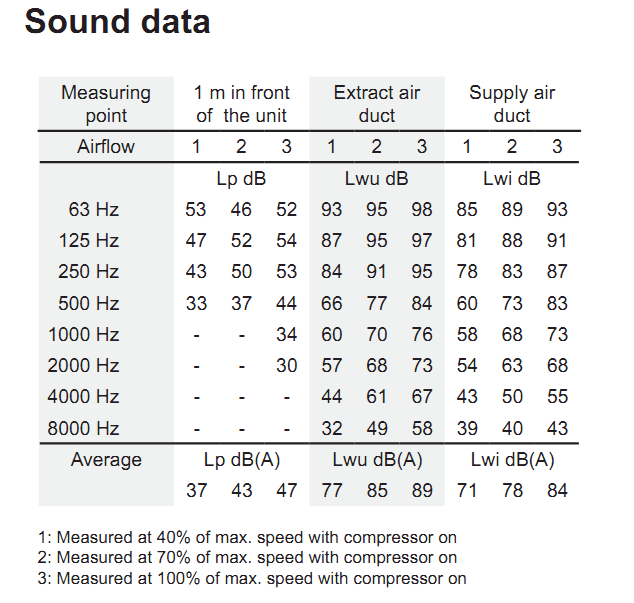
-
MVHR newbie.. help needed
Jeremy Harris replied to Savage87's topic in Mechanical Ventilation with Heat Recovery (MVHR)
Depends really on how the noise is being transmitted. Some units are just inherently much noisier than others, and anti-vibration mounts may well make little or no difference, they may even make things worse if the noise comes from the case itself, by allowing it to resonate a bit. If the sound is coming from the case of the unit, which was what seemed to be the source with one of those we looked at years ago (pretty sure it was a Paul unit), then the only real fix is either to change it for a quieter unit or, perhaps, try and fit some acoustic insulation around it. There's no guarantee that fitting additional acoustic insulation around will get the noise level down to an acceptable level, though, especially if the unit is just inherently noisy, as some can be. I lined our services room with acoustic foam, in a bid to reduce the sound level, and that does seem to help a bit, in that it seems to absorb a fair bit of the sound coming from the MVHR, but it doesn't exactly make the unit silent. -
Any chance that the batteries could be changed? Having several, smaller, 12 V batteries connected in series would reduce the current in the cable, and a DC-DC converter could then be use to get 12 V at the end. For example, using 4 off 12 V batteries connected in series to give 48 V would reduce the current by a factor of 4, and significantly reduce the wire size needed. 4mm² wires would drop about 0.9V over 30m, next to nothing, really. Just need a 40 A capable DC -DC converter at the remote end, or, perhaps, a fixed smaller 12 V battery trickle charged via the 48 V supply and a low current DC-DC converter, as I suspect that the 40 A load is only intermittent, as the traps reset.
-
They are fitted to installations where panels might be subject to some shading, as a way to optimise the output from each panel under shading conditions. They don't really do much that's useful for a system that doesn't have any shading issues. You can't easily see if they've been installed, as they will be underneath the panels, most probably. They are just a small DC-DC converter module, that has a maximum power point tracker on the DC input side from the panel.
-
Step away from the gun
Jeremy Harris replied to Pocster's topic in General Self Build & DIY Discussion
Key things I found when using MDPE: - Make sure that the ends are always cut square, preferably using a plastic pipe cutter with a very sharp blade. - Always fit an insert into the pipe before putting it in the fitting. - Always mark the pipe with a Sharpie or similar to show the full inserted depth, so you know when it's fully home in the fitting. - Always may sure that the end of the pipe, where the fitting seal sits is both clean and free from scratches, particularly longitudinal scratches. MDPE pipe does scratch easily, so it's always best to keep areas where fittings will go protected until you're ready to connect them. Electrical tape works well, and leaves no residue (as long as it's decent stuff). - If the end of a pipe is scratched, then you "may" be able to polish the scratches out with a bit of fine Scotchbrite pad, used so that it is spun around the outside end of the pipe. This will leave very fine circumferential scratches, but the seals in the fittings are better able to deal with fine scratches like this than they are longitudinal scratches. - Worth adding a smear of silicone grease around the inside of each fitting, where the O seal is. They usually have a bit of silicone grease there, but a bit more often makes things a bit easier to assemble. Finally, the worst fittings I've used have been the Flo-Plast ones from Screwfix, the ones with the very pale blue collars, that use a sort of lip seal, rather than the O ring that other fittings normally use. For some reason these seem very fussy about the condition of the end of the pipe. -
The issue regarding the number of extracts versus supplies is very important. Extract rates will be higher per room very often, because building regs mandate the minimum extract level for kitchens, bathrooms, utility rooms and WCs, and these rates are significantly higher than the supply rates you would normally want in bedrooms, living rooms etc. It's therefore best to have more supply vents that extract vents, to enable the system to be balanced more easily. That way the flow rates through the supply terminals will be lower than that through the extract terminals, meaning noise will be lower. A bit of noise on boost is normally acceptable in a bathroom or kitchen, but less so in a bedroom. Silencers must be fitted as close to the MVHR as possible, before the main ductwork. Unless the wood burner is a room-sealed model, with an external air supply, then fitting MVHR will really be a waste of time and money, as the extract rate provided by the wood burner when it's running will just overpower the MVHR fans in all probability.
-
But it's unlikely that they would have the same combined power signature as an EV charge point. A charge point tends to run for around 90% of the on time at maximum power, then it gradually reduces power during the balancing phase of the charge at the end. A couple of storage heaters and an immersion are likely to each switch off asynchronously, with a pattern that could be correlated with the weather, so I'd guess that it would be reasonably easy to determine the most likely cause of the load pattern. The hot water usage is probably fairly consistent, whereas the storage heaters will probably vary their charge roughly in proportion to the weather, I'd guess.
-
MVHR newbie.. help needed
Jeremy Harris replied to Savage87's topic in Mechanical Ventilation with Heat Recovery (MVHR)
Sadly I think you're right, in that it seems that manufacturers don't make it easy to compare noise levels realistically. We did go and see two or three houses with MVHR fitted, and this gave us a fairly good feel for how noisy different units were, at least in that particular installation. The quietest one we heard was a Brink, fitted in a top half of a hot press. It was noticeably a lot quieter than other units when stood next to it. The noisiest one we heard was a Paul, although that was mounted in a larger space, so it may well be that the sound level from it wasn't that much higher, but just seemed to be, as it was less enclosed. My daftest decision was knowing that the combined MVHR and heat pump unit we'd chosen was a bit noisy, choosing (sensibly) to mount it on a vibration isolators (well, they are Mini exhaust mounting bobbins...) but then choosing not to fit silencers initially. From when we were looking around it was clear that most of the MVHR units that included a heat pump were noisier than those without, which isn't really a problem if the unit is mounted somewhere where the noise isn't going to be a problem. I'd definitely not want our Genvex mounted in the loft space above a habitable room, though it's fine tucked away at the back of our services room (or at least, it's fine now that I've fitted silencers). -
MVHR newbie.. help needed
Jeremy Harris replied to Savage87's topic in Mechanical Ventilation with Heat Recovery (MVHR)
Depends a very great deal on perception and sound energy level, though. At very low noise levels, like in a bedroom at night, then our hearing tends to be far more sensitive to small changes in sound energy than it does for loud noises. I can certainly very easily hear a 1dB difference at levels down around 30dB(A), but I can't really hear a 1dB difference up around 70 to 80dB(A) at all (I struggle to hear a 2 or 3dB change at around 80dB(A). As most people can detect a 1dB level change at low levels fairly easily, I'd suggest that, for MVHR, aiming to get a unit that's a few dB quieter than another, if it's going to be located in a noise-sensitive area, like above a bedroom, would still be a very worthwhile thing to aim for. There's nothing worse than deciding to save a few pounds by opting for what seems, on paper, to be a slightly noisier unit, only to later find that the noise level is higher than expected. When we were looking around, it seemed that some of the Brink units were amongst the quietest. Not cheap, but probably worth the additional cost if noise was a potential concern for the best location for the unit. I opted to locate the MVHR at first floor level, tucked away in a reasonably well soundproofed room (I lined it with acoustic foam, a bit like a studio), as I knew that the unit we'd chosen was likely to be a bit more noisy than some that are available. -
1.5 V drop over 30m (so 10.5 VDC at the end), at 40 A, will give a cable size of ~27mm², so the nearest size would be 25mm², accepting a slightly higher voltage drop.
-
MVHR newbie.. help needed
Jeremy Harris replied to Savage87's topic in Mechanical Ventilation with Heat Recovery (MVHR)
Yes: https://pulsarinstruments.com/en/post/understanding-3db-rule It's why people will often agree to save some money by, say, getting a 30dB MVHR over a 27dB MVHR, without realising that the 30dB one is twice as noisy. -
Depends very much on the maximum allowable voltage drop. If it was acceptable to only deliver 11.5 VDC at the remote end (so a voltage drop of 0.5 V) then ~85mm² cable would be needed.
-
OK, so if this just a mix up over units then? Do you mean "5.5kw per day", as that is only about 0.229 kWh Just to be clear, 5.5 kW is a measure of power, a bit less than the power drawn by most EV charge points. 5.5 kWh is a measure of energy, enough electricity to allow many EVs to drive for around 22 miles.
-
Yes, not at all hard to do. "smart" meters log and report usage to a reasonably fine level over the network, and the data can be analysed and an approximation as to what type of device is being used can easily be determined. For example, a load increase (or decrease) of about 3 kW, for a period of an hour or two, would almost certainly be an immersion heater. A similar load switching on and off several times for a period of an hour or so would probably be an oven. A load of around 7 kW on for several hours pretty much has to be a car charge point. A load that comes on at a modest level, then reduces over time, is probably an ASHP. Tracking energy usage, and correlating it with the time of day, day of week, outside temperature, etc, could allow a pretty accurate pattern of use for all fairly large appliances in the house to be built up by your energy supplier. By doing this, they get a better profile of you as a customer, so can then target you for a range of purposes, which may include selling the data they collect to third parties (for example, knowing your pattern of use of an electric car would be of interest to insurers, car suppliers, etc).
-
But you can never, ever draw anything close to 2,000 kW from any domestic supply. Most are limited to an absolute maximum of 100 A, which is about 23 kW.
-
Most domestic supplies are rated at well over 5.5 kW, in theory ours is rated at 23 kW. Car charging normally runs at around 6.5 to 7 kW, so if there's a 5.5 kW maximum power limit then that means turning the car charge rate down. Added: Is there a mix up between power and energy here? 2,000 kWh is about 5.5 kWh per day. That then makes more sense. 2,000 kWh would be around 8,000 miles in most EVs.
-
MVHR newbie.. help needed
Jeremy Harris replied to Savage87's topic in Mechanical Ventilation with Heat Recovery (MVHR)
Good point, but as I mentioned above, it's also worth looking carefully at the specification of the MVHR, especially for the larger sized units. Some can be a great deal noisier than others. In some cases, where the location pretty much has to be above a habitable room, it maybe worth paying a bit more to get a quieter unit. For example, a unit that's 3dB noisier than another will be twice as noisy, as each 3dB is a doubling in noise level, something that may not be obvious when looking at the spec. The bottom line is that you often get what you pay for in terms of both noise and efficiency. -
It's an incentive scheme to get people to have a "smart" meter fitted. Once you have a "smart" meter you cannot get it switched back to a standard one, and so can be subject to any variable tariff scheme that the suppliers come up with. The suppliers are desperate for more people to have "smart" meters, as it enables then to reduce their risk in buying wholesale electricity on the 30 minute slot, buy-ahead, spot market. They can vary tariffs every 30 minutes to consumers if they wish, so once people have "smart" meters it's going to be pretty hard to compare one supplier with another as far as price goes. I've been trying to track the Octopus Agile tariff (which is a variable rate one) with our standard E7 tariff, and it's incredibly difficult to do. Right now, many of the "smart" meter incentive tariffs look quite attractive, but I can't see this lasting, TBH.

