JamesPa
-
Posts
1899 -
Joined
-
Last visited
-
Days Won
2
Everything posted by JamesPa
-
No, but it would still be good if they did it, just to start challenging the mindset. They have the advantage that they are in control of the end to end process so can more readily appreciate the opportunities.
-
"Installation of the clean heating system would be 'free' for households that do not need any additional work to fit the system in their homes after they have availed themselves of the Boiler Upgrade Scheme grant, Octopus Energy said. However, homes that need adjustments, such as new radiators, piping, or hot water tanks, would need to pay around roughly £3,000 to complete the installation, it said." I wonder if this tells us that they won't insist on throwing out perfectly good cylinders that have standard size coils? I hope so, it would shake the industry up in a way that's now well overdue.
-
Vaillant Arotherm in open loop, with buffer
JamesPa replied to Peter269's topic in Air Source Heat Pumps (ASHP)
+1 for that response, KISS. One idea which has been advocated by an installer that has impressed me is this: Identify your main group of adjacent living rooms, ideally mostly downstairs (because heat rises). Operate these fully open loop thus guaranteeing sufficient engaged volume at all times = no need for buffer or separation or indeed any other 'add ons'. Then use trvs/timers on the remaining rooms only,those rarely used/those that you need at a lower temperature. I think the validity of this depends on the layout of the house and it's use patterns, but it is an appealing middle ground if the layout/use pattern fits. In the coldest weather it might be necessary to turn on the rarely used rooms. -
As a matter of interest, split or monobloc and if the latter what pipework are you planning on?
-
I found it back up the thread, its a useful tip thanks. I will (a) use it myself and (b) pass it on. Unfortunately the practice of selling 'upgrades' when there is no actual change in the hardware or software (other than the contents of a register) has been established for decades. I did a bit of work with ICL in the 1980s/early 1990s (remember them, the Manchester based British mainframe company, eventually bought by Fujitsu), I was told that several of their models could be 'upgraded' with a software 'switch'. So you didn't even get a nattily packaged resistor for your money!
-
Are they the same then? And how does a boiler do cooling, or is the boiler one for some other purpose but in fact the same part?
-
That's come down in price, was £200 a year ago. I guess Vaillant realised that selling a resistor for £200 wasn't sustainable.
-
My understanding is this. Your fit payments, which are based on your generation meter reading (FIT is a confusing misnomer, it's actually a payment for generation), continue based on the original capacity. It's still at (more than whatever generous rate it was when you signed up because it increases each year for 25 years. If additional capacity goes through the same generation meter a proportionation calculation is done based on former and new capacity (both must be MCS certified) SEG can be based on your actual smart meter reading, and will be if you go eg with octopus. You can get seg on your entire exported capacity provided you meet the rules set out by your supplier. If seg is based on deemed export I don't know what happens if you increase capacity and the new capacity goes through the generation meter, but I'd bet it gets proportionated like the generation. Lots of people give out of date advice because the rules were only changed in late 2021 (I think) to allow fit eligible installations to be expanded. Best check any plans with your supplier before proceeding in case they have any particular requirements.
-
Just don't use it on PID control. That will mess with the heat pumps controller!
-
The good old placebo thermostat - best control strategy ever. I'm genuinely surprised it's not used more often.
-
Screening design for heat pump - comments invited
JamesPa replied to JamesPa's topic in Air Source Heat Pumps (ASHP)
Its 'NEW' technology used mostly by FOREIGNERS and follows FRENCH laws of physics. Just like unvented cylinders, which might BLOW UP. ...therefore it must be bad, and thus you have to burden it/its an opportunity to burden it with unnecessary regulation (all done in the name of consumer protection). With apologies for the Daily Mail style reporting! In fairness some light touch rules on noise only are probably justified both for oil burners and ASHPs. LPAs should then be prohibited from imposing more severe noise restrictions, but allowed to permit more relaxed ones eg in noisy areas.. -
Screening design for heat pump - comments invited
JamesPa replied to JamesPa's topic in Air Source Heat Pumps (ASHP)
Perhaps somebody should design a combination heat pump/juke box with directional sound, able to broadcast different tunes on each of the sides. For what it's worth I have regular experience of resonance effects when taking my narrow boat through a tunnel. Get the angle precisely right, and the person steering (ie me) can be deafened by the reflected, resonant noise of the exhaust. Fortunately the window for the effect is very narrow, the tinyest of angles completely kills it. Hopefully too with the heat pump. -
Screening design for heat pump - comments invited
JamesPa replied to JamesPa's topic in Air Source Heat Pumps (ASHP)
Hmm, thanks for this thought. The slat width is 45mm, so I guess that's 6kHz. I would have thought that it was the slat pitch that matters though, but that's only a bit larger. I'm definitely not going to model it, I'm going to build a prototype and see what happens. I was aware of the (alleged) whine, I haven't asked for a refence site and many report a good experience. In I haven't asked because, to be honest, I've had a pretty exhausting 2 year journey with the difficulty of all of this, and the many obstructions that both the industry and my LPA put in the way. I am thus grateful to have a solution which fits within PD rules (they don't consider Yagis) so the LPA doesn't need to get involved with. So I'm now taking the view that any further challenges (of which there are bound to be some) will just have to be ironed out experimentally. In extremis I will move the pump 20m down the garden, or revert to putting it on the garage roof (which is MCS-020 compliant without any barrier, albeit has no chance of meeting my LPA demands). Both are 'solutions' that I want to avoid if at all possible, but not much is actually lost if I am eventually forced to adopt them. Sadly, after this 2 year journey, I can't currently see how heat pumps have got any chance of being adopted by the mass market in the UK. The industry and in particular the gatekeeper, MCS, and my LPA at any rate, simply doesn't understand (and, so far as I can tell, doesn't want to understand), the challenges of the customer experience. Perhaps I (like many on this forum) understand too much and would have an easier time as a 'dumb' customer, with perhaps an 80% chance of getting a workable installation and a 20% chance of getting rubbish (which in the latter case they have no chance of understanding enough to fix and which the industry will close up around its protective regulations to justify ignoring). Unless the government steps in seriously, bothers actually to understand the industry, and forces it to fix itself up (which currently would entail disbanding MCS, which appears to be the root of much of the problem, or as a minimum taking it out of the PD loop), I predict that the political hurdles will be too great and the transition will be watered down or abandoned. I'm really quite depressed about it, because I fear that the civil service has been diminished to the point where it can no longer do the work that would be necessary to fix up the situation, even if ministers had the will. -
Screening design for heat pump - comments invited
JamesPa replied to JamesPa's topic in Air Source Heat Pumps (ASHP)
I googled reticulated form and fish tank filters was what appeared top. I had to add sound absorber to the search term to get foam specifically for this purpose. Im not particularly keen on foam between the two sides of the hit and miss panel because it will obstruct air flow for the heat pump, although there is an argument that its anyway far enough away and also air from above is pretty unrestricted because its a single storey building so this wouldn't matter much. -
Screening design for heat pump - comments invited
JamesPa replied to JamesPa's topic in Air Source Heat Pumps (ASHP)
... maybe, but either its not a solid barrier (plants are not a solid barrier) so cant reasonably be assumed to block sound, or its a third reflective surface within 1m, thus restoring the penalty for reflective surfaces. Also it doesn't make sense visually in context (this isn't obvious from the plan, you have to see it on the ground). Plus it doesn't do what my planned screen does ie. resolve a long standing visual problem which anyway needed resolving (thus justifying the cost of using cedar wood). Thanks for the suggestion all the same, they all add to the thought process. I'm not intending to make the sound screen complex, just hit and miss in the first instance, which because it is solid and obstructs the view meets the MCS requirement and is genuinely reasonably 'sound' from a sound perspective. The principal risk with this simple design is, I think, reflection into my house not towards the neighbours house; the basic sound trajectory, given the orientation of the heat pump and barriers, is going to be 'down the garden'. Since I am unlikely to be running it even for DHW in summer as I have solar PV, I really don't think that noise in the garden matters much (and anyway the neighbours have a heat pump for their swimming pool about 15m down the garden, so they cannot legitimately complain too much about garden noise). My intent therefore is to prototype it in cheap wood, see if there is a problem in my house. If there is , see if rotating it as @sharpenersuggests makes a difference and if so somehow angle the slats on the production version of the hit and miss. Its a pity that this area appears to be so 'experimental' There must surely by now be acoustic modelling software which would allow these sorts of things to be designed. I guess that uncertainties in the materials would still impose limitations, and its (apparently) already pushing expectations to expect plumbers to become heating engineers without also expecting them to become acoustic engineers as well! -
Screening design for heat pump - comments invited
JamesPa replied to JamesPa's topic in Air Source Heat Pumps (ASHP)
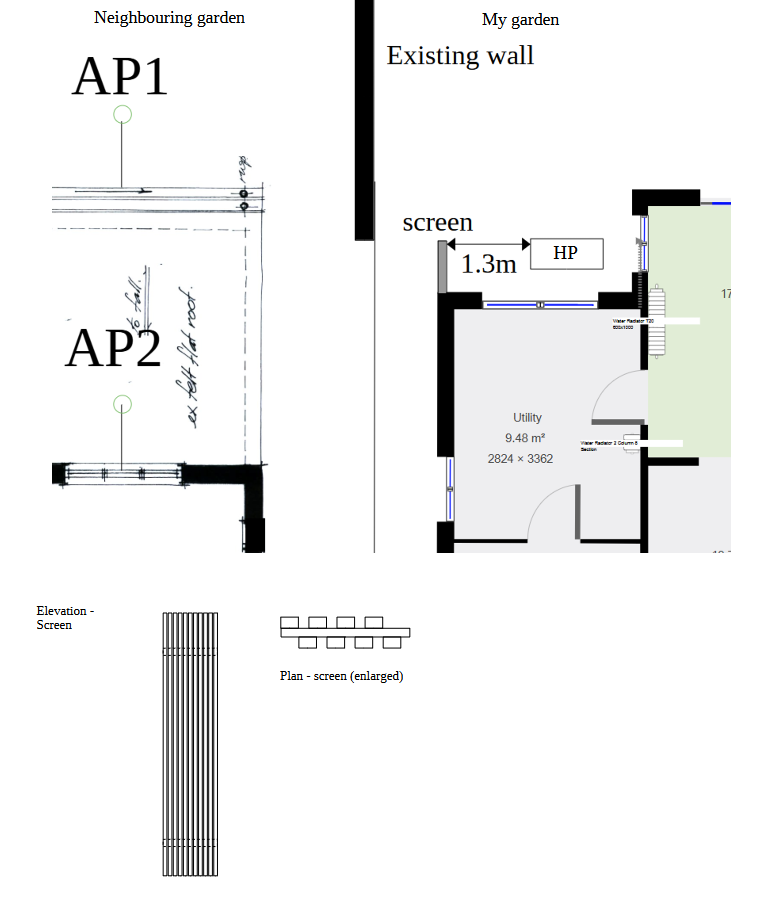
1.Visible from AP2 with no practical option for screening so in total poorer according to the MCS analysis 2.The piece of wall against which the HO is sited is <1m long, the heat pump is 1.1m long, thus it would obstruct my patio door or project to the left beyond the wall which is architecturally ugly . -
At last somebody has suggested this. I never fully understood the logic of combining ufh with radiators that need a higher flow temperature given that there is no good way, with a boiler or a hp, to achieve two different flow temps simultaneously. Of course I realise that it's the pragmatic solution in some retrofit scenarios, but I can't see how it makes sense in a new build.
-
Screening design for heat pump - comments invited
JamesPa replied to JamesPa's topic in Air Source Heat Pumps (ASHP)
And my mind when I look at it from the window... I guess it could become a conversation piece. -
Screening design for heat pump - comments invited
JamesPa replied to JamesPa's topic in Air Source Heat Pumps (ASHP)
Something like this might be possible. At 30degrees slat rotation the reflected sound in principle misses the window and the wall and there is still no line of sight through. Reflections from the rear slats still head towards the window but through a fairly small aperture. Not particularly easy to build though - I think I'm going to suck it and see.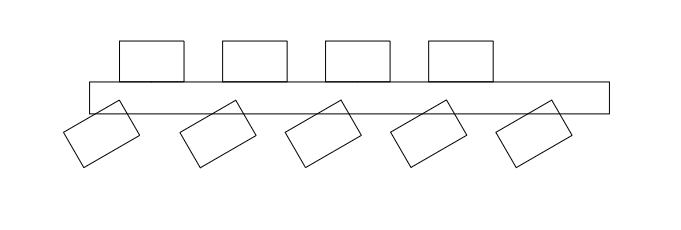
-
Screening design for heat pump - comments invited
JamesPa replied to JamesPa's topic in Air Source Heat Pumps (ASHP)
Re the wall/reflections fair enough. The house walls are rendered with 10mm stone chips in slurry, creating something about as far from a plane surface as you can imagine. I'm hoping this turns out to be a good thing not bad. Interesting, re plank sizes, I don't have the info but I'll try a search for it. I did find a company that sells a slatted wall sound insulation product for interior use, I might take a closer look and see if it tells me anything. Sorry about that, the door was long ago changed to a fixed window, the elevation is out of date. That was the original plan that got abandoned when I thought I might have to install under express consent and installation on the flat roof is simply incapable of achieving anywhere near to the (quite ridiculous) LPA noise spec, because distances are similar or less and there is no realistic possibility of barriers that look anything other than completely ridiculous. I could in principle reinstate the plan now I'm installing under PD, but the thought process and preferences have moved on. Yes, like anechoic chambers. If I could find a small exterior rated version I might consider it! I had considered this. I don't think the whole screen can be canted enough but maybe the individual slats can. I think it needs an angle of about 30 deg. I'll play with the CAD, but most likely just experiment with a prototype screen and dehumidifier (as the sound source). -
Screening design for heat pump - comments invited
JamesPa replied to JamesPa's topic in Air Source Heat Pumps (ASHP)
Thanks for the comment. Two walls and the ground within 1m = 3 reflective surfaces according the MCS noise assessment which has of course been done. 'Existing wall' is the boundary wall so not allowed because within one metre of boundary. The words themselves are in the middle of the route from patio to garden and would definitely be visible from ap2. It might just pass the MCS criterion but by a smaller margin than proposed location without visibility. Thanks also for the comment. The thin line below the wall in the diagram is a fence which, according to MCS, is a barrier because there is not visibility (although I have my doubts MCS is correct, but that's generally the case!). More importantly I can't see the trajectory to which you refer. Can you clarify? The barrier design currently ends more or less level with the end of the wall (based on a projected perpendicular from the house). This gives a 'solid and massive' overlap of 100mm due to the fence ending with a concrete post. -
Screening design for heat pump - comments invited
JamesPa replied to JamesPa's topic in Air Source Heat Pumps (ASHP)
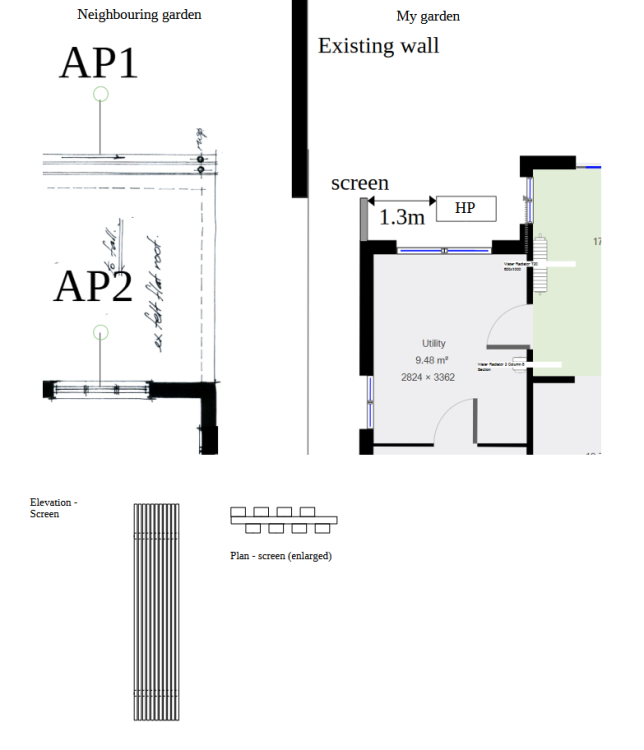
Thanks. Its about 2.3m high in order that assessment point (1m in front of the window) is not visible from any position 25cm from the pump. Thats just a bit less than the height of the (single storey) wall that it abuts (which obscures most of the view) - elevation below (panel being the arrangement of vertical rectangles) I intend to have no gap between wall and panel however the planks will have gaps between them (because the horizontal member holding them together passes between them to let air through (including wind!) but without any direct line of sight. (edit, by wall did you mean the boundary wall not the house wall?) Pretty much my intent. I may even build a prototype out of cheap wood first (I happen to have plenty kicking around) before committing £300 worth of cedar)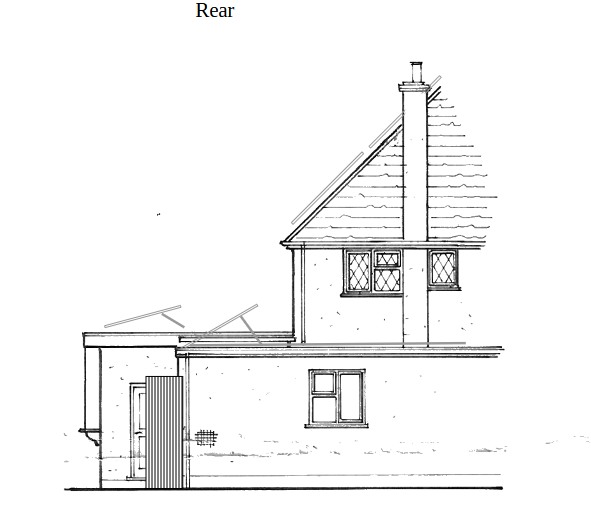
-
Screening design for heat pump - comments invited
JamesPa replied to JamesPa's topic in Air Source Heat Pumps (ASHP)
Thanks for that. I was also thinking about putting Cedar cladding on sides and top of the unit as a whole to integrate it visually (there are no side vents). Loading this with sound absorbing material is definitely an option. However I am guessing that most of the sound comes out of the front with the expelled air, so sceptical top and side loading will make much difference. Obviously directly loading the compressor is also possibility if that is the dominant noise, although I guess Vaillant might already have done that to get to their published sound power. Once I have it I can open it up! My preferred tipple is real ale but the point is well taken! There are restrictions on R290 pumps which this is, but there is no restriction (according to the data sheets) on putting them below windows. Propane falls not rises, so its things to the side and below that matter. The window to the side doesn't open so isnt a problem.. -
I'm finalising the details of my ASHP installation, now scheduled for mid October under PD. As part of the design there will be a ~2.3m high 750mm wide 'screen' which will provide both sound isolation from the neighbours and, serendipitously, resolve a visual mess visible from one of our windows. The screen supplements a barrier already provided by a wall of my house and an existing brick wall. Im thinking of an offset 'hit and miss' design built from 20mmx45mm cedar, sketches of location and screen design below. The requirements are Not to reflect too much sound back towards (my) window to the right of the HP Attenuate sound reaching AP2 (mostly its attenuated by my house wall anyway look superb (or at least visually attractive) not cause a problem with air flow I am certain it achieves 2 - 4. I have a slight worry about 1, but am hoping that the complexity provided by hit and miss will resolve this. There is probably going to be an element of trial and error, and to be honest I'm not expecting it will cause any problem for the neighbours even without the screen, as the unit itself is the '7kW' (8.5kW in reality at -2/45) Vaillant which is one of the quietest on the market and Quietmark certified. Does anyone wish to/feel able to comment in order to help improve the design?
-
Allowed placement, Under a kitchen window?
JamesPa replied to Post and beam's topic in Air Source Heat Pumps (ASHP)
Very sensible advice if it weren't for MCS rules and our crazy permitted development regime. Instruction manuals adhered to rigidly, and immovable interpretations of regulations (eg G3 where the regulations are entirely sensible but the industry interpretation is hopelessly constraining) are holding this industry back and costing the customer big time. We need intelligent engineering solutions not installation by numbers. Sadly our government, doubtless spurred on by an installation industry that cares about protecting itself above all else, have more or less legislated against engineering solutions thus propping up an industry that needs to think and innovate not forever tell consumers what they 'cant' or 'must' do.