AliG
-
Posts
3211 -
Joined
-
Last visited
-
Days Won
11
Everything posted by AliG
-
Two doors should be allowed. You can get composite fire doors which would look like the door you have in there and should provide some level of insulation. Looks like they aren't cheap at around £1000 but would ave two lots of door frame and so on as well as the hassle of two doors. The actual heat loss from a door to an internal garage would be pretty small. I wold be more worried about draughts and it should be possible to make a fire door air tight.
-
TBH I am just reading on the internet here, so you may have already seen this yourself. The "bolt" is a lightning bolt. This means that it is using the immersion heater instead of the ASHP to heat hot water. The electrician has done what is shown in this video - He has changed the heat source from Standard to Heater. I would change it back. The sound you are hearing is the relay switching on the immersion. P1 error seems to be for reading the flow temperature. It may be that the P1 error is caused by it using the immersion and not the heat pump as there wouldn't be any flow to measure. Or it may be something else. Can you change it back to Standard using the instructions on the video and then see if that resolves the error. If not something else is the issue.
-
So far it seems quieter since I turned up the boiler, but the heating has only been on for a few minutes. This now has me thinking. At some point I plant to switch over to an ASHP. I would probably have to take out the mixers as they won't be required and likely won't like the low flow temperature. I have 4 manifolds, so won't be in a hurry to do that!
-
This is very interesting. I have 4 large eaves spaces with PIR between the joists. The architect specified airtightness membrane at the last moment to cover this. It was installed by the builder at a cost of thousands of pounds. Last year I opened up the eaves and spent quite a bit of time making sure the membrane was actually airtight. For example there were many places where nails had been put through it, or it was torn. However, now that it is airtight, it billows out when it is windy. I have been thinking, does this cold air getting on the inside of the PIR actually render it useless? The document there confirms my suspicions. Would I in fact be better cutting off the (very expensive) membrane and taping up the PIR directly to the joists with airtightness tape? The rooms with these eaves spaces take notably more heating than other rooms in the house.
-
Thanks @Nickfromwales I realised last night that there might be something in all the manuals etc I was given. It appears that I have this unit -248TH MCE2014.pdf248TH MCE2014.pdf248TH MCE2014.pdf This has been replaced by the 248N and the technical data for this says that the primary flow should be at least 15C higher than the set temp of the mixer. When I was looking for replacements, some of them said 20C. A while back, trying to optimise boiler efficiency, I turned the boiler down to the high 50s. The flow in that manifold is set I think at 42C, so I have turned the boiler up into the 60s to see if in fact the problem is being caused by the low temperature differential.
-
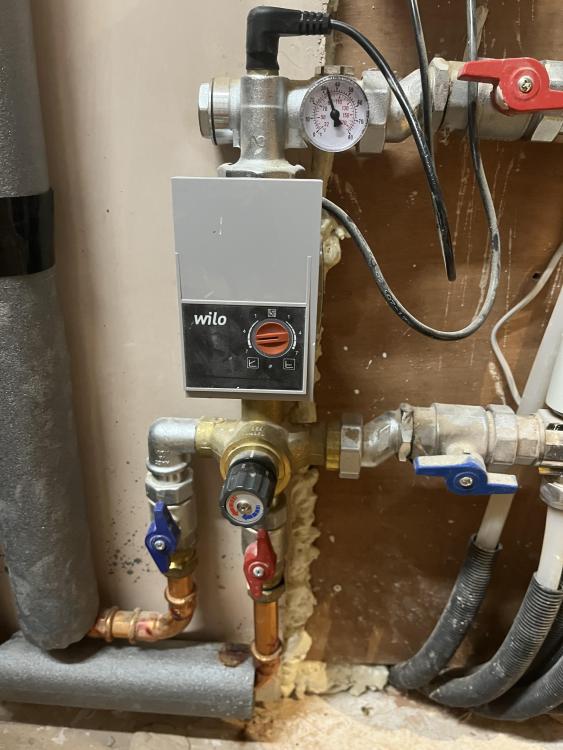
Thanks Sorry meant to include a picture - I think it says TH MIX on it as well as made in Italy.
-
Hi, I have a mixer valve that "groans". I think this issue has come up before as kind of fluttering in the system. It was fine for three or four years before it started to do this. You can temporarily fix this by adjusting the temperature but then it gets to the new temperature and does it again. I was thinking of getting the boiler serviced and asking them to replace it when they are here. Can you just replace the 4 way mixer or does it only come as a unit with the pump? Looking online i suspect it was all supplied as one with the manifold and I cannot see a make on the actual mixer. Are general heating engineers a bit wary when it comes to messing with UFH?
-
I think this thread has got off topic. The original question from @flanagajwas how much would they expect to pay an architect. Please can we keep to this topic, not bashing architects. We all have a choice when paying anyone whether it be architects, lawyers, electricians or plumbers. We can decide if we are happy with their charges and pay them or go elsewhere. I think considering the interest in the forum from architects it is unfair for them to be so harshly singled out and bashed.
-
There was no chance of that, it was based on quite a low number, I think it was around 60% of the actual build costs.
-
Both times I have been involved in a build, we agreed a fee as a percentage of a very reasonable build cost and fixed it. If costs then came in higher, there was no extra payment to the architect. This seemed a fair balance to me although the architect complains he underpriced my build. He does agree that there is no reason to be paying your architect more if you specify a fancy kitchen or bathroom as could happen on a straight percentage basis with no cap or fees would have exploded along with build costs in the last three years.
-
Much as this might work in theory, looking at the brochure it seems designed to be fitted to a Grant ASHP. It might well work with other ASHPs or there might be a different generic version that I have missed, but if it is designed for Grant ASHPs they won’t want to fit it here. If you were able to use the heater in the Grant low loss header, why couldn’t you use a backup heater in the ASHP which is why I think this has to be answered before almost anything else is considered. Maybe there is something going on that none of us know about. Tbh we can suggest all sorts of things but Vaillant and the installer are unlikely to want to deviate too far from their normal practices which is something we have to consider.
-
I think this is getting a bit hypothetical. Ultimately if a buffer of circa 100litres is needed then it will take up a minimum amount of space. I spent a bit of time looking and found one square buffer here - https://www.advanceappliances.co.uk/product/141-buffer-stores/ However it is short and squat so wouldn’t particularly help unless there is a place where it would fit. I don’t believe anyone makes a very tall skinny buffer. If someone finds one please post a link. I would simply ask the installer/nice lady at Vaillant - 1. Can we have a backup heater instead of a buffer? 2. If we have to have a buffer can we have one that fits in the cupboard where the hydraulic unit is or any other space that would work for @zoothorn accepting that there might be a minimum size required. No one needs to know how ASHPs work, why buffers are needed, is this different to other makes of ASHP or anything else. @zoothorn can you just put those two questions to the nice woman at Vaillant and the installer. Just email them if possible and await the response. If the response makes no sense to you then post it here and we can see if we can help.
-
Just what @ProDave said. You don't really need to know the ins and outs of it. You can either have a backup heater and no buffer as you do at the moment or a buffer and no backup heater as currently proposed by the installer. You just need to ask them why the new ASHP does not have a backup heater and no buffer like the current one.
-
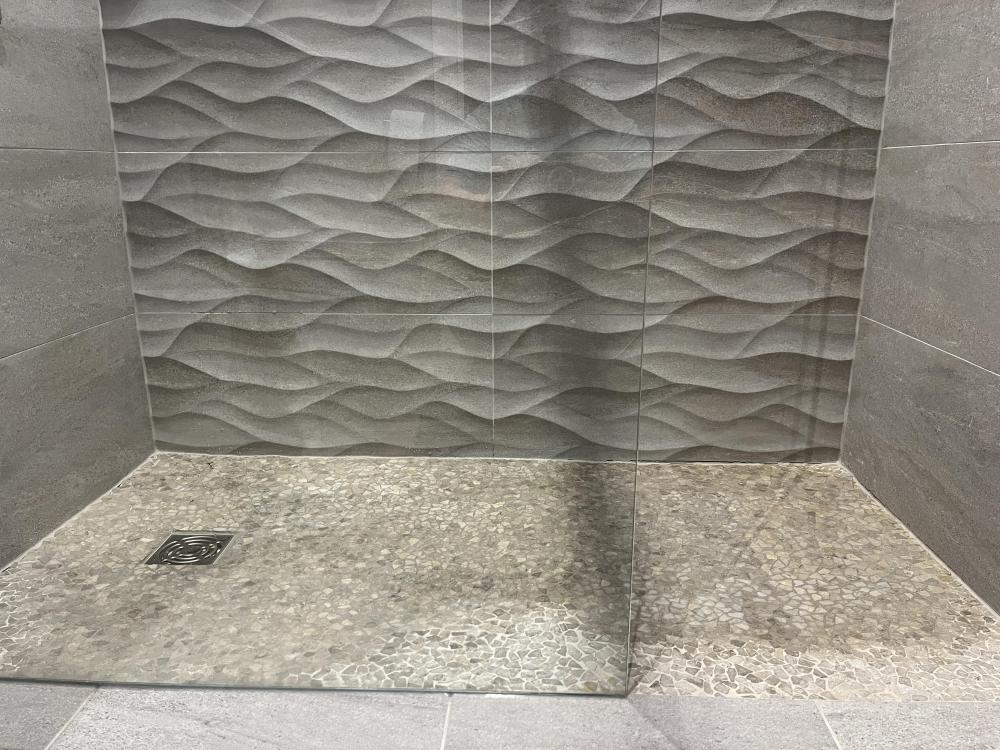
All of our showers are wetrooms with tiled/pebble floors. 3 of the 6 pebble floors have had issues. Despite being regularly sealed the one in our room, which gets by far the most use, constantly sees some of the grout start to come apart after 6+ months. I constantly regrout it which isn't a big job. I suspect the problem is that in some area the new grout is not that thick and if I could get all of the grout out it would fix it, but hey are thick pebbles and this would not be easy. One shower had a run in the wrong direction at the far end so water would run out into the en suite. When this was noticed the builder came back and fixed it. A third shower now has an issue. It is rarely used, so we did not know about this until too late to get the builder back. There is a pronounced bump in the middle of the shower so that most water runs away, but a pool forms around 5mm deep behind the bump. If no one notices this, it starts to fester and smell until it is cleaned away. More recently the base of the shower under the pebbles appears to have moved very slightly, there is a few mm gap in the grout line at the bottom of the tiles. I can easily regrout this, none of the other ones have moved. Any suggestions on a way to fix this without removing all the pebbles? If they were bumpier I would try adding more grout to life the level behind the bump, but they are pretty much level with the grout already. I am considering trying to channel into the grout in a couple of places to create channels for the water to run towards the drain, but I suspect that the area behind the bump is pretty much level with the drain so this may not help, indeed water could run the other way. If the tiles need to be removed how is it done? I think in the other shower room they maybe cut through them with an angle grinder then chipped them out. The floor is absolutely rock solid and hardly sued at the moment. I think there is a former at the drain end and they built a ply raft under the rest of the pebbles. The bump I suspect is where they meet. In most showers the former is the whole pebbled area, but they ones for this shower were a different shape I think. Genuinely these floors are a lot more work to upkeep and clean than a tray and a lot less durable and I would stick with a tray.
-
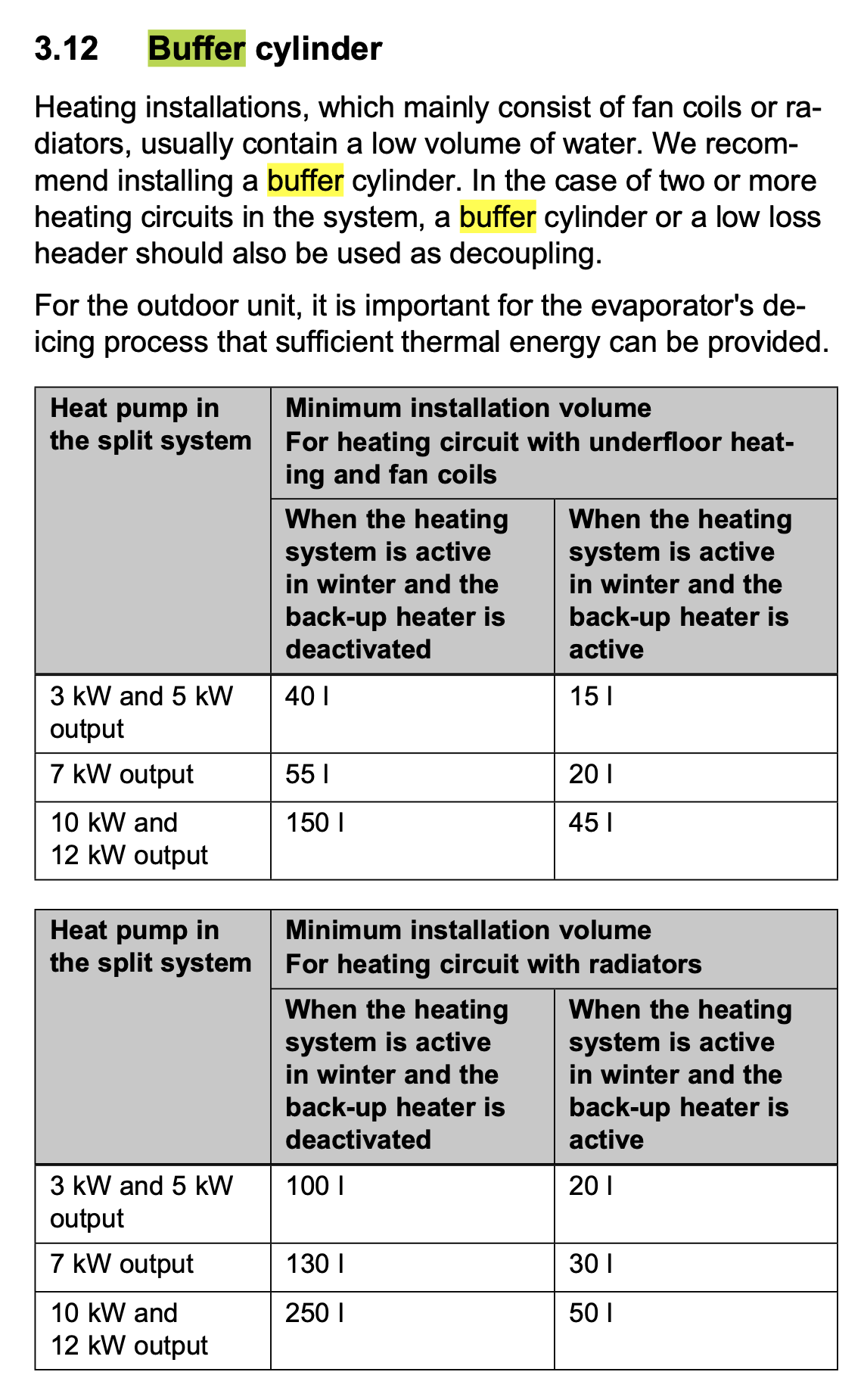
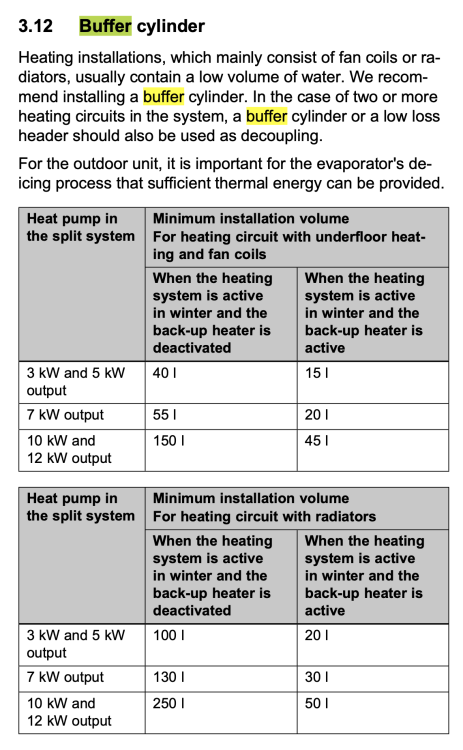
OK @zoothorn I don't want to get you frazzled. Feel free to read this tomorrow. Your current and your replacement ASHP both have the same requirements for minimum water volume in the system. The requirement is 45 litres if they have a backup heater installed in the heat pump and 150 litres if they don't. You don't need to know anything else about the backup heater just that with a backup heater you need 45 litres of water in the system and without it you need 150 litres. If your current ASHP does not have a buffer tank the assumption would be it has a backup heater so only needs 45 litres of water in the system and this is covered by the water in your radiators and pipework. So if the new ASHP also had a backup heater it also would not need a buffer tank. The only reason it would need a buffer tank is if it does not have the heater. So ask them if it can have a backup heater instead of a buffer tank like the current one.
-
To keep it very simple, ask them why they cannot install the backup heater in the new ASHP which means it will either need no or a very small buffer tank. Ask them if the current ASHP has a back-up heater. If so why can the new one not have one?
-
I'll try to explain this simply. I am not 100% sure myself but this excerpt comes from the split system manual. It would be the same for a split or mono system. 1. You need a buffer as UFH and radiators will run at different times and the ASHP is not efficient running in short bursts (short cycling). With a buffer tank the ASHP heats up the water in the tank as well as in the heating system and when the heating system calls for heat this heat can be supplied first from the buffer tank before the ASHP runs for a longer burst again to heat up the tank and water in the radiators/UFH loops. 2. When you run an ASHP, it is like a fridge running backwards. If you stand in front of it, the air coming out is cold as it has drawn the energy out of the air and used it to heat water. In the winter, when the ASHP runs harder, eventually this causes water vapour in the air or rain/snow to freeze onto the coils of the ASHP which stops it running efficiently. So every so often it will run a defrost cycle to melt the ice. Indeed you will see a large amount of water running off it in winter. There are two ways to perform this defrost cycle, you can either run a backup heater directly in the ASHP, or you can briefly reverse the system and use warm water in the system to melt the ice. This is why if you have no back-up heater you need a buffer tank as you need a large enough amount of warm water so it carries enough energy to melt the ice ("sufficient thermal energy" as it says in the manual). It is also why turning off the radiators is a bad idea as it could impede this function by reducing the amount of warm water available to the system. I can only assume that the current split unit has a back-up heater and the mono unit is not planned to have one. You would have to ask the installer the reason for this. Both units appear to be able to have a back-up heater and have the same requirements for 45l of water with the heater and 150l without it. Unless of course the current unit was incorrectly installed with neither the heater nor buffer. Someone should be able to tell you why this change has happened. Just to be clear the 45l and 150l figures are for the amount of hot water in the whole system. Radiators tend to hold less water than UFH loops, so your system probably does not have much water in it and would need a larger buffer tank than someone with UFH needs. This issue why altering the number of radiators would alter the size of the buffer tank.
-
Looks like we crossposted. The 150l requirement is total water in the system between radiators and the buffer tank. I suspect they are looking at a 90l buffer tank which would be roughly the size you have quoted. If you turn off the radiators then there will be even less water in the system and they will want a bigger buffer tank again. If historically you have turned off the radiators then this may have caused a problem as they assume the volume of water in the radiators when making their calcs for the system. I think the system will run better with the radiators on and they will be providing some heat at a reasonable cost even if you then have to run a fire/stove or whatever on top of this.
-
Even if they are not producing enough heat to get the room up to temperature, they will still be producing heat and as an ASHP is a cheapish way of producing heat I would recommend using them augmented by other means. The 150l requirement is total volume of liquid in the system, so this should include water in your radiators, if you exclude them the buffer will have to be even larger. The reason for this is that the system runs the warm water from the system back through the ASHP to prevent it freezing. The alternative is a backup heater, it is not clear why they do not plan to use this, ask the installer if you can. If you have turned all of the radiators off and there is no buffer tank at the moment then you may not even have the 45 litre minimum water in the system which may be causing issues. Also as the system is undersized for your house I am not sure if running it in reverse sometimes is a good idea at all.
-
Yes. The installer should be looking at these depending on heat loss calculations. We have different pipe spacing in different rooms.
-
Good that it is running better. One of the things to do when installing an ASHP is to design the system for the lowest reasonable flow temps as this improves the CoP and reduces running costs. Larger radiators and closer spaced UFH pipes for example as well as insulation. Mixing down the temp for UFH means that the system runs less efficiently than it should. At this point the cost of larger radiators upstairs so you can reduce the flow temp to them to be the same as for the UFH would probably be too high relative to the modest savings from a better CoP. This definitely will partly explain your worse than average CoP. Hopefully the improved insulation since last year means that you can run lower temps on the radiators and have a better CoP.
-
Screening design for heat pump - comments invited
AliG replied to JamesPa's topic in Air Source Heat Pumps (ASHP)
I can stand a couple of feet away from my parents' Panasonic 7kW ASHP and barely tell if it is on. I'll try again on a really cold day in winter, but I think the issue of noisy ASHPs is a thing of the past and not a concern nowadays. -
@zoothorn you are being absolutely ridiculous here. 1. Your unit may be broken and noisier than it should be. 2. Your unit may be noisy due to being installed in a house that is entirely inappropriate for a heat pump. 3. Everyone has different sensitivity to noise whilst they are asleep. 4. Beds can move around so they don't know if a bed will be there when they install the ASHP. Most importantly though, for your own mental health. You have your own problems, don't try and fight the world's battles, it will just get you down.
-
You beat me to it @S2D2 I was just checking the installation manual. The water volume requirements are exactly the same for the split unit and mono block unit. If the split unit has the backup heater why wouldn't the monoblock. Clearly a question for the installer. With this the whole issue goes away. If the buffer absolutely is needed, you previously posted this picture of the hydraulic unit. It looks to me as if the buffer can fit in there, has the installer looked at this?


-
They look awful. Don't do it. However, builders should put more effort into putting sound insulation around them.