AliG
-
Posts
3211 -
Joined
-
Last visited
-
Days Won
11
Everything posted by AliG
-
Hi, I have got a few names from Google but thought someone may have a recommendation of someone they know/have used. We will probably use MBC for the foundations and frame on my parents' house so will need a soil report for them. The SE organised it for my house, but it was extremely expensive and included the costs of coming up from England and staying overnight which seems a total waste of money. There is no SE involved at the moment so I am trying to see if I can organise it myself for more reasonable price. Thanks
-
The window looks nice there. Depends a bit on the outlook. You get various Quooker taps. You can have a stand alone one with a separate tap that has normal hot and cold water or you can have a Fusion that has both Quooker water and normal hot and cold water available at the same tap.
-
I just rinse stuff under the cold water tap, you will still have normal water available, and might well leave it running whilst peeling vegetables. You wouldn't want to use water from a Quooker for this, it only holds 2L of chilled water. You could use it but it would seem pretty wasteful.
-
Sorry just meant a standard single cupboard 600mm wide. Basically these things just sit on the bottom of the cupboard and you don't move them unless you have to. Sounds like the CUBE needs access to change the CO2 canisters. From the description above including a space in front for the canister it will basically take up one side of a cupboard. The main thing to watch will be where the sink waste goes as it probably won't clear the top of the Quooker. These are details the kitchen company should be aware of. I guess you are thinking of putting the Quooker in the island. Our is on the other sink on the thinking that you would keep tea cups in the wall cupboard above the sink. Also you use it to fill up large pots to boil stuff which is easier at a larger sink. I can see you wanting it on the island for cold water though. My family don't like sparkling water so we just use the tap. We had an American fridge freezer before and the water was no colder than tap water so it seemed pointless. Also visitors loved playing with the ice machine which used to really annoy me as I am on the hook if it breaks. Now we have a freezer where the ice falls into a tray inside and you scoop it out. Nothing for visitors/children to see and want to play with.
-
We prep stuff in the space between the hob and the sink on the island. Actually looking at the close up there, we had a sink very close to the edge of the island in our last house. That was a much bigger problem than the hob as people constantly splashed water out of it and it ran down the side of the island. I move it in a bit in our current place. We have a 7L Quooker plus a waste disposal in a standard 600mm cupboard and plenty of space left over. From Quooker, it looks like they would both fit in a 600mm cupboard but not leave much room over. The CUBE is big. We have a similar system in the office at work. What I have noticed is that the cupboard gets very warm and it melts stuff left on the worktop above. The Quooker PRO3 tank requires 480mm of height space and is 150mm in diameter. The tank is a cylinder. The Quooker PRO7 and Combi 2.2 tanks require 550mm of height space and are 200mm in diameter. They are both cylinders. The CUBE system requires a 430mm in height, 230mm in width, 440mm in depth. 65mm extra space either on front or side is needed for the CO2 cylinders. The tank is square. If you have specified a Flex tap please note we require at least 500mm deep x 200mm wide space below the tap position under the worktop in the cupboard. This is required to allow the weight that operates the Flex hose to move freely up and down. If it becomes restricted it will not operate as intended. We have one stainless steel sink and a white Silestone sink in the island to match the worktop. When it gets replaced they will both be stainless steel as the Silestone sink is just a pain to keep clean. Do you really want such a large sink? I actually measured a kitchen shelf and made sure the single bowl was big enough to put a shelf or pan in the bottom to clean, but other than that we have two dishwashers which my wife says was one of the best ideas that I have ever had.
-
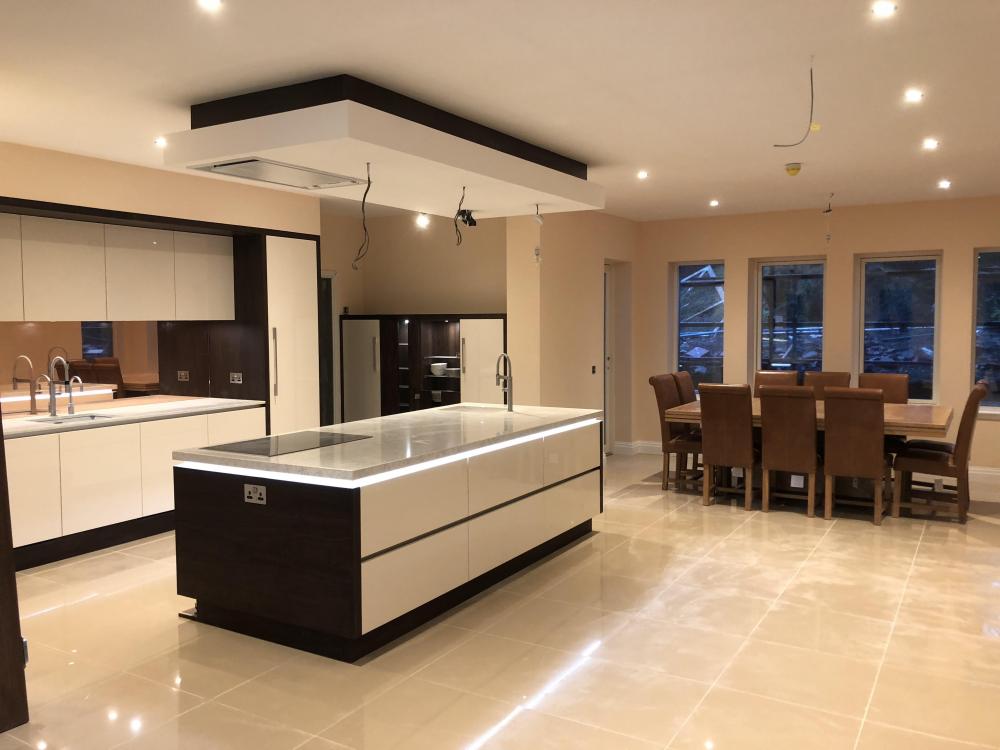
Yeah. That looks like a dark winter day while we were building. As you say fine with the lights. The hob is around 100mm from the edge which is plenty. I have seen them closer which would be too much. Also it has one of those long areas on the right hand side which hardly ever gets used. TBH who ever actually uses all 5 positions on a big hob. I actually almost changed to a square one but the rectangular one looks better on the island. I wasn’t really commenting on positions of hob etc as I felt you were just getting the building right and there will probably be a kitchen plan later. I do agree with some of the comments though. Our fridge is nearest the table so you can get drinks and condiments. The freezer is at the other side. When you think about it they are neatly always together yet it would be pretty rare you would move stuff between them so they do to have to be next to each other. Also the fridge and the ovens are opposite the spaces at the top and bottom of the island so there is nothing behind you
-
Forgot. Happy birthday. Now I am in I wish there was a window above the mid height cabinets to light the kitchen
-
It is a combination of things. All the lights are on there and that kitchen has lots of very reflective surfaces whereas you have shown yours with a dark floor and darker matt surfaces. Sitting at your table you will be in the light. That’s how ours is.
-
I think you said something about the kitchen being bright before and tbh I didn’t want to rain on your parade. My kitchen has 10 windows and 2 French doors yet the actual area where the cabinets are has no windows where light falls directly on it and you nearly always need the lights on in that area. If I had known I would have had another window that hit that area specifically. Light tends not to fall more than a couple of metres from a window. The problem is it is hard to have lots of windows where your cabinets are as they interfere with the wall space a kitchen needs. It will be fine with the lights on but if you want natural light you’ll have to move the kitchen. I notice the top of the windows in the sunroom are very low. According to my architect it is seeing the sky through a window that tends to make it feel lighter. I would take the windows higher up towards the ceiling. Windows normally go up to within a few hundred mm of the ceiling if not all the way.
-
Minimalist wash basin table
AliG replied to ToughButterCup's topic in Bathrooms, Ensuites & Wetrooms
Similar price but at least it is stone resin not laminate https://www.lussostone.com/countertops-c15 This Tavistock stuff is Corian and a bit cheaper, available in various sizes and can be cut. Should be a lot more water proof than laminate https://www.designerbathroomconcepts.com/tavistock-1280mm-solid-surface-worktop.html?gclid=EAIaIQobChMIt56h8K3X6QIVV-vtCh0ESgpgEAQYAiABEgKdl_D_BwE -
ICF integrated Garage Threshold details
AliG replied to magnethead's topic in Insulated Concrete Formwork (ICF)
Everyone is being very helpful re the details here, but before going any further can I make a few points. 1. Garage doors provide a pathetic level of insulation and air tightness. If you take a picture of one with an IR camera, much as the centre of each panel is insulated, the edges are not. Nor is the frame etc. The amount of heat you lose through a cold bridge at the edge of your slab will be inconsequential to what you lose through the door and the door frame. 2. I thought at one point that this was a good idea, but my research suggested that heating your garage and putting a damp car in there is bad for it. If you plan to use it as a heated workshop that is different, but if you plan to put the car in there it is a bad idea. 3. How much time do you actually spending the garage? My unheated integral garage with a 40mm insulated door drops to around 10C when it is cold outside. This is much better than keeping a car outside and fine to nip in there to put the trash in the bin. So again unless you plan to use it as a workshop and spend hours in there it would be a lot to spend for not a lot of use. Of course if you want to it is up to you, I have been thinking of plastering and tiling mine as it would look nice but then I keep telling myself I don't really need to. So far sense is winning. -
I usually comment on these threads. However, if you haven't seen the architect yet, I would let them do what you are paying them for and then start to tweak their design. I gave our architect a list of the rooms we wanted - bedrooms, en suites, kitchen large enough to site in and have an eating area etc. Then waited to see what he could come up with. He might come up with something better than you thought of, mine certainly did, but you need to give him a bit of freedom. The architect will also be aware of building regs etc, so for example if you have a bedroom in the third storey, the kitchen cannot be open to the hall. A couple of general design points though. 1 - Why all the bi-folds. They are expensive and can be draughty and unreliable. Do you actually think you would use them all? 2 - Would you want guests walking through your junk in the utility room to the WC?
-
Timber frame studwork is generally 89mm finished size studs so 114mm taped or 120mm skimmed(My walls are skimmed but it is pretty rare in Scotland) It would be more normal to show stud walls on a floor plan at closer to 100mm thick not 200mm thick that was all that was suggested, not being millimetre accurate. Bathroom walls are often normal thickness but have a bulkhead inside the walls, but it depends on the specific bathroom design which it seems a bit early to go into.
-
Good morning! Kitchen/utility much better now. That is what I meant about gaining the space where the wall was, but didn’t have time to draw. The door closer on our utility room was noisy and I had to have it replaced as people seemed to go in and out of that more than any other room in the house. You won't regret having it warm. Now I understand why you are walking through the dressing room to the bedroom. I must admit I always prefer to design a bedroom where you aren’t facing the bed directly when you enter. Only thing I will say is we have a dressing room and en suite. Every morning I go into the dressing room, get my clothes and take them into the en-suite where I get dressed after my shower. But maybe that is just me. Actually my wife usually gets dressed in the dressing room as she tends to shower at night. You can still lose the 200mm walls if you want. Pipework to baths/showers/WCs is usually 15 or 22mm. Drainage is usually 40mm. Soil pipes at 110mm are more difficult to route. I wish we had spent more time on that in our house. You can soundproof a 100mm wall in lots of ways, it is more about the detailing. I have been reading up on this as we have one wall which is quite bad for noise transmission and it is a block wall.
-
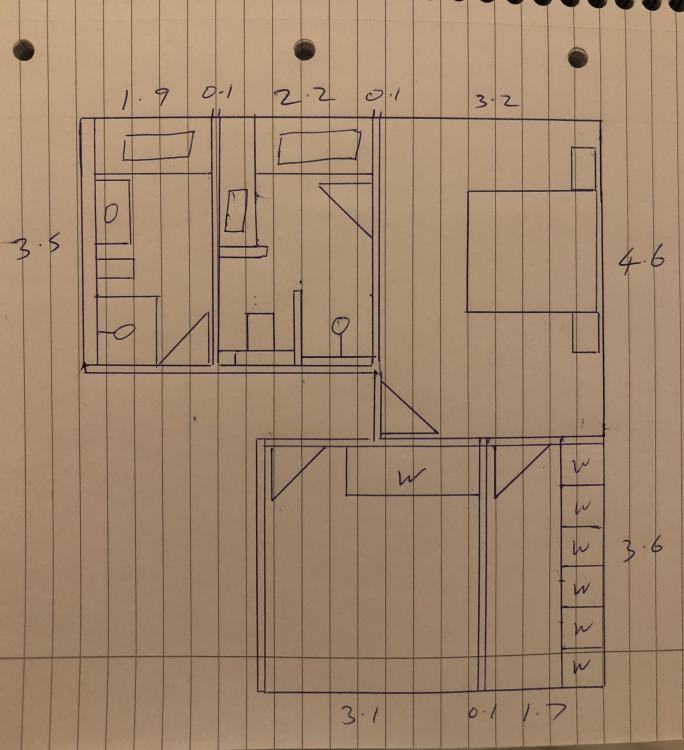
OK, my quick sketch before bed, sorry for the lined paper. If you use normal 100mm wide stud walls, then you have 7.5m across the back, less 200mm of wall. Also the wall between the bathroom/en suite and the landing being 100m frees up 100mm to make the rooms 3.5m long. If you reduce the size of the shower in the main bathroom (or do away with it) and cut the main bathroom to a still decent 1.9m wide then you can put the master en suite where the walk in is and the walk in where the en suite is. As the walk in is narrower then this gives you more room for the spare room which can also have a wardrobe. There is plenty of scope in those spaces for bathroom design, I just put something down quickly. I should have drawn the main bathroom the other way round so the pipework backs on to the pipework on the en suite. In the en suite I put the WC in a little space of its own and made a walk in shower, but there is plenty of space to do other things. All of our showers are walk in, no doors to clean and more space efficient. Putting the door into the middle of the ensuite and not the end usually lets you use the space better.
-
The reason I asked is if you have a 2m ish carport but then make the wall between it and the utility the outside wall of the house it frees up a bit of space for the kitchen due to moving the thick insulated wall. It would also nicely line up with the bedroom wall above making the build easier. The carport area would just be like a small porch then. If you put a hot water tank and MVHR in that utility space it will never be possible to convert it into a garage, so why not just make it part of the house now. I think you are compromising the house for something that won’t happen. Also the door from the kitchen to that space would have to be an insulated outside door or you will lose considerable heat from the kitchen. I am not an expert on ASHPs but they have to be in an area with unobstructed airflow. It is just about conceivable it could go in the open carport at the front but ideally it would be at the left hand side of the house. However you only have 1m width there and an ASHP might be 400mm wide with various clearances required depending on the model. Just something worth noting.
-
I have been playing around with the layout for a few hours but, I have a couple of questions. 1. What equipment do you want in that utility area in the garage? The ASHP would have to be outside. Is there any reason it is not part of the heated envelope of the house? If it is so it could be turned into a full garage in the future that would be very difficult by the time you have the MVHR etc in there. 2. As the kids bedroom has an en suite and you have a shower and bath in your en suite, do you want a shower and a bath in the main bathroom as it may help to arrange the rooms upstairs if you can lose the shower or bath from the main bathroom, but equally that may be what you want.
-
TBF I think you have made life a little harder for yourself than you need to. It is unlikely your outside walls would be 500mm thick. For a brick/block skinned timber frame you are looking at around 400mm for 0.14 U-Value and 450mm for 0.11 U-Value. You have also drawn the walls around the upstairs hall and either side of the bathroom as 200mm thick. In some cases I think it is to get the sliding doors inside the walls, but for example, if the wall to the left of bedroom 2 was 100mm thick and the outside wall 400mm then the bedroom could be a better width. I probably wasn't clear enough, it is the slide into the master bedroom that I was talking about doing away with The sliders into the dressing room are fine, but as a door into a main room a normal door is better, it would fit next to the bedroom 2 door. Also if you want to make the roof habitable space, it will have to be a self closing fire door, something hard to do with a sliding door. To do it you would have to make the entrance to the dressing room narrower so that the door doesn't slid into the hall wall, then you can put a normal room door there. I have been trying to draw it up, so let me come back with a sketch. I was going to ask about that, that is what we had in the cinema room in the last house. That was a dedicated cinema room and what happened was we never opened the curtains and never used the TV. The rear speakers can go in the ceiling so you don't have to worry about them, I would probably build a false wall where the screen is and embed the TV and speakers into it.
-
Someone else may know the regs better than me, but will permanent access to the roof create fire regulation issues and mean that all the doors below have to be fire doors or at least the access has to be sealed off in some way?
-
Working off 100l per person per day of hot water, your requirement for hot water heating will be 20kWh a day. I think your builder is optimistic, there are plenty of cloudy days in summer as well as sunny days when you will generate more hot water than you can use and there is no guarantee that the generation of PV coincides with the need for hot water, although this can be managed with a larger tank. PV will only cover your DHW for a few months of the year. Also PV is better used to offset normal electricity use which is more expensive than using an ASHP to heat water. When you don't have any PV or run out of hot water, heating it with direct electricity will be quite expensive. Around £2.50 a day, versus less than £1 for an ASHP. So you would probably save around £300 a year on DHW using an ASHP, offset by the higher cost of the ASHP. If the house is close to passive but not passive the favoured system seems to be UFH on just the ground floor with an ASHP. As soon as you use direct electricity for heating the costs will rise above my calculation for hot water and eventually the ASHP would pay for itself as well as having a more comfortable house when it is cold.
-
Yes, I just noticed that, the wonders of autocorrect
-
A few things. 1. Mentioned before, but it is even worse now with the thicker walls. That corner between the island and the pocket door to the living area is both narrow and awkward. It would be even worse with a chair at the island. The space around the island is just too small. When you open the door to a dishwasher, it sticks out almost 80cm, you won't be able to pass between it and the island, you won't be able to pass between an open cupboard door and the bottom of the island. If the plan is to put the dining table in the garden room, then the space between the hall and patio doors seems wasted and I would move the packet doors back in line with the other side of the stairs to give you almost an extra metre in the kitchen. 2. You will not be able to use the projector there. I have a 5 m long room painted dark brown, including the ceiling, with a little slot window and the projector is OK in the daylight on a 2.9m wide image. In my old house with a slightly smaller screen, white ceilings and larger windows it was impossible to watch the projector in the daylight. And this was much closer to the screen. The combination of light coloured room, patio doors and projector will not work. 3. Spaces of 600mm and 500mm either side of a bed are too narrow. By the time the duvet hangs over the sides you can knock another 100mm off that. 4. Now that you have made the master bedroom larger, I would move the door to being a normal swing door next to bedroom 2 and close in the wardrobe more. Sliding doors are a pain to use relative to normal doors. It is not quite clear though as the render appears to have wardrobes there. You have a lot of room in the walk in, I would try to keep all the wardrobes in there. 5. The floorpan shows windows on 3 sides of bedroom 3. With the already limited space, a window or door on every wall will make placing furniture difficult. 6. I would make the sink area smaller in the master ensuite so it does not impinge on the entrance area in front of the shower.
-
Would be grateful for any opinions on my estimated costs
AliG replied to a topic in Costing & Estimating
There is a very similar thread just posted here. https://forum.buildhub.org.uk/topic/14865-first-costing-of-project-opinions-required/ The general consensus is to assume £1500 a square metre unless you are doing a lot of work yourself. I would say that especially goes on a bungalow which has more roof and foundation relative to its size than other houses, offset by some savings from an easier build, no cranes etc. You don't seem to have allowed for the bathrooms and kitchen, just plumbing. So that will be £10-15k right there. Your number for the roof seems low, assuming it includes building the roof, insulating and tiling it. Depends how it is built up. You will need a hot water system of some sort so a combination boiler or tank as well as connections to the kitchen and WCs. Nearer to £3000. Guttering, downpipes, soffits, fascias etc. If the inside perimeter is 9x8, you will have 82 square metres of plasterboard on the outside walls, plus 75sq metres of ceiling, plus as much again for partition walls, so 2-250 square metres of plasterboard. That is about £20 a square metre fitted and taped and filled or skimmed. 8 doors at £300 a door plus facings, skirtings etc. So maybe nearer £8k, plus £1k for painting. Plus the cost of the studwork. Flooring - £2-5k depending on carpets or hard floors. Windows depends a lot on the spec, that is at the low end. Other numbers seem fine, it is just that you have missed quite a lot of items, or maybe you didn't intend to include them as part of this estimate. All this gets you up to £90k ish which seems a more reasonable minimum estimate. -
Just looking at our quote, the twin wall is another 20% more expensive than 0.14 u-value walls and the 0.1 u-value blown insulation roof. I couldn't see much justification, it would be lucky to cut £10 a year off the heating bill. I did wonder about the better racking strength of the 300mm wall and the sound insulation, but you get some of those benefits from using the blown cellulose roof and the combination of mineral wool plus PIR in the walls should do a pretty good job. It was also just too thick a wall in our case. My last house was around 17 years old and only had a 90mm kit with mineral wool plus a rendered block skin, so the 0.14 wall is already a massive improvement on that. Your price does seem very cheap once you take out the windows, kitchen etc you must be looking at around 65k for just the kit, so about half the price of a similar spec MBC kit.
-
Just out of interest what kind of price per square metre did the further away kit come in at? We are about to do a build with the same wall spec for my parents in Edinburgh. I had a couple of quotes from Scotframe and MBC. I reckon MBC were about 15% more expensive than Scotframe once I had adjusted for the difference between the quotes. MBC is around £450 a square metre including the roof insulation to 0.1, or about £400 ex the roof insulation. As to your question I would get a detailed list, because different people could easily include different things in first, second fix etc and you don't want to have to argue about it later. If you run the numbers on heat requirement for a house there is very little difference between 0.14 and 0.12 u-value. In our case we have a width restriction so I am sticking with 0.14. The extra budget might be better used for the windows where it is likely you can get a bigger uplift.