


epsilonGreedy
-
Posts
3877 -
Joined
-
Last visited
-
Days Won
6
Everything posted by epsilonGreedy
-
Heat pump latest government offers
epsilonGreedy replied to nod's topic in Air Source Heat Pumps (ASHP)
Would "carbon neutral" be a valid alternative description? -
Heat pump latest government offers
epsilonGreedy replied to nod's topic in Air Source Heat Pumps (ASHP)
Insulate Britain is one of the few eco warrior groups I have a bit of respect for. At least they focus on the single most achievable policy that can reduce emissions within 10 years. -
The building pros and surveyors I have encountered would not worry about the degree of this problem that concerns you as long as they understand the cause and are confident the motive force causing the damage has ceased. At the end of the day that is not a lot of movement in 60 years. How much would 5 meters of underpinning or footing wall repair cost? Or how about booking a 1 hour visit from a local surveyor for an on the spot verbal report with no written follow up, they might have spare time now the stamp duty holiday has ended.
-
@dssr have you examined the wall above the brick abnormality all the way to roof height particularly at any window opening? I ask because one situation I encountered with a 60's built house was a leak in a mains water pipe running through the ground floor slab.The pressure of the leak combined with a swelling of material under the slab caused some upwards and outwards expansion that was lifting the building a fraction. I would not worry about the dpc you cannot find, you would struggle to find the dpc on my new build. Local brickie convention in my region is to skim a few mm over the dpc to hide it.
-
A trial low temperature run of the existing boiler is such a good idea Parliament should enshrine it in statute law. This would force all these cowboy ASPH installers, pocketing ££'s from incentive schemes, to demonstrate to a customer how a heatpump will perform at a COP 3 factor with existing radiators.
-
I opted for private building control which was @PeterW 's advice at the time. Happy with my choice and suspect my guy's long experience and intuitive assessment has saved my loads compared to a younger box ticker. With either choice it comes down to the personal characteristics of the BCO assigned to you. I would suggest looking at possible overrun extension fees if you think your build will be slower than average.
-
I think you need to quantify the damp problem with hard numbers before expending effort based on a hunch. My first thought is that a newly occupied old property is going to shed moisture as it warms up. Why not wait until it reaches a new environmental equilibrium? Another issue might be your perception of normality, if you have moved from a modern house with a low humidity level you might need to reset your expectation. Some forum members have resorted to retrofitting a device into their MVHR system to prevent humidity falling to an unhealthy level in their newly built high performance passiv house. Your new old house is providing that free of charge, which although said in jest this does illustrate you need to quantify the humidity & damp you are experiencing.
-
I remember watching a TV documentary featuring the life-long struggle of an Irish Aristocrat to keep his inherited mansion from falling apart. His main advice was to view any old property as an upside down ship where the top priority was to eliminate water ingress from above i.e. start at the chimneys roof then work downwards.
-
I think @TonyTis suggesting that a trial 40 degree run for a few days during a cold spell of weather will allow @chrisgreen to assess whether an ASPH will keep the property warm via the current radiators.
-
Fascinating numbers, thank you. By my calculations a Watt-Year now costs £1.75 (24 x 365 x £0.2) and so I can foresee a fully spec'ed home automation system with multiple cameras, wifi APs, NVR+AI, hubs adding £100 to the annual electricity bill. The biggest consumers of home automation power will be AI software scanning multiple security camera feeds, wifi APs and multiple cameras. In contrast presence sensors, thermometers and radiator valve actuators will consume little on an annual basis. I am only 3 weeks into my attempts to comprehend HA technology but I am already thinking an ideal setup would have many active 24x7 PIR detectors but with security cameras powered off by default. Such a system would eliminate 99% of the consumption of two of HA big consumers of power namely cameras and AI software. This type of system would require some high-end home automation routines but might be technically possible. This morning I have been looking into API driven on-off switching of a PoE socket on the Unifi switch. In theory a routine triggered by a PIR sensor could cold-boot all PoE security cameras into action via the PoE socket api. The viability of this design depends on the boot time of a security camera and how long it would take the BlueIRIS software to recognize each newly active camera feed at the NVR box.
-
A forced action mixer apparently, never used one personally.
-
I understand that different categories of LAN cable can deliver higher PoE watts. Do you think the max PoE watts is significant for ordinary home automation? Personally I am not happy with the idea of delivering many amps via a POE switch, a night time external security camera with a PIR triggered light is the most power hungry device I can think of.
-
I reckon a standard 150l electric Bell would mix as fast as you can lay it. The bigger challenge is getting the right consistency. You are not pouring a thin wet concrete garage slab, unless that it you are not intending to do a classic dry screed floor.
-
Ok good to know. A dark slate roof can get very hot which led to my concern about the battens expanding lengthways. I don't want them fighting with the brick wall on a hot day and popping off the trusses under stress. So a few mm it is. A smaller gap does lessen the chance of a batten splitting open at the end grain near a truss fixing nail.
-
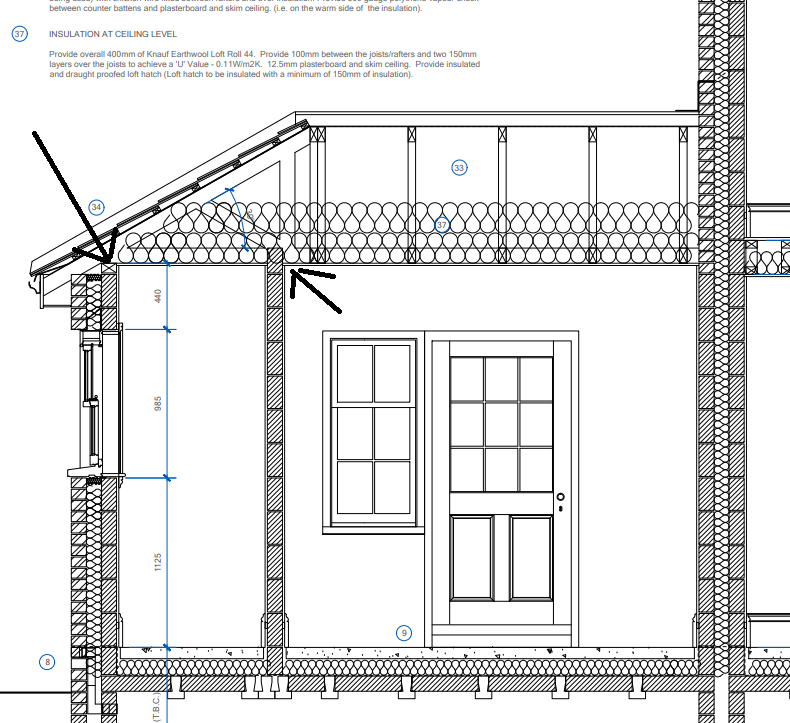
I have a small roof over a single storey room where the ridge abuts to the main house 2-storey brick wall at 90 degrees. The run from ridge to fascia is short i.e. 2m and will require about 11 2 x 1 battens each side butting up to the two storey wall at 90 degrees. I assume some expansion air gap is recommenced between the 22 batten ends and masonry wall? The final truss below next to the main house wall has a clearance of 40mm. The longest batten length is 4m. There will be a lead soakers from ridge to fascia. I will be using slate and a halves alternating at the abutment. The code-4 lead roll for the soakers is 240mm wide. I understand a 3mm gap between natural slates is standard industry practice. However the slates at the abutment will need to be about 5 to 10mm (I assume) back from the wall to accommodate the 90 degree bend of the soakers that will be formed around a block of wood at (guess) a 5mm radius. Please ignore the black arrows in the image below, they were for another question. This question relates to the roof abutment next to the main cavity wall on the right.
-
One ton or a bit more of screed is an awkward quantity but I think you are still down in by-the-bag territory. How do you propose to mix it? When considering a similar job the resident experts here strongly recommenced hiring a horizontal mixing drum. Apparently a conventional mixer does not achieve the well mixed consistency required for screeding.
-
Think so the one with a silly price tag, it was new on the market 3 years ago. I purchased mine online from that dodgy tool retailer in Swansea who supplied my Makita pulse driver in a plain cardboard box and zero Makita paperwork. It is still performing well and I like how controllable it is at low speed or when applying an extra 1/4 turn when a screw is nearly home. When it packs in I won't be able to afford a replacement at the current retail price. I think the first batch were heavy discounted 3 years ago.
-
My Makita charger purchased 3 years ago looks the same except the model number is DC18RC. Not got the new one out of the case yet. You won't miss the fan when it kicks in.
-
I got mine yesterday and was using the combi up on the scaffolding 20 minutes ago until dusk stopped play. Don't know how I got this far in the build with a single 3Ah battery. The brushed combi drill creates a bit of light show when used in the dark, it is my first brushed 18v Makita. They say brushed motors do not have the same oomph as their brushless counterparts but I reasoned I will switch to my wonderful Makita pulse driver drill when the combi lacks power.
-
The charger has a noisy fan to keep its internal works from overheating. Beyond that all I can say is that it just works and usually takes a depleted battery from 1 to 4 bars within 30 minutes. I have never noticed the batteries overheating though there is a status light on the charger to indicate charging has halted to let the fan cool things down.
-
In another video he presents it as a completely local solution.
-
I am only 2 weeks into my journey of trying to comprehend home automation and where the technology is going. NPR seems more difficult than general AI image analysis. I understand NPR works best with a dedicated camera configured to focus on a small area. Regular security lights or IR lighting onboard a camera can overwhelm a camera at night because of the intensity of the reflected light from the number plate. Some advise use of filters in front of the lens to simplify the image. Some highend NPR cameras can do the image analysis internally. At the other end of the scale others report success sending image frames to a cloud server for AI inspection.
-
Ok this phrase is interesting. I thought the switch network speed referred to the speed from a switch RJ45 socket down the wire to the remote device and I assumed that once the network traffic was flowing through internal circuitry of the switch the speed and total capacity were far far higher. What I think you are saying is that even if a high end 1 gig switch is configured with multiple subnets that constrain where traffic flows, the switch is still limited to a cumulative 1 gig of internal traffic across all subnets.
-
I thought that a switch + subnets could be used to limit traffic propagation across a network though I take you point that WiFi could get overloaded. Scot Hansleman describes how he segments his home network using subnets in that first video I linked to. I was thinking of going 100% wired PoE for home automation but now realize that each PoE socket on a high end switch is pricey so now I am considering bluetooth and the non wifi Zigbee networks for some data.
-
Which multitool blade for brick and mortar sugery?
epsilonGreedy posted a topic in Tools & Equipment
I need to comp into a small section of masonry wall for a local repair, actually a few locations. Nothing more than 1ft across. My options seem to be blades that look like a wide multitool plunge blade and the other option is a semi circular blade. Which multi tool blade should I choose? In ascending order of harness I need to cut into and remove bits of the following: Fibolite (clay bubbles) internal wall block. Mortar. Regular clay bricks. Denser coursing concrete bricks. Looking at these: https://www.toolstation.com/smart-multi-cutter-mortar-buster-blade/p46597 https://www.amazon.co.uk/Bosch-Starlock-Carbide-Riff-Remover-Multi-Tools/dp/B009TGOMJ6

