epsilonGreedy
-
Posts
3877 -
Joined
-
Last visited
-
Days Won
6
Everything posted by epsilonGreedy
-
Lead times seem to be worse for fancy heritage range bricks. At a recent trade show a junior at a stand seemed to take delight in claiming I would have to wait 6 to 7 months for my bricks. The following day the MD of the brick manufacturer hinted that a single house production run could be squeezed in within half that time. And yes I have all those things on your check list to do, just planning ahead and thinking what can I do before September once the beam & block floor is in.
-
This sounds like hip height and maybe a few more courses up to nose height at corners without bracing? Then there is that 140mm beefed up internal wall discussed in another thread, it would be tied into the external block wall at one end and 5m away at the other end there would be that "abutment pillar" (two blocks wide x 700mm long) to take the decorative oak lintel mentioned in yet another thread. I also have a kitchen cooker alcove formed with blocks and the same for the feature fireplace in the sitting room, I hope these will act as bracing pillars and hence support a 2m block height locally. The plot is in a sheltered position. Given an 80m house perimeter plus some internal walls I hope this will create a few weeks of work prior to the facing bricks arriving.
-
It looks like I will be waiting a few months for my chosen facing bricks. How high can the inner blockwork be laid while waiting for a delivery of facing bricks? In the context of this question I am assuming the planning office will OK use of grey or red engineering bricks upto DPC.
-
What goes more than 100mm deep into the slab.
epsilonGreedy replied to MikeSharp01's topic in General Structural Issues
Is this the stuff? http://www.ct1ltd.com/product-applications/info-on-ct1-sealant/ Ceramic to concrete screed? -
This is just a theoretical question. My potential private building controller undertakes the admin work to register a new residential build with with LA Building Control. Does this irrevocably shackle me to using them for building control inspection for the whole build? If not would I still have an option to switch who does building control right up to the day before my foundations are poured? Assume that post concrete-pour it is impossible to dismiss BC because no replacement would be able to assess the ground conditions after this event.
-
Are private building control fees typically competitive with LA? I ask because a quote from a recommended private building control firm (with a national coverage) has come in at nearly double LA published rates. Their fee for plan assessment and new build registration is the standard £240 + vat but their inspection fee is double the LA published rate at £700 + vat and there is no warranty element to this quote. Their justification for this newly elevated price is post Grenfell professional insurance rates. I am now in a dilemma because the private BC chaps talks a lot of sense, he knows my plot plus ground conditions and is happy for the dig to start at very short notice. At end end of the day, 7 site visits budgeted for 2 hours each, free old-sage advice and a flexible attitude to my proposed iterative multi phase 1st/2nd fix is a good deal putting aside the LA price discrepancy.
-
You need to break this assertion down into simpler steps for my small brain.
-
It was my guess based on the satellite image.
-
I can understand RA's frustrations. The 10,000 year history of the human civilization can be essentially distilled down to a struggle to live in ever more dense communities. Religion, myths and rules are glue around which this human story has been formed. About 1200 Fitbit steps from my house there is a blot on the landscape which is a Chinese doll of permitted development rights abuse. Swmbo knows my blood pressure rises for 20 minutes if our evening walk passes this testament to local planning enforcement failure. The said 3000 sq ft blot on the landscape has been overextended multiple times and the heated footprint of the house must be well over 50% of the plot area. The front of the garden/garage has been clearly pushed beyond the historical frontage of a country lane and this transgression has been compounded because the grass verge which allows two cars to pass anywhere else along this 200m lane has been landscaped by the owners of the Blot with rocks and scrubs. Last year the wife of the property started haranguing drivers for using this lane if they could not demonstrate a need for access, matters boiled over into a Facebook hate campaign and police intervention. A little further digging revealed the husband had recently served a suspended sentence for violence. Someone who knew a bit about the husbands business background said experienced tradesmen would not work in his business because of payment problems and he was well know in the locality for abusing the apprentice employment scheme. I can elect to walk past my example of local planning failure, poor old RA is reminded of highly paid public sector incompetence every time he climbs his scaffolding.
-
Ordering concrete, how to sound like a trade pro.
epsilonGreedy replied to epsilonGreedy's topic in Building Materials
I was rumbled within seconds, even so the outcome was good with a pleasant price for the pump-able stuff and plenty of advice. The supplier will assign two wagons to my site on the day and these will run in a shuttle (about 8 miles each way) to feed the pump, should be all done within 4 hours. Last night while reading the House Builder's Bible again I noted that trench fill is typically left 150mm below ground level so I was able to shave 15% off my cubic estimate. -
Barrier to channel away surface water.
epsilonGreedy replied to epsilonGreedy's topic in General Self Build & DIY Discussion
Ok, so the principal is help it drain away elsewhere rather than fight back against the deluge. -
Barrier to channel away surface water.
epsilonGreedy replied to epsilonGreedy's topic in General Self Build & DIY Discussion
BuildHUb saves me money again, thanks chaps. The planning condition for the hedge states the suggested variety with its Latin name, it is related to beech but does not loose all its leaves in the winter. -
So much to learn... given the two heat charge up time examples above and assuming the slab would drop to say 15 degrees by Friday AM following 4 days of no heat, then to get the slab up to a useful temperature of 25 degrees for friday evening the UFH should start its charge up at 8am. I wonder if such a usage profile (mis-use of UFH) could lead to a stress fracture in the slab due to the expansion/contraction cycles? I guess I am only part-way mentally adjusted to the adoption of UFH so I am still thinking of it as a strange radiator.
-
I find myself between these two life styles. If I elected for 65mm of screed sitting on 150mm of insulation could you provide any guess how long the slab would take to warm up for the weekend? My new build will be insulated to just above basic building regs.
-
I am considering how to make a minor barrier to prevent road surface water drainage veering off into my garden during periods of heavy rain. One of the planning conditions of my plot is that I have to establish a native hedge along what is now the site access road. This hedge is 25m long and it is intended that the site access road will eventually blend in with the other hedges along minor roads in the village, this is fortuitous because long established countryside hedges tend to build up a mound along the base. Rather than waiting decades for nature to create the root base mound I want to kick start the process with some discrete civil engineering that will hide my surface water barrier within the hedge base. This barrier need only be 250mm high and one idea I have is to buy the deepest plastic honeycomb mesh that is normally used to stabilize a gravel drive. I would plant the hedge saplings in gaps between the plastic sections, load up the honeycomb with mixed aggregate, then top it off with soil and grass seed. Sound like a good plan?
-
Ordering concrete, how to sound like a trade pro.
epsilonGreedy replied to epsilonGreedy's topic in Building Materials
Thank you for taking time to assess this. Was your clear advice influenced mostly by the unprepared ground/distance from the site road or lack of a heavyweight ground worker crew? Ok. Would a direct concrete only supply be subject to VAT as it is just a material, if so that is quite a large chunk of VAT saved. -
Ordering concrete, how to sound like a trade pro.
epsilonGreedy replied to epsilonGreedy's topic in Building Materials
Here is the site layout. The site road is actually half the width compared to my hand drawn attempt. Each square is 1m. The site is level and the lorry could leave the site road at any point subject to ground condition. The shaded finger along the left side of the plot is the future drive which could be laid to hardcore.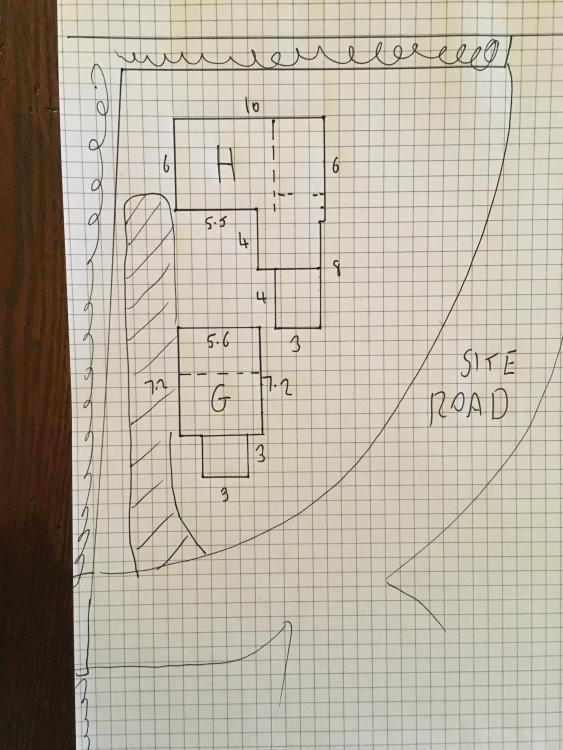
-
Ordering concrete, how to sound like a trade pro.
epsilonGreedy replied to epsilonGreedy's topic in Building Materials
Thanks for this offer, give me 20 minutes to upload something. -
Ordering concrete, how to sound like a trade pro.
epsilonGreedy replied to epsilonGreedy's topic in Building Materials
I have been considering this. There is a well compacted internal site road that has taken heavy deliveries in worse weather. The concrete lorry can get within 8 meters of the nearest house foundations while remaining on that site road and the far corner of the house is 10 meters further away. A bit of Google indicates a standard delivery chute has a 3m max reach. The green field site is now solid with a firm grass surface at the moment even so I doubt a 25 ton loaded lorry will venture onto that. There is time to lay the hardcore for the 15m long term drive into the plot. The pour team will be a scratch team, so I guess this all points to a pump? -
Ordering concrete, how to sound like a trade pro.
epsilonGreedy replied to epsilonGreedy's topic in Building Materials
What do they do with the surplus? Presumably it will be well on the way to curing by the time the lorry returns to base with the unused portion of the load. -
Ordering concrete, how to sound like a trade pro.
epsilonGreedy replied to epsilonGreedy's topic in Building Materials
Have been looking at concrete lorry load capacity which is about 6 m3. Would I get 1 lorry per hour arriving on site through the day? I reckon 2 to 3 loads for the garage and the rest (4 to 5) for the house. -
Ordering concrete, how to sound like a trade pro.
epsilonGreedy posted a topic in Building Materials
Can someone suggest the right trade lingo when phoning up a business to get a quote for the supply of foundation concrete? By "right trade lingo" I mean language that will lead to the best price. Edit: Looking to trenchfill 70m linear meters of 600m wide trench that is 1m deep, so for quotation purposes I make that 40 m3. -
Yes 102mm. Maybe a sandwich, it depends on the depth of the frame. I like the idea of a DPM for the front face of the frame, this had been troubling me and left to my own devices I might have used copious amounts of structural adhesive to both perform fixing and also provide an insulation layer. Thinking more it guess it is better to use one material for sealing i.e. a bead around the aperture and another for the membrane function. From the inside. The inner blockwork would be stepped back on the window aperture verticals by say 100mm each side. Is the R value of wood low enough to create cold bridge concerns?
-
Ok I can picture the fitting process, thanks for the extra description - no need for a photo unless it also shows how you fitted around services. I assume you had to keep an eye on batten centre distances to ensure this matched plasterboard sheet size? Oh ok I just thought that mixing the raw chemicals onsite in a machine would be cheaper than ready made foam insulation sheet and folks here have complained about the cost of these. I am happy to be persuaded that insulation sheet is the answer as it is more diy friendly (if laborious to cut @recoveringacademic ). I think @PeterStarck is the forum's spray insulation expert.
-
Only drawn in my head. I have found a caststone cill design that hangs back 50mm over the cavity, it is specifically to support the bottom of a sash window frame set back by a full brick reveal. The frame will be oversized horizontally so that the sash boxes will sit behind the facing bricks to allow for more glazed area and also match building standards of the late 1700's. I hope that with a 100mm cavity enough of the frame will butt up against the inner blockwork to allow some fixing. This is the most fuzzy part of the design, though I have a couple of months before the blockwork needs to reflect the a final design. Where would a cold bridge be formed?