Gordo
-
Posts
243 -
Joined
-
Last visited
Everything posted by Gordo
-
Indeed my friend the guidance and clarity of same does need some attention and possibly the standard should even be improved. I can see why you have adopted this interpretation reading AD B and we will have to agree to disagree. It is a worthwhile debate after all.
-
You are mistaken my friend cavity barriers do require FR.
-
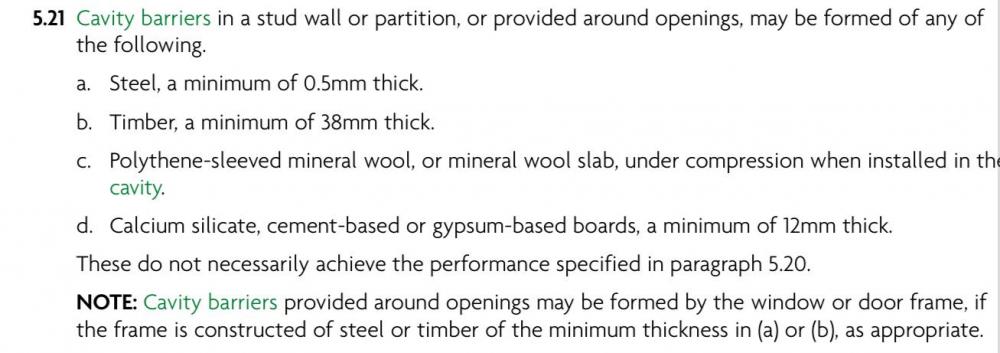
Thanks for the link to AD B. I did say AD B is not my usual source of advice, and humble apologies for not using the latest amended version, however the essence of fire safety advice rarely changes, only how it is presented. This Diagram 5.3 is commonly misquoted as it was in the previous ADs and the NI TB E. The diagram only related to 5.18c where some cavity barriers may be omitted where cavities are closed as per the diagram. It does not mean that all cavity barriers need not have FR obviously, only a lower standard (than 30/15 FR) ie 38mm timber or 0.5mm steel is a lower standard but can be accepted in ADB 5.21. The presentation of this is quite confusing and should be improved in AD B hence our debate. I have indeed read both BS 9999 and BS 9991. Again humble apologies for quoting BS 9999 instead of BS 9991 but they both concur. Both BS 9999 paragraph 34.2.1 and BS 9991 paragraph 19.1.1 are identical and offer more clear guidance than AD B on this subject and confirms my stance that cavity barriers are required and PVC Frames are not suitable alone. I did not imply the subject matter entertained you. I said I would entertain your argument. Very different things. It is obvious you have decided that you wish to exploit perceived loop holes in the wording of ADB for a lower standards of fire safety, which is a shame but I would advise against promoting this view to others. cavity barriers around window opening was one of the big failures in Glenfell tower disaster. Where PVC and spray foam and such inappropriate materials were used around pvc windows and services. That failure in the flat where the fire started was the catalyst for what ensued.
-
Sorry I would prefer not to hi jack this post with this argument. But the aim is to make everyone aware so they make informed decisions whatever they then chose to do.
-
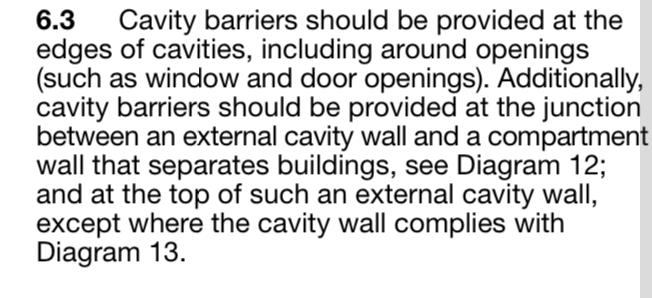
Indeed I am very well qualified both by qualification and experience. I have gone to the trouble to present the background facts. Therefore it is not an opinion. As stated the Scottish and English guidance say the same? As does BS9999 the fire bible, NHBC etc etc. I don’t intend to look at the Welsh also but would be amazed if they conflicted with the others. I advised that cavity barriers are required to openings. I didn’t expect someone to try and argue that they are not. Should I just have posted the full guidance TB E, AD B, BS9999 etc as you imply? If you want to dispute that they are required in AD B then go a head and quote the paragraph you are referring to that supports your view. It’s not the document I usually use but I will entertain you. I’d suggest you start with AD B 2010 paragraph 6.3. Do you need me to quote the specification for a cavity barrier too?
-
I am not referring to timber frame buildings. This applies to traditional cavity call construction. Timber frame construction has increased requirements including reduced maximum interval spacing between barriers. Please be careful and research subject before you offer advice on life safety issues. I have researched this subject thoroughly using many different authoritative guidance on the subject. Granted if it’s A1 fire rated insulation it would less of a hazard, I have debated the merits myself but cavity still requires cavity barriers if you wish to build to standards. If you don’t provide them then take your chances and hopefully there will be no repercussions.
-
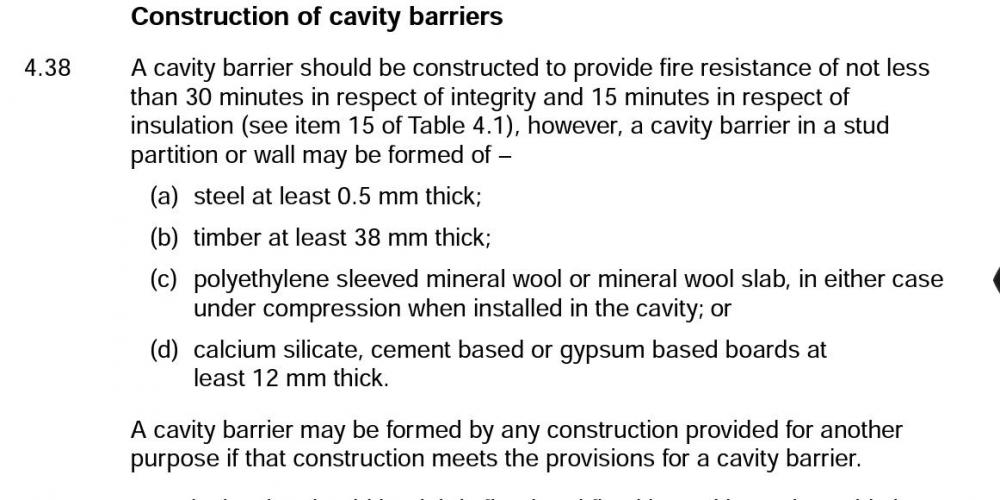
If you take the trouble to read the whole of the document instead of trying to fuel the ignorance (ie paragraph 4.38) window / door frames are only suitable if they offer adequate FR themselves Ie 38mm timber or 0.5mm steel.
-
Best close cavities with polythene enclosed rockwool strips (cavity barriers) Compression fit between tops of two leafs
-
Advice Needed - Cold Bridge Behind Full Fill PIR Insulation
Gordo replied to Johnny Jekyll's topic in Heat Insulation
Quality of workmanship it a problem in building. But as said by someone before. Your concern is thermal by pass, where warm air escapes around your fancy insulation via voids to a cold void. So long as the boards are tight fitting (doubtful) there should be no issue. The best you can do is to make sure the cavity walls are effective sealed at all openings and tops and services to limit the movement of warm air to cold spaces. Obviously thermal dry lining will improve what ever u value you would have had without it. -
Cement board is usually A1 non combustible material rating which is totally different but widely recognised as offering SSF rating of 0.
-
National classifications (class 0) for surface spread of flame are still the normal specification used. Euro classifications are also quoted and may be used. Class 0 being the highest rating. TBH I’d say this is likely a little zealous application of the guidance for a small room or corridors. Maybe you could appeal to his common sense if you think it is over zealous
-
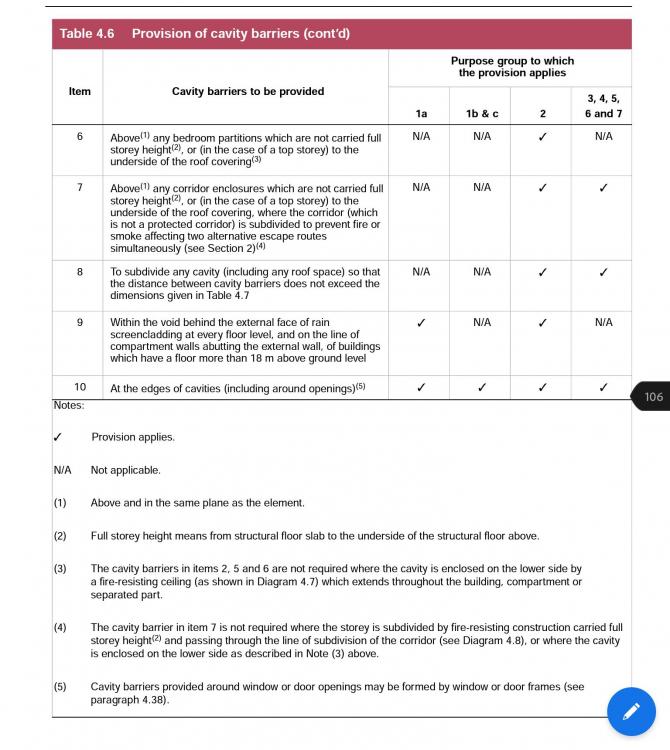
That’s a bit of a flippant statement with dangerous reproductions. Id be interested in knowing what guidance confirms cavity fire barriers are not necessary to openings in cavity walls. I have attached copy of Table 6 to TB E 2012 to NI B regs. Item 10 which refers to openings applies to all buildings. AD B 2010 paragraph 6.2 confirms same without this table. Scottish guidance says same with different wording
-
Was just thinking there. This floor makeup really suits timber frame with services in walls (not a fan). But with the traditional cavity wall construction a lot of services would I guess be in floor screed? The plumber will likely want to fix these down for screeding operation. Maybe best to consider a concrete sub-floor with DPM under. Anyone got some thoughts/input on this?
-
Lol I’ve heard of this risk, but have never seen it happen yet. Still not worth the chance.
-
Id second that both these points. Note this would only alllow 75mm brick course to FFL for tamping screed. Perhaps lower insulation by 25mm or so for a 100mm screed.
-
Yeah. Need a VCL over insulation. That’s why I’d suggest DPM/radon on top. To act as VCL and keep concrete slurry from going in between imperfections in insulation.
-
The cavity closer should offer 30mins fire resistance and not act as a significant cold bridge. (The EPS/plastic patent closers should be certified by manufacturer as cavity barriers). I often see polyurethane insulation used to close cavity in ignorance, that perform as cold bridging but not as a fire barrier. If a fire gets into a cavity who knows where it could spread. Especially if the cavity barriers elsewhere are wanting.
-
Attempting a straw bale, off-grid passive house in Somerset
Gordo replied to Smallholder's topic in Introduce Yourself
Live and learn lol. Not being farming background I didn’t know there was a difference. That’s why I would shy away personally. So many unknowns and loose ends to research -
With pvc frames? Frame would be no good. Cavity closer should seal two leaves of brick. Just something to consider.
-
I assume you are providing a cavity fire barrier at reveals and just omitted for clarity
-
Attempting a straw bale, off-grid passive house in Somerset
Gordo replied to Smallholder's topic in Introduce Yourself
Most farmers have moved towards those huge round bales of hay in our area. Only hobby farmers seem to use traditional rectangular bales -
Internal stud at 600cc when the roof trusses are 400cc
Gordo replied to saveasteading's topic in General Joinery
-
I was referring to the first detail with suspended floor slab. Most recent details show ground bearing slab. IMO I’d place DPM /radon barrier on top of insulation under screed/slab but it’s a matter of preference TBH. But if GL high I would wrap DPM up inner block. This detail falls down at doors and maybe overkill. As long as cavity ending is 9” below DPM level DPC it’s not necessary to wrap. I’d also leave outside block work perpends at cavity ending open for drainage, all in all the most recent details are excellent
-
DPM/Radon barrier carpet laid before insulation. Tape radon barrier to exposed tails of wide stepped DPC
-
With a suspended floor the DPM/radon barrier should be fully supported. With the high GLs I’d suggest wrapping Dpm up inner leaf to 9” above GL with a stepped DPC over