SteamyTea
-
Posts
23268 -
Joined
-
Days Won
187
Everything posted by SteamyTea
-
No, pretty standard 1987 timber frame. Temperature is kept at a steady 20°C, plus or minus a degree. Heated by a couple of storage heaters (from 1987). It must have some, even a cardboard box has insulating properties. It would not be hard to set up a room for testing and comparing different heating systems. Just a case of putting in all the kit. would cost a bit, but that is the nature of developing new products. For two winters I experimented with just heating the house with a 1 kW fan heater rather than the storage heaters. It worked just as well, used the same amount of energy, but cost more as I was using E7 and running the fan heater during the day. I did this to see if it was worth me changing my heating system. Decided it wasn't. That is the beauty of data collection. It is easy and cheap to collect electrical power and temperature data these days.
-
Scratching my head a bit here. That works out at 60W/m-2 I heat my house with 12W.m-2 I think you may be getting installed capacity and mean power delivery a bit muddled. This also seems a bit odd and adds to my suspicions.
-
May be worth remembering what Richard Feynman has to say about this sort of thing:
-
Think it is more a case of comparing it to E7/E10 heating systems, which are very controllable now.
-
I am not sure that is strictly true. We have capillaries that carry blood to our skin surface, as well as sweat glands, to control kin temperature. Also, there are many organs that are that close to out skin surface (unless one is covered in blubber. Just been to Redruth and people look like seal pups there), so if FIR really can penetrate over an inch, then we would not be able to stand outside for very long. Also, the thermal conductivity of water, which is around 0.6W.m-1.K-1, or near enough the same as brick, plaster, soil, is not really relevant when it comes to efficiency. Thermal Inertia, which is what I think you are on about, is the product of specific heat capacity, density and conductivity, also plays no part in working out the efficiency in this scenario. If it was important, then efficiency ratio calculations would be quite complicated. Now who said about a microwave and a convection oven. There really is not much difference. It does depend on the shape of what is being cooked, but they both work by thermal conduction. Microwaves don't really cook 'from the inside'. They just jiggle water molecules effectively, starting off a convection process.
-
Have you read all this: http://www.greenbuildingforum.co.uk/newforum/comments.php?DiscussionID=125&page=1#Item_0 Makes @onoff bathroom an afternoon project
-
Not that multifoil insulation sellers would do anything like that.
-
I was waiting for this. What you seem to be saying here is that you can be in a room that has cold air in it, but as long as you are bathed in some far infrared radiation, you won't feel cold. This is not how one measures efficiency. I can make my car more fuel efficient, over a set period of time, by not driving it much. Not really the point though is it. One possible problem with having a house that is colder than necessary, is that condensation can be an issue. I hope you have done a risk assessment on this aspect.
-
Not sure what to make of that.
-
Probably twist the picture frame.
-
A hinged bucket on wheels then. Now, I lived in France and was joined by my Belgium cousin for a few days. He was always amazed how well I got on with the local girls and wanted to know my secret. I said it was simple, I just put a potato down my Speedos. The next day, he came up to me and said that he had been trying the potato trick but he was just laughed at. I said 'You need to put the potato in the front of your Speedos'.
-
There is another way to look at efficiency, and that is comparing the surface areas of the emitter and the receiver. This is something that bugs me about radiative heating. If the object to be heated has an exposed area of 1m2, and the emitter covers 10m2, then that is a simple 10% conversion, with 90% not heating the object. This ratio cannot be reduced by increasing the temperature of the emitter, or reducing the distance between the emitter and the receiver. That just changes the temperatures reached. Also, when keeping people warm, the claim that the local air temperature is unimportant just seems odd to me. As we breath in and out, we move air about. If we breath in cold air, we have to heat that up, using energy. As we breath out, that warm air is expelled, loosing some of the energy that we have used in heating it. There is also the enthrapy losses from the change in humidity. It is much easier, cheaper and more efficient to just heat the air that we live in.
-
Took me ages to find out the difference between an oral and anal thermometer. It is the taste! Jeremy is going to post up something really serious and sciency about efficiencies soon, hope I have not put people off.
-
Tougher in fact.
-
Welcome Mark Without seeing the pictures, and if you don't want to change the doors/thresholds, can you get some ramps made up to make entry and exit easier.
-
My Father chopped some toes off with his petrol Flymo. Just for clarity, if you chop your big toe off, you only temporarily loose your balance.
-
Joe90 lives in Devon, they do odd things there with pasties and cream teas.

-

Your Home Base Load / Background Power Draw
SteamyTea replied to MrMagic's topic in Photovoltaics (PV)
Just pulling up your data now. Here it is, big loads first, then the little ones.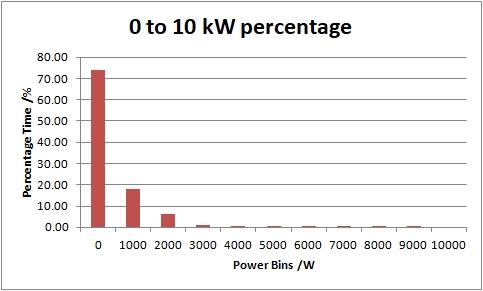


-
Pick you up too, you will need to keep that garage warm when working all winter on your car and tractor.
-
Chop Chop then as I am interested in seeing the data, methods used to analysis it and the conclusions drawn. Where is your factory, if it is local to me I may drop in. Just seen you are in Andover, about time I did a trip up country, can pick up @JSHarrison the way.
-
Your Home Base Load / Background Power Draw
SteamyTea replied to MrMagic's topic in Photovoltaics (PV)
My major loads are at night, but if I look at the fraction of time that I am drawing up to 10W, it is, between 28/06/2019 and 07/07/2019 (last week) 0.6, so 60% of the time. 10W up to 20W is 0.01, 1% of the time. So that is basically the radio, laptop and fridge, toilet MVHR unit. If I look at the same time period, but bin the data into 1kW chunks, then 0W up to 1000W is 0.92, 92% of the time. 1000W up to 2000W is 0.004, so less than 0.5% 2000W to 3000W is 0.05, so 5% (probably kettle and cooking and maybe washing machine) 3000W plus is 0.021, so water heating is around 2% of the time. I need to work on my sub 1000W loads, but mainly below 50W as that accounts for 72% of the time. Radio is 3W, laptop 8W, fridge, on average 5W. But when I look at the numbers at 1W resolution, 60% is between 0 and up to 1W. So I am not going to worry. 60% of the time I use no power at all, I should ask for a reduced meter rental. -
Plenty of radon down here, one of natures own nuclear reactor.
-
Few metres lower, I am always surprised how high I am, probably accounts for the wind and rain.
-
So 2.55°C different for 200 km West, similar altitude I think (you may be a bit higher), but 25 miles from coast.
-
For a laugh I have just looked at my external temperature, it is 21.75°C at 11/07/2019 13:47:24 What are other people reading for a similar time?