
saveasteading
-
Posts
10074 -
Joined
-
Last visited
-
Days Won
82
Everything posted by saveasteading
-

Underground workspace - how to shore up and waterproof?
saveasteading replied to BodgeBodge's topic in Garages & Workshops
Ahhh. 2 different things, sorry. I meant the principle of keeping water in rather than out. A swimming pool is tiled of vinyl lined. Bentonite is a very heavy mineral, mixed as a dust in water to fill trenches in very heavy Civil Engineering, but I came across it in membrane form. No issues with the basement after 8 years. -
Softening the feel of a concrete slab floor
saveasteading replied to Sparrowhawk's topic in Floor Structures
I guess so. Ask away. -
Softening the feel of a concrete slab floor
saveasteading replied to Sparrowhawk's topic in Floor Structures
We've just fitted carpet on ufh.* Special underlay has a large proportion of gaps. Then the carpet must also be open textured. For laminate I don't know how this can be achieved. I would worry about timber laminate over ufh. *Scottish rules sensibly require a bedroom on the ground floor. The rest is tiled. -
Brise soleils or balconies
saveasteading replied to Furnace's topic in New House & Self Build Design
Yes that works too. Depends on the structure to some extent. Have you otherwise left a gap? -
Brise soleils or balconies
saveasteading replied to Furnace's topic in New House & Self Build Design
The thermal bridge can be broken but it is complex and costly. Brises soleils are also expensive and need serious fixing to the walls as they are sails. They must be modelled to suit the actual sun direction....many are fixed without thought ...or useful effect. Balconies are also tricky to drain without risk of wetting the house. 4 leg retrofit with a small gap to the house is my choice. -
Yes. It can sometimes be worth finding what they would rather not have to do. Builders work basically. So holes in joists, ducts, patching up after. For example, we were doing a daughter's grott kitchen up. Electrician quoted £1500 and refused to chase the walls or work in the ceiling. So I chased the walls and fed wires through the joists, cut holes for downlighters and got a different electrician to join up and connect( £300) It took me several days. On new build there is much less advantage, but you could ask.
-
Yes but... As a designer and contractor we never used drawings provided by the client. By this stage their previous consultants were probably not involved. There was too much risk of errors which would become our problem. However, if we provided our cad drawings to our SE ( I sublet most of it for client comfort) then they would use it happily. Likewise suppliers with design input were happy to use them. So yes, ask for them, but they may decline because of potential liability for dimensional errors. This happened before cad. One Architect colleague would draw precisely but then trace as if freehand. Another Architect drew in pencil, and studiously removed all dimensions before handing over as "client's requirements".
-
Commencement before New Building Regulations re-submission?
saveasteading replied to Deejay_2's topic in Building Regulations
It varies. On our project the original owner did this and got an official certificate to confirm the project was commenced as far as planning was concerned. In the past i used to put up site level control posts, paint them red and white and send photos to the planner. They dont accept that any longer. I had a project (English) that was coming close to the 3 years but client still wanted to delay. I discussed with the bco what he regarded as sufficient to constitute commencement. He suggested drains or a foundation, but that required detailed design, which we would have to do and present and get checked..that is the downside of the trench, if you don't have the building designed above it. So we agreed that stripping the site and hardcoring would do for the work. But we also submitted a section of drain design so had something technical to approve. That way we had correspondence and a site apptoval visit....but had to pay half his fee. That to show that sometimes a lot is required. If your bco ssys doing a footing is enough then go for it. I wouldn't dig a useless trench nearby. It isn't part of the work and an astute bco would know. So if, and only if, you know the position , depth and width of a footing, then i think i would concrete it. Just a 3m section or so perhaps. 3m x 0.6 x 0.6 = 1m3 of concrete approx. The builder can mix that on site, so no access issues. -
If the tree and soil combinatiin present a grpund heave issue, then the ground will need at least a year to recover, or you could design deeper foundations as if he trees were there. How naughty is it? I haven't hesitated to remove poor quality trees, having taken pictures first. Once even got an arboriculturalist (phew) to condemn them. If they are large attractive trees then i would think twice, or more. Not just naughty but might sway opinion against the application.
-
Retaining walls required before garage foundation
saveasteading replied to wertert's topic in General Structural Issues
Plenty, but do what suits you. Laying blovks is less work than mixing concrete. 150mm or 125mm into the concrete is enough for the rods. Ballast is also fine. It is a designed mix so that the small stones fit between the big ones, then the sand between them. Then the cement is simply an adhesive rather than a filler. If you bought concrete it wouldn't be much different, except the price. 0.5m3 at £120 but then add 5m3 empty at about £40. £260 ish. Ballast. -
Best place to buy Heras fencing
saveasteading replied to Meabh's topic in General Self Build & DIY Discussion
Don't forget clips to hold them together. And bases. Neither will be common second hand as they get lost and broken. -
Underground workspace - how to shore up and waterproof?
saveasteading replied to BodgeBodge's topic in Garages & Workshops
For lowest cost, wait for a very dry summer so you can dig a big hole. Then build it. Otherwise you are looking at coffer dams: sheet piling that will allow you to dig. Then build a waterproof floor and walls: an inside out swimming pool. So you line the underside and outside. The concrete has to not crack much. Last one I did we used a bentonite membrane. It self heals if it is punctured or torn. Then either cover, or install a sump and pump. So your £15,000 car hoist will need a £75,000 hole in the ground. Even in central London that might not be worth doing. -
Insulated Concrete Slab Garden Office - Questions
saveasteading replied to Ticky's topic in Garages & Workshops
A self-builder wants to fill an infinite hole with spheres to maximise the void space for drainage. All the same size. Should they use spheres the size of peas, golf balls or cricket balls? If you know, perhaps smugly don't answer yet. -
Insulated Concrete Slab Garden Office - Questions
saveasteading replied to Ticky's topic in Garages & Workshops
It should all be no fines. I did buy a bag recently that was a bit mucky (some sand ) and would have rejected it if it had mattered. -
Best place to buy Heras fencing
saveasteading replied to Meabh's topic in General Self Build & DIY Discussion
The new ones all seem to come from the English Midlands. You are south of the despicable surcharge line at Drumochter. I hate to think of the origins and conditions of the used ones you are quoting. Prob not stolen as such, just bought cheap. Or backhanders to site managers. -
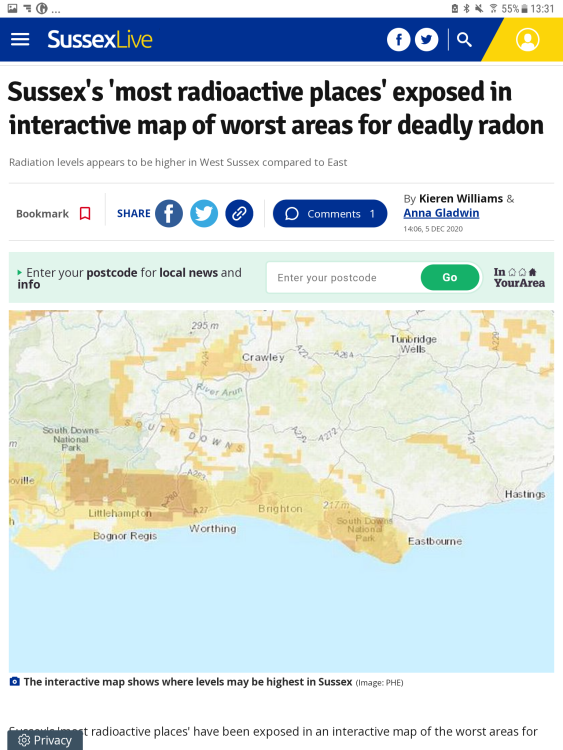
Good. Shouldn't have been on the drawing though. Are you getting the drawings revised to 'as built'. While on the subject , if you ever needed proof of no radon requirement, it comes up on that map as a postcode search , and a formal certificate costs £5.
-
I'm just thinking that there seem to be lots of changes since this drawing. Keeps the bco happy for £30 of unnecessary plastic. Slip layers are often helpful too.
-
See map here. If you are on the yellow then i would upgrade to radon quality. If it is marginal then there is a more precise map.
-
Dpc is very cheap and the only concern is wasting plastic. I see it is also a radon barrier. I wasn't aware of radon in Sussex. But i see i should have been... eastbourne all the way west.
-
Sorry for bringing it up too late! The chances are that the site had issues i don't know about.
-
Best place to buy Heras fencing
saveasteading replied to Meabh's topic in General Self Build & DIY Discussion
Never hire for construction unless for a few weeks and can ensure no damage. Hire cost equals buy cost at 5 or 6 months, then they charge for damage. First try to find second hand and pay max half price for 'as new'...which is unlikely. Transport will cost too. There are repair splices for broken corners. You would think hire companies would sell tired pajels off cheap, but i thknk they scrap them. Next go online. Note the varying qualities in tube size and costruction. The only time one of the hire companies was competitive for me was when we built next to their depot....another suplier's signs would have looked bad. We used to buy by the lorryload and move them from site to site. Near enough given away when we had surplus. -
Ok. I was wondering if this was a design borrowed from somewhere else or standard design by a kit building company. SE presumably knows you site. Still, it all looks rather over cautious. I don't know the circumstances of course. You have rock at a "variable" depth which the footings sit straight on....great. Then an insitu reinforced suspended slab. Presumably the ground is really poor quality? But if it is stronger than eps then it should be usable. Up to you of course but it is trebling your floor cost, and making it specialist. Perhaps for good reason. Ask again why?
-
Retaining walls required before garage foundation
saveasteading replied to wertert's topic in General Structural Issues
Ballast yes. Ties: either but these mesh ones look useful, esp at any day joints. Gravel rather than type 1....we want free draining and self compacting, which gravel is. Behind it backfill with earth or rubble but compacted. A manual tamper from wickes. Ballast for concrete yes. Check the mix on the cement bag. 1 : 5 probably. Compact it into the voids with a 2 x 2 or similar. Splitters is fine for strength. Get a nice new branded masonry bit. Just bigger than the bar, or you waste lots of epoxy. Have spare nozzles for the epoxy. What bar size? 12mm seems right to me. Rebar or threaded...either is fine. 3/4 into the concrete base. -
Excuse me going way back on this. Building on bedrock. Why do you need the cordek, which is for the severe expansion of clay?
-
Commencement before New Building Regulations re-submission?
saveasteading replied to Deejay_2's topic in Building Regulations
Possibly. But it would be dangerous to fall into. Also the base of the trench will soften and more need to be taken out later. Backfill but loosely? Ie no need to compact it. You will have about 1/4 of the earth left over.