


RichardL
-
Posts
205 -
Joined
-
Last visited
-
Days Won
1
Everything posted by RichardL
-
+1 This Ideally the controls market would be separate from the A2W/A2A (Whatever) systems like they broadly are with gas/oil. Granted currently an on/off dry contact for a boiler is a bit crude - but its simple and doesn't fail when the internet/cloud/wifi/firmware version buggy (choose any) is down but The added value this time round should have been standard ways to talk to the smart meter and work out current cost export import etc - I mean talk to the smart meter direct - not some fancy integration across the cloud which a techie can keep working but joe public has no interest or time (quiet rightly) in fiddling with. No one wants to call a software engineer to fix their CH.
-
Seems like original idea was replace the gas/oil boiler with an equivalent & ideally an equivalent skillset to fit it. ASHP A2W - nearly fits the bill - but not quite - needing carefull sizing and ancillary works - insulation/radiator sizing etc to guarantee success. The next shift should be some sort of admission that the swap out gas/oil boiler and swap in something doesn't fly - which leads to opening up the market for other ideas rather than one size fits all. It feels like this sort of forum is already there with that open thinking - it needs to filter up to whomever drives the marketplace; I don't know who that is Subsidy drivers/politics? Manufacturers risking take-up? Word of mouth? CH and DHW options for moving off carbon should be a simple consumer level selection of a few options - A2W, A2A combinations etc on a level playing field.
-
A2A sizing - am I on the right track?
RichardL replied to Gill's topic in Air Source Heat Pumps (ASHP)
Yes - personal decision only - but last thing I want is WIFI integration, apps, cloud etc etc. (Worked in IT too long to have that hooked into my central heating - certainly not turning my house into an IT support zone). There is a lot to be said for an overall house level timeclock and a few zones with basic on/off/temp. Mitsubishi Electric has some really simple 2 wire setups for wall mount buttons - just needs some digging. A bit of phone cable and jobs a goodun. Agree with the point of research up front! -
A2A sizing - am I on the right track?
RichardL replied to Gill's topic in Air Source Heat Pumps (ASHP)
@Gill I've got Mitsubishi Electric - the Zen models though, one under your LNs. Can't complain at the kit and the outside units quiet most of the time - when working hard its just the fan blowing air creating any noise. Re the sunroom - if you use it at different times to the living room you can always undersize the outside unit a little since neither is on at the sametime. Honestly - I'd bow to your fitter experience at that point though - my fitter had a 'gut feel' 'professional experience' call it what you will re inside unit sizes vs. room sizes which pretty much matched my BTU calcs. The other part to be aware of - the inside units on multi split all come with remote controls - they work fine, but by default you end up with a time clock on each inside unit rather than central control. I didn't ask my fitter re wired controls - instead fancied the project myself - sourcing components directly for a fraction of the retail price. The Mitsubishi electric install and combination files are out there - sometimes on European or even Australian installer sites though. Google: MXZ-2F33-42_3F54-68_4F72VF_Combination_Tables.pdf (3.3-5.4kW outside) MXZ-3F54VF_Comination_Tables.pdf (5.4kW outside) MXZ-5F102VF Combination table.pdf (10.2kW outside) -
A2A sizing - am I on the right track?
RichardL replied to Gill's topic in Air Source Heat Pumps (ASHP)
Looks good To keep in mind - indoor units connected to a single outdoor have to be in the same mode; You can have one on a mini split on heat while another is on cool - I think you took this into account already - i.e. bedrooms split from living. Power Where is the fusebox - ideally if you can get a separate circuit for the outside units (in my opinion - I am not an installer) its nicer/cleaner than tapping into a local ring/socket. Sizing 1.5 in bedrooms seems reasonable 3.5 in that living room would probably work - consider if you want a wall or floor unit - the floor units really pump out the heat - I've a 3.5kW indoor happily heating a large dining room/up the stairs and landing in my house. Starting point for the outside units is add up the kW of the indoor's attached to them. So very roughly (and I'm not an installer) a 5kW outside the bedrooms and a 10kW outside the living room. Depending on the manufacturer you can downsize by say 10-15% and the indoor units will get less heat/cool performance accordingly (search combination tables for rules on same) Sunroom The sunroom is the question mark for me - I read the cooling point - its going to push you from another 5kW to a 10kW - i.e. (again roughly) 1kW typical draw to double that. Depends entirely how you use it of course - but heating or cooling in an uninsulated (guess) space feels like it needs some thought. If you open the bedroom door and the sitting room door will enough cold air filter into the sun room for those few days it needs cooling? If you know the model you are likely to fit - try googling <model install pdf> <model combination pdf> etc... some of the detail docs are public. Ultimately you need to trust the installer but you can go in with some knowledge. -
They're selling ready made groups/creating a market place of interested customers to sell to installers. You're not the customer in this one. You are the product.
-
Transform warm air system from Gas to Electric.........possibly.
RichardL replied to merlyn's topic in Introduce Yourself
A2A challenges so far 1. control out of the box If you go whole house the default is a remote per inside unit and takes a little work, extortionate for what it is from manuf. to build a more useful system. I guess unless you go ducted and build on your existing system infrastructure - if you can - only one unit = control will be fine. 2. inside unit locations Installers like to mount on outside walls - anything else needs a little planning 3. bathrooms challenge Unless you have ducting - and even then getting A2A anywhere near wet environments needs some work or alternatives. 4. Need an alternative for DHW Otherwise its great - feels much more suitable for a more leaky house than A2W - not as critical to get the sizing just right plays closer to the 'I need this room hot now' mindset. You can also try it out in one room first - provided a little planning on which outside unit to invest in for later expandability. -
Which ASHPs are more prone to defrost cycles
RichardL replied to Steve W's topic in Air Source Heat Pumps (ASHP)
Is it worth a double check of the installation manuals that this location is appropriate? i.e. on paper exercise. -
I suspect the customer is the installer and they're trying to produce a ready made market, you are just the bait.
-
Loadbearing wall missing on a butterfly roof?
RichardL replied to Kennedy123's topic in General Structural Issues
if you noticed - any harm in mentioning exactly the same to the vendor see what the story/history is? +your own building survey (not just a homebuyers walkthrough) -
Air Source Cylinder to power both hot water and underfloor?
RichardL replied to cee's topic in Air Source Heat Pumps (ASHP)
Are you saying you want to run the same water through your UFH as in your shower? Generally, best practice, perhaps even laws, (I am not a plumber) - you don't mix heating water with anything you wash in or especially consume. Traditionally your heating water ends up a nasty mix of radiator corrosion and inhibitor chemicals, For UFH while corrosion isn't a problem additives to stop blocking the pipes etc I thin are a thing, You really don't want to bathe or shower in it. (If I misunderstood ignore the above) -
TBH - the install is pending a firm to drill some holes. However I don't heat the bedroom at night - so its going to be a warm up before we get up in the morning, and another in the evening before turning in. For cooling probably similar - but for cooling the comfort will massively outweigh any fan noise. They're very quiet units unless the room temp is a long way off the target temp. If you talk softly you drown the fan noise on low settings. Try it and see though - the above is very subjective. I put A2A in 2 rooms last year to check out noise levels, winter performance etc before extending.
-
My installer didn't seem keen - you're putting mechanical systems motors etc inside a hot humid wet environment - I guess its not ideal. Ducted is an option... (Can't maybe was too strong - there's always options )
-
Think about when the inside units will run - do you need 100% bedroom capacity when you need 100% living space capacity? If not - size accordingly - perhaps a smaller external banking on the above and referencing the combination charts for your manufacturer. The bedrooms likely only running first thing and in the evening, the core house mostly off during the day mon-fri and only my office and front room on all day in the week. If you know roughly how you will use it you can be tight or slightly oversize on the outside units. A sized example Overall approx 175m2 house (I know huge variables every house is different) A2A: 10kW outside running 2.5 + 3.5 + 3.5 inside which is the core of the house & home office, 5.4kW outside running the master bedroom and other end of the house 2.0 bedroom + 2.5 back door area Bathrooms on IR panels & electric towel rails 2x bedrooms mostly unused so doors open for airflow - perhaps IR if they need it eventually but decided against individual cooling for them 2x outside units really just due to the size of the house and to keep installation practicable/outside trunking and inside routing minimal + the 5.4 outside was put in first last year to gain experience re phasing out oil. Central heating to A2A: 10 radiators being replaced with 5 indoor A2A units, 2 towel warmers going electric only + supplemented with IR panels Mostly designed around heating / cooling almost a secondary bonus.
-
My learnings so far - perhaps obvious/perhaps not? Sizing If you know a room's BTU requirement you can convert that to kW and get an idea of the A2A heat input required. Google will convert - or there will be a constant, google again, to get an idea. For mine there were limited options anyway, 1.8, 2.5, 3.5 - small, decent, huge room basically. Note - as above the kW on the units are specified as cooling - but google for <unit name>.pdf install or combination and you can find the combination tables which give info on heat vs. cool inputs etc. (I did for Mitsubishi Electric anyway) Replacing central heating You don't need an internal unit in every room or where you currently have a radiator - A2A blows warm air through the house, especially useful if you have corridor or open plan layouts. The floor based units seem noisier / blowier (but still quiet TBH) than the wall ones - may be because the wall ones are further away though? You can have more -or- less kW capacity on external vs internal multisplit - but there are limits / rules etc. You can't really put an A2A inside unit in a bathroom - so need IR panels or electric immersion radiators etc with their own control system. Control is by default - not good - expect to pay extra or add on Control on A2A is generally bad - its, by default, based on IR remotes for each inside unit - a far cry from a zoned timer system and you risk a proliferation of clocks through the house or dependency on apps and all the layers of software and network that need to work to keep them happy. 100% Research the wired options for control - especially if you can pickup and self install those parts after the difficult A2A install itself. Location The installers like to put the units on outside walls (generalism) - but can be persuaded otherwise just needs a little planning and legwork to keep their lives inside their comfort zone while also getting what you need. Google searches that I found useful: BTU to kW <model> install pdf <model> user pdf <make or make multisplit> combination pdf Sometimes it picks up australian documentation or European - if so can be a guide if not completely accurate - depends who left documents publically available
-
Personally Its not just the security - its trying to avoid my house being a debugging and configuration scenario with potential for everything being reliant on a single point failure (or reconfiguration if it changes). I can see some advantage to cloud and certainly local wifi, not a total luddite , but laying a bit of signal bell wire once with a switch and a central time-clock is pretty much guaranteed not to break with software updates or router changes etc. Nothing against full automation - just not for me in my house.
-
My reading of the manual is there are 2x dry contacts on both V & D machines, which are the PV input - but presumably also the simplest way to override the onboard timer with a 'heat now on immersion' command without hubs/cloud etc. Both manuals seem to talk about 2x levels of PV input but not much/any more detail I could see. One of the dry contacts on that board is shorted by default - might indicate that could be a simple external control/timer input? (or might not - I'm really guessing - no direct experience) Update - theory? - one of the contacts is immersion and the other is the compressor/A2W via the onboard timer - hence why its normally shorted? I really don't want my heating or DHW connected to wifi - worked far to long in IT to think its a good idea to add layers of complexity on a basic switch.
-
FWIW If you look at the manuals - dimplex edel and vaillant arostor have suspiciously identical compressor/circuit board layouts, would be interesting to know if there's much more than marketing between them - looks like a shared technical design at some point - or off the shelf product?

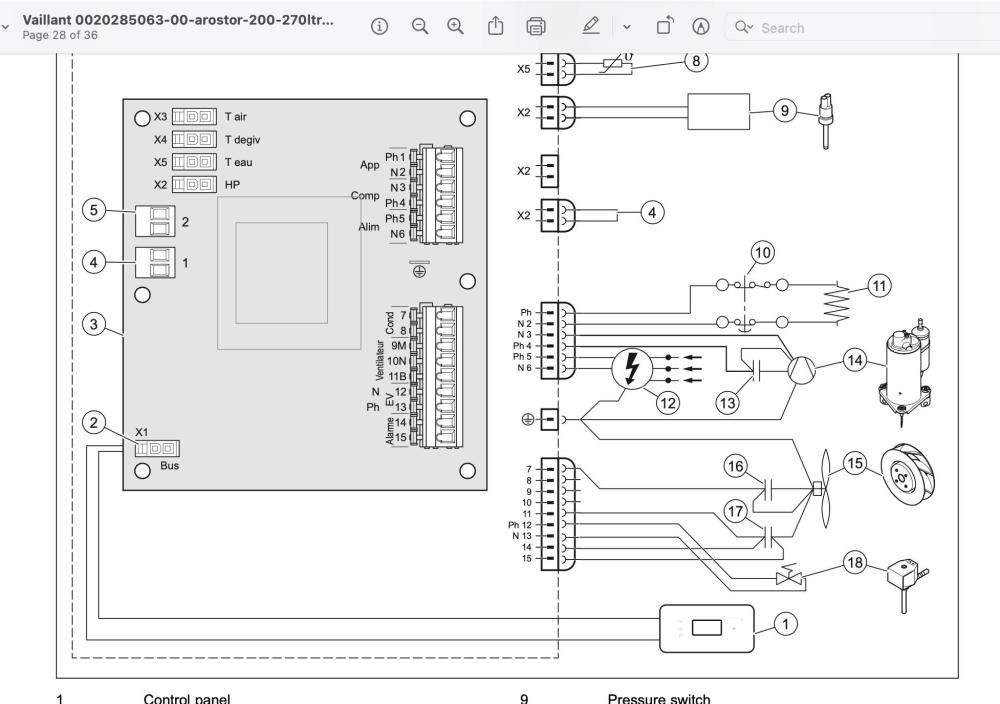
-
Certainly good enough for me to measure my own actual immersion spend on DHW before making a decision... Very much evens depending on your optimism re energy prices (will always go up shortening the gap), how long off peak overnight will last (finite and require more automation vs. time windows to access), and reliability of equipment ? - who knows - luck? (I don't hold much faith in warranties TBH) -but- if the ESHP does last 7 years (or less as prices go up) after that its all downhill and that 2020 hindsight will be looking over your shoulder.
-
Suggestion - a slip of paper, go around all the window seals and double check they are all making contact with the wall, slide the paper between the window and wall looking for loose/easy spots. It only takes a small gap and the sound will leak in.
-
A2A + A2W ASHP or a more powerful A2W ASHP?
RichardL replied to puntloos's topic in Air Source Heat Pumps (ASHP)
New build - I'd have a scenario with no wet heating - it seems simpler somehow to have self contained A2A as a sort of module, rather than lacing water pipes, even UFH, through a house. Perhaps the romans had the right idea all along with underfloor hot air ducts? I would also look into ducted air for the A2A generally, and route hot bathroom/kitchen etc air out via a heat exchanger or exhaust type hot water heat pump - i.e. use some of your waste heat and ventilation for the DHW. (Apologies If this was already discussed/discounted - I only skim read the thread.) -
Hindsight now, with off peak about 30p+ from peak - I'd spend on extra batteries until you don't have excess solar. (Up to a point anyway)
-
Mini split instead of a heat pump?
RichardL replied to anonymous's topic in Air Source Heat Pumps (ASHP)
Re extend I have a house of two halves with challenging routing for the A2A - so it made sense, for me, to heat my living room and home office first with a multisplit - see how that went over the winter, and only now extending to the rest of the house with another outside unit (Multisplit). The wifi thing is cool and all - and I work in technology (perhaps because of) - I wanted basic wires and OEM control on the heating relying as little as possible on other infrastructure or configuration - i.e. if its plugged in it works. You take your pick here - no wrong answers Heated towel rad I'm using a TCP200- very low tech, but on a low setting its the equivalent of 150W (an old-school lightbulb) i.e. low enough to just keep the radiator warm. -
Mini split instead of a heat pump?
RichardL replied to anonymous's topic in Air Source Heat Pumps (ASHP)
Hi, I looked at ducted - but in the end an IR panel (Herschel) + electric towel rail on low in the bathroom was a more practicable install. The shower room only needs to heat in the early morning really, then just take the edge off all day. Re your plan: Try A2A, then extend, + you can get combined Cylinders with ASHPs (Vaillant:Arostor Dimplex:Edel etc do them) is exactly what I'm in the middle of. I'd advise planning up front the outside units required and which rooms they will service so you don't end up with too many. Research control too - the usual standard 1x remote per inside unit is great for flexibility but not a good fit for whole house control. My project eventually will be: - Outside 10kW unit to 3x inside rooms on the ground floor. - Outside 5.4kW unit to a bedroom + one other room the other side of the house. - Combined tank+integrated ASHP for hot water. Control they'll be linked logically to a controller for downstairs, one for upstairs and back to the standard time-clock for the house. Removing radiators as I go, and eventually the oil burner and its tank! -
Octopus ASHP Quotation info
RichardL replied to lakelandfolk's topic in Air Source Heat Pumps (ASHP)
Possibly quite innocent/more focuses to protect the cost/scope of the job and avoid an escalation into validating the wiring/internal condition of the properties consumer unit. i.e. M.O. assume the consumer unit is good - don't open it and potentially find that rats nest of ancient wiring that means 2x visits and affects the initial effort/£ estimate. The meter perhaps feels more like a known quantity/more consistent quality at site since its owned by the grid side rather than the house side?



