


andy
-
Posts
187 -
Joined
-
Last visited
Everything posted by andy
-
Ivar stainless manifold with Ivar thermostatic mixing valve pump set sounds like a good option to me along with good Wilo or Grundfoss pump. With two manifolds, do I need two pumps? Second manifold is 1m higher due to sloping site but still "ground floor". Am I right in thinking that in a well insulated house, I want to control the flow to a room to ensure it's getting the correct heating input but due to slow response time, the whole house is treated as a single zone? If that's the case, do I need actuators? Also, not sure what the Heatmiser wiring centres are actually controlling...
-
Yes, that's correct - 1000m of pipe and 2 manifolds.
-
Hi all I've had a quote for my UFH and am concerned about the choice of brands that have been specified (Capricorn manifolds, Tweetop PERT E pipe, etc...). My heating requirements are as follows: Not quite passive house level (due to elongated shape mainly) ASHP - 7-8kW - including cooling, looking at Samsung Wet UFH - circa 1000m, 2 manifolds (due to split slab) and 2 pumps One room upstairs above lounge (office) - low temp radiator? Bathroom and en suite - wet and comfort electric UFH All controlled via Loxone - Touch switches for thermostats/possibly timed for electric UFH too So, given the above, what would your "wish-list" be for the best options for the following: Wet UFH Manifolds? Mixing valves? Actuators? Pipe? Pumps? Anything else? ASHP? Electric UFH? Anything I've missed? I would love to do the UFH pipes onto slab myself but I've never tackled this before (done plenty of 2nd fix plumbing) so I'm nervous of screwing something fairly fundamental up Thanks all! Andy
-
Ecology Building Society - application process and pricing
andy replied to Conor's topic in Self Build Mortgages
Just been through this myself and they were excellent to deal with, we have a mortgage on the land only with release of funds as we need (no stages). We provided anticipated EPC as part of this. -
Perfect thanks for confirming @Bitpipe!
-
Does anyone know if the standard Velux windows with (I think!) manual vent are airtight enough? Not quite at passive house level but want to be there from an airtightness perspective. Looking at Velux GGL MK06 306621U for example. Thanks for the Velux rewards tip @wozza
-
That's good to confirm on the insulation side of things. If I wanted to use a single 110mm SVP for additional outputs like sink or bath, is it OK to join them in the insulation layer? Obviously inaccessible once the slab is down so would be a pretty dire situation if they went wrong! I'm not too sure what the "norm" is here for these? I will be able to do the sinks/washing machine/dishwasher as boss connections with durgos above (A1 rated if below sink flood level) but the shower wastes I think may need their own run like this if I cannot join them in (boss connections shown in green).
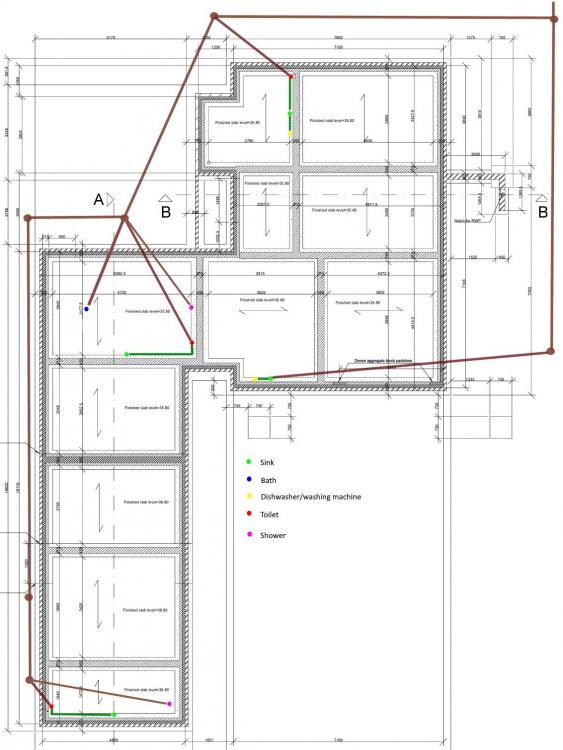
-
My concern is around making sure I've got the correct amount of penetrations vs. losing thermal efficiency (I haven't modelled this to understand if it's a valid concern). I want to do 110mm through the floor where it makes sense but make use of it with other inputs like sinks where I can. For example the bottom left toilet it would be easy to run the sink into that same 110mm but the shower wouldn't make sense (both showers are using Impey formers).
-
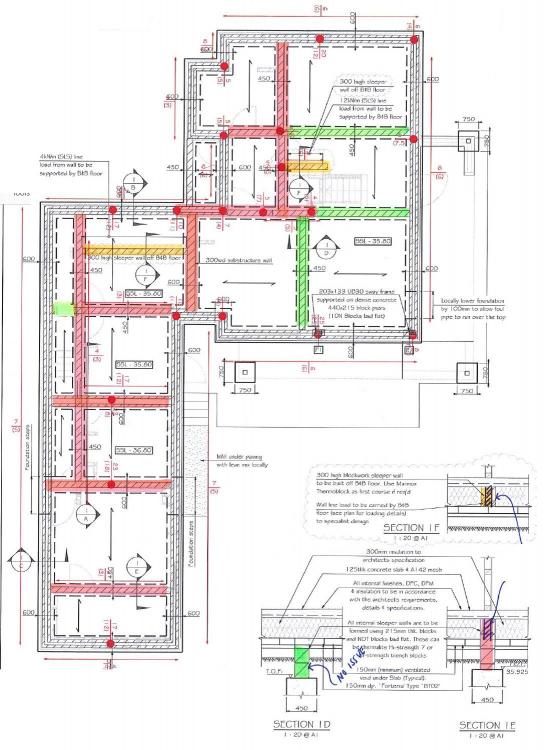
Hi all On site chatting with our ground worker yesterday, he was concerned about the number of 110mm penetrations through our slab the architect has indicated, which I agree with. The following image illustrates the current foul water drainage plans and the associated internal use (the only additional one will be main pressure cylinder discharge via Hotun from attic space above linking in to SVP for toilet in the middle bit). The floor is beam and block, followed by 300mm EPS100 then 125mm reinforced slab (don't ask, I am sure this floor will be strongest known to man). The site is a bit of a slop going downhill from bottom to top of drawing. What I am trying to work out is can I combine the waste runs within the insulated floor? I don't know if that's permitted or not (or equally importantly, a daft idea!). Or do I need to run additional penetrations through the floor? Any thoughts on best options here? If you need any more info, please let me know.
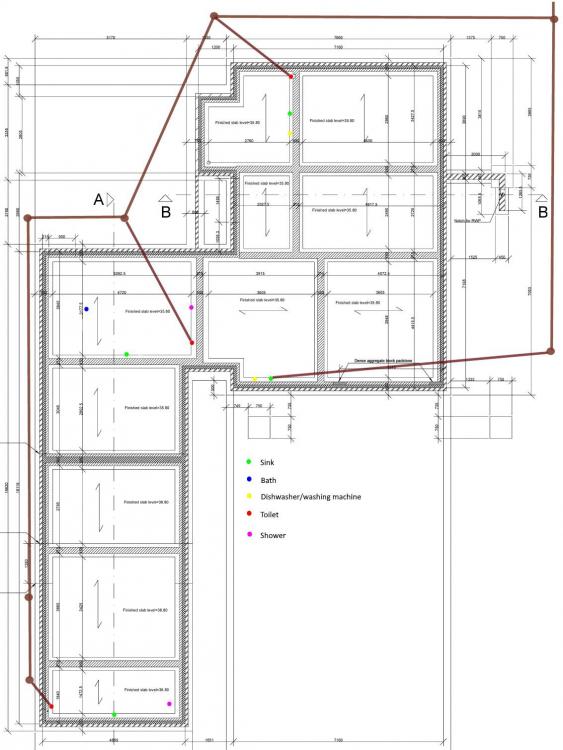
-
Interesting - the U6 are also trickle-vent free, might see about a price for those with electric myself.
-
Hi @Nickfromwales no problem at all!! Pressure was tested but only once so far and it’s 5.5 bar and circa 20l/min flow rate.
-
I'm happy to upload the Visio but I'd like to iron out any obvious flaws that exist first. @Nickfromwales any thoughts if you have 5 mins?
-
Thanks @ProDave, I've update the expansion vessel location. I didn't know if a separate pump was required in addition to the manifold pumps but I've added one on the return. I did have an automatic bypass between the ASHP flow and return but wasn't 100% sure if it was needed and where it needs to go. At present I've got 3 valves - one for each UFH manifold and one for DHW, I could have a single one that diverted between DHW and UFH I guess but that would serve both manifolds?
-
Hi all So things move glacially along here. Perhaps we'll actually get the ground works started in July but I am not holding my breath as it was (theoretically) supposed to have been December... But whilst we wait, I've been busying myself with plumbing design, trying to work out what the best option is here and I've come up with the attached so far: I'm quite sure there are numerous things I need to add/remove/correct in it but what I wanted to try and get to was a design that made sense, so I can get a plumber to get me up to AHSP/hot and cold manifold level, so I can do the Hep2O runs to each room as needed. I like @JSHarris idea of having a continually circulating UFH pump but I'm going to have two pumps and linked to this I am also not sure whether to do a single zone per manifold or split them up into zones per room. I think continuous circulation is only sensible if you have a single zone. Again, conscious of following the KISS principal and how far I seem to be deviating from it on this design so far...! My plans for the control system is Loxone but I will need to ensure I have the correct inputs into that e.g. use Loxone switches per room as thermostats to request heating (again makes more sense to have multiple zones then). Or do I just nominate two Loxone switches, one for each manifold and get that to run as required? The house isn't up to passive levels mainly due to the stretched out shape of it but it isn't too far off with 300mm EPS100 on top of beam and block floor and 300mm warmcell filled timber frame walls, 350mm warmcell filled roof. Anyone have any thoughts/corrections on the above? I am also happy to upload the Visio that sits behind this if that is of use to anyone?
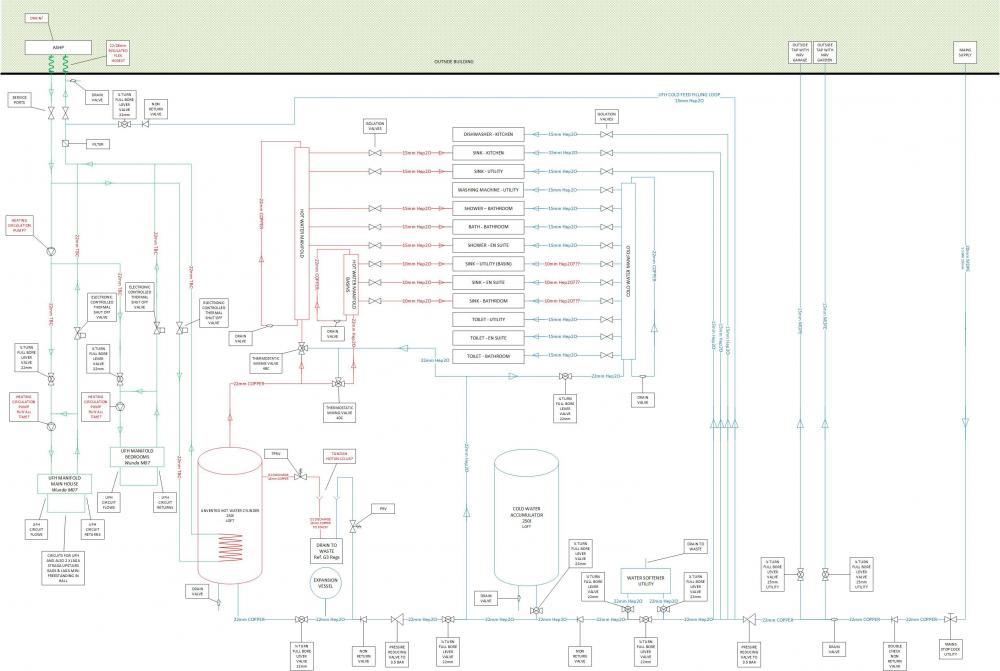
-
What I was after (and usefully acquired, many thanks all!) is confirmation if the foundation design is "normal" as I am no expert in these things. As you rightly say, I am paying someone a lot of money who is supposed to be and I will be having a meeting with them ASAP to tell them to design what I want. This nonsense design only came in at the end of Thursday, so not had any time to liaise with them yet. It is also the first time that it had ever been mooted that such insulation penetrating walls were in the design at all, so we're pretty unimpressed right now.
-
No radon here, it’s all based on SE “comfort” basically. He even asked where the insulation went on and insulated raft foundations, alarm bells went off then but the company was the on our architects used...
-
Trees were by old house and gone along with house, possibility of shrinkage due to that over time I think. Site is about 2m higher at back of house which we’ve terraced roughly into the required 2 levels with 1m difference, rest taking up by small walls/sloping banks.
-
Exactly, it’s complicated by the slope and large trees that were right next to old house. We’ve really struggled to get sense out of SE and are tempted to revisit quotes from insulated raft companies, cutting our loses with SE.
-
Dig down 1m and we’re on solid chalk here...
-
So here's the layouts - I've cleaned them up to remove a lot of "noise" on the pics but hopefully this gives you an idea. Main house section is 8.5m x 11.2m (at widest, measured top to bottom x left to right), bedrooms is 5.1m x 16.3m. There's a step up in level of 1m just to the right of the steps in the bedroom area due to slope of site. I can understand the need for dwarf walls across some of the beam spans but not for any walls that penetrate the 300mm EPS100.
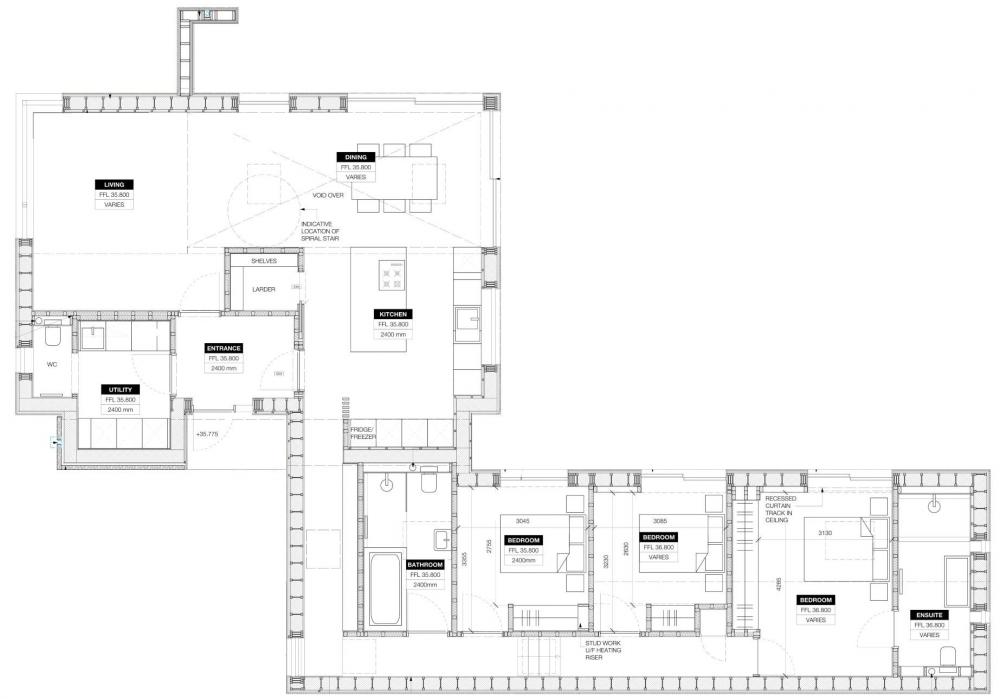
-
That's what I don't get - it seems seriously over-engineered.
-
At pub, will respond with floor plan details tomorrow! We're on chalk but some disturbed ground but nowt too crazy (trees right next to previous house and general disturbed ground over past 100 years!). The whole left section is ground floor only apart from some loft space in half of it.
-
Hi all We're slowing getting there with our design (slow being the operative word here!) but I've had the final construction drawings from our structural engineer now for our foundations that I am concerned by (we are about to get a firm quote from our groundworker who wants to actually start soon!). The house is mostly single story with a mezzanine area on the top right corner of the image. It's timber frame with walls filled with warmcell (including internal walls) yet our SE wants dwarf walls either coming through or built on the beam and block floor (and then the 300mm EPS100 and 125mm slab) which the internal walls are supported by. I am at a loss to understand why this is a requirement as the house is circa 5.5m wide on the left section and 8m on the right section (as you look at the picture). I'm concerned that the thermal efficiency is compromised as a result. Does what the SE designed seem appropriate? P.S. I have no idea what the red dots are signifying!
-
Most email is opportunistically TLS encrypted anyway which results in emails traffic between servers being encrypted (can be enforced between parties). This is independent/in addition to the actual underlying message being encrypted or not. Digital signatures aren't of much value tbh and the best approach is to never, ever click on a link received in an email, doesn't matter who it's purporting to be from (and also ensure you don't load external content in the message either). If you think it is genuine, copy the link and paste it in a browser (or hover over it to verify it is indeed going to the same place as the link appears to be). Going back to the original good advice from @newhome as it's so easy to spoof an email address (yes I am aware of SPF, DKIM, DMARC et al but probably somewhat off-topic), never trust bank details received via email. Verify that they are correct first with the (purported) sender; if you're viewing an online invoice, that's much harder to spoof.
-
Interesting - https://octopus.energy/static/consumer/documents/agile-report.pdf





