


J1mbo
-
Posts
333 -
Joined
-
Last visited
Everything posted by J1mbo
-
Map consumption to degree days over some time as a spot test is subject to a wide margin of error
-
Under-sized vs over-sized ASHP conundrum
J1mbo replied to muhrix's topic in Air Source Heat Pumps (ASHP)
Observe the time where the system has zero output. But the structure doesn’t magically have zero thermal loss in that same window, and that cumulative energy deficit has to be replenished by the ASHP during the next heating period, and to do that the radiators must produce more output than they would otherwise be needed to, meaning the surface temperature of them will need to be higher than if the structure were heated continuously. There is clearly a trade off in running cost between running hours, average delivered flow temperature, average outside temperature, and likely electricity tariff rates that make this all a bit of a judgement. -
Under-sized vs over-sized ASHP conundrum
J1mbo replied to muhrix's topic in Air Source Heat Pumps (ASHP)
With direct combustion heating it certainly saves money. The average temperature of the fabric will be lower and therefore the heat loss and heat demand are also lower. However, the case with ASHP is not so clear. Assume the night set back is 8 hours in duration and the low threshold rarely results in heat demand, this reduces the compressor run time from 24 to 16 hours (obviously). Since the fabric loss is still high at 18 degrees when freezing outside (90%), the heat pump is being asked to provide nearly the same energy in 24 hours via less runtime. This obviously means higher radiator surface temperature, as much as 10 degrees higher, with the resulting lower COP only offset by a marginal energy demand saving. I did some maths in another thread that showing a small saving when fully optimised in both scenarios to run 24x7. Of course it depends on the daily temperature profile and the length of the set back period and the thermal performance of the building. But I don’t think it can be assumed that a night set back is cheaper with an ASHP when fully optimised. -
Under-sized vs over-sized ASHP conundrum
J1mbo replied to muhrix's topic in Air Source Heat Pumps (ASHP)
You do need some headroom to allow for DHW heating, unpredictable thermal losses, and unusual cold. If you have some time, record your daily space heating energy consumption over the next month then plot that against degree days at your location for the same period and you will be able to determine both the heating load and the required weather compensation curve for the system when it’s installed. -
Air tight is all very well but air needs to get in to allow extractors (cooker hood and bathroom) to do their job and in equal measures.
-
Air source heat pump with log burner
J1mbo replied to Nikki Locke's topic in Air Source Heat Pumps (ASHP)
As said, do get log burner(s) but don't connect them to the ASHP. Bear in mind that over a certain output (I think 7kW) they have to drill a massive hole in the house for air supply. So you might conclude that a smaller log burner without the 5" hole is better, depending obviously on the overall heat demand. As an aside, a log burner can also be a useful way to achieve a really warm lounge on a cold evening without having to play with the heat pump too much. i.e. let the ASHP keep the fabric broadly steady pretty much 24x7 and use the log burner when you fancy a toasty warm night in as well. -
In this scenario the issue is going to be how much water there is circulating when only one zone is calling, and the liklihood of that scenario. Even with a modulating ASHP, especially mid-season the range isn't going to be that much and it will need 10 litres per kW circulating to avoid short-cycling. The other issue is defrosting, if all the zones are closed?
-
Most ASHP will have separate DHW and CH programs and will do only one of them at any given moment in time. When the DHW is programmed to heat, a 3 port valve will be activated that sends the flow from the heat pump through the coil and there are various algorithms used to heat the tank depending on the required recovery time basically. When the valve is not activated, the flow is via the heating circuits only and the ASHP will typically use a weather compensation algorithm to determine the required flow temperature.
-
What ASHP are you looking at? Many will deliver DHW at over 60 degrees anyway
-
Optimizing LG Therma V Controller settings
J1mbo replied to Hogboon's topic in Air Source Heat Pumps (ASHP)
Was it windy? It could be additional ventilation losses? -
Optimizing LG Therma V Controller settings
J1mbo replied to Hogboon's topic in Air Source Heat Pumps (ASHP)
@ReedRichards using native controls will eliminate that problem. Even on oil setting, typically 3 TPI cycles per hour are allowed and obviously that can introduce short-cycling in the scenario described. -
I would see it as project management tbh
-
I wonder if you could get the ASHP installed with a plate heat exchanger and a buffer cylinder - with nothing connected to the other side of it - so that the installation could nevertheless be completed, assuming there is electricity available?
-
…whilst halving the available funding
-
Hitachi Yutaki S80 vs Daikin Altherma?
J1mbo replied to ashthekid's topic in Air Source Heat Pumps (ASHP)
I would personally look for a product using R32 or R290. -
It's a contract for 7 years, it's closing to new applicants at end of March.
-
The way the heat programme runs sounds the same as the eco DHW mode on the Vaillant. Having colder incoming water would surely increase the COP as the average output temperature would be lower. Could it be the way that the controller is reporting things that is the issue? As in if it’s reporting energy consumer and environmental yield, then adding the two would provide the total energy transferred. If you’re prepared to run the DHW right down to cold then heat it all you could easily do the maths to check.
-
I don't yet have a full year and have changed strategy a few times... but it's data nevertheless:
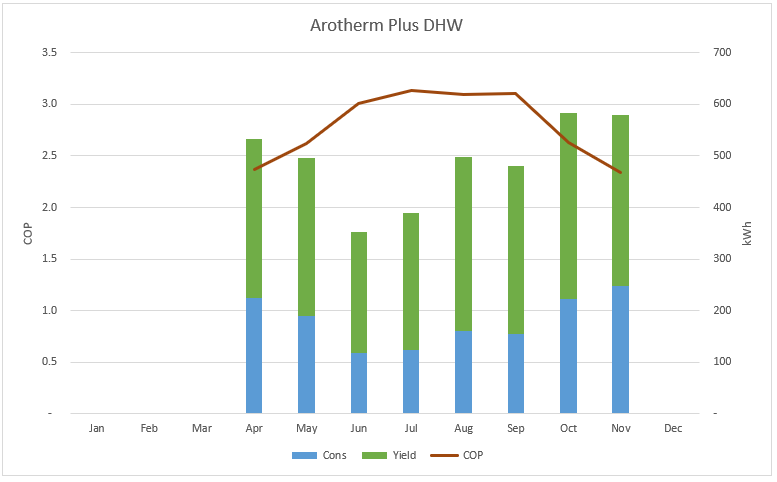
-
Do ASHPs work with heat batteries?
J1mbo replied to ReedRichards's topic in Air Source Heat Pumps (ASHP)
I was looking at these, thinking that they would be a better option than buffer cylinders. But I suppose it depends how quickly energy can be transferred to and from? i.e. the kW that a heat battery can sink at dT of 5°. With dual coils it could be buffer cylinder and heat exchanger in one. -
Tbh if you’re metered only for performance there’s no real issue either way.
-
Metering for payment is not usually needed, just add a £30 meter on the supply for the ASHP if meters aren’t built in to the selected product. Don't use RHI? And pass up on like £12k??
-
Whilst that may have been the case previously, RHI as of 2018 is not affected by cooling capability - EssentialGuideforInstallers_V4__0_SpringSummer2017 (ofgem.gov.uk) If the system is metered for payment however cooling consumption would need to be metered somehow and deducted to avoid short payment. Many products have built-in meters for this purpose though.
-
R290 and R32 systems will deliver SCOPs in the region of 3.9 with 50°C design flow temp.
-
Have a look at the installer manual for 720 specifics but in VR700 terms (I presume 720 substantially the same) I think the config would be to have the VF1 in the buffer, heat curve set, adaptive heat curve off and room temp mod none. Maybe setting the multi-function input to 'PV' and then configuring 'buffer cylinder offset' to e.g. 10K might do what I think you want, i.e. heat the buffer more overnight (obviously a time-clock input would need to be provided to the multi-function input to trigger it). And likewise the legionnaires function can be used to heat DHW to 65°C or so in the same time window.
-
Setting the room temperature higher in the period of cheap electricity will shift the flow temp curve up (2 degree increase in room temperature is a 5 degree increase in flow temperature in the example in the manual). The system can apparently also be configured for buffer maintenance (would need VF1 sensor) but Vaillant told me it’s not generally recommended.
