


OldSpot
-
Posts
80 -
Joined
-
Last visited
Everything posted by OldSpot
-
Or here.... Boom, Boom!
-
@matthyde83 Rather than using a 300mm thick piece do it in layers (100/100/100). You can brick bond it so you overlap the joints and it's a lot easier to cut at that thickness!
-
@Iceverge Looks like you can use staples in EPS from that thread and long ones would definitely be better! I've got a piece of 150mm EPS that I'll stick a couple of 60mm staples in and see how they hold although reading through the other thread with a gun looks like you're okay - I didn't have one. For the cost I think I would. You only need a vapour barrier which you lap can lap up the walls rather than a DPM as that's been put in lower down. So, EPS ---> DPM ---> EPS (or PIR) ---> vapour barrier ---> UFH pipes stapled then pour the concrete.
-
@pilgrim This is exactly what I've done. Pm me if you want to have a chat.
-
EPS is fine to use below DPM whereas PIR isn't due to water ingress. PIR will give a better u-value for equal thickness but if you have the depth/space, EPS usually gives better bang for buck. There is also research to suggest that PIR degrades much more than EPS over time. With regard to the slab build up, a number of people here (not me) have done away with the reinforced slab and screed scenario and simply used a single reinforced slab. The slab can also contain UFH pipes. Build up would be, from bottom up - with DPM inserted either below or between insulation: hardcore insulation slab. If you search the forums it will throw up some debate on this build up. HTH!
-
As @Nickfromwales suggested, if you put a 25mm EPS sheet down first and then your DPM on top you instantly reduce the likelyhood of getting holes in it. Then do what you like with PIR or EPS. If you're installing UFH, the pipe clips struggle in EPS so having an EPS build up with a 25mm - 50mm PIR on top aswell really does help (alot)! We've got 325mm (300mm EPS100 & 25mm PIR) and then a Cemex Cemfloor @ nominal 45mm which is great. With hindsight I would have gone with 50mm PIR for the reason above as 25mm is okay for the clips but a bit thicker would have been easier.
-
Pocket Thermostat/NTC probe - Thermal Paste?
OldSpot replied to OldSpot's topic in Boilers & Hot Water Tanks
Thanks @vala Did you use this for NTC probes or for 'standard liquid filled thermostats' as linked to above? -
I read a while back about using thermal paste on pocket thermostats but it doesn't seem to get a mention from those that sell them: https://www.rwc.co.uk/wp-content/uploads/Dual-Single-Stats.pdf https://www.esicontrols.co.uk/assets/esctdeb-installation-instructions-web.pdf Is it the case that these don't require thermal paste? What about the use of NTC probes in dry pockets? Tia
-
@vala @RHayes Just coming back to this thread and apologies for the delay as I've been away. I have successfully managed to wire up a DIN relay in the two stats configuration that we previously discussed. I have tested the system using two switches and a light bulb. The switches representing the two tank stats and the bulb represents the "call for heat" from the boiler. If you want to see the circuit working pm me and I'll send you a video clip. The wiring is pretty simple and I'll put a diagram up later if anyone is interested. The relay that I have used is a Heschen ct1-25, they can be found from various online sellers for around £8.50. I'm not promoting this one in particular and there are of course other brands available. I have also bought a small DIN rail enclosure (~£11) to house it in. Hth.
-
@SteamyTea Thanks. I meant is there a simplistic way to work out how long it takes for the UFH to reduce the temperature of the water in the tank by drawing off (hot) water from the tank? Appreciate there are a number of variables!
-
@SteamyTea Is there a way to work out how long the tank will take to cool when in use? I'd like to work out (approx.) how long different sized buffer tanks would take to cool when used in conjunction with UFH. Thanks
-
@vala Apologies, I missed your question about the relay previously. Yes, it's like an RCBO/RCD/MCB. There are a few companies who make them. One I've found is called Geya and another Eltako. The relay "clips" on to a standard DIN rail. So if you do a search for din rail enclosure it'll throw a few up. Hth On reflection, having read through the thoughts of those on this thread (Thank you!), I think I'm going to go with the simpler Elitech set up. This seems to be a simpler solution. It means: there will be less frequent bolier cycles (which are controllable) allows the buffer to be configured with a single thermostat configurable, generous wide dead band for ON/OFF temps. Cheaper, wider range of tank options
-
There's also a controller made by Elitech - the EK-3010 - which allows you to set ON/OFF temperatures. It uses an NTC 10KΩ temperature probe which is supplied. Less than £20 but looks like you'll also need an enclosure ~ £10
-
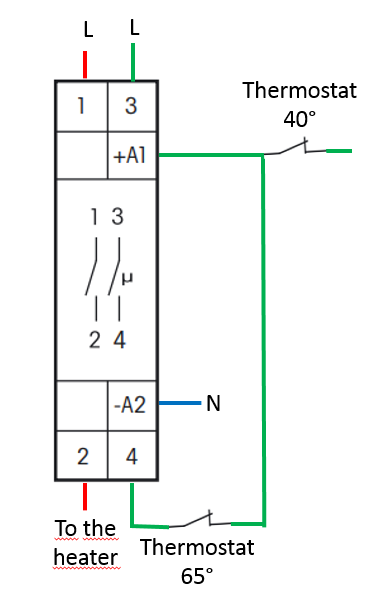
@vala Well I was sent the wrong relay so not been able to set it up yet but a circuit like this would work:
-
@vala. Haven't forgotten, still haven't had chance to make up my circuit!
-
Can't work out to edit my previous post so thanks to @PeterW for the steer.
-
@vala ? Great, I was going to do the same but will wait to see what they come back to you with.
-
I'm building up a test circuit (when i get 5 minutes!) so will report back when it's complete.
-
@RHayes @vala Hi @RHayes, Yes, that's correct you would need more than just the two stats to make this work! You'd need to use a latching (or holding) relay circuit would work. So say we set Stat 1 to 40oC and the other - Stat 2 - is set at 65oC. In addition I think you'd also need a high limit stat for safety. The temperature scenarios are: <40oC & <65oC => Boiler ON >40oC & <65oC => Boiler either ON or OFF >40oC & >65oC => Boiler OFF. Stat 2 would be normally closed and a relay would latch "across" Stat 1 (normally open) to ensure the boiler remained in the correct state (either on or off). This would be dependent on both the actual tank temperature and also on whether the temp was rising or falling.
-
I'm looking at a similar set up and just out of interest did you consider two stats on your buffer tank? (I think Peter W may have intimated this in his first reply on this thread, with the 1/3 & 2/3rds) This may help to reduce the boiler cycling as my understanding is that an oil boiler is either on or off i.e they have very little modulation. From my limited research I gather the hysteresis on a tank stat is around 8oC but with a two stat setup you could increase this differential. For example, boiler ON @ 40oC and OFF @ 65oC. This would then allow the boiler to run (or shut down) for longer since UFH runs on lower flow temps. So if your UFH requires a 40oC flow temp and the buffer is @ 50oC, it can still be provided without the boiler firing. Whereas with a single stat (set @ 65) the boiler will probably have refired. One of the calculators I have seen suggests that to increase the temperature of 100 litres by 8oC, it will take a 20kW boiler around 3 minutes to do so.
-
Thanks Nod. Ah, okay I see. I guess this is the same for Anhydrite but because of the high level of laitance you have no choice but to sand? That's what I'm wondering although we haven't made a decision on who to use yet... We've had a couple of them to look at quoting. Both have suggested a decoupling membrane/mat. One is suggesting priming with a grit primer first whilst the other is suggesting to use Ardex membrane glue to stick the decoupling membrane down. No, absolutley none and it's been down for 12/14 weeks now. It just has a slightly shiny appearance though. How long has yours been down and presumably you also tiled @wozza? Thanks again
-
Thanks Nod. Sorry, couple of other q's. When you say "definitely shouldn't be sanded" is there a reason for that? I presume by sanding you mean using an orbital type sander as you would with anhydrite as opposed to using 80 grit simply to scuff it and clean off? Is your sealing the same as priming? SPR = SBR? Cheers
-
We have a Cemfloor screed (nominal 50/55mm) with wet UFH in it. The dlimema is that there seems to be a bit of conflicting information about whether Cemfloor should be sanded and primed or not prior to tiling. Tilers saying it needs sanding and priming but the Cemfloor literature suggests there is no need to do either, saying only that the surface needs to be 'lightly abraided" -(whatever that means as opposed to sanding!) I wonder therefore what other people's real world experience of prepping Cemfloor is and whether it is not worth doing? Any advice would be gratefully received along with the techniques and products used! Many thanks
-
@Onoff Just wondered how you were getting on with your magnetic filter? It looks like an intaKlean 2 which is a hell of a lot cheaper than the more popular brand so wondered how it was working? Ta
-
When do G3 regulations apply? Buffer tanks?
OldSpot replied to OldSpot's topic in Boilers & Hot Water Tanks
I'm inclined to agree @dpmiller. At what pressure does a vessel become a pressure vessel...............?
