Adsibob
-
Posts
3604 -
Joined
-
Last visited
-
Days Won
10
Everything posted by Adsibob
-

Anyone know where I can find jumbo sized MDF shelves
Adsibob replied to Adsibob's topic in General Joinery
So this works out at 45mm thick shelves. What if I wanted to u use this technique, but make it thinner? Would the same principle work with 12mm ply either side of 15mm battens? -
Anyone know where I can find jumbo sized MDF shelves
Adsibob replied to Adsibob's topic in General Joinery
I have these already. What would this be useful for? -
Anyone know where I can find jumbo sized MDF shelves
Adsibob replied to Adsibob's topic in General Joinery
Yeah, I guess it’s not too difficult to do this - certainly within my capability. But I will be sawing by hand as I don’t have a circular saw. I’m also not that keen on the chunkiness of these floating shelves. Ultimately the nook these are going in is in the corner of my room, and the shelves will be painted same colour as wall (a darkish green). So I don’t think the battens would be that visible once books are in. -
Anyone know where I can find jumbo sized MDF shelves
Adsibob replied to Adsibob's topic in General Joinery
So the new plan is to use a different alcove in the room altogether, with the result that most of the shelves will be much shorter, at 1405mm long, rather than the silly 2.57m length I was working with before. I’m also not that bothered about making them “floating”, particularly if I can get away with installing three battens along the three sides that come into contact with the wall as supports, though I would make the two end battens slightly shorter than the width of the shelf so they aren’t so visible. So with this in mind: 1) is 25mm thick pre-primed MDF thick enough, or do I need to go thicker at 30mm? 2) should I abandone MDF altogether, like I think some on this thread favoured? 3) what thickness should the battens be? Thanks all! -
Anyone know where I can find jumbo sized MDF shelves
Adsibob replied to Adsibob's topic in General Joinery
Two months later I still haven’t ordered anything. But I have rethought the plan… should hopefully be easier… -
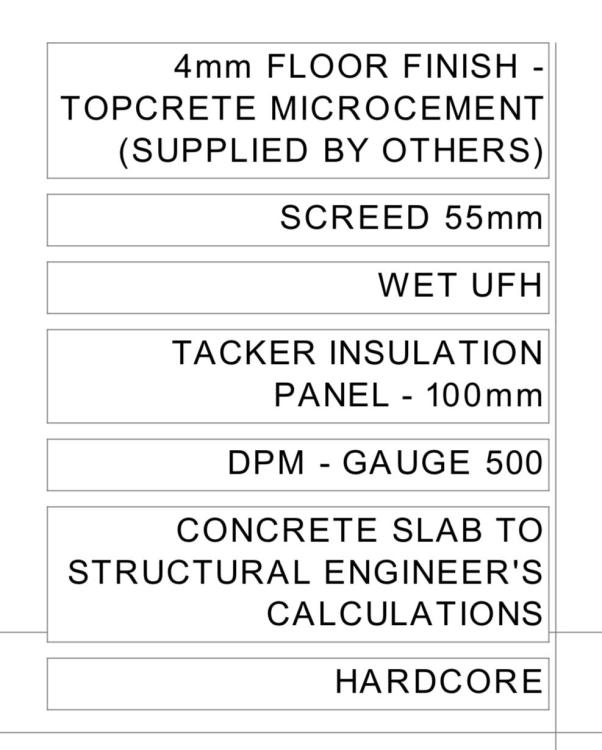
Your situation sounds very similar to mine. We were converting and extending a 1930s semi, but council limited the height of our full width extension and so to make it “nicer” to live in we dropped the internal floor level of the whole house (not just the extension). But in our case we took the opportunity to install a slab floor, instead of the ventilated timber subfloor that was there previously. To do this, we had a DP membrane cover the whole floor (over the slab) and then come up the sides, past the house’s original DPC. The build up looked something like this (there is some info missing, like sand blinding, which in think was in a separate drawing): And before anybody tells me 100mm insulation isn’t enough, this wasn’t a passive build and I was starting with a 1930s house and a council that wanted to limit parts of our extension to only 2.4m high!
-
Lepidó has been described as “a new form of heat exchange equipment”. But isn’t this just a variation of MVHR? https://www.bbc.co.uk/news/business-65328579
-
Virgin companies? Yes, the availability is endless.
-
The ratio of companies to humans in England and Wales is about 1:12. In the BVI it’s 32:1. This is not because there are more addresses in the BVI!
-
Court Judgments like this make me happy
Adsibob replied to Adsibob's topic in Party Wall & Property Legal Issues
You are assuming there was an architect. Also, what does “builder” mean these days? Any cowboy can call himself that, even us lot on here. -
Court Judgments like this make me happy
Adsibob replied to Adsibob's topic in Party Wall & Property Legal Issues
So let’s just ignore legal precedent and do what we like. Property rights are sacrosanct. Full stop. -
Court Judgments like this make me happy
Adsibob replied to Adsibob's topic in Party Wall & Property Legal Issues
Seems pretty clear from the report of the judgment that the offending neighbours were told part way through the project that they were trespassing: The judge found that, by April 2019, Mr and Mrs Ashraf 'were on notice that they would be encroaching and that there would be a trespass', but carried on with their project regardless. -
Court Judgments like this make me happy
Adsibob replied to Adsibob's topic in Party Wall & Property Legal Issues
By your logic, anybody could just land grab to their heart’s content, so long as they paid the going rate. Makes a complete mockery of property rights and property rights are the foundation of the rule of law. -
Court Judgments like this make me happy
Adsibob replied to Adsibob's topic in Party Wall & Property Legal Issues
Yes, because it shows the justice system working, and idiots getting what they deserve. My reading of the article is that they were told to stop during the building process and ignored the requests. It’s not a question of a settlement, the encroachment was causing ongoing damp issues, so an injunction is a suitable remedy. -
Court Judgments like this make me happy
Adsibob posted a topic in Party Wall & Property Legal Issues
https://www.standard.co.uk/news/london/neighbours-at-war-extension-redbridge-london-shabaz-ashraf-avtar-dhinjan-b1077637.html -
A family member has asked me to post this on their behalf: Victorian end of terrace house in Cardiff. Has had various damp problems, which have been “fixed” but the humidity levels rarely fall much below 60%. Kitchen is currently being redone and is being plastered. The owner of the house has a dehumidifier on site to aid with drying everything out. Got about two buckets of water out of the air today . He’s worried that the dehumidifier might cause the plaster to crack as it dries. But at the same time, he doesn’t want the 60% humidity in the house to slow the plaster drying as he’s in a hurry to paint. He asked his plasterer who said the dehumidifier won’t crack the plaster. Does everyone here agree?
-
You keep mixing legal personalities here. The director and the company of which he was a director are separate legal persons. He can only be liable for the debts of the company in certain limited circumstances, such as if he committed wrongful trading, by allowing or authorising the company to continue to trade, after he knew or should have known that it was insolvent. It’sa fairly complicated areas of law, but worth reading up on before going off on some crusade against the director, when he actually might not have any liability to you because your contract was with the company.
-
incredible. On most days recently, it has felt like it's not stopped raining here in the last month...
-
https://www.telegraph.co.uk/news/2023/04/25/hosepipe-ban-south-west-water-devon-plymouth/
-
Global warming is in fact entirely natural and has already peaked
Adsibob replied to ProDave's topic in Boffin's Corner
jesus christ that party is scary. And stupid! Look at their mini manifesto; so much of it contradicts itself! -
Global warming is in fact entirely natural and has already peaked
Adsibob replied to ProDave's topic in Boffin's Corner
I really don't understand those who continue to think anthropogenic climate change isn't real, or that this is just a cycle that will correct itself soon. That is simply not the findings of decades of careful research by the UN's intergovernmental panel on climate change (IPCC). The IPCC has nothing to gain from inventing climate change. There is no conspiracy. The panel is composed by top scientists from around the world. Here is a snapshot of the CV of one of the UK scientists who is currently the co-chair of one of the IPCC's working groups: Jim Skea read Mathematical Physics at Edinburgh University, followed by a PhD in energy research at Cambridge University’s Cavendish Laboratory. In 1981, he moved to Carnegie-Mellon University in Pittsburgh, Pennsylvania to work on emerging US energy and environment policy. Since then he has worked at the Science Policy Research Unit at Sussex University (1983-1998), where he moved through the ranks, becoming a Professorial Fellow in 1994. He was subsequently Director of the Policy Studies Institute (1998-2004). He was awarded an OBE in 2004 and CBE in 2013 for his work on sustainable transport and sustainable energy respectively. -
Good grief no. I bet you voted for Brexit and would vote for Trump if you lived in the US.
-
That’s not how a decent justice system in a modern democracy works. Particularly in England, where many aspects of the law is effectively judge-made, it’s important for Judges to feel like they can do their job, without fear of punishment. That is because often they will be called upon to make very difficult and bold decisions. They don’t need the added pressure of punishment if they get it wrong. Believe me, it’s highly embarrassing to be overturned on appeal, that is punishment enough. Ultimately, judges are human. We all make mistakes.
-
The case you are thinking of is probably Ruxley Electronics and Construction Ltd v Forsyth [1996] AC 344. In that case, some builders had agreed to construct a swimming pool with a diving area 7 feet 6 inches deep. The pool when constructed had a depth of only 6 feet. The cost of rebuilding the pool to the contractual depth would have been £21,560. But the trial judge, having heard the evidence, concluded that the pool owner did not have the intention of using the damages to reconstruct the pool. He found also that the residential property of which the pool formed part had suffered no diminution in value by reason of the lack of one foot of depth in the pool's diving area. Nonetheless the pool owner claimed the £21,500 as damages. The builders, on the other hand, contended that, on the facts as found, the pool owner had suffered no loss and the damages should be nil. The trial judge accepted neither contention but instead awarded the £2,500 expressed as compensation for "a loss of amenity brought about by the shortfall in depth" (see at p 363). The Court of Appeal [1994] 1 WLR 650 set aside the £2,500 award and substituted an award of the cost of rebuilding, ie the £21,560. The House of Lords, overturned the Court of Appeal’s decision and restored the trial judge's order. However, I think that case can be distinguished from the present situation, for the reasons below: @ggc is not intending on keeping the undersized windows, whereas Mr Forsyth intended to keep and use his undersized pool. There are differences between the utility of a swimming pool that is a little bit shallower than intended and windows that are a little bit smaller than intended. The latter will require additional remedial work to fix, will let in less light, and will end up giving a slightly different aesthetic. Perhaps these differences are subtle, I’m not sure.