


Adsibob
-
Posts
3604 -
Joined
-
Last visited
-
Days Won
10
Everything posted by Adsibob
-
Thanks Marvin, but I'm a bit confused. In England an EPC is only required when one rents or sells one's home. At that point you pay an EPC assessor to come and assess it and what he or she isn't able to prove, they generally take your word for it but add "(assumed*)" and the asterisk explains that this is assumed because they weren't able to verify it. Are you suggesting I could avoid the assumptions and actually get it verified? I'm not planning on selling for MANY MANY years after all this stress and heartache, so apart from when I do sell, why else would I need an accurate EPC?
-
So discussing this further with a RICS surveyor who is helping us with some of the trickier design elements, he has recommended to go 15mm thinner on the insulation that is below the DPC so we can have a drip bead. Basically this: What are people's thoughts on this? The pro is one keeps the area of wall underneath the DPC drier, whereas the downside is that we have less insulation there, though not that much less.
-

No waterbar - big ooops or not needed
Adsibob replied to Adsibob's topic in General Structural Issues
So the update is that I have had a more careful look and I can definitely see that the Waterbar has been installed on two of the four walls of the house. As for the other two, one is the rear wall which is brand new (extension) so maybe not required there. Other wall is front of house, which was the wall where I remembered NOt seeing it and it is where I think I would be most concerned about damp. I cannot see it there, so either he forgot or he covered it over with the pour, rather than leaving an edge exposed. A bit more relaxed about the situation as it seems that at most wet need to tank that front wall join, or he can reassure me that he really did install it there. -
No waterbar - big ooops or not needed
Adsibob replied to Adsibob's topic in General Structural Issues
Builder has now said he did install the waterbar. Odd, because I can't see anything at the edges with the wall. If it had been installed, wouldn't it be showing at the top as per the diagram above? I fear that if I adopt @ToughButterCup's suggestion of kindly asking the builder for "the invoice for the Koster Quellbend Waterbar" he will get defensive and so only want to go down that route if this waterbar is really necessary. I note that bitumin DPM paint/sealant, such as this is cheap. For a belt and braces approach, would there be any downside to painting an additional membrane onto the slab and joins using something like this paint? -
No waterbar - big ooops or not needed
Adsibob replied to Adsibob's topic in General Structural Issues
Spoke to architect who said the engineer had specified it. This is the same engineer that told me to adopt chemical injection treatment for some damp (which I obviously didn't do), so it was somewhat reassuring to hear that it was the engineer's suggestion not the architect's. The slab has actually been poured in three stages, one stage for the lower ground floor and two stages for each of two sections of the upper ground floor, as opposed to one monolithic pour. Would that change the requirement for a waterbar? i.e. should it have been installed along the joints where the portions of slab meet? Engineer didn't specify waterbar there, just along the perimeter with the wall. -
No waterbar - big ooops or not needed
Adsibob replied to Adsibob's topic in General Structural Issues
Yes. -
No waterbar - big ooops or not needed
Adsibob replied to Adsibob's topic in General Structural Issues
Yes, the picture isn't great. As mentioned above, the picture doesn't show that over the slab we are putting a layer of sand blinding, then the DPM (Gauge 500). The DPM is indicated by the black and white hatched line which goes horiztonally and then up the walls until it joins the DPC. On the walls, under the DPM, we are going to apply the waterproof repair mortar, just because the brickwork there is almost 100 years old. On top of the DPM goes PIR insulation, then the UFH pipes then screed. -
No waterbar - big ooops or not needed
Adsibob replied to Adsibob's topic in General Structural Issues
No, it was just poured onto hardcore that had a steel mesh over it so that the mesh would be embedded in the slab. Here is a drawing, although: it doesn't show that over the slab we are putting sand blinding, then DPM (Gauge 500) it does show the next layers in the build up which are PIR insulation, UFH pipes and screed, then finished floor which is microcement.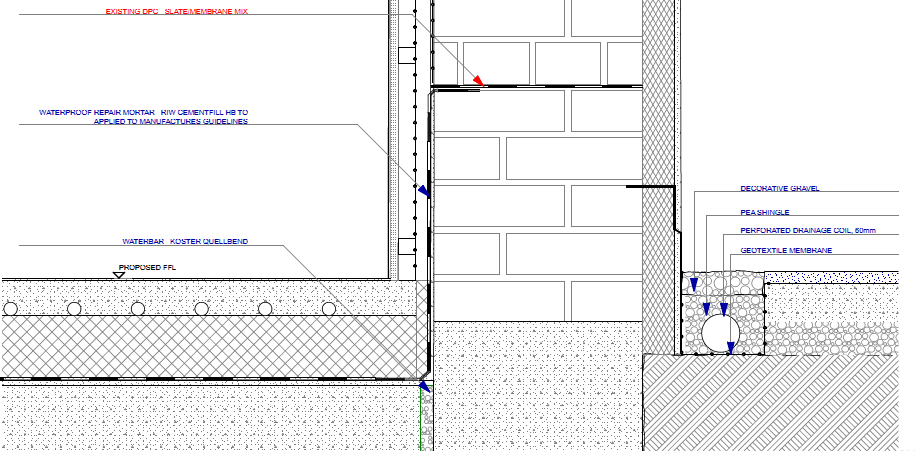
-
We installed a concrete slab as a better structural base for our 1930s house than the suspended timber subfloor that was there before. The build up shows hardcore on the bottom, then the slab, in both cases extended right across the subfloor of the house wall to wall. The bricks enclosing this area are below the DPC (which is a 1930s DPC in any case). The cross section drawn up by my architect shows that in between the bricks (which are either corbels or the course above the corbels) and the new slab, there is to be Koster Quellbend Waterbar. The slab has been poured, a couple of weeks ago now, and I cannot recall seeing that this was installed before the pour. Trying not to panic, but it is somewhat worrying. I will ask my builder if he installed it and hope he gives me an honest answer. The builder is experienced and has poured many slabs before, so if he didn't install it I'm hoping that he has good reason for thinking it was not necessary. Could that be? My understanding is that it is to make a joint between two concrete solids waterproof, even in the event of the concrete cracking. But in this case, it is a joint between concrete and old 1930s brick wall. Is it still required. It is not a basement, although we are slightly below the external ground level at this point, and I do remember that when they dug up the place to make space for the hardcore, there was some water coming up underneath. If it is required, a quick google found this as an alternative of what to do: "If your concrete has been set without waterstops in site, the focus should turn to waterproofing the exterior of the slab. Techniques such as torch on membrane waterproofing and epoxy coating will ensure that at the very least each of your individual concrete slabs won’t soon feel the effects of intrusive water." I then googled "torch on membrane waterproofing" and it seems to be some sort of bitumen that is applied. The architect has also specified that the whole slab and the walls on the side up to the DPC be coated with a waterproof repair mortar, known as RIW Cementfill HB (details here https://www.riw.co.uk/products/cement-based-systems/cementfill-hb). So I'm now wondering what to do. Will it be sufficient to put in the RIW Cementfill HB, or should I also be doing bitumen?
-
For our driveway, the architect has specified a premium drainage system made by marshalls called a driveline drain: https://www.marshalls.co.uk/gardens-and-driveways/product/driveline-drain?gclid=CjwKCAjwlrqHBhByEiwAnLmYUGPHaVk4-IiF6gM9hc__0GqyRZ8-1blp2HJyTUKZ70NS9AnfIkHJVBoCMhoQAvD_BwE Anyone have any experience of this style of drainage for the boundary between one's driveway and the highway/pavement. House and driveway are downhill from the pavement/highway, so need some protection from rainwater.
-
Trying to find an affordable stove fitter that covers the London area. Had a couple of recommendations from stovesonline but none of them worked out. Also got a quote from one based in Kentish Town but they were ££££. Maybe @Trw144 can give some tips as to how to find a good one?
-
Rainwater harvesting tank
Adsibob replied to Happy Valley's topic in General Self Build & DIY Discussion
I'm currently considering this. We have to install at least one tank and pump as our extension is too far from the sewer and BCO has insisted on it. That cost of that is about £1200 plus VAT. Architect said if we are going to do that (and we don't have a choice) then we might as well install an additional pump and set up a proper harvesting system. Quote for two pumps and a 3000L tank, supply only, is £3,200 plus VAT. Not sure why it is so expensive. This will enable us to use rainwater from our roof and ACOs in toilets and appliances. So it's an additional £2000 plus VAT to get the water saving and environmental benefits or reusing the water collected as opposed to just sending it to the sewer. I'm struggling to justify it as I think it will take me 15 years plus to recoup that additional £2400 in water savings, and I'm sure in that time I will have to replace the pumps, which I am struggling to understand why they are so expensive. The quicker than expected return on @saveasteading's set up sounds like it might be because it was used in an office block. I imagine there most of the use is toilets, which probably get a lot of use and therefore provide an opportunity for lots of savings. But in our case, most of our use will be for showers and baths, with toilets and appliances being secondary. And as I'm not willing to install the tech required to sanitise the water for showers and baths, I just can't see us saving more than a £160 or so a year, but maybe I'm doing my sums wrong. Been quoted £600 for one with a battery back up in case the power supply is cut off. Not sure that is essential, but I guess if there was a storm with lots of rainwater, that would be a bad time for your power to go. @Simon R I'm interested to know which model Divertron pump you went for which cost less than the £300. I'm being advised to install a £600 pump, which just seems obscene. -
Wet slab and freshly laid padstone - is it a problem?
Adsibob replied to Adsibob's topic in Damp & DPCs
That's reassuring. Thanks guys. -
Worst shortages and how to plan around them (Jul 2021)
Adsibob replied to puntloos's topic in Costing & Estimating
What sort of stuff? -
For those not in the South-East, there was some pretty incredible flash floods here yesterday. You can see pictures and videos here: https://www.bbc.co.uk/news/uk-england-london-57816647 Where I am in London, we had more than 40mm of rain in just an hour and several inches over the course of the afternoon/evening. Wading in welly boots didn't really protect your socks from getting wet it was that bad. Unfortunately, my house is about 1m below the street level, so as soon as the street and pavement flooded it all came down into our property. Although we have a trench dug all around the property (where we plan on putting in a french drain) the water filled the trench and then came in. The trench is about 30cm deep and about 35cm wide but it just filled with water. It didn't help that there were some old air bricks on the wall where the trench is (previous owners raised the patio above the DPC and blocked off some of the air bricks, so trench has uncovered those air bricks. The only potential damage that has been done is that our slab has got wet and a freshly poured padstone has a bit as well. Of the slab, some was laid about a month ago, some was laid about two weeks ago and some was laid about a week ago (so 6 days before the flood). A padstone which was poured about 4 or 5 hours before the flood also got a little bit wet, it sits on a piece of DPM above the slab which was poured about 2 weeks ago but not as much of this padstone got wet because it is on the side of the room and was somewhat protected by some crates in front of it. The builder pumped the water out on Monday evening but it continued to drain into the property overnight and he had to pump it out again this morning. Is this a problem? My main concern was the padstone, but he assured me it was fine and invited me to prod it. Is this all fine? Does it matter that it will all be damp when we install the membrane and insulation in about 2 weeks. Or will the rainwater not have penetrated the concrete and so actually it will dry quicker than 2 weeks. There is no rain forecast for the next 10 days and I'm imploring the builder to finish the french drain in that time.
-
So the builder does hold himself out as experienced in EWI. All his marketting material states this, and whilst I'm not one to fall for marketing material, all of his work to date (which has covered many different things) has been very good quality with lots of attention to detail. EWI has been around for a while and so has he, so I get the feeling that he's done it many times before. But the questions you raise are helpful and I will ask him these before I commit. As for condensation risk, yes the whole build up, internal and external, has been designed by a specialist RICS surveyor with input from Tyvec/DuPont who are the manufacturers of the internal breathable vapour membrane. We are letting the wall breath on the inside rather than on the outside. There is also an internal MVHR system so that too will minimise the risk of condensation. Gutterings aren't a problem because we are installing everything new, so it will go over the EWI. As for soil pipes, the holes for these will need to be drilled through the EWI, but there is only two places where this will be done, and I assume he will have a detail for keeping it water tight I will ask. No idea what plinth insulation is, so I will ask about that too!
-
Already bought roof tiles. Next life.
-
No. I tried, but unfortunately that Scheme was a total joke. Impossible to use and I believe was withdrawn at the end of March. Pathetic government bureaucracy. They should have just zero rated all Green goods, such as insulation, and then given people a cheque for a couple of £k upon showing an improved EPC certificate. Would be so much easier than that stupid scheme. Our house was rated “D(56)” when we bought it, but I think we will hopefully get it up to a “B(85)” or slightly higher.
-
Thanks for your comments, that is reassuring. With insulation, obviously the more we can put in, the better, but unfortunately there is a limit before we start to ruin the architectural features of the house. It's a 1930s semi, and whilst replacing all the windows has given us some play with the reveals, there isn't anything we can do about the soffits. I'm putting a LOT of insulation in the roof and the whole of the ground floor will be upgraded to an insulated slab, and we are fitting MVHR and brand new thermally broken 2G windows everywhere so I'm hoping overall we will dramatically increase the energy efficiency of the house.
-
Received the quote from my builder for supply and installation of the 40mm K5 Kooltherm onto the external wall of my house. There is 114m2 to do across three facades: back, front and rear (it's a semi detached house). The quote is to supply and install it and apply a "base coat" ready for subsequent rendering, but does not include the rendering itself. The substrate it is being applied to is mainly 1930s brick which we recently uncovered (previously it was covered with pebbledash) and there are around 9 windows which will need to be navigated. It's come in at a whopping £6k plus VAT. Given the 40mm Kooltherm itself will cost about £21.10 per m2 plus VAT (including 10% extra for wastage), the labour is coming out at £3,594.60 plus VAT, or £31.53 per m2 which seems high to me although the K5 boards are not huge (1200x400). I am having the same builder also re-roof the whole house, so I do not think the above costs include scaffolding because I am already paying for scaffolding for the roof, unless to re-roof a whole roof of a semi detached house one doesn't need side scaffold access and only needs scaffolding at the rear and front, in which case the above might include the additional scaffolding required to do the side of the house. Meeting with my builder tomorrow to go through the latest set of extras (of which this is the only real surprise) and would be helpful to get people's views on the reasonableness of this quote and whether scaffolding would in any case have been needed on the side for the roof or whether the roof could be done with just scaffolding on the rear and front. I will obviously ask him about the scaffolding, but wanted to see the lay of the land here first. Many thanks!
-
The side wall of our semi detached 1930s house is made from a double thickness solid wall on ground floor and a single thickness solid wall above that. This wall, predominantly the ground floor, but also some further up, was diagnosed with damp at the beginning of winter. It has been damp for a couple of years as when we bought the house in 2018, damp came up on the survey. The surveyor who looked at it in December last year identified various issues causing the damp, predominantly 1930s pebbledash not being great for walls, the pebbledash itself having lots of cracks, the DPC being too close to the external ground layer, inadequate drainage, various cracked downpipes. We have taken off all the pebbledash, dug a trench to install an aco drain and are planning to improve the wall by affixing 40mm K5 insulation externally and then rendering over that. All drain pipes will be replaced as well. The insulation will stop the breathability of the wall on the outside, but to mitigate that we are using a fully breathable build up internally, with a ventilation gap. The surveyor is happy that this will be a good solution but would like us to dry the wall a bit more before doing this. His "belt and braces" solution for drying it was to install a temporary render on the outside (instead of the K5) that will draw out the moisture and then take it off after a couple of months and then do the K5 and finished render. This is quite expensive as it effectively triples the labour as well as adding material cost. As an alternative, he suggested we hire some large dehumidifiers and run them for a couple of weeks. The difficulty we have is that we are not air and water tight yet, so I don't think the dehumidifiers will work well until we are. Most of the windows are in, but they've not been sealed yet and there is a large 4.3m by 2.1m gaping hole at the back of the house where we are still waiting for the sliding doors from Sunflex. The wall is on the side of the house in an alley way so doesn't get much/any sunlight, particular at ground floor where the damp is worse. My builder has a large space heater, a bit like an industrial sized hair dryer and I was just wondering if it would make any difference if we blasted the wall with that for a few hours a day for a week? It would surely heat up the bricks and allow the moisture to evaporate, but could it damage the bricks in any way?
-
Legal meaning of 'property' in General Binding Rules
Adsibob replied to Omnibuswoman's topic in Waste & Sewerage
"Boundary of the property" is different to "property" because the latter is a little ambiguous in that it could mean several things, from a chattel to real property, whereas the former is quite clear that it is referring to real property (i.e. land) and not to any building on the land. "Boundary of the property therefore means, in the strict sense the boundary around your land as shown on the title plan. Now whether you count that as your sole land or also including the shared ownership bit, is a bit unclear and I agree with @IanR that if one interpretation over the other suits you best you argue for that one, as they are both arguable. Where I think you are on less strong ground is in respect of the portion of driveway that you don't own at all and just have an easement of access. That is not your property at all and certainly doesn't fall within its boundary. -
Roof to keep first floor extension cool - wood fibre in a cold roof?
Adsibob replied to Adsibob's topic in Flat Roofs
Are you serious? On the pitched roof, I think the neighbours would complain to the council and I would get in trouble. But on the flat roof on top of the loft conversion, that is probably fine, as long as it doesn’t affect the performance of the roof covering, which I think will be GRP - assuming that is the standard covering for a loft conversion’s flat roof??? -
Roof to keep first floor extension cool - wood fibre in a cold roof?
Adsibob replied to Adsibob's topic in Flat Roofs
That was my plan, but in this thread you had a look at my roof and didn't think PV would work well. We are using a heat reflective membrane/felt within the roof build up, something made by Tyvec, which is meant to be quite good, but I'm not sure it will actually work. I hadn't considered a reflective coating though. -
My build up for the walls and roof includes a layer of 40mm Steico Protect dry internal wood fibre board. This is out of stock with all the merchants I have approached (Mark Wye, insulationsuperstore and ecomerchant) and most are quoting very long lead times of up to 10 weeks. Can anybody suggest an alternative which would have the same decrement delay properties. Someone has suggested Phenolic Foam based product Kooltherm K7, made by Kingspan, on the basis that it has a density of 200kg/m3, but I don't think it will have the same decrement delay just because of the density. Any thoughts?