Adsibob
-
Posts
3604 -
Joined
-
Last visited
-
Days Won
10
Everything posted by Adsibob
-

Not enough glue in 22mm Egger Chipboard installation?
Adsibob replied to Adsibob's topic in Floor Structures
If anyone has any pictures of their chipboard installation with foaming glue leaking on the underside, be grateful if you could share so I can see how much messy foaming we should be aiming for. -
Not enough glue in 22mm Egger Chipboard installation?
Adsibob replied to Adsibob's topic in Floor Structures
Is D4 always black? Is it possible they used another manufacturer's D4 glue that dries clear? -
Not enough glue in 22mm Egger Chipboard installation?
Adsibob replied to Adsibob's topic in Floor Structures
You are probably right, but my concern is not just that there are no squeaks before floor finish goes down. I want no squeaks for the next 20 to 30 years. That's why I went with a product that has a "lifetime guarantee". I guess my only real option now is to double up on the floor tite screws. Egger also show that one can paint over the joins with their adhesive which appears to protect them from moisture ingress, so maybe we should do that as well. -
Not enough glue in 22mm Egger Chipboard installation?
Adsibob replied to Adsibob's topic in Floor Structures
Extremely close to sacking him over this and generally inability to follow instructions. He told me he was not doing this this week and then he did it anyway. Only thing saving him from the sack right now is that I understand there is an extreme lack of labour these days. -
Not enough glue in 22mm Egger Chipboard installation?
Adsibob replied to Adsibob's topic in Floor Structures
Yes, you are probably right. This just gets from bad to worse. -
Not enough glue in 22mm Egger Chipboard installation?
Adsibob replied to Adsibob's topic in Floor Structures
Update: builder agreed to redo two rooms where he hadn’t put glue between floor joists and chipboard. That hasn’t been done yet, but will happen soon I’m told. In the meantime: 1) I bought him loads of the blue floor tite screws and told him to use those instead of the regular screws he’s using; and 2) he’s done another room, this time he has clearly used glue in the right place but I remain concerned that it is the wrong glue. The video on caberdek’s site shows a glue that when it dries it foams slightly and dries like an opaque slightly off white colour, almost yellow. This glue has dried clear with no foaming, but maybe it is just Caber’s glue that does this, not Egger. See picture. They possibly also didn’t use two beads of glue as sometimes the glue has only dribbled out on one side of the joist. If I’m right about this, then it’s really just F-ing annoying. Getting closer to sacking territory. But given they have at least used floor tite screws this time, I wonder if using the wrong glue and possibly only one bead rather than two will matter?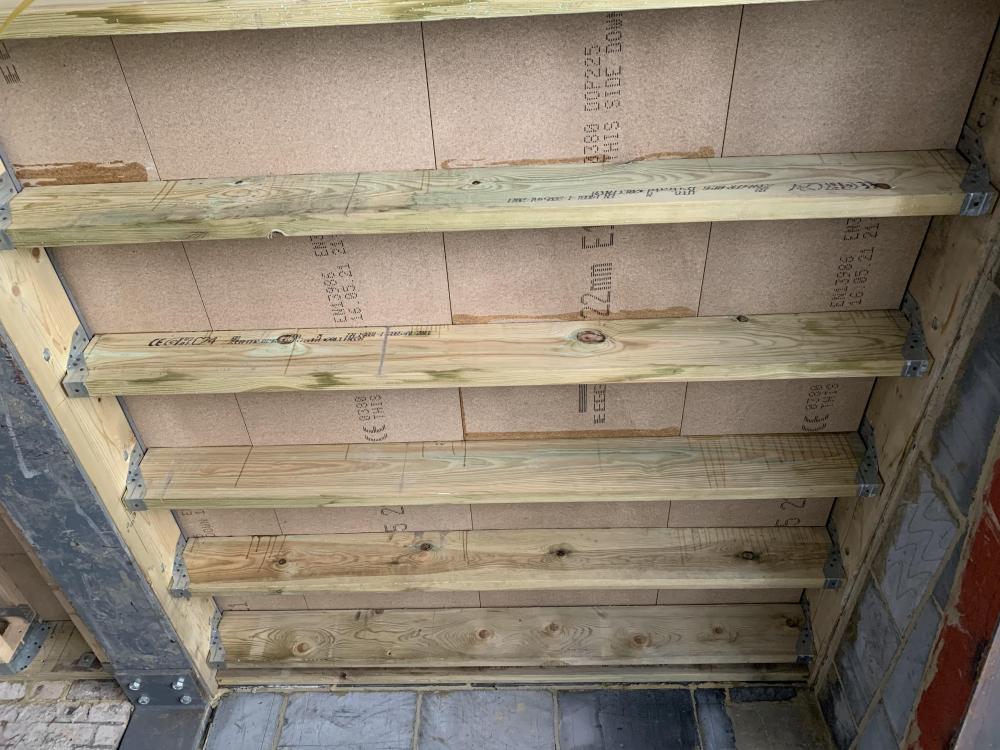
-
The plot thickens. The manufacturer of the light has come back to me and told me that her supplier "does not have the correct size sockets rated for 240 volts". I assume by "sockets" she means the bulb holders. I'm confused by this as I thought they were just metal cups where the contact conducts the electricity to the light bulb. If the manufacturer is right, I just need to buy a pair of bulb holders. Looking around, I see that this UK website states (under the "finer details" section) that their bulb holders are only suitable for 220 to 240 volt countries. Is this a case of pen pushers rating things unnecessarily, or could an american bulb holder really fail with 240 volts? On the plus side, she has confirmed that the wire they use is this: https://grandbrass.com/18-1-black-single-conductor-tffn-105-wire-2500ft-spool/ and that they earth the fixture with a copper wire that is connected to this cross bar that screws into the junction box.
-
That all sounds easy enough, but I read somewhere that UK wiring is slightly thinner than US wiring. Not sure if that is a reference to the actual wire or the insulation around it. Maybe what I read takes things to a level of detail that isn't necessary for my purposes though...
-
I've purchased a light fitting that is being manufactured in the US and supplied with the following hardware: "E12 candelabra socket, max wattage = 60w per socket (2) 40W G16 Globe 120V white bulbs" The light fitting is a ceiling pendant so will be wired into our lighting circuit. I rather not have to use a transformer. Is it simply a case of changing the bulbs to ones that work with our 240V system, or is there a risk the wiring might not be compatible as well. In case it's relevant, I want to use this light with a dimmer switch.
-
Good tip, thanks. I see from their website that they also do a new range called SteelShield. Looks like it might be even better than Ultimum, although perhaps it's just marketing.
-
I agree with your sentiments re an induction hob. What would you recommend as a good one? Re non-stick pans, I’m yet to find one where the non-stick coating that lasts that long. We use our frying pans almost everyday and find that after 6-9 months the “non stick” is pretty sticky. We’ve tried Tefal and even spent £75 on a heavy John Lewis one, and both failed in less than a year. Are the Lidl ones you mentioned in your post (4.5 years ago now) still going strong? Any recommendations for long lasting non-stick pans would be much appreciated.
-
That's a gamechanger then. Thanks for the info! Sounds much better than the functionality of the other smart home tech that I'm already invested in: tado (https://support.tado.com/en/articles/3477781-what-happens-when-the-internet-connection-is-temporarily-lost-can-i-still-control-my-heating-or-air-conditioning-using-tado)
-
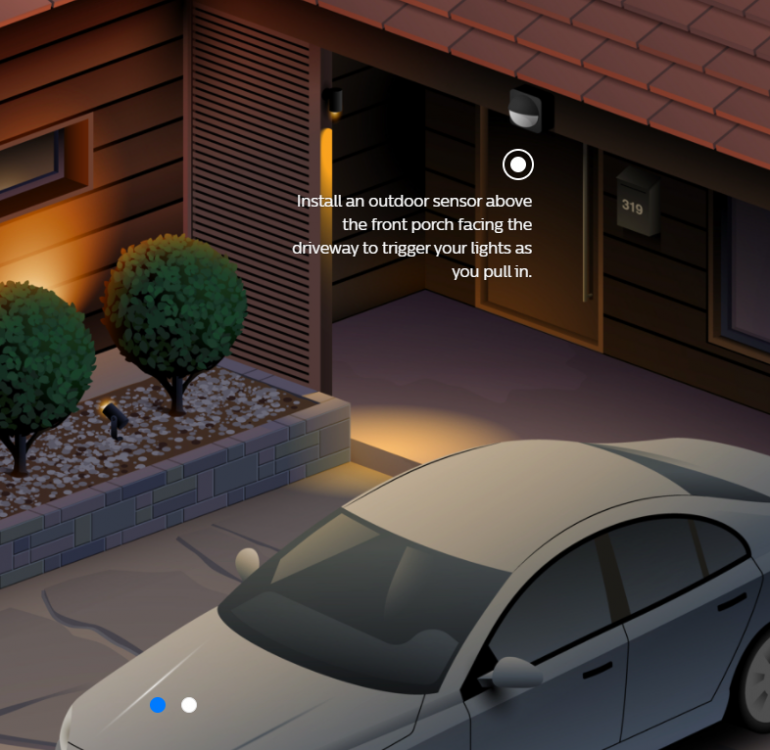
I tried the Phillips Hue system many years ago when it was first released and was really impressed. The only thing that put me off at the time was the price, but I see that bulbs are now cheaper. In terms of motion sensors, I think the only thing that puts me off for the outdoor setup is that they are a bit too conspicuous for my liking. Is Phillips really expecting everyone to fit one of these above their driveways? The other downside is that lighting becomes dependent on internet, which is fine when the internet works, but not great when it doesn't.
-
I guess it depends on the spec, but in Surrey won't you be paying similar prices to London prices for labour? I'm not sure £500k is enough. But if it is, make sure you factor in a contingency buffer. We started our build about 8 months ago, are probably only two thirds of the way through and are already at least 20% over budget. Part of that was the BCO insisting on things that really weren't required; part of it was Brexit increasing costs of importing products from the EU (so much for a free trade agreement, I've just paid my fourth customs invoice in a month) and part of it was just general inflation.
-
I see that a lot of members here have installed dusk to dawn lighting. My understanding is that basic dusk to dawn lighting (i.e. without separate sensors, but all in one integrated units) comes in two varieties: simple dusk to dawn lighting that comes on at dusk and switches off at dawn; and the PIR variety that is off during the day, but will turn on at night if the motion sensor is triggered. Generally speaking, when would you use each type? I am planning to have three zones of external lights, with each zone illuminating: my driveway the side passage of my house the front door I think a PIR motion sensor would be useful for the side passage as I only really need light there when I use the passage (this looks like an affordable option), but for the front door of the house and the driveway does it make sense to have PIR as well? I see some houses illuminate their driveway and even their front elevation throughout the night, but I query if this uses a lot of electricity? In addition to the doorway, I will need about 8 lights for the driveway, so seems like a lot of light to have running all night. The disadvantages I see of the PIR lights are that (i) the sensors are a bit too noticeable and give the light a somewhat functional aesthetic; and (ii) I haven't been able to find many recessed options that have a PIR sensor, and need it to be recessed or have a minimal projection as otherwise they will get in the way. As an alternative, this has a projection of only 30mm, so would probably not need to be recessed, although it doesn't have a dawn to dusk sensor or a PIR sensor. Is it straightforward to fit these separately or is my instinct to look for an all in one solution a good one? What dusk to dawn lighting have you installed? Any tips?
-
True in many cases. But it depends. For example, if you claim is big enough or complex enough to merit being allocated to the multitrack, there is fairly decent Costa recovery whereby the winner of the law suit has most of their reasonable costs paid by the loser.
-
If the old company transferred anything to the new company, it might be caught by the section 423 of the insolvency act 1986. Or if there was a pre-pack and administration of the old company before or at the same time as the transfer of assets to the new company, in addition to section 423, there might be a breach of Statement of Insolvency Practice 16: https://www.gov.uk/government/publications/statements-of-insolvency-practice-16-sip-16 ie just because the party you contract with us wound down/goes “bust” doesn’t mean you don’t have a legal remedy.
-
Just thought I’d provide an update, in case it alleviate my impending sense of doom. The original end date is in two days’ time. The extended end date is in a months’ time. We will miss both by several months I think. I’ve been lucky enough to have the last two weeks off on holiday and even managed to get far away from the UK. Very nice holiday indeed, but now really struggling with a severe case of post holiday blues which is mainly driven by having to return to the building site that is my house. The top floor loft conversion structure has now been built and should be water right by the time it is tiled and windows are in, which will hopefully be mid Sept. Then all the windows (top floor, middle and ground) need to be sealed into frames (currently they are in position, but it’s not airtight or water tight). And then still have so much more to do. All the plumbing and heating and electrics still to be done (and I really mean all) MVHR plus 3.5 bathrooms still need to be installed. All the tiling and all the decorating still to do. Still have the driveway to do. It just feels like it will never end.
-
We are getting quotes at the moment. Brass is not particularly expensive, so I’m hoping it will be affordable; will report back soon.
-
Small shower room with MVHR, how long will it be wet?
Adsibob replied to Adsibob's topic in Bathrooms, Ensuites & Wetrooms
There will be UFH, probably no towel heater. I hadn’t actually thought that through. Maybe I va need a towel heater as well. There is a small 750 by 900 window which will get a bit of sun in the afternoon. I guess I was looking for approximate estimates of drying times based on others’ experiences. -
We have a pretty small space we are trying to make into a wet room. It is 1690 long by 1648 wide and about 2.5m high. So almost a square in terms of the floor space. One of the considerations in choosing the optimal layout is how important is it that stuff doesn’t get wet. ie. is it better to put the vanity unit or the toilet opposite the shower. The toilet is obviously fully water resistant (except the toilet paper) whereas the vanity unit is made from wood, oiled to make it shower proof, with a counter top sink occupying almost the entire top surface. We will have MVHR so the room should dry very quickly. The plant room for the MVHR is actually directly next to this shower room, so quite easy to double up the extraction ducting in case this speeds up drying time.
-
The bathroom will be predominantly tiled and quite small. About a third of the floor space will be covered with a wooden/cotton bath matt but I doubt that will dampen any noise. Gap will be minimum required by MVHR but I will probably widen the door to about 860mm to try to reduce the height of the gap by a couple of mm. The walls will be made from metal studs that are interlaced so that the plasterboard on one side of the stud is not in contact with any stud that touches the plasterboard on the other side. But I query what happens with the pocket. Perhaps the pocket can be separate to that build up so that I am essentially deepening the depth of the wall to accommodate the pocket without compromising the sound performance of the wall. I am effectively asking: all other things being equal, what pocket door system do people recommend? Something premium that will feel substantial.
-
Is a well soundproofed internal pocket door possible, or is this an oxymoron? i have to have a gap under the door for the MVHR, but subject to that I would like to make the pocket and the pocket door as solid and sound proof as possible. It is for the doorway between a bedroom and it’s en-suite bathroom. Any pocket door systems people recommend?
-
MVHR and rooflights
Adsibob replied to Adsibob's topic in Mechanical Ventilation with Heat Recovery (MVHR)
Panic over. Architect has drawn it up in CAD and shown me that with window open there is still 2.1m of space. I had forgotten that the rooflight sits where the tiles are, and calculated the distances from the ceiling, ignoring that the skylight is recessed within it. -
I have an openable Velux, measuring 134cm wide by 160cm long going in my loft conversion. Originally it was going to go in quite near the top of roof, starting about a metre away from the ridge (measured along the diagonal of the roof slope). This size in the spec I wanted only comes as a centre pívot. Architect has now recommended we move it down by about a metre along the diagonal to improve light coming in to the floor below. The problem with this is that instead of having 2.1m under the open velux, we will only have 1.5m. This basically means it won’t really be possible to open it more than just ajar, as otherwise it would create a head hazard as one is going up and down the stairs. My question is, how much of an issue is this given we will have MVhR? Most of the year, we won’t open the rooflight, but I thought that in hot summers it would be helpful to open it to help cool the house.