


revelation
-
Posts
250 -
Joined
-
Last visited
Everything posted by revelation
-
Liquid DPC Damp Proof Course Injection Cream
revelation replied to revelation's topic in Damp & DPCs
I was advised after the dam to get the the walls filled with liquid DPC stuff that I have ended up using. Is this a really set up? Would the MVHR system help control the moisture level in the house? Many thanks -
Liquid DPC Damp Proof Course Injection Cream
revelation replied to revelation's topic in Damp & DPCs
The DPM and slab were around 12 months ago. Therefore there isn't any way round that (beyond digging it up) I have owned the house for around 3 years, when it had no DPM there was damp coming through as the concrete floors were damp. What would have been the best course of action? And is there anything that can be done now? -
Liquid DPC Damp Proof Course Injection Cream
revelation replied to revelation's topic in Damp & DPCs
I am not sure I understand the question, they laid the DPM over the surface they had prepared (stone, sand etc) and then we had the concrete pumped in for the slab. -
Liquid DPC Damp Proof Course Injection Cream
revelation replied to revelation's topic in Damp & DPCs
I forgot to mention that I will be having an MVHR system fitted and the house is a 1930's house. We have also added external wall insulation to the outside of the house. However, all the damp/wet issues were apparent before any of the additional works. They had also remained wet even after the plaster was taken off and the house was getting plenty of ventilation through about 6-7 months while we had no doors and windows in places. -
Liquid DPC Damp Proof Course Injection Cream
revelation replied to revelation's topic in Damp & DPCs
Thank you for the information. The house I am renovating has gone back to brick everything stripped out, old plaster, skirting literally everything. There were a few areas where the bricks were damp higher up. My builders who are experienced said that it looked liked rising damp. Our floors were damp too so they suspected no DPM under the concrete, so we had that dig up and there was no DPM. So we have laid new DPM and concrete slab. Due to their advice we had already had a so called ‘damp proof specialist’ to inject some of the house already. -
Hi all I was wondering if anyone has and experience of using products like the one below https://www.restorationuk.com/damp-proofing-products/damp-treatments/product/focus-damp-proof-1l-cartridge-tubes Because its an old house with some instances of rising damp my builders advised that I get a DPC injected, so I went ahead and got someone out to do it, so they have drilled a load of holes in the mortar and injected the mentioned liquid/cream. They weren't able to indicate how soon it was going to act which wasn't reassuring, my builders and the DPC person argued whether it should be below final finished floor level or above. The other concern is that in the description of this product it states "When re-plastering following a Focus damp proof course DPC installation under NO circumstance use a Gypsum based product. Please ask for a Renderpel replastering specification if required" We plan to dot & dab the walls and liquid screed the floors, which are all generally gypsum based from my understanding. Could anyone offer in insight as to whether I should be concerned or whether it all sounds ok and I'm worrying about nothing.
-
Thank you for the information, how many sq. m is your property? Because ours is largely a retro-fit we don't have the facility to go for anything more than 75mm radial ducting, so I expect that we will be getting more noise than the ducting you used. However we are using Zehnder Comfo Attenuated Manifolds and due to having UFH on all floors most of the spaces between floors will have acoustic rock wool between them. So I am hoping it wont be too loud. How has it helped drying towels and washing? Just by detecting the moisture levels and boosting extraction? Regards
-
Insulation in studs and insulated plasterboard
revelation replied to revelation's topic in Heat Insulation
I think thats the route I will go down down for the ceilings and the walls too, if its going to be cheaper and easier to do, without reducing effectiveness of the insulation then it makes sense. -
Insulation in studs and insulated plasterboard
revelation replied to revelation's topic in Heat Insulation
Yes I am in England, I was advised that the 120mm Kingspan may not be enough, if it is I am happy to fill any gaps tape it up and then plasterboard it. If I need go go for insulation then you think that battens + 25mm PIR would be better than insulated plaster board? Or is that just because of the cost? Regards -
Hi all I have a few questions regards to insulation. 1. We have had a loft conversation, part of which is timber stud work filled with 90mm kingspan, we were looking to also add some insulated plasterboard ontop, do we need any kind of vapour barrier in between? The ceiling of the dormer is a cold flat roof, we have 120mm kingspan between the rafters, what's the thinest insulation that I could use to get it to regs, we already only have 2300mm head space so don't want to lose too much more. 2. We are having some insulation put on the party wall for sound and heat. We are using Acoustic Rockwool for this, again would we need to use any kind of vapour barrier before boarding? If we need to add vapour barriers, then does that mean on those walls we can't have any lighting or sockets as that may mean piercing the vapour barrier. Thanks in advance. Regards
-
If you're running a Q350 for 200sq.m and its running well, then that is certainly reassuring that I should be good with running it on mine. Especially as I have the opportunity to purchase a Q350 unit for less than 1500 and a Q450 would cost me more than 2000. Did you go for a pre-heater? Regards
-
We are almost ready to have our screed put down. The plan is to have our insulation and UFH pipe work installed then have 50mm of liquid screed, there seems to be a number of different types of products available on the market. I have heard some people say they're brilliant, but I have had a friend that has had it put into to two different properties and it has cracked fairly badly. Which I definitely want to avoid, so I was looking for a recommendation for the best product to use for my screed. Thanks in advance
-
Thats handy to know. We will be using the Zehnder silencer/attenuated manifolds which go directly on the main unit. Our sitting space will be pretty close to the utility room, (around 2-3 metres away from the unit). I guess due to the airflow you will have some low level sound all of the time anyway, which I expect. Would anyone recommend going for a Q450 instead of the Q350. my house is pretty much 165m sq which is the upper limit of the Q350, so I assume the Q450 would run at a lower level to do the same work? Regards
-
Hi all I was wondering if someone could offer a little insight. We are having our heat recover system installed soon, we have the decision to make whether to install it in our downstairs utility room, or our loft (has been converted and is fully insulated with easy access). The utility room would be our preference as we have space and it allows for a larger bathroom in the loft, and will make external venting (supply and extract) easier. However, I biggest concern is the noise. The utility room is next to our open plan kitchen and our living room too, we plan to use Zehnder comfowall attenuators and manifold so that should help too. Does anyone have much experience with such a set up that could offer some advice? Regards
-
We are looking to have a similar set up to yours. Our extract in the kitchen will be close to the hob but no directly over it. The extract point in the kitchen will have a grease filter set up to prevent any grease from getting into the system. We are also have a Bora re-circ hob fitted too.
-
Best Roof Surface for raised decking on a Flat Parapet Roof
revelation replied to revelation's topic in Flat Roofs
We are going to have decking on-top so if we had felt it would be shaded from the Sun/UV. That should stop the felt from heating up significantly? -
Best Roof Surface for raised decking on a Flat Parapet Roof
revelation replied to revelation's topic in Flat Roofs
Would that be general Firestone or a higher grade? The contractor who suggested the Sika said he's done it before and on wood it will need a reinforcement mesh laid. Its literally twice the cost of GRP, he said it achieves the same performance as fibre but can be laid with less worry about the weather. Ideally I don't want to be paying twice the amount if I can have another material that will give me a suitable finish. -
Best Roof Surface for raised decking on a Flat Parapet Roof
revelation replied to revelation's topic in Flat Roofs
Thats the problem, the guys don't really want to do fibre because of the weather and its going to be difficult to get 3 days of good weather to ensure the right conditions for GRP. So I am going to have to go for felt, or on person has recommended going for Sikalastic 650, do you have any knowledge or experience with it? Regards -
Best Roof Surface for raised decking on a Flat Parapet Roof
revelation replied to revelation's topic in Flat Roofs
Right now the membrane is down (we have ordered more insulation for the warm deck). I assume its going to take that time due to all the insulation and OSB cutting, the detailing for the gullys and around the roof windows etc and the drains its all being bonded down too. I would have thought 2 days is enough but they have suggested 3 days to be certain. -
Best Roof Surface for raised decking on a Flat Parapet Roof
revelation replied to revelation's topic in Flat Roofs
Hi all, We have a bit of an issue, I have called about 5 different people to do do the GRP roof and they all all not keen to do it due to the weather. They said they would require 3 days of good weather to do this and its unlikely that we will have that any time soon. What would be the next best thing to use? Regards -
I have previously spoken to the manufacturer about the slope of the walk on and they said it can be laid without a slope if we wanted due to the strength of the glass we wouldn't get pooling. But we are putting 1 degree on it. Its a good call speaking to the manufacturer about the 150mm to see if that can ben dropped due to the decking. Forming gullys around the roof light maybe possible but will be a pain as the roof light is in the middle and it will mean having to make further gullys off that to run to the edges. (I will speak to the builders about this one. My building control officer is fine with spray foam as long as the product is certified etc...
-
I don't think I am. I have attached the drawing of the glass on-top of the curb, from the finished GRP to the top of the glass its 190mm (according to the manufacturers instructions). So 190mm + 50mm (insulation) + 10mm (approx for GRP)+ 18mm OSB = 268mm 268mm is pretty much level with the sill. We could make the curb a little shorter so the side of the roof light frame is sitting close to the GRP but that still wouldn't give us enough room to get enough insulation on top. Thats why I have been exploring options to insulate below. I hope that makes clearer sense now.
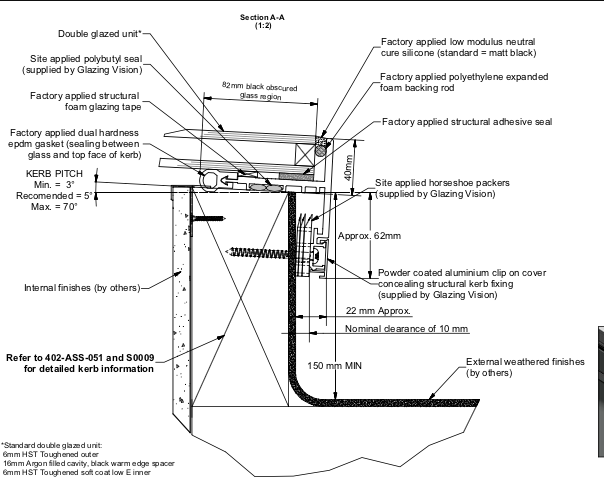
-
Peter, we have gone through all the measurements and maths on this. We are restricted more than anything by the glass and its own frame around it, that has to sit around 80mm above the final roof finish. So an increase in insulation means a raising of the glass. The original plan of 50mm insulation was leaving us with the glass and decking all running flush (almost level with the door sill). Ideal Scenario is to be able to used closed cell spray foam underneath, what are your thoughts on this? Next best thing, we have a small step up next to the doors and the rest of the decking sits higher but flush with the glass. That will allow us to have around 120mm of insulation (We will probably still need more below?)
-
I think our choices are effectively either the spray foam if I feel reassured by people that it won't cause any condensation issues. Or to have a small step up next to the door ways and the rest of the decking to be higher but flush to the glass. If we did this the max insulation we could get is 120mm, so we would still need to put some below I assume to get to building regs?
-
So if I have the amount of insulation I said in the original post and spray foam insulation underneath will that work as far as building regs go and no issues with condensation?
