


MortarThePoint
-
Posts
2168 -
Joined
-
Last visited
Everything posted by MortarThePoint
-
Garage/Workshop Fantasy Time
MortarThePoint replied to MortarThePoint's topic in Garages & Workshops
Or with a magnetic 'downforce' system so the cars can run upside down on the ceiling, that would be cool. -
Garage/Workshop Fantasy Time
MortarThePoint replied to MortarThePoint's topic in Garages & Workshops
In theory a 2t car would need 2m2 per side so thats about 1.5m square on each side. The limiting factor is likely to be the GreenGuard GG300 insulation under the concrete -
Garage/Workshop Fantasy Time
MortarThePoint replied to MortarThePoint's topic in Garages & Workshops
I've been wondering if you can get a ~10mm thick neoprene mat with built in electric heating elements. Then you can lay it where you need it and it saves tools and elbows from hits on the floor -
Garage/Workshop Fantasy Time
MortarThePoint replied to MortarThePoint's topic in Garages & Workshops
A quick Google turned up a bloke from the US saying 3000PSI @ 4 inches. 3000PSI > 21,000 kN/m2 so that doesn't make sense [Edit: that's the tensile strength of the concrete not the floor loading] -
Garage/Workshop Fantasy Time
MortarThePoint replied to MortarThePoint's topic in Garages & Workshops
I've had the floor designed for a 5kN/m2 loading, 150mm mesh reinforced. I don't know if that's enough for a 2 post lift but probably not. Underneath that it's MOT Type 1 for about a metre down to the stiff clay -
Cavity ties and DPC in save bed joint
MortarThePoint replied to MortarThePoint's topic in Brick & Block
Sorry, I was meaning inner leaf. Nice picture though ? -
Cavity ties and DPC in save bed joint
MortarThePoint replied to MortarThePoint's topic in Brick & Block
This raises a question, I've been presuming periscope vents need to enter the void below DPC. Is that true? -
Cavity ties and DPC in save bed joint
MortarThePoint replied to MortarThePoint's topic in Brick & Block
The DPC can't go lower as the next bed down is only 225mm above top of trench concrete and has been laid anyway -
Can you put cavity ties in the same bed of mortar as a DPC and if so which one goes on the bottom. We are using a slab floor product that rests on the inner leaf and the inner leaf is then built off it. The slabs are 375mm thick. There needs to be a DPC in the blockwork somewhere beneath it. When both leaves are blockwork that leaves a slight challenge as to hit gauge you need to have a coursing block (375mm slab and 75mm coursing block+mortar makes the required 450mm tie spacing). As the floor slab installation is likely to be quite an operation we'd like the bed of mortar beneath it to be just mortar. That leaves nowhere else below the slabs for the DPC to go but in the same bed as the cavity tie. If they can't go in the same bed we'll have to think of a different way.
-
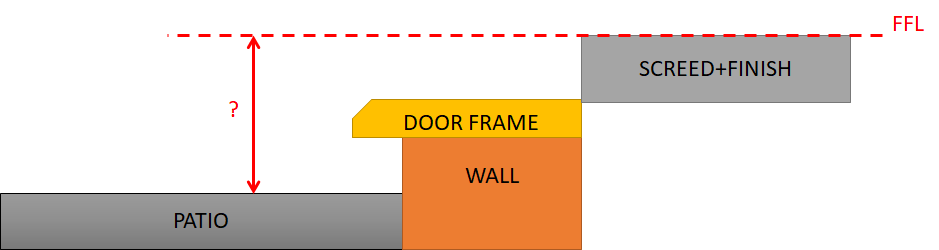
Cool, thanks With cavity walls being so thick these days you could almost put a step within the wall but that might make for a difficult to clean corner and an odd looking door. You'd have to add something to protect the floor finish too.
-
So you think 150mm is probably the limit of what feels OK to actually use. What feels weird to one person may be natural to another though and if there are regs that I should be aware of I don't want to get caught out.
-
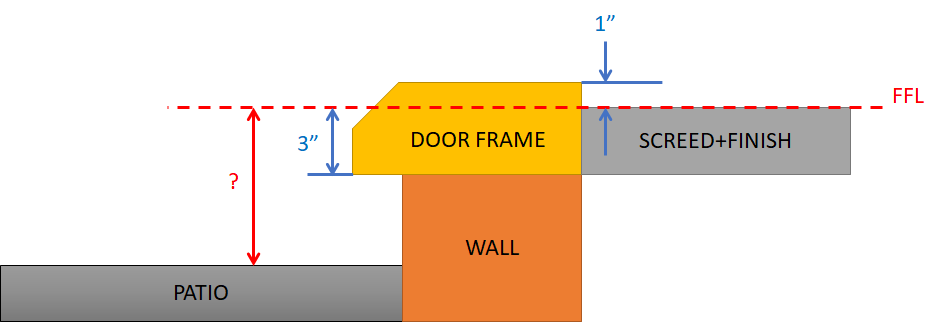
Is this what you mean?
-
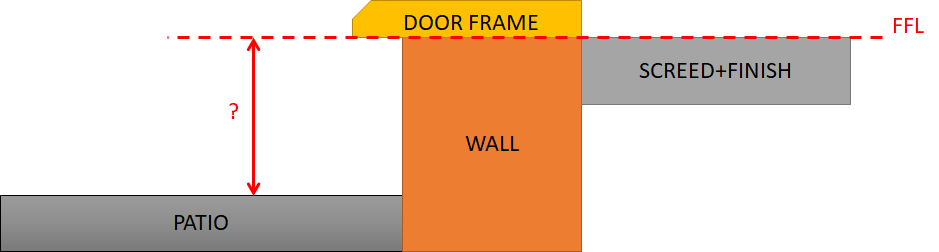
I'd like to lower the level of the patio in the design as there is a gentle gradient along the length of the house that makes the patio quite high at one end. The design has two courses of bricks between the patio level and finished floor level (FFL), so that's 150mm. There will be a door frame which will add a bit more height I expect. The factors that come to mind are: Is there a building reg that limits the height change without the use of a step? Staircases have a 220mm limit and the door threshold is in some way equivalent to a step, but if there is a frame that adds extra height What would feel weird, 350mm doesn't feel viable but is 225mm? How low can the door frame be before it adds expense or looks rubbish. I'd expect the door frame to sit on the two courses of bricks and so have its bottom at FFL. I'd like to have 200mm between patio level and FFL I think, but that is only on paper not based on experience of traversing such a doorway.
-
Tolerances to expect
MortarThePoint replied to MortarThePoint's topic in General Construction Issues
It's a fair point Vijay. I'm not trying to be difficult It's just that I don't have years worth of experience to rely on to be able to spot a good job when I see it and there are various things that need to line up. They were out by 150mm with a section of foundation and my very nearly preordered (I bottled placing the order when I saw the foundation misplacement) floor slabs have a tolerance of 10mm + 0.1%. I hadn't given them a spec for the foundation presuming that the drawings and accepted best practice gave sufficient guidance. I think I should have asked them what specification I should expect from their blockwork and that's what I'll do with the brickie. I can then evaluate what they come back with. -
Tolerances to expect
MortarThePoint replied to MortarThePoint's topic in General Construction Issues
You're right, I had some sour faces over that. They were OK with reaching the other tolerances, but not the plumb / cavity ones due to exactly what you said. When it's above ground it will be the face that needs to be accurately plumb. Unfortunately, they were generally put out by it all. I'm used to having my work specified and am uncomfortable doing work for people without a clear specification. Trades seem to take it as a lack of faith thing which is unfortunate as it isn't personal. We are using precast floor slabs that set a tolerance on the wall. -
Tolerances to expect
MortarThePoint replied to MortarThePoint's topic in General Construction Issues
Well I have sent the text below to the guys doing the below ground blockwork. It's tighter than the figures discussed above but then I can accept mild exceedance. Saying I specified +/-5mm, knowing I actually needed +/-10mm, and got +/-15mm makes the discussion clearer. I think all of the things are reasonable. I'll let you know how I get on ? "Dimensions: Lateral construction drawing dimensions +/-5mm (i.e. brick or block lateral placement +/-5mm) Brickwork or blockwork flat +/-3mm over 10m (after 450mm of blockwork from foundation concrete) Brickwork or blockwork level +/-5mm (after 450mm of blockwork from foundation concrete) Cavity gap +/-3mm Plumbness +/-1mm over 1m Mortar: Check the Structural Engineer's Construction Drawings but I think it specifies class (ii) / M6 below FFL. "Site mixed mortar should be batched consistently and accurately using batching boxes or buckets. The use of shovels for proportioning should not be used." Full joints (no tipping and tailing or deep furrowing). Other: The concrete fill in a cavity wall should stop at least 225mm below the base dpc Any drawings, building regulations and accepted best practice (including NHBC guidance) that sets tighter tolerances or additional requirements apply." -
Where to put the electricity meter
MortarThePoint replied to MortarThePoint's topic in Consumer Units, RCDs, MCBOs
Looks good and certainly got your money's worth on the connection ? -
Where to put the electricity meter
MortarThePoint replied to MortarThePoint's topic in Consumer Units, RCDs, MCBOs
I've just received the default answer: "all new build domestic services/meters do now have to be external, either on an external wall in a meter cabinet or an external kiosk." I'll have to decide if I want it inside and if so how important it is to me. -
Where to put the electricity meter
MortarThePoint replied to MortarThePoint's topic in Consumer Units, RCDs, MCBOs
I've added a couple of other options: E - ProDave's suggestion F - On front elevation of utility near where house consumer unit likely to be I've also added drain routes. I'm hoping it's not an issue to pass under a surface or foul water drain. If not only A, B and options.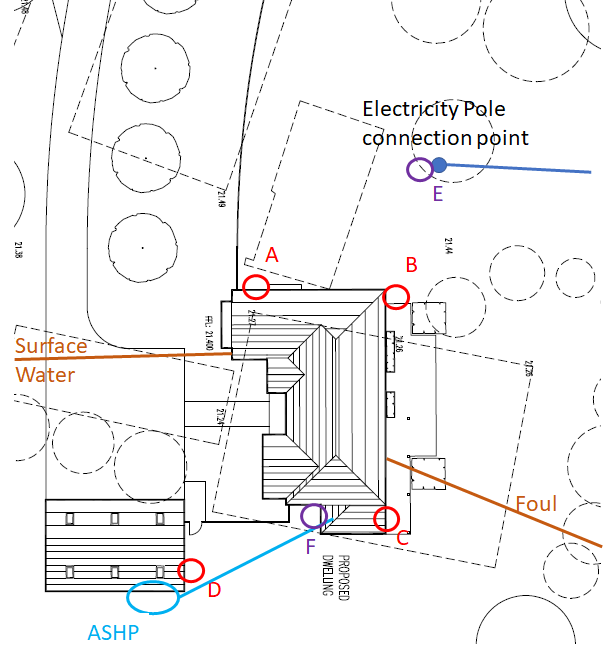
-
Where to put the electricity meter
MortarThePoint replied to MortarThePoint's topic in Consumer Units, RCDs, MCBOs
OK so it sounds like A & B are back on the cards then. I have emailed UKPN to ask if they allow new connections inside a new house. -
Where to put the electricity meter
MortarThePoint replied to MortarThePoint's topic in Consumer Units, RCDs, MCBOs
I was mindful of the routing clashes but not the 3m requirement. The 3m requirement rules out A & B. ProDave: does that mean you have the CU in your kiosk? In terms of clashes, can the electricity be routed under drainage pipes? -
Where to put the electricity meter
MortarThePoint replied to MortarThePoint's topic in Consumer Units, RCDs, MCBOs
I'll pass it by them. Did they insist it had to be visible from the front elevation then? -
Where to put the electricity meter
MortarThePoint replied to MortarThePoint's topic in Consumer Units, RCDs, MCBOs
Interesting thought. I don't have a problem with supply during the build, but this does have its benefits. Is a kiosk not expensive? -
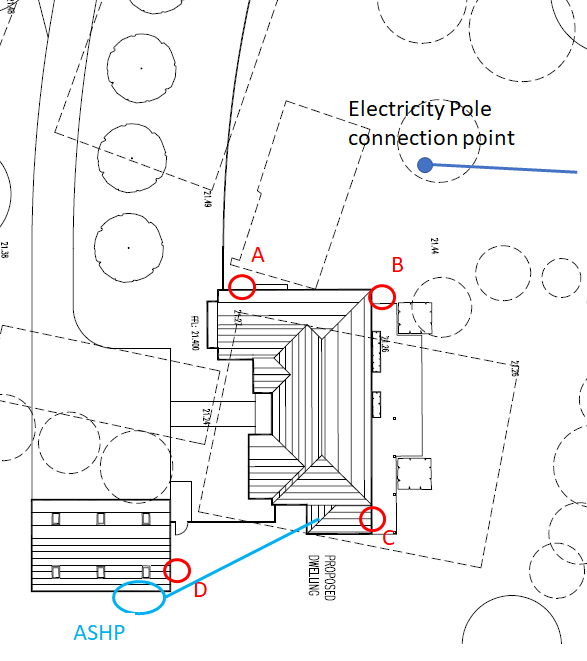
I need to decide where to put the hockey stick for the electricity meter as the sub floor blockwork plan is being finalised. The diagram below shows where the electricity enters site and the DNO would make the connection. I can see three main options A - On the house elevation nearest pole and most visible from the drive B - On the rear elevation nearest the pole and visible from gthe back garden C - On the utility wall (rear or side) where the plant is located, but not the ASHP D - On the garage which is where the ASHP is to be located The Air Source Heat Pump is planned to be on the back of the garage so as to hide it visually and acoustically. I have asked ASHP suppliers and they say that run of pipe to the house is fine. What do people think? I am tempted to go with 3 phase as well as the pole supports that (site previously had it).
-
Reclaiming underfloor insulation (built 2010)
MortarThePoint replied to MortarThePoint's topic in Demolition
I am tempted as it is out of the way then. It may be more possible now given the lockdown being eased slightly.
