ToughButterCup
-
Posts
11716 -
Joined
-
Last visited
-
Days Won
98
Everything posted by ToughButterCup
-

Help me out of these holes, please!
ToughButterCup replied to ToughButterCup's topic in Insulated Concrete Formwork (ICF)
Exactly . 's war I'm gonna do baby.... What an excellent idea- 79 replies
-
- 1
-

-
- icf
- cold bridge
- (and 3 more)
-
Help me out of these holes, please!
ToughButterCup replied to ToughButterCup's topic in Insulated Concrete Formwork (ICF)
The old iron pipe acts as the slide hammer, yes?- 79 replies
-
- 1
-
-
- icf
- cold bridge
- (and 3 more)
-
Help me out of these holes, please!
ToughButterCup replied to ToughButterCup's topic in Insulated Concrete Formwork (ICF)
No you're not, not in the least bit sorry. Just wait until you need some welding doing, then you'll be sorry -
Help me out of these holes, please!
ToughButterCup replied to ToughButterCup's topic in Insulated Concrete Formwork (ICF)
Declan, behave yourself , this is serious.... And you Pete...- 79 replies
-
- 1
-
-
- icf
- cold bridge
- (and 3 more)
-
Help me out of these holes, please!
ToughButterCup replied to ToughButterCup's topic in Insulated Concrete Formwork (ICF)
Ha! This problem is almost fun now. Its kind of you all to pitch in.... -
Help me out of these holes, please!
ToughButterCup replied to ToughButterCup's topic in Insulated Concrete Formwork (ICF)
Quite a bit of the job is left to finish. It's 12mm threaded bar, @ProDave. I'd need approximately 14mm (o/d) conduit inserted in 16mm hole : my SDS+ is 16mm. Is it possible to get 14mm o/d conduit? I've looked, and can't find any.... yet How about Heat Shrink .... 13mm. That should do it. -
Help me out of these holes, please!
ToughButterCup replied to ToughButterCup's topic in Insulated Concrete Formwork (ICF)
Thanks J. Pouring at 2.30 is, so Sparrow's Hiccup next morning, then. And, in relation to our pour, the hole size is small - so the stone would block the hole pretty quickly. Anyway, looks like a very early rise the following morning. Excellent. I really am so grateful for all the help. Ian -
Help me out of these holes, please!
ToughButterCup replied to ToughButterCup's topic in Insulated Concrete Formwork (ICF)
Hi @Russell griffiths: that was going to be my fall-back strategy. There's no need to (normally) cover Durisol (u0.15).... -
Help me out of these holes, please!
ToughButterCup replied to ToughButterCup's topic in Insulated Concrete Formwork (ICF)
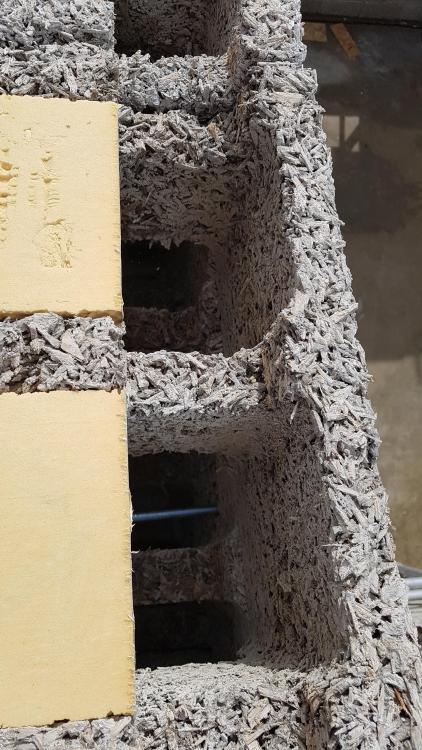
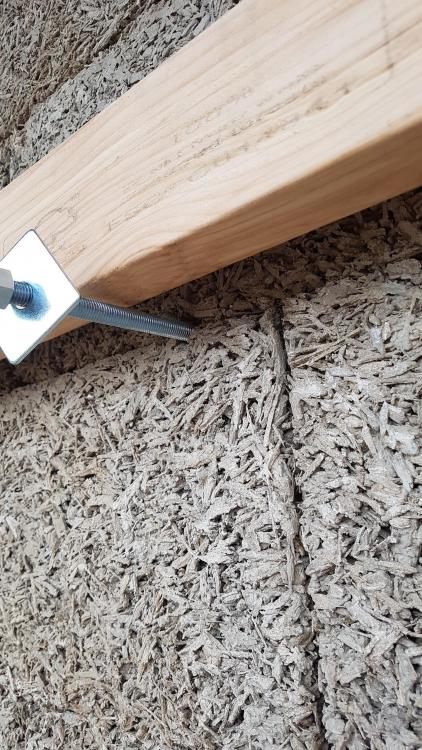
As you can see from the following pics: There are three layers of reinforcement, each tied by threaded bar into a parallel set of timbers the other side of the wall The top layer is easy to see and so to get to thus; Then, some of the threaded bar in the middle layer is exposed because it hasn't been tightened up yet, so I stand a good chance of getting some silicone grease or vegetable oil or something like that to worm its way along the metal; ... a good squirt or two of whatever might well make its way along the bar... And the bottom row of fastening points are driven through concrete that has already set for a month (the layer on which Mark is working in the top photo..... and so should be easy to withdraw, and squirt foam through. Which leaves a fighting chance of being able to withdraw most of the bars. @JSHarris, How long can I leave the bars in before concrete grips too hard to withdraw the bar?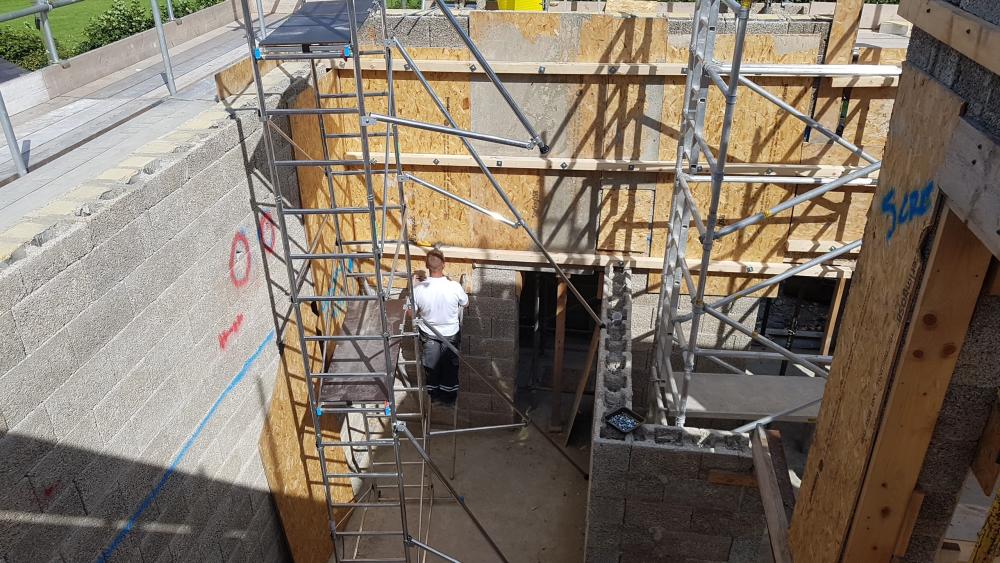
-
Help me out of these holes, please!
ToughButterCup replied to ToughButterCup's topic in Insulated Concrete Formwork (ICF)
Or some simple electrical conduit would do.... my head's fizzing -
Help me out of these holes, please!
ToughButterCup replied to ToughButterCup's topic in Insulated Concrete Formwork (ICF)
Been out and had a closer look at everything. Piccies to follow soon. State visit from friends - and lunch - intervenes -
Help me out of these holes, please!
ToughButterCup replied to ToughButterCup's topic in Insulated Concrete Formwork (ICF)
Arghhhhhhhhhh. The wall was plumb before we shuttered it. But thanks for the nudge. I'll go and check the bits that we have already shuttered now. Like right now. -
Help me out of these holes, please!
ToughButterCup replied to ToughButterCup's topic in Insulated Concrete Formwork (ICF)
Hmmm, probably not, but I have do have a very curious cat. I'll try and persuade him. I've just emailed the MD of Durisol to see what's what on this one. -
Help me out of these holes, please!
ToughButterCup replied to ToughButterCup's topic in Insulated Concrete Formwork (ICF)
Quite a few of the bits of threaded bar are already in: I don't suppose I could use WD40 spray to the same effect could I? It would save a good few hours' work. I'm thinking that simply removing one set of braces from one side would expose the threaded bar partially. And being able to spray a good size gobbit of WD40 along the bar would help a good deal. I'm on my own on site until they come to pour on Monday...... -
Help me out of these holes, please!
ToughButterCup replied to ToughButterCup's topic in Insulated Concrete Formwork (ICF)
You seem to suggest you both clamp the inner nut (in a drill chuck) and put a spanner on the same nut.... or have I got the wrong end of the nut, as it were? -
Help me out of these holes, please!
ToughButterCup replied to ToughButterCup's topic in Insulated Concrete Formwork (ICF)
They have no recommendations because shuttering is not normally needed. Normally. -
Help me out of these holes, please!
ToughButterCup replied to ToughButterCup's topic in Insulated Concrete Formwork (ICF)
You lot are brilliant. Thanks so very much indeed. I lost a good deal of sleep about this last night. I wish I'd posted this earlier................ Now, only got 60 studs to take out, grease and replace before we pour on Monday. -
I chickened out......until
ToughButterCup replied to ToughButterCup's topic in General Self Build & DIY Discussion
It's right on the roadside for God's sake. Wouldn't want the newts traumatised would we? -
I chickened out......until
ToughButterCup replied to ToughButterCup's topic in General Self Build & DIY Discussion
I haven't forgotten @Russell griffiths...... just wait, revenge is on its way -
I chickened out......until
ToughButterCup replied to ToughButterCup's topic in General Self Build & DIY Discussion
What, my weder can cut tooooooooooooooo? How? When? How much? Honest? No, I mean really....... -
I chickened out......until
ToughButterCup replied to ToughButterCup's topic in General Self Build & DIY Discussion
God, don't encourage her lads.............. -
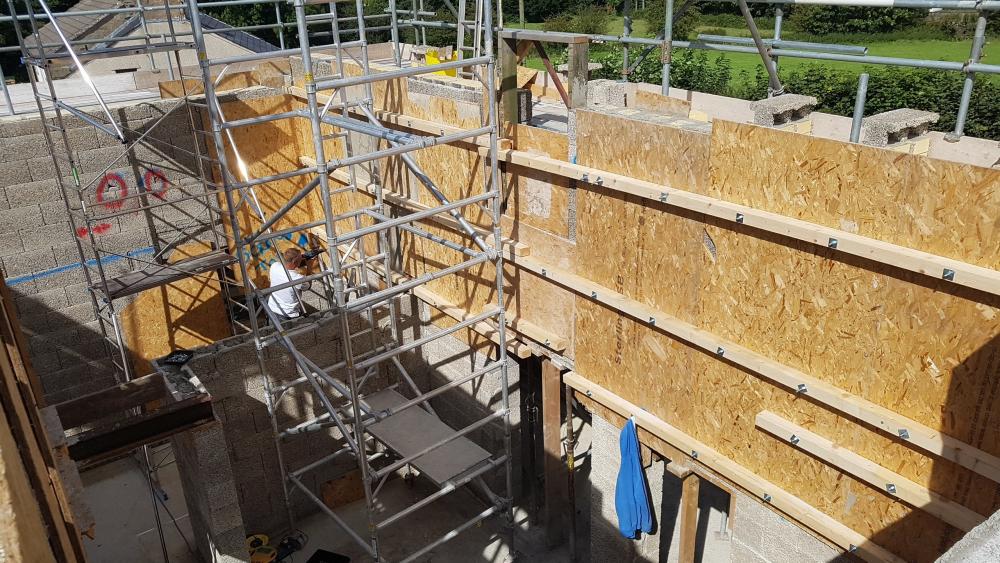
Meanwhile, back at the ranch, we decided not to trust even one block laid by the original builders. And that means treating the Durisol like, well, the wall at Blackpool sea front. I know, it's tantamount to an admission of defeat. But do we want a wall we can trust or not? Short of scanning each block for integrity (well nigh impossible) there's nowt else we can do. Have a look at those lovely lengths of threaded bar fastening the OSB to a similar support structure the other side of the wall. My God I can cut and trim threaded bar to size at speed now. And in doing so have presented myself with 60 cold bridges. Poo. Here are two ideas that we have come up with to fettle the issue. A few hours after the pour, undo the nut on the outside (insulation side of the ICF) and tap the threaded bar back in (say) 60 mm, and fill with foam. Allow the concrete to cure. Remove the sheeting, and drill back the bar from the inside this time. Fill with foam. Leave it. Allow to cure. Drill out 120 (both sides of 60 bars) to a depth of 60 mm, fill with foam Has anyone got any bright ideas? Please? Hope so Ian
-
Mum's the word.
-
I chickened out......until
ToughButterCup replied to ToughButterCup's topic in General Self Build & DIY Discussion
That does it..... -
The purpose of a Phase 1 study is to assess whether or not to do a more thorough survey. By another name, a cost reduction exercise. You may find precisely nothing needs doing. Let's hope so. But why would you want to submit an application for a lead-soaked patch of made ground? Or landfill that leeches cyanurates? I am lucky enough to live on a heart-breakingly beautiful patch of land, that was filled with damson trees. On made ground. (Hear the warning bells "Made Ground") On a row of four workers cottage built to house the families who built the local canal. A tiny hamlet straight off a picture postcard. Our Phase 1 survey found Weak made ground Glacial Till So, we had a Phase 2 study done. Why? How deep was the Made Ground on top of the glacial till? Were there any other issues we needed to know about? As it turned out we had lead to deal with too. Not much, but lead is lead, and I don't want that in my lettuce. Yes, I can. Get several quotes and do it. Just do it. Here's what doing the soil survey 'did' for us.... Enabled us to send two charlatan Would Drainage 'experts' packing when they tried to sell us a drainage system based on an inadequate Percolation Test I knew exactly what was under the ground. Bastards. Helped us dismiss several Piling 'Experts' when they turned up chanting "£22 thousand pounds mate" while deriding the relevance of soil surveys "Buuuut ah'll tell thee what meeert, 'ahve gorra contact as'll do yer wun fer next ter nowt". Bastards Took the wind out of the company we eventually used for piling when I told them we already had the detailed Phase 1 and 2 reports along with a soil profile: the piling company wanted to charge a good deal more (because they needed their agency cut for their 'partner' company) Eventually we paid £6,500 for piles - most companies wanted at least £15k. Bastards. Told the ground workers exactly where to get off in terms of describing exactly where the water table is. Teeth sucking estimates about how dodgy it is 'roun' yer' Bastards Identified exactly where to put our soak away Happy Chappie A soil survey is a risk reduction strategy. It isn't foolproof. But it helps you plan, and it helps weed out the inevitable charlatans (bastards) that home-in on self builders. Just do it. Ian
- 18 replies
-
- 1
-
-
- soil sample
- phase 1
- (and 3 more)