Dan F
-
Posts
1431 -
Joined
-
Last visited
-
Days Won
2
Everything posted by Dan F
-
I don't know that it does make them more efficient at 60C to be fair. Also, as I said elsewhere 75C doesn't mean DHW at 75C. My aroTherm gets up to around 73C, so the max DHW temperature is really not much more than 65C. We sometimes heat the tank to 65C if we know DHW is going to get a lot of use, and it makes the 300L UVC go further. R290 doesn't have any specific issue with the cold, it does have some additional installation guidance regarding clearances.
-
Vaillant quote following SCOP for 55C: 7kW - 3.39, 10kW - 3.58. Few points on DHW: - When you look at temperatures, you need to consider ASHP flow temp will need to be 60-62C to heat the tank to 55C. So check what the max temp on non-R290 models is. - If you run a Legionella cycle weekly, the R290 AHSPs won't use immersion for this. They can heat the tank to 65C with COP of, at worse, around 1.8. SCOP and COP vary because they are two different things. The COP of all three is roughly the same (with Nibe a touch better). Given how close they are though I'd be looking for the best controls including weather compensation (which can have a significant impact on performance), the best integration with Loxone and support for cooling and price.
-
16 mm or 20 mm MLCP for combined bath/shower fill?
Dan F replied to markocosic's topic in General Plumbing
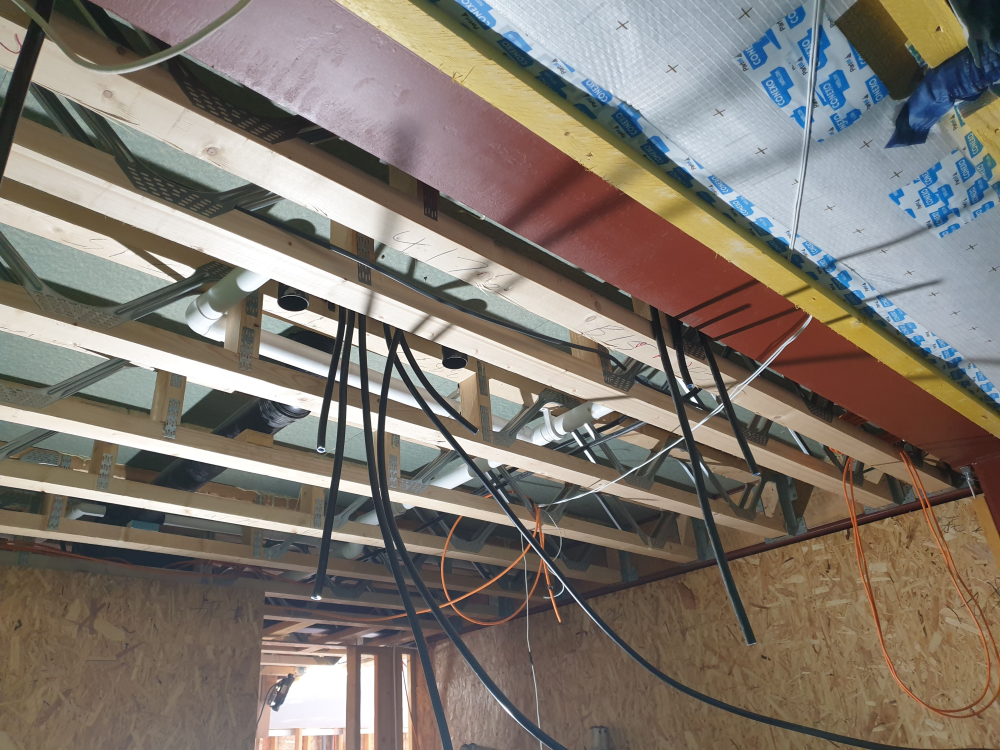
Then, on top of this, there were going to add more 90deg fittings in between the joists: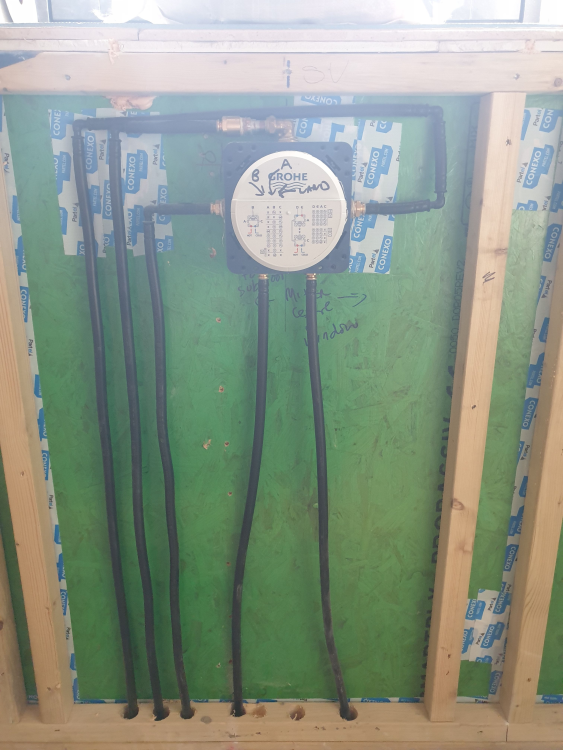
-
16 mm or 20 mm MLCP for combined bath/shower fill?
Dan F replied to markocosic's topic in General Plumbing
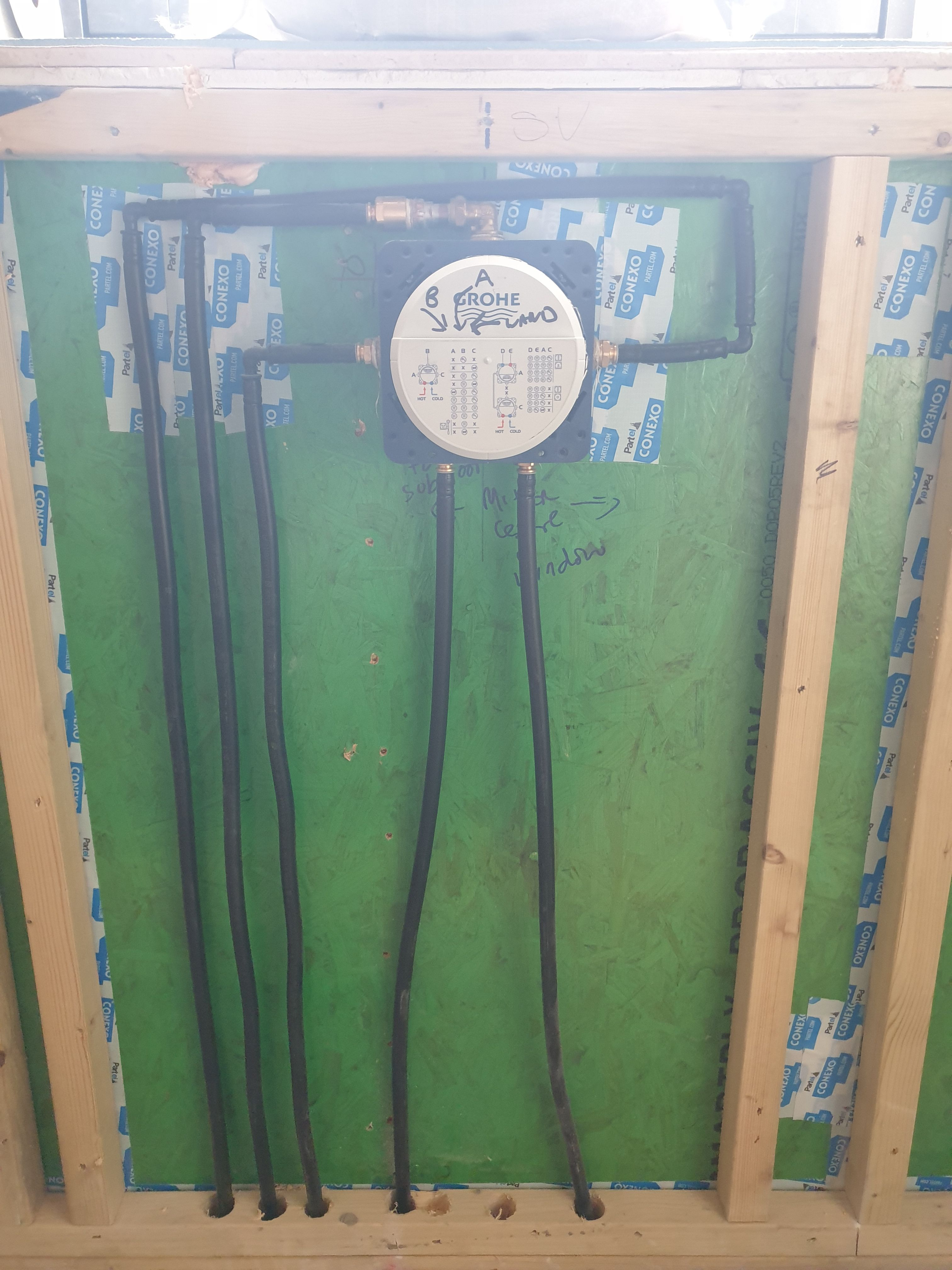
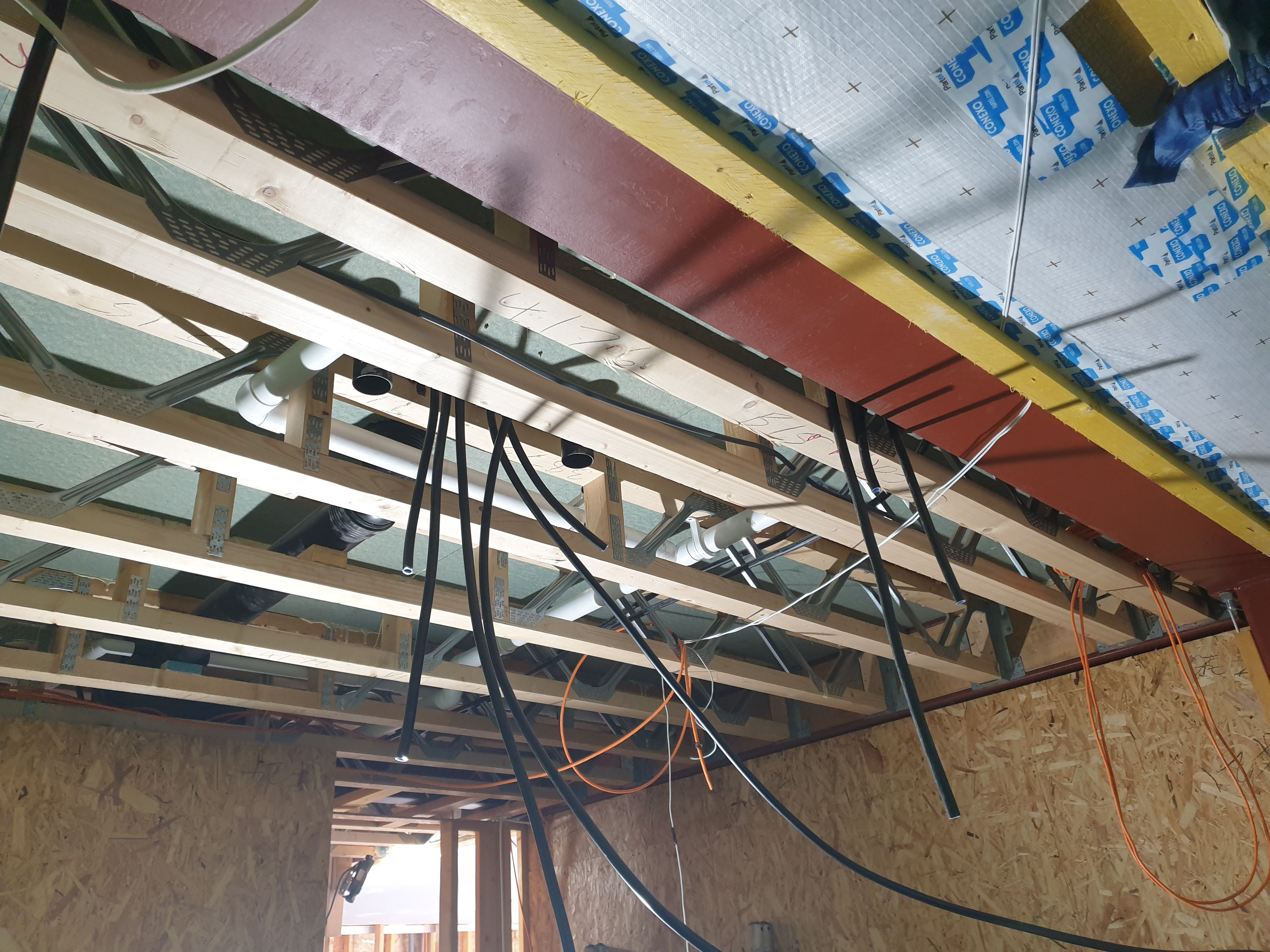
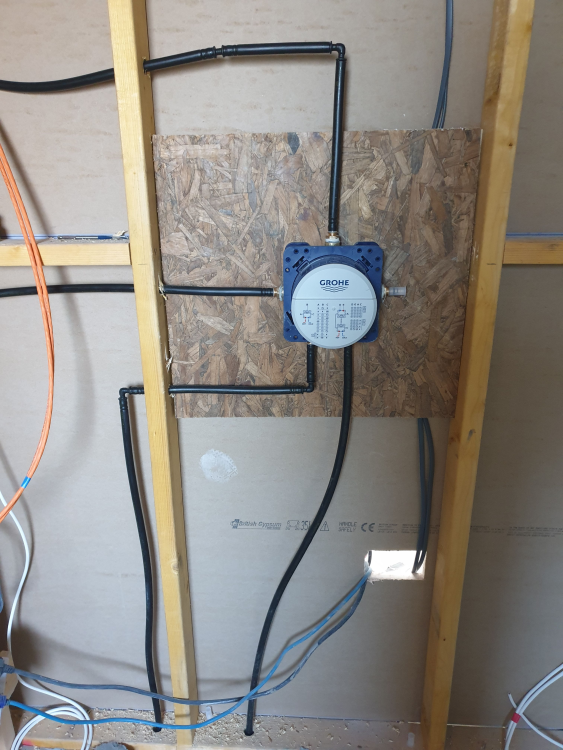
Tell me about it! Our plumber hadn't used MLCP before (or at least it seemed that way) as he installed shower runs as if they were copper with fittings everywhere, rather than bending the pipe. This was with the MEPLA fittings, which are even narrower than some of the other brands, so, with a 12m 16mm run and 5->6 of the 90-degree fittings, we'd had got minimal flow rate from the shower. Had to take some photos and send them to Geberit technical who confirmed that it wasn't going to work and not designed to be used like that, to convince the plumber (with the help of the main contractor) to redo things. I've still got the photos somewhere, which were quite assuming.. -
We use a 63mm duct cut into EPS below the concrete, then coming up under the island and under the consumer unit. Has a large supply for the induction hob, another supply for sockets and additional room for a lighting run etc if needed.
-
@puntloos Why don't you put your MVHR near the outside wall? Your ducts to the exterior as they are will need a lot of insulation if you want to keep your PHPP person happy, also you'll lose a small amount of MVHR efficiency. How about: - Consumer unit next to the door. - Loxone where it is but higher up, with cupboards (reduced depth due to ducting at read) above the Loxone panel. - MVHR on the same wall, but all the way over to the right, ideally at a height that makes changing filters doable without a stepladder.
-
Drop ceiling where you have this? That's what we had to do..
-
Exactly the same MVHR as us then, yours is just specified to use all Zehender kits probably. We have one of these, but we did bring 3-phase into the plant room. https://hager.com/uk/products/h/jk112bg-125a-12-way-tpn-board-glazed
-
Are these all hidden in the ceiling then? Good! We've got big Lindab Silencers and standard Lindab manifolds. That looks like a more compact solution which would allow MVHR at height. Few observations though: - You'll have to get on a stepladder to operate the controls (although you can do everything via the app if you buy the LAN extension box). - You'll have to get on a stepladder to change filters. - You'll need a condensate drain for the MVHR unless you have an enthalpy exchanger specified as we have. which doesn't require this. It'll be in hand when you have a design and also know what you are doing for lighting control, so you can be confident about cabinet(s) size etc. That looks better, but: - Is the consumer unit within the height limits? - Is the consumer unit big enough for all your circuits? Ours is 850x465mm!! - Is the consumer unit accessible enough and usable given the MVHR position?
-
If we assume that @puntloos chose his M&E consultant/installer based on their experience and credentials. If this is the case, and his system is designed correctly, then there is nothing wrong with using Ecodan (unless you are concerned about lower GWP). If as you suggest, most Ecodan systems are badly designed or installed, then this would explain why they do poorly on heatpumpmonitor.org. But I'm not sure why you say that Ecodans are not performance oriented. That's my take anyway.
-
I think a lot of installs, including Vaillant, use 4-pipe buffers. I know ours does. The Vaillant branded buffer is 4-port and their schematics show a 4-port configuration too.
-
As I mentioned in my previous post, you may need trunking from that out of your Loxone cabinet and it's a good idea to separate 24v and 230v. This might be harder to improve on with the MVHR directly above the Loxone panel. Do you have a Loxone design yet and have you decided on your lighting control strategy? These would both help you understand how many terminations you will have into this panel as well as what size/depth cabinet you need. In terms of the MVHR, does your design not include noise attenuators? If so, where will these go? In our installation, our MVHR has some pretty large attenuators installed vertically above the MVHR, which wouldn't fit where you have the MVHR in your 3D model. Unless you have a noise-attenuating manifold somewhere else?
-
It's also about the volume of water in the system. If you aren't using per-room zoning you'll be OK, if you are using zoning need to ask i) why? ii) what size buffer do you need to minimize cycling. UFH aside, where you will almost certainly need a buffer is for using fancoils, especially if you have per-room control and they may be used without UFH.
-
Are you doing Loxone DIY or having someone do it for you? Either way, it's a good idea to understand what's going on in the cabinet, and if you need any other satellite cabinets at this stage. Also to understand if you need the LXN-D. In terms of trunking, depending on how much you are doing with Loxone there could be a huge amount of cables coming into the panel, both 24v and 230v. What I have done, and I think others also do, is use two lots of trunking with the LHS trunking for low-voltage and the RHS trunking for 230v. This follows the standard practice of using the LHS of the cabinet for low-voltage wiring and the RHS of the cabinet for 230v wiring.
-
That's small! Typically the whole top rail is used for terminal blocks and a good chunk of the bottom rail for RCBOs and power supplies etc. This leaves you will a single rail for all your Loxone extensions, is this enough? Or is this some sort of satellite cabinet? Also, if you may be mounting any of the larger DIN-mounted power supplies typically used for LEDs, it can make sense to get the deep version of the LXN cabinet.
-
You have to be careful though because a smaller kW, doesn't necessarily mean it will module any lower! The Ecodan (PUZ-WM) is actually a good example of this as both Ecodan 6kW and 8.5kW seem to have the same minimum outputs.
-
We used Vailant because they use R290 (lower GWP than R32), they can heat to 70C if needed, has good SCOP and low noise, and because their 7kW unit was the right size for us while allowing some headroom (PHPP heat loss also just over 3000W). Vaillant modulates down to 30%. That said, I haven't heard anything bad about Ecodan, this was our second choice and I know various others have Ecodan. https://heatpumpmonitor.org/ is an interesting resource, but there is so much that contributes to efficiency beyond just the ASHP itself that I'm not sure it's a reliable source for deciding which manufacturers are efficient personally. @joth How is yours performing and what is its minimum modulation?
-
16 mm or 20 mm MLCP for combined bath/shower fill?
Dan F replied to markocosic's topic in General Plumbing
Which book is that? 16mm Geberit MEPLA (which is what we used) has 0.9 bar loss over 10m at 18L/min. 18L/min is the max recommended flow for 16mm, as they recommend keeping velocity at <3m/s (but higher than for copper). In reality though, if your design flow rate 12L/min and your hot water tank is at 48C, then you'll only need 10L/min hot water. In this case, the loss seems to be more like 0.3 bar, yes. -
16 mm or 20 mm MLCP for combined bath/shower fill?
Dan F replied to markocosic's topic in General Plumbing
What shower flow rate did you want/expect? -
Technically it's a maximum heating load of 10W/m2 or max heating demand of 15Kw/m2.yr. The heating load is typically always <12W/m2 though. You have to allow some headroom though IMO because: i) house might not perform as well as PHPP says ii) outdoor temperature used for PHPP is quite modest. In our case (SE England) it's only -1.6C and we've just had a winter where it was much colder than that for multiple days. The next Ecodan down is likely 5kW which could well be too small for a large house if you were to allow for e.g. max 20W/m2.
-
Do all windows have to be 1100mm from the floor to opening now?
Dan F replied to Papillon's topic in Surveyors & Architects
Overhangs and blinds are the best first measure to manage overheating from solar gain, before using reflective coatings or reducing window sizes. Correctly designed overhangs allow light in the winter, but shade in the summer and blinds of course and be used on demand. Depending on u-value and g value of your windows, smaller windows can actually increase the yearly heat demand of a building, due to a reduction in solar gain in the winter (when overhangs don't shade as much and blinds are up). -
I used a decided shielded CAT7 daisy-chained for 1-wire, and radial CAT7 runs to each room for tree and IO. This means I've got more cores for IO in each room, and means I get 20+ 1-wire devices on a single Loxone extension. I found the following worked well: - 1 pair: DQ+GND - 2 pair: VDD+GND - shield: GND I haven't tested to see if i) twisting VDD with GND or ii) connecting the shield to GND had the most impact, but I know I had some issues before doing this.
-
Loxone says max 20 devices, but I've got just over 20 working well and plan to add a couple more. I'm using a long single run around the house with the probe leads forming short legs. I haven't used any resistors but did tweak how I was using the cat cable slightly to try to reduce noise, without this I was having some issues.
-
Is there a no-frills R290 heat pump?
Dan F replied to sharpener's topic in Air Source Heat Pumps (ASHP)
You seem to be describing the salus self-balancing actuators. Makes sense for per-room fan coils and upstairs vs. downstairs UFH. But are you using per-room on/off actuators on the ground floor UFH? -
These are good https://www.blanco.com/gb-en/kitchen-taps/full-tap-range/. A lot of them have pull-out heads, and some different spray types and spray buttons.