Dan F
-
Posts
1431 -
Joined
-
Last visited
-
Days Won
2
Everything posted by Dan F
-
Zehnder Q350 Lan C + Options Box
Dan F replied to BartW's topic in Mechanical Ventilation with Heat Recovery (MVHR)
You can do everything and get all stats using https://wiki.loxberry.de/plugins/comfoconnect/start. If you use this approach there is no need to connect anything else, so it's just single cat cable and no need for options box. -
The Force batteries might be stackable but don't appear to have very good charge/discharge rates. 60A (which is less than 3kW) for 14kW is pretty poor. That said, I agree that the Pelio series look interesting as these are stackable, have slightly higher capacity than the US5000 and quote 5kW per battery vs. 3.8kW.
-
Multi-click function block
-
Interesting KNX significnatly more expensive. Did that include a KNX "server" that gives nice usable central control/interface?
-
Just looked ours up, it was 950x2300 so a fair bit smaller. Your not going to have any issues moving with a door that big, just hope you've left enough in the bank for some home automation 🙂
-
Another Flush threshold question - Aquabocci R47
Dan F replied to SBMS's topic in Landscaping, Decking & Patios
Dont have an answer for you, @craig is the expert. But I can share our slider profile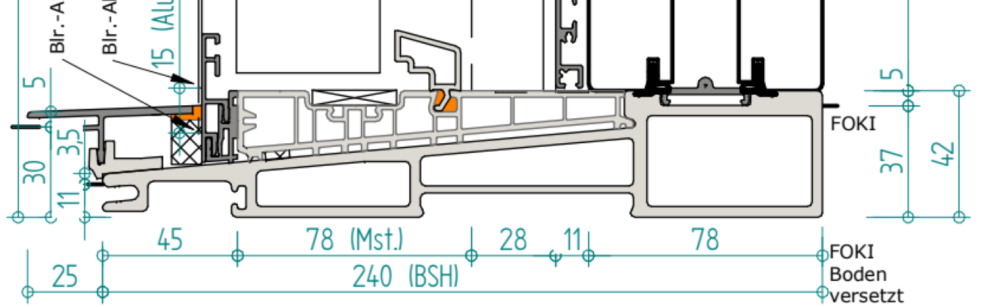
-
Our Iroko UrbanFront door was 7.8k all in (ex VAT). This long stainless steel handle was 600 for the pair, motorized lock 800 and matching side-light frame 1500. This was 2yrs ago though, so either prices have gone up a lot, yours is very big or the black oak is v expensive. Not installed yet, but planning to use the Loxone NFC keypad instead of fingerprint, thought it was more flexible for cleaners or giving someone a temporary code while away etc.
-
Already have Unifi protect yes. As for if Unifi is better than Hikvision I'm not sure. The software is more polished and is integrated with the wireless controller which I liked, but it's also a bit more of a closed system I bought some Somfy curtain tracks/motors recently from https://thehomeofinteriors.co.uk/. Most of what is on their website is "RTS", but they do sell the very basic "WT" version if you ask. Looks like they do motorized blinds too. Wow. either thats a big door or prices have gone up a lot over the last 2yrs!!
-
@Hilldes must be using one for half of the loops and the other for the other half of the loops. So each Salus actuactor is balancing 10 or so loops (as a whole) each.
-
You can do exactly this with the Vaillant without needing a Wunda wiring centre. The easiest solution (which best supports weather compensation and optimum efficiency) is to have a Vaillant controller on each floor. If you want you can use an external call for heat (from something like loxone) but then it's a bit harder to leverage the weather compensation as well and there isn't a simple way to control ASHP flow temperature externally so doing your own weather compensation isn't easy. My understanding was that these are designed to be used one-per-loop, and will automatically constrain flow on shorter loops to self-balance. One per floor may help balance GF and FF (if they are on the same ASHP circuit), but you won't get per-loop auto-balancing.
-
Yes, they aren't different options, they all work together. VR71 is the wiring centre, the sensoComfort is controls. The most basic installs don't use VR71, but anything with more zones does.
-
It's not wireless. It's wired (via ebus) to all the other Vaillant stuff and has input for temp sensors and outputs for zone valves and mixing valves.
-
Yes No, price was based on centralized relays using relay extension. Hard to beleive that a basic blind motor is £150. You don't need to use a Loxone motor and for a new build I wouldn't use Loxone Air either. Ideally buy blinds that come with the motors and get basic wired motors without any wireless control. For example? KNX has the advantage of being vendor-nuetral and having a lot more hardware options, but this does bring some additional complexity.
-
With the VR71 you can use 3 mixed (or unmixed) circuits. You can do even more than 3 circuits if required with additional VR71's I think. These circuits can be UFH, radiator, fancoil or anything. It's more of a companian to Loxone (running on a rapsberry Pi) to integrate with additional things including internet weather services etc, than an additional layer. With a KNX-based approach, have you thought about if you would have a central "server" with nice app for everyone in the family to use? Have you thought about how you would integrate with things that may only have a cloud API and not a KNX adapter?
-
Yes. Unifi Protect doesn't have low-voltage option though, and no direct support for Unifi notifications in Loxone or any Loxberry extensions. I think there is a home assistant plugin for this though, so that might be worth me exploring and then bridging to Loxone. The relays aren't hugely expense at £40 per blind. You've can probably get cheaper KNX relays yes but other costs/complexities with KNX. Another option that integrates easily into Loxone would be cheap DMX relays, but this make more sense if you also use DMX for lighting. It's very easy to control volume and skip tracks. Make most sense if you have a favorites playlist or want to listen to radio without having to use your phone. You can do creative stuff with the Loxone switch to achieve this like a double-tap to switch between blinds, or using the RHS if you aren't using audio. But there are cases for simple switches, and this might be one of them. Is this motors + relays? What blinds are they, what motors are you looking at? Don't the blinds come with motors?? Makes sense and you can do a lot like this, just harder to pull things together and you don't have a single go to app that controls everything. For example, you are going away for the weekend and want to turn off lighting, lower blinds, turn-off music and put MVHR on minumum and put heating on 17C setback and set alarm, thats a lot of apps you need to go into to achieve that vs. something you could do via a simple quadruple-click on the switch as you leave the house.
-
We have one of these and it's effiicienlty managing 2 zones using weather compesation with no use of seperate UFH controls. Reasoning makes sense, but in a modern well-insulated and airtight house its harder to do this effectively and per-loop controls risk conflicting with ASHP controls with potential for short-cycling and reduced efficiency as @JohnMo also mentioned. That would certerinaly be a much more complex route that using something like Loxone. You are right Loxone can't integrate with everything out of the box, but you can expand it's functionality via LoxBerry or even using a KNX extension if needed. With the MVHR you can integrate using simple volt-free contacts for simple things like boosting, if you want full contol and all the data then you can use Loxberry plugin: https://wiki.loxberry.de/plugins/comfoconnect/start
-
Need to be seperate, but you can hook up to a loxone DI. See: https://www.aico.co.uk/product/ei128r-hard-wired-relay-module/ Yes, although something I want to try to do is get motion alerts from "Unifi Protect" to turn lights at front of the house on/off. You should run 2xCAT6 minumum anyway, even if you don't use video distribution these serve to hardwire tv and apple etc etc. Also run 2 x co-ax for freeview/stalalite. This guide is slightly US-centric, but still very valuable: http://www.tymhomes.com/wp-content/uploads/2018/01/TYM-Prewire-Quick-Guide-3-D.pdf If you are doing a new install I wouldn't use wifi-extenders! Instead use hard-wired (PoE) access points around the house, all wired back to a central router in plant room, or where your internet comes into the house. You will need two relays per blind motor if you use basic blind motors. This approach is the simplest though and avoids you being tied into a given manufactuer and their wireless protocol. Other motors have a permamant live and are then control via low-voltage I thought I'd be controling actuactors via Loxone when I first started, but quickly realised that this doesn't make sense. Instead I know have two zones managed by the Vaillant controls and each UFH loop has a self-balancing always-on actuactor instead. Yes, they have a KNX or LAN box you can get. With the LAN box you can connect to Loxone using a Loxberry plugin. I have programmed boost based on bathroom humidy just yet, to be honest I've been suprised at how well the Zehnder units do things themselves, especially the automatic night purge that they do in the summer then it's cool outside but still warm inside, that's invaluable and not something. Lots of ways to do this. We used a mix: - For larger areas where we entertain or want higher quality we used local Bluesound Powernodes with better speakers. - For bedrooms and other smaller rooms (where power output and quality less important) we use Loxone AudioServer - For TV room we use local AV receiver. Loxone Tree switches are expensive, but start to make more sense if you also use them to control blinds and audio. Also, they are slightly more than a 1-gang switch in the sense that it's easy to do things with double/triple taps. That said, there are cheaper alernatives for sure, including the more basic switches that Loxone sell. The tree switches do mean less cables to terminate. £3k for blinds or blind controls? I'd think a bit more about the heating controls. Audio you can pre-wire and then work out the rest later can't you? What do you mean my "mini-smart"? Have a mix of different wired/wireless protocols from different manufactuers will make it a fair bit harder to have a centralized control and create automation that span multiple things. Are you planning to hire someone for Loxone install/configuration or do it yourself?
-
Yes you could, not missing anything. What is your heat source? If your house is well-insulated I'd consider the following though: - Not trying to control UFH on a per loop/room basis, but rather per-floor. - Have your heating controls control 3 heating zones, rather than an external system.
-
Correct, also a lot of it is is likely to be 230v anyway. For the tri-rated cable it comes down to max current. While tri-rated supports higher current/temperatures than most cables it is wise to leave a decent about of headroom, also because you are suppsed to derate max current where wires are bunched up (as they often are in a cabinet). How much current each cable has will also depend on how you wire things up within the cabinet i.e. if you distribute power from a power distirbution block or daisy-chain. I used a mix o 0.75mm2, 1.0mm2 and 1.5mm2 - 0.75mm2 for DC (this is all low current though, as all my lighting drivers are outside panel) - 1.0mm2 for almost all 230v runs, including blinds, dimmers, UFH, towel rails (I used power distribution though, so no single run was more than a few amps) - 1.5.mm2 from RCBO's to power distribution and any higher current runs. - CAT7 twisted pair for Loxone tree. See page 3 of https://www.doncastercables.com/product-documents/TRI-RATED.pdf. I think I used 1mm2 for anything under like 8A, and 1.5m2 for anything that might be a bit higher. No reason not to use 1.5mm2 everywhere either, I just had a bunch of 1mm2 that my electician provided to use.
-
I used a dedicated run in shielded CAT7 and by ensuring i earthed the shielding was able to use more than the recommended 20 devices without any issues. Earthing the shielding is easier if the CAT cable has a drain wire i found. The initial batch of CAT7 I got from fscable didn't have a drain wire, even though datasheet said it did.
-
That isn't how I read it. It says that if windows open outwards then the handle much be reachable which makes sense. I don't see anything about windows needing to open outwards only.
-
Detailing for cill drainage with a 'flush' finish patio
Dan F replied to SBMS's topic in Landscaping, Decking & Patios
We used these for level threshold: https://www.aquabocci.co.uk/products/r-47-x-blade-drain Looks like you need to order your sliders with a different cill type, or with an additional profile that can be added on to create a flush finnish. With the sliders we got @craig made sure they were supplied with the correct level-threshold cill. -
https://www.caleffi.com/international/en-int/catalogue/antifreeze-valve-brass-body-108601
-
https://www.seconrenewables.com/volano-wall-mounted-buffer-7698-p.asp Not all installer have moved on to use anti-freeze vales.
-
Don't need HEX. Only real reason to use one is if you have glycol in your heat pump circuit, but not in your internal circuits. But even in this case it's easy just to use Glycol everywhere rather than adding costs/complexity and loosing efficiency. That said, as @HughF says, with anti-freeze valves you don't need glycol. I have a Vaillant install with no glycol, no HEX and a 25L buffer.