Jolo
-
Posts
59 -
Joined
-
Last visited
-
Days Won
1
Everything posted by Jolo
-
 Yeah it's a bit confusing! Easy to read them as directional, which they're not. Just imagine the main unit in the loft of the little house, and it makes a bit more sense. Regarding brands, they're also sold in Germany by Wolf (also owned by Ariston) as the CWL-2. Knowing the various names helps when comparing prices on filters etc! Well I'm glad it's not just us DIYers who have to think carefully about it!
 -
Sounds pretty idyllic! (Though I'm surprised you don't get a lot of flies in the filter) I only just had enough space -- I hadn't planned to add a pre-filter, so luckily there was a gap big enough between two other ducts to fit the box in. If the gap was a few centimetres narrower I couldn't have done it!
-
I'm surprised that ventilation systems don't come with a pre-filter like this, really -- or at least, that the're not more common. Sure, the unit has a filter inside it, but on mine this comes after the temperature sensor and the pre-heater, meaning that these components get covered in dust, and probably flies too. Also it's nice to protect the fancy expensive fine filter with a cheaper one!
- 99 replies
-
- 1
-

-
- mvhr vents
- filter
- (and 1 more)
-
MVHR Enthalpy Exchangers, BS or SB?
Jolo replied to LnP's topic in Mechanical Ventilation with Heat Recovery (MVHR)
@JohnMo Thanks, and yep we crossed off 1, 2 and 3 already, this was pretty much my thinking process when the problem occurred. I'll let the supplier decide whether to try a regular exchanger, but as I mentioned I'm sure it's not that, as the odours transfer even when the extract air isn't flowing through the exchanger. So it can only be number 4 (which is also my conclusion) and as you say, not something I can fix myself, it's for Brink or the supplier to do. -
MVHR Enthalpy Exchangers, BS or SB?
Jolo replied to LnP's topic in Mechanical Ventilation with Heat Recovery (MVHR)
I've checked the bypass by watching it through the port, as it's right below the top of the unit. It's working correctly, but even if it wasn't I don't think it would account for the leak, as the both routes just diverge then meet again anyway -- one route goes through the exchanger, and the other one goes around the back. They're both parallel routes, which converge again before the extract/exhaust fan. So I suspect the leak is either before the bypass valve (although I can see in there via the port on the top, and it all looks fully sealed), or after the two routes converge again, somewhere before or after the extract/exhaust fan. I think it must be the latter, but I can't see much of anything in this area without taking stuff apart, which I'd rather leave to Brink for now as it's all still under guarantee! -
Wow, that filter really is doing its job well! That colour change really is astounding.
- 99 replies
-
- 1
-
-
- mvhr vents
- filter
- (and 1 more)
-
MVHR Enthalpy Exchangers, BS or SB?
Jolo replied to LnP's topic in Mechanical Ventilation with Heat Recovery (MVHR)
This is one reason I chose the ERV exchanger -- it cost an extra 500 euros or so, but if I'd chosen the regular exchanger then I'd have probably spent more than that getting a plumber out to install a drain line, which would have been a pain as there's no suitable point near the unit. It would have involved drilling through two brick/concrete floors and adding a connection directly to the main soil pipe leaving the house. Plus I'd read (I think on here) how some people had uncomfortably dry houses in the winter with a regular heat exchanger, and figured that that, plus the plumbing challenges, made the extra unit cost worth it. For us, the decision about whether to buy any MVHR at all was mostly about comfort! We use so little gas in this house that savings on heating bills never really came into consideration, it was always about living comfort (including indoor air quality). Wow that really is a thin exchanger material! I had no idea there was such a futuristic thing in our cupboard I guess it's true that there could be manufacturing issues with the exchangers, but we've also tested the problem with bypass mode on, and the problem persists. I'm not sure how other units do it, but on the Brink Flair 200/225 left-hand model, when bypass mode is on the extract air is routed directly to the exhaust port, so it doesn't go through the exchanger at all. The incoming air still does pass through the exchanger, though. Although thinking about it, there must be a point at which the extract->bypass channel and the extract->exchanger channels meet just before the exhaust port, so I guess there's a possibility for some back-flow into the exchanger from there..? Anyway, just thinking out loud, that's something for the other thread really! -
Everything is definitely connected properly, I've checked it all about a thousand times, and the bloke from Brink checked it too. I've not gotten around to boxing in any of the ducting yet, so it's really easy to see what goes where, and follow it to its destination. We've also tested the issue by disconnecting the house ducting from the unit entirely, and just putting two single internal ducts on the top -- one on the extract port, one on the supply -- to prove that the problem exists purely within the unit, so it can't be due to anything wrong inside the house. Incidentally, I've also tested by sniffing at the exhaust duct, and the smells do also come through there, so it's definitely mixing air streams inside the unit. (If I'd somehow mixed up the exhaust and supply ports, the smells should only come through one of the "blow" holes, not both!) I'm hoping to hear back from either Brink or the supplier in the coming days, I think they're planning to do a smoke test. I'll keep this thread updated!
-
Thank you @JohnMo and @Nickfromwales for your fast and clear replies, much appreciated 👍 It's good to know that I'm not losing it! The unit was manufactured earlier this year, and it's only been installed and running for a couple of months, so I'm hoping there'll be a quick resolution.
-
Not sure whether to start a new topic or resurrect this one after 4.5 years, but as I have the same problem I suppose it's best to comment here... But I need a bit of a sanity check from those with experience of MVHR systems! We have a Brink Flair 200 unit (it's the Dutch version, the same as the UK Flair 225, but without the screen) with enthalpy exchanger, and have noticed the same issue as described here. Except it's not just kitchen odours, but even less pleasant ones..! To rule out our internal ducting, we even tested it by disconnecting the house entirely and just attaching two lengths of ducting to the unit. Smells which are sucked into the extract duct (shower gel, cream cleaner, coffee, whatever) come out of the supply duct almost immediately. It's really noticeable and strong. It's also not due to cross-flow outside -- Brink came out earlier this week and had a look, our installation is within spec. (Plus the effect is too strong and immediate to be external.) They swapped the exchanger core for a replacement, but the problem persists. (Not a surprise, as the smells also transferred with bypass mode on.) Their next plan is to do a smoke test. I'm pleased that Brink seem to be taking this seriously, and the company that sold me the unit has been helpful. Am I right in thinking that this just shouldn't happen? This isn't normal with MVHR or ERV, right -- nobody would want a ventilation system which spreads smells around the house! I clearly have a defective unit, right? Some seal must be missing or loose, otherwise this just wouldn't be occurring. Both my supplier and the man from Brink said they've never experienced this before, just my luck to get the one defective unit! I wonder what model MVHR @readiescards has/had which exhibited this same behaviour?
-
Ubbink - what are they like?
Jolo replied to lizzieuk1's topic in Mechanical Ventilation with Heat Recovery (MVHR)
Ah that's interesting, I'd been wondering if something like this existed! I'd been pondering how our Flair will behave when the outside temp drops and the built-in pre-heater turns on. I know this is a heat exchanger protection thing, rather than a room temp thing, but I'm not sure if it uses a ton of electric, as it's just a resistive heater as far as I know. But because we have radiator pipes running past our unit and ducting, I'd wondered if it was possible to merge them somehow... Purely speculation though -- I'm trying to resist fiddling with the MVHR any more and concentrate on other stuff, such as boxing in the green ducts! -
Ubbink - what are they like?
Jolo replied to lizzieuk1's topic in Mechanical Ventilation with Heat Recovery (MVHR)
I agree -- if you can stop the sun from hitting the glazing, that makes a massive difference in the summer! External sun shades are really common here in NL and we've gradually had them added to all the windows. One room that was previously a hot box from June to September became a comfortable shady space. Back on the original topic -- although we only turned it on at the end of the summer, having the MVHR in bypass mode helped a lot too, drawing out all the hot air and bringing in cool night-time air. It meant we could close the windows without suffocating (it can be noisy around here even at night due to a big road not far away). -
Ubbink - what are they like?
Jolo replied to lizzieuk1's topic in Mechanical Ventilation with Heat Recovery (MVHR)
Yeah, estimates for our 80m2 house (supply and install) came in about that price, so for somewhere over 5 times larger that just sounds too good to be true. -
Ubbink - what are they like?
Jolo replied to lizzieuk1's topic in Mechanical Ventilation with Heat Recovery (MVHR)
It's definitely not a light bit of DIY! I would certainly consider having a company in to install it in our next house, instead of self-install. Though I'm happy with the results, it was a lot of work. -
Ubbink - what are they like?
Jolo replied to lizzieuk1's topic in Mechanical Ventilation with Heat Recovery (MVHR)
Are you asking about their air distribution system or their MVHR units? Their Ubiflux Vigor units are rebranded Brink Flair units (as far as I know both companies are owned by Ariston, so they're sibling companies, and stuff is cross-branded in different countries -- the Ubbink ducting is branded Brink in France, for example). Like JohnMo I've also used their distribution duct (the green ribbed stuff, Air Excellent) and the grey foam main ducting (the weirdly spelled Aerfoam), along with their distribution boxes and vent terminal adaptors. I also used their wall and roof penetrations for the external connections, and everything fitted together neatly and easily. Had no issues with it (as a first-time self-installer), although the Air Excellent is difficult to undo if you want to make changes -- once they're connected, they're pretty solid! This is a good thing, of course. While it's possible to ease the plastic clip back out, it's tricky in confined spaces. (Funnily enough, if you look at photos of Air Excellent installations in Poland, they use a metal clip which goes around the adaptor, instead of a plastic one which goes inside. The metal one looks easier to remove, though I've never handled one so that's just a guess!) It sounds like you're having it installed by a third party though, so I doubt all that is much of a concern to you! It's solid stuff, and is very widely used as far as I can tell, so it's a sound choice IMO. -
It's a DEC International flexible silencer non-woven, Ø 100mm, 1m long. (Pretty cheap, about 25 quid?) I used Ubbink Air Excellent distribution box adaptors to connect the semi-flex ducting to the silencer, as I have several spares of these (I'd accidentally over-ordered when ordering the parts for the distribution boxes!). https://www.ubbink.com/int/products/ventilation/air-excellent-ventilation-ductwork/duct-adaptors/air-excellent-ae48c-dbox-adaptor/ The ducting clicks into it as designed, and I've used aluminium tape to attach the silencer onto the adaptor. I guess a cable-tie might also be a good idea, I might add one before I put the cupboard ceiling back on. The outer diameter of the adaptor matches the inner diameter of the silencer fairly well, so it fits together pretty neatly. At the vent end of the silencer I did the same thing in reverse, though this was only necessary because I have a Vent-Axia UniflexPlus wall vent in the bedroom, and the design of the ducting connector means it needs the semi-flex duct to be air-tight. If I'd used another brand of ducting at the bedroom (such as the Ubbink Air Excellent ones) then the end of the silencer would just slip over the vent adaptor and be taped on, as the air-tight design on those would allow that simpler connection.
-
I do have a multi saw which I love to use, as it happens That's definitely an option, although cutting the new floor is my 2nd choice, even though that might well be the easiest way to do it! It's probably because the floor is new, and the skirting boards are old, so they feel less valuable and fragile. (So that's more of a psychological issue than a DIY one!) The cornflake box cardboard trick is a genius move, thank you for that! I'd been wondering how we'd get a small but consistent gap, that's the perfect solution.
-
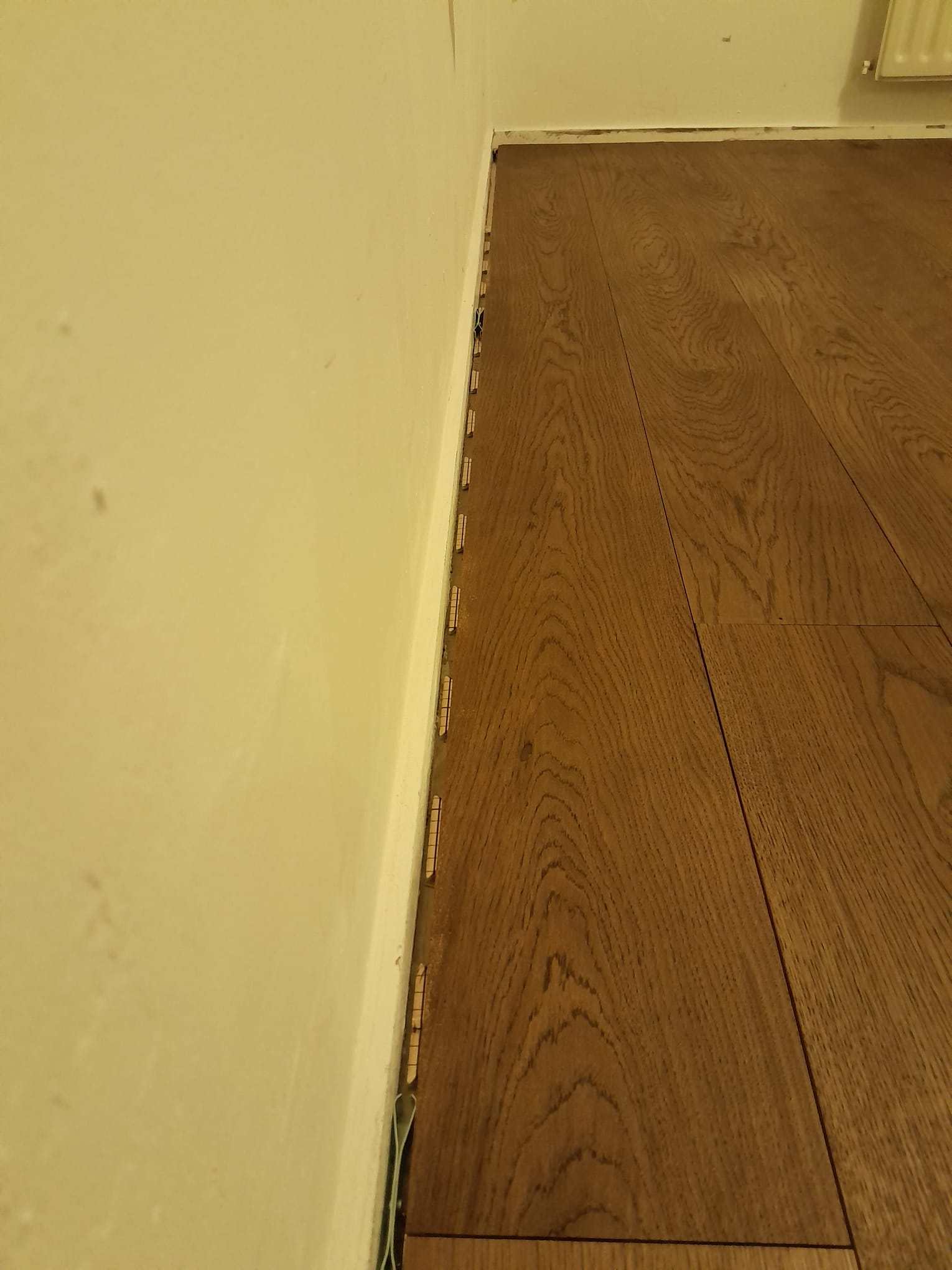
Directly opposite the gap is very generous -- maybe 20 to 25mm, because there's a wood and plasterboard build-out. The plasterboard doesn't go right down to the concrete floor, but stops about 20mm above it, so the floor tension springs are against the framing. Are you thinking that this gap might make up for the lack of a gap on the other side? (If I can get away without cutting, that would be wonderful!) Most of the room has about 15mm gap, which is a bit big, but I've got quarter-round to cover that.
-
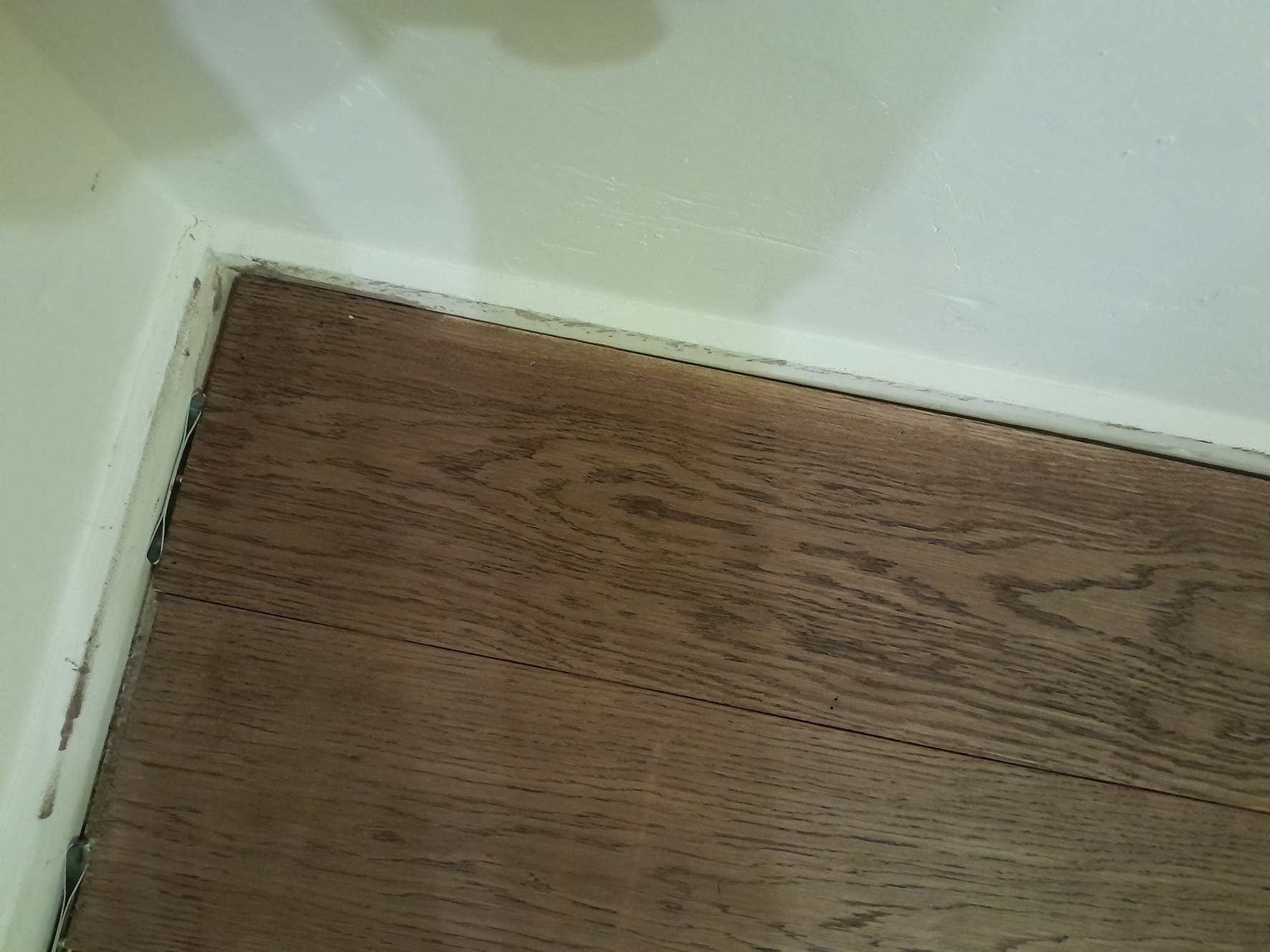
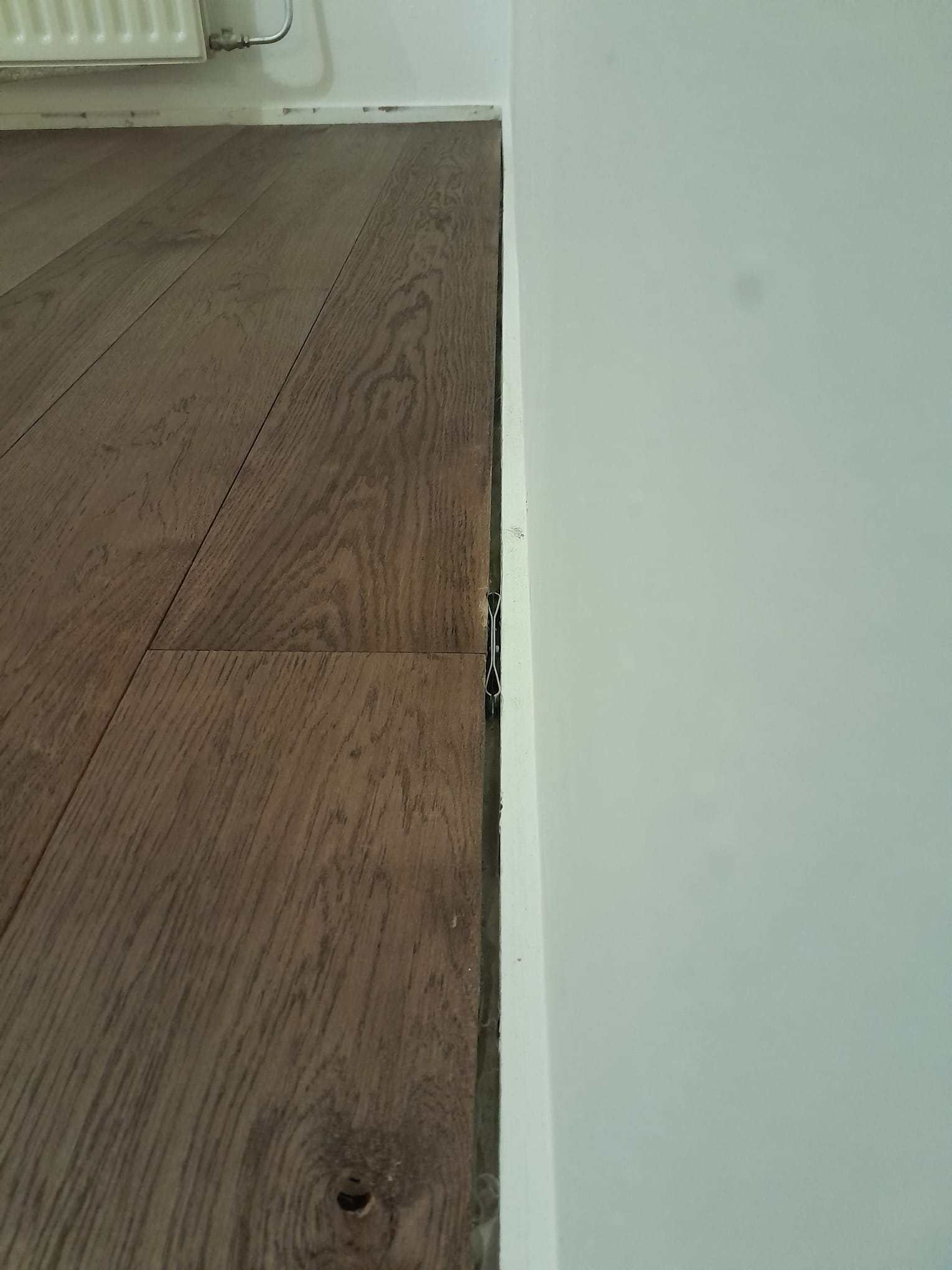
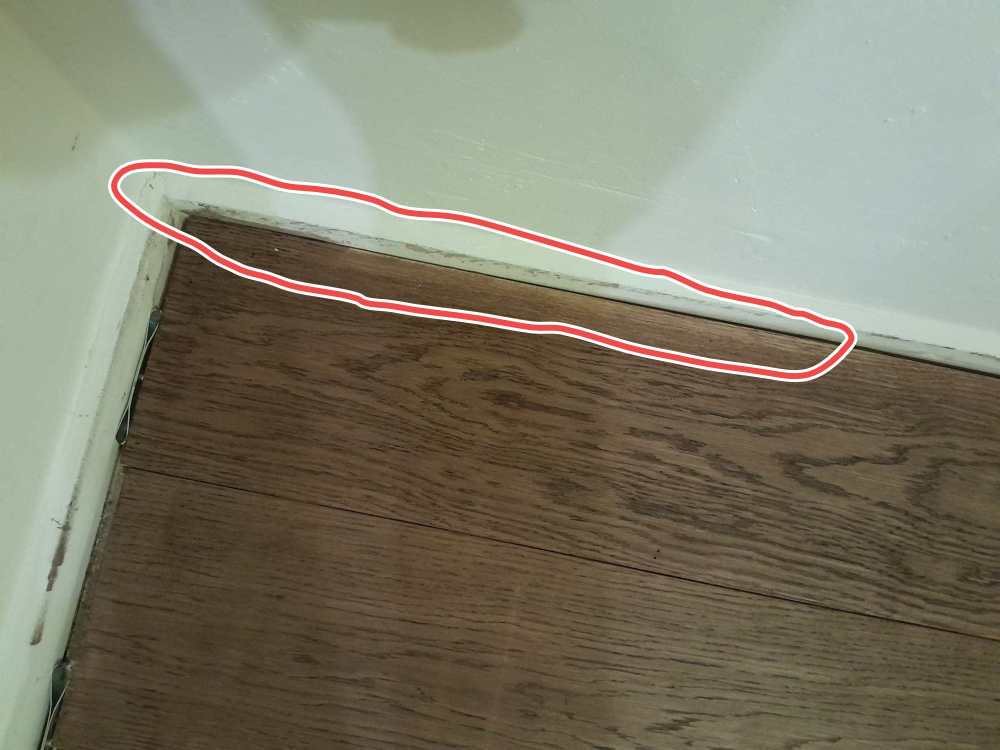
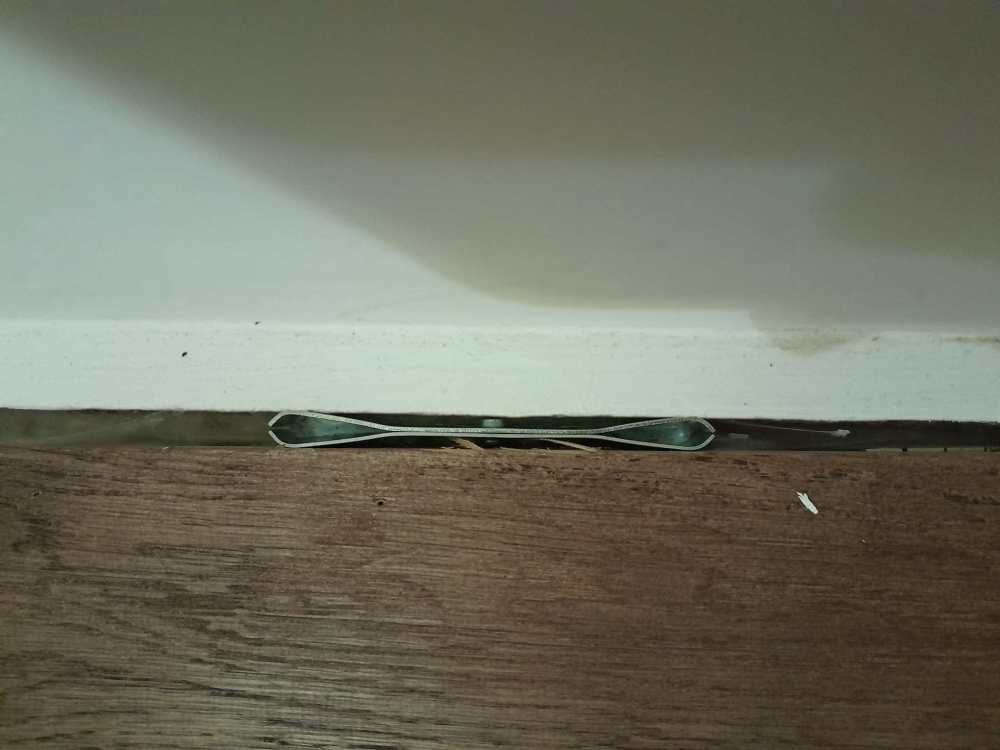
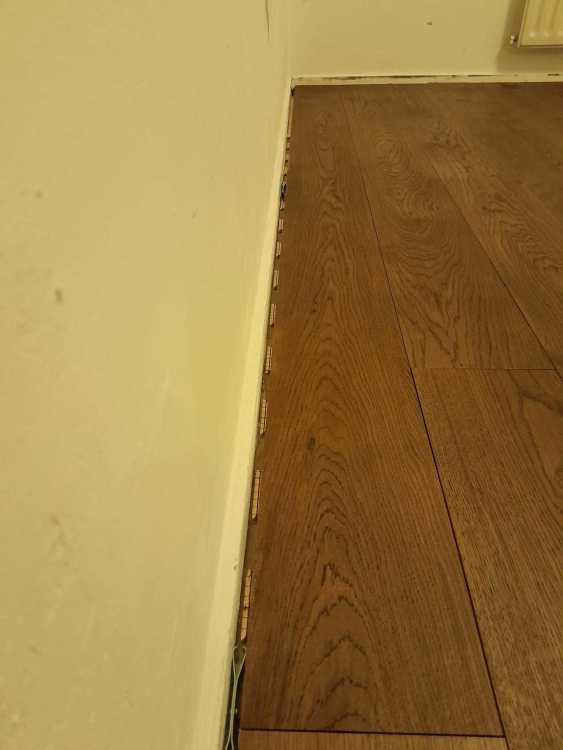
Thanks for the reassurance! But the section I'm concerned about is regarding the width of the plank -- I've highlighted it on this photo. The side of the plank is pretty much right up against the skirting board, maybe 1mm gap, if any. I think my only option is to try and cut off the skirting board. (Either that or trim the side of the plank.)
-
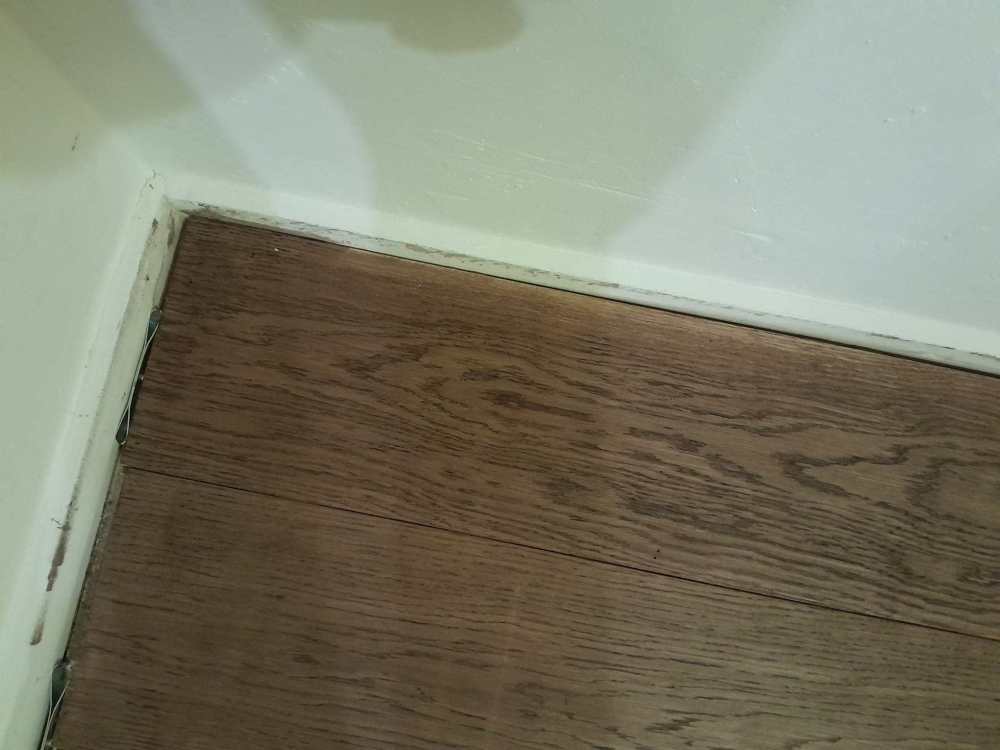
I quite like the look of quarter-round -- already bought some, in fact! (I did consider the cover-over skirting, but the expansion gaps are too wide for that, hence the quarter-round.) My question isn't about how to cover the expansion gaps that are there, it's about how best to deal with the one that isn't there! The top photo shows the plank touching the skirting board, with no gap.
-
If I'd known as much about floating floors a week ago as I do now, I would indeed have considered removing the skirting boards! 😄 They did use temporary packers while laying it (though clearly not enough along that one section!) The springs are intended to stop the floor from separating as it expands and contracts.
-
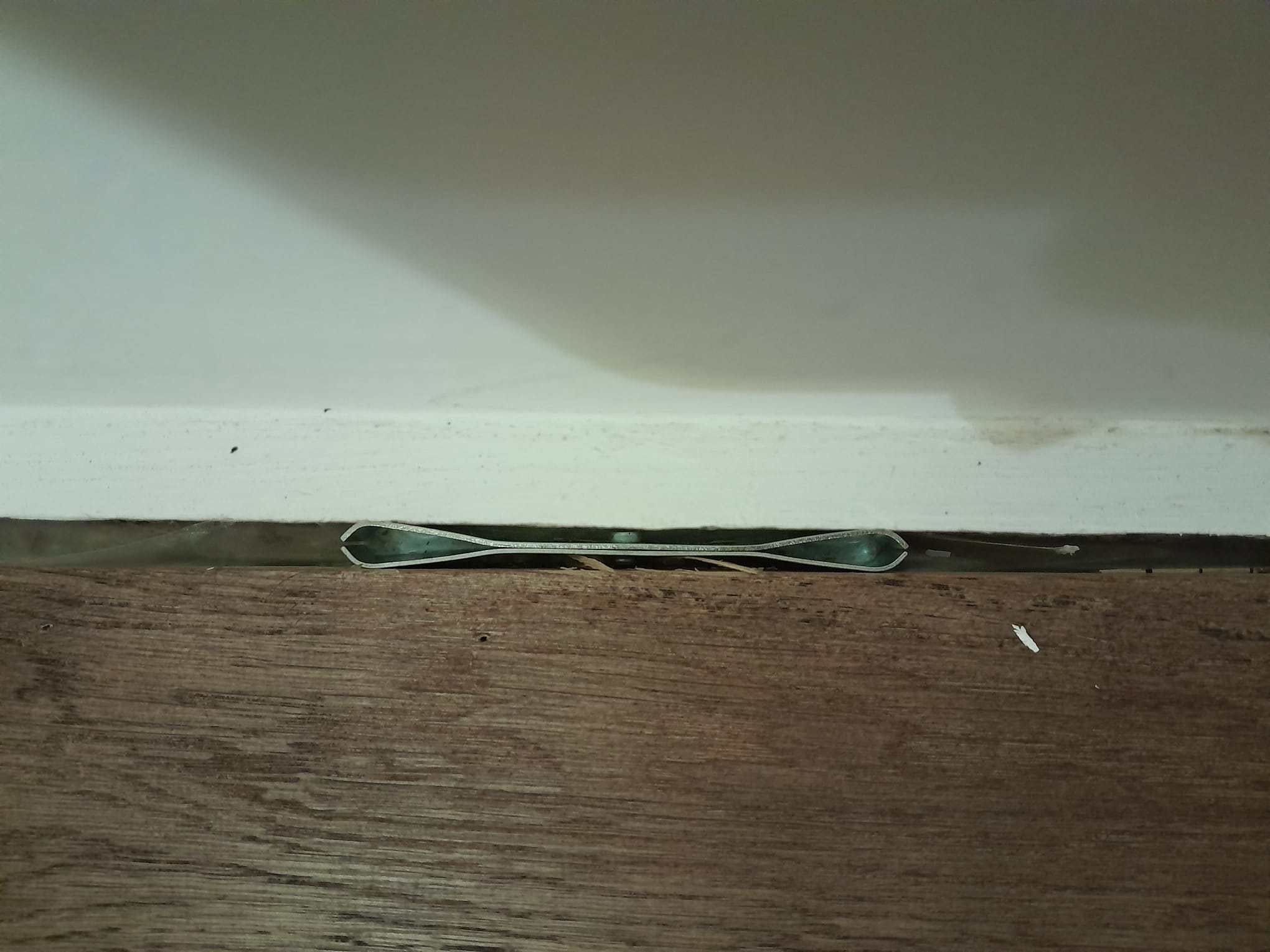
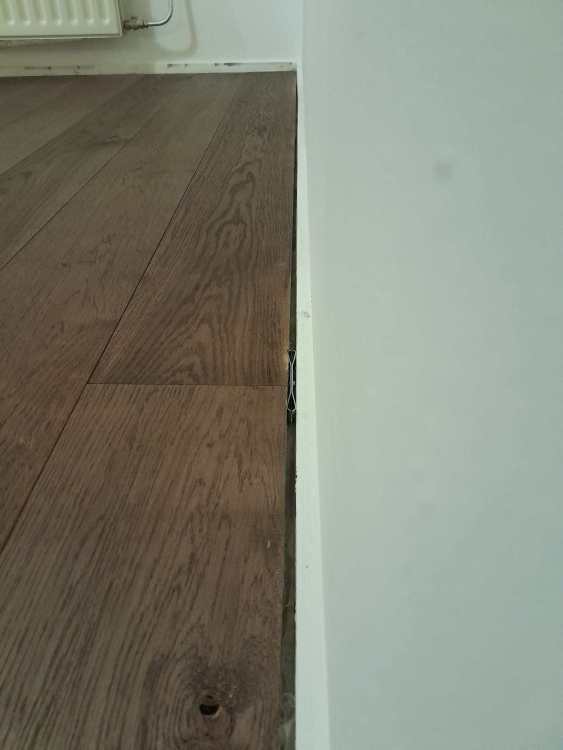
We recently had a company in who installed a floating solid oak floor. They seemed great to begin with, a small local family firm, but they got worse as time went on, to a point where they clearly just wanted to finish and get out of here. I think they'd grossly underestimated the time required, and were rushing by the end. I now suspect they mostly do laminate, and that a real wood floor isn't that common a job for them, due to the time miscalculation, and also the edge trim was the wrong sort and installed badly (and that's being very generous!). For the main part of the floor they did a nice enough job though, it's installed nice and straight and even. But we're now in the process of fixing some of the mistakes they made. I really don't want them back in here, as while they're not con-artists I just don't think they have the skill to do it right. At this stage I'm sure I can fix it better myself! So, the advice I seek... Along just one wall they don't seem to have left enough space for expansion. For some of the length there's no expansion spring as there's simply no space, and some of the ones that are there look fully compressed. This wall isn't totally straight, which is why I think they've had issues with it. There's an acceptable expansion gap further along the wall where it curves outwards slightly to make the room 1 or 2cm wider. (And everywhere else there's a decent expansion gap too. It's just this one wall.) So I assume this should be rectified, what are my options for fixing this myself? For a start I'm thinking of removing the over-compressed springs and replacing them with ones designed for a smaller gap, as the ones they've used are for quite a big gap, maybe 20mm, but I can buy some as narrow as 6mm. I can also either remove the existing skirting board, or maybe just try to just cut the bottom half of it to provide some expansion space. (They'll eventually be covered with quarter-round anyway, so I'm not worried about them.) Does that sound about right, or is there a better solution? (Also would anyone like to see the edging trim they installed, for a laugh?) Thanks in advance! (PS. Ignore the brown on the skirting boards -- that's floor oil, we were a bit slap-happy with the roller there!)
-
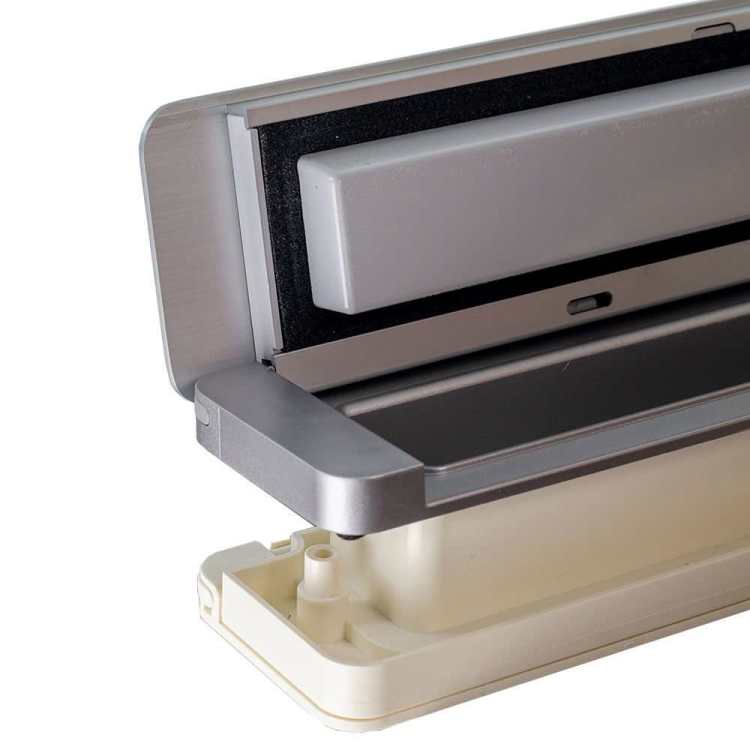
We went through the same conundrum here! But decided to go the other way, thinking we'd buy an insulated letterbox, something like the one in the photo. It claims a U-value of 1,23 W/m2, has a thick insulated front plate, and is supposed to be draught-free. It's not cheap though (about 150 - 200 quid) and if the inside plate has a strong spring on it we might still have the same dangling letters problem! Though having spent that amount of money on it, I think I'd definitely have a word with our postie...
-
I guess that's outside the house?
-
I should add for clarity, it was always silent in the bedroom on the lowest setting -- the audible hum was when turning it up in the summer, when we wanted to do to get as much cool night air in as possible, i.e. bypass mode on with no heat recovery. Adding the attenuator before the vent meant that we could increase the speed without adding any noise. I did wonder about that too, although the valve itself is 125mm internally, so although it adds a couple of extra bends, the speed within it should be fairly low. It doesn't seem to have added any extra noise, anyway. Even running on higher settings it's silent in the bedroom (even on boost it's only just audible) which was my main goal. With the 3-way valve set to "bedroom boost" we get about 40m3/h into the bedroom (which I think is what PH guidelines suggest), while the system remains set on the lowest speed.