Jolo
-
Posts
70 -
Joined
-
Last visited
-
Days Won
1
Jolo's Achievements

Member (3/5)
27
Reputation
-
 I feel the same way, it seems weird to bring 26°C air into a 23°C room - except my CO2 meter quickly shows that the air quality quickly worsens if the ventilation is turned off. So I set it to the lowest possible that keeps the living room under 1000ppm CO2. This really isn't a lot of air, so I don't feel it heats the room up that much. As you mention, external window shades have made the most difference for us. We now have some form of external shade on all the windows, I'm sure it would be far hotter in here without those!
 -
Below is the temperature graph for yesterday and today so far (until 2pm CEST). I put the sensor into a living room vent outlet at about 7pm (it was in the living room space until then) hence the slight peak at 7pm - the incoming air being a little warmer than the room itself at that time, despite the bypass being closed, as the inlet air will have been around 28°C then. Overnight the unit was on 100% flow the whole time (so I think 42m3/h for this vent), and the bypass was open. The lowest incoming temperature shown is 20.8°C. I don't have anything outside to measure the temp with, but according to the nearest weather station it dropped to about 17°C overnight. So it seems that the air is gaining 4°C between the inlet and the supply vent! I'm not surprised it's little higher, as the wall that the inlet is on does get afternoon sun, which isn't ideal but as it's a retrofit there wasn't any way around that (plus it probably helps warm the incoming air a bit in the winter). So that will be warmer for a start. Internally, this particular vent runs straight down the stairwell and across the downstairs hallway, and is probably 4m in length, so there's not too much scope for heat gain there. (The bedroom ducting runs beneath the flat roof for a couple of metres, so that vent probably has a little more heat gain.) I'm not sure if this helps your original question @diarmidR as there are quite a few variables, including your house being completely different! But given the same outdoor temperature of 14°C as in your original question, with everything else being the same I guess this vent would output 18°C. It's a shame I didn't do this the previous two nights, as the outdoor temp was reported as 12°C, it would have been nice to get a comparison over that temperature range.

-
I haven't actually measured it, but it does feel cooler than the ambient temperature inside the house. I'm curious about this myself now, I'll put a temp sensor in one of the vent outlets tonight, and I'll let you know the results!
-
In most MVHR units I've seen, the incoming air always flows through the exchanger, it's the exhaust air that flows directly out in bypass mode. So it can take a short while for the heat exchanger to cool down. I assume you've given it time to cool, but I just thought I'd mention this! Another factor to consider is that if the fabric of the house is warm, then the ducting will also be warm, which I find can heat the air up a little as it travels to the vents. I don't know that this would make such an increase as you describe, but it's worth bearing in mind. It might be worth checking that the bypass actually is open too. For example there's an software bug on my Duco MVHR which closes the bypass when the outside temp is below 15°C in "auto" mode, even if the target temperature is set to 10°C! (According to the manual, this forced closing of the bypass is only supposed to happen below 10°C outside temp.) I'm waiting to hear back from them about a software update, but in the meantime I set the bypass mode to "open" instead of "auto" to prevent it from warming up the incoming air.
-
I went for wall vents in a couple of rooms, and have since increased the number too! In the bedroom (supply) we have one of these: https://www.ventilationland.co.uk/en_GB/p/uniflexplus-wall-manifold-rear-connection-1x-o90-mm/9744/ with an adjustable grille insert: https://www.ventilationland.co.uk/en_GB/p/uniflexplus-grille-with-adjustable-louvres-200x100-for-wall-manifold/9770/ (it's a slight faff to install if the wall is thick, but still doable). I'm considering converting the kitchen to one too, which would mean I wouldn't need to add a dropped ceiling in there. I was also originally planning to add a dropped ceiling in the toilet too, as I had the pipe coming through at the top of the wall, then a 90-degree adaptor. But then I realised it would be much easier to just end the vent with a flange at the hole in the wall, and put a circular vent cover on that (as it's extract, the directionality isn't really important).
-
Thanks, I was wondering what the English name for this sort of floor was! Had a quick search, it does look similar. Luckily I'm not attaching much weight to it, and I'm hoping to not have to drill into it at all, if possible!
-
Yes, my plan was to frame both side walls, then timbers spanning the gap, as you described. Like a horizontal ladder laid beneath the ducts. The thing I really wanted to check was if I needed extra connections to the ceiling along the middle. I've not done this before, and I know on a larger room I'd need additional supports in the middle. I tried searching but couldn't find what the recommended maximum span might be. I've made a rough sketch -- the red is the wooden ladder, fixed to both walls along the length of the hallway, with timbers spanning the width. The green bits are the thing I wasn't sure was needed, vertical supports connecting the timber spans to the ceiling, along the length of the hallway, in the middle.
.thumb.jpeg.c812fb7199f0e090f6b63de33fd56097.jpeg)
-
Exactly right, Dave. It would also be fiddly to box in the whole wall, so just that part with the pipes is plenty, and as you say it won't make the stairwell feel narrow. So my main worry -- that the 1 metre span across the hallway would need ceiling brackets in the middle -- sounds like something I can ignore! Instead I can just anchor the frame to the wall all around the edge. Thanks!
-
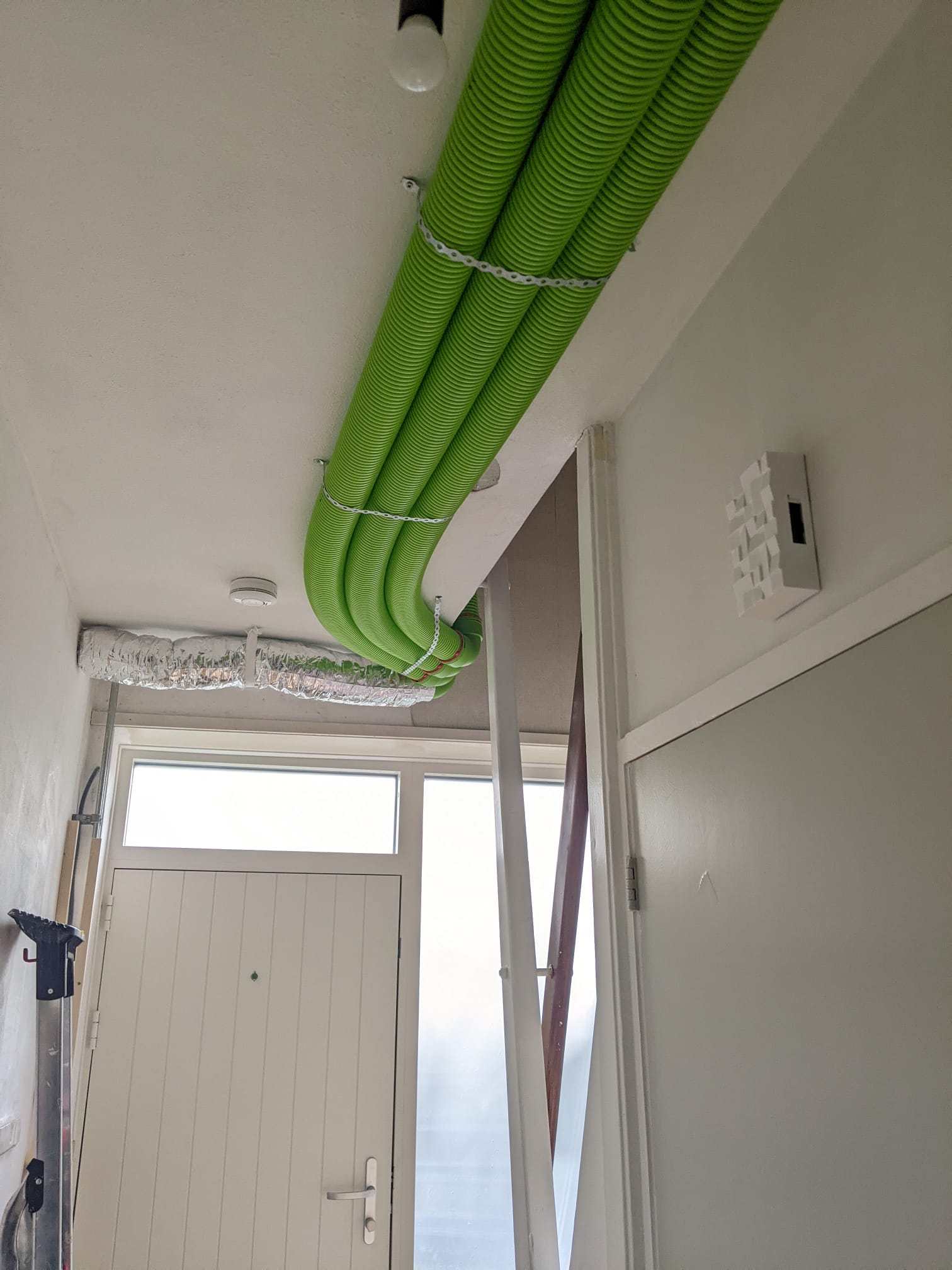
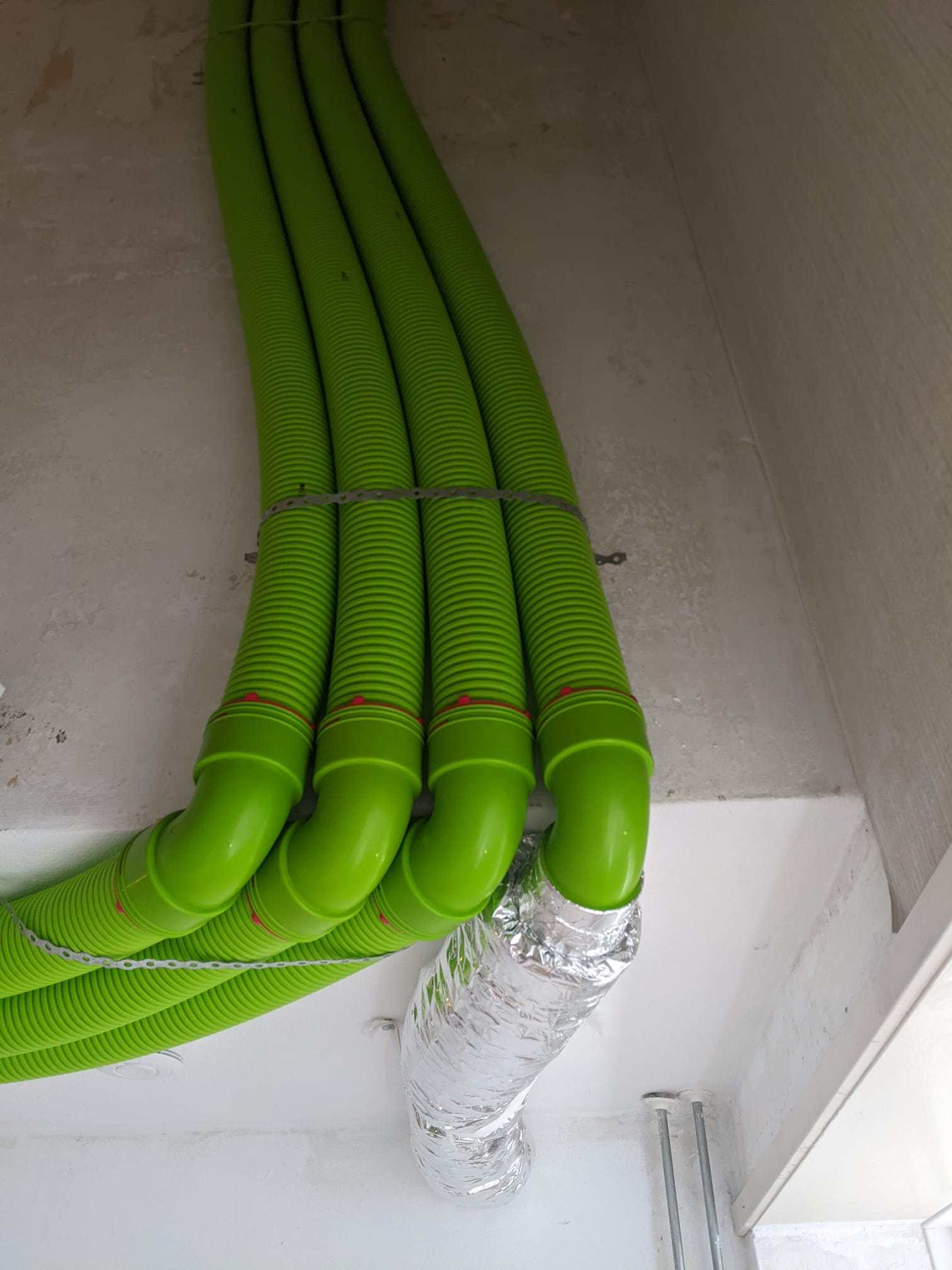
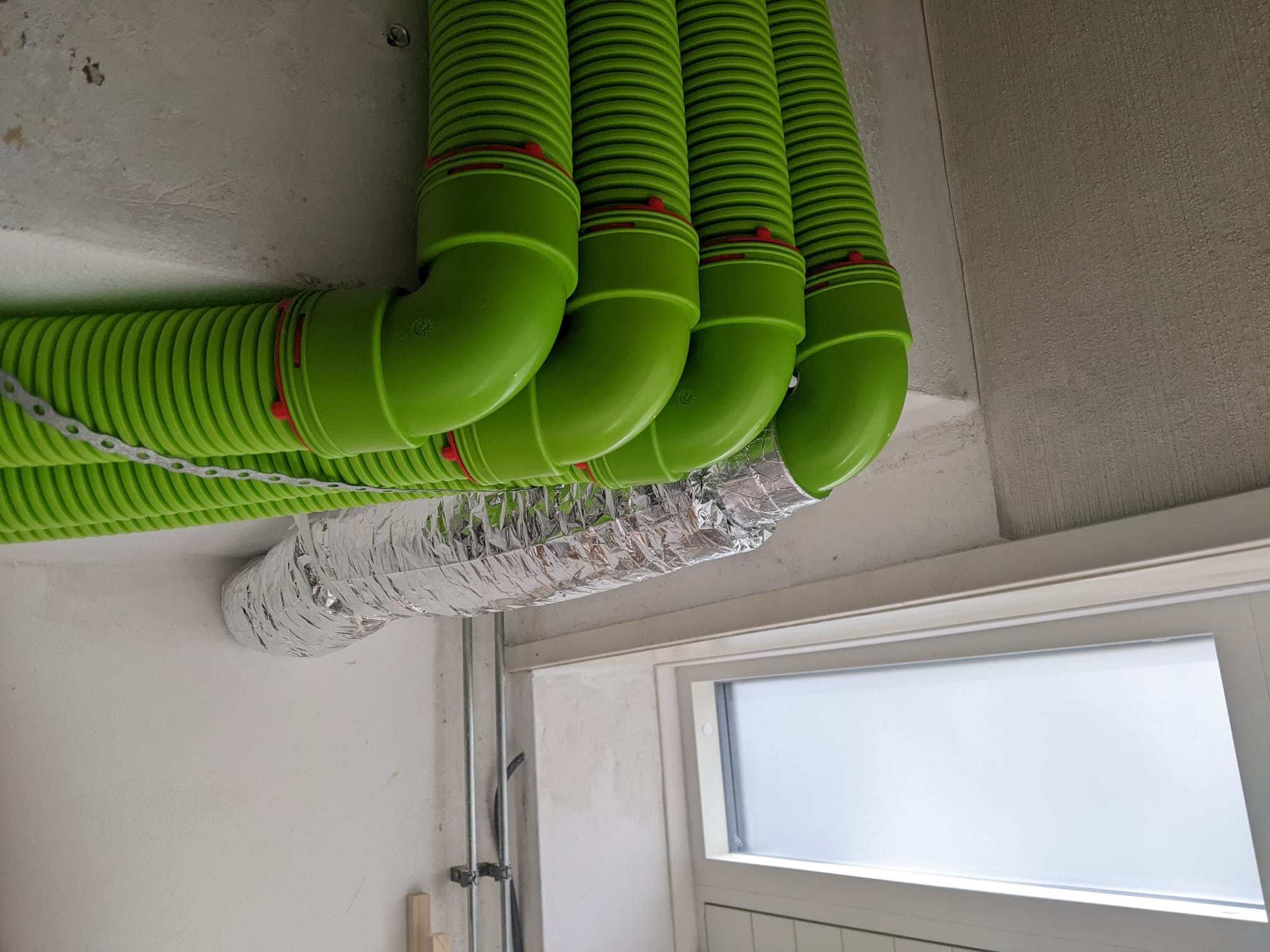
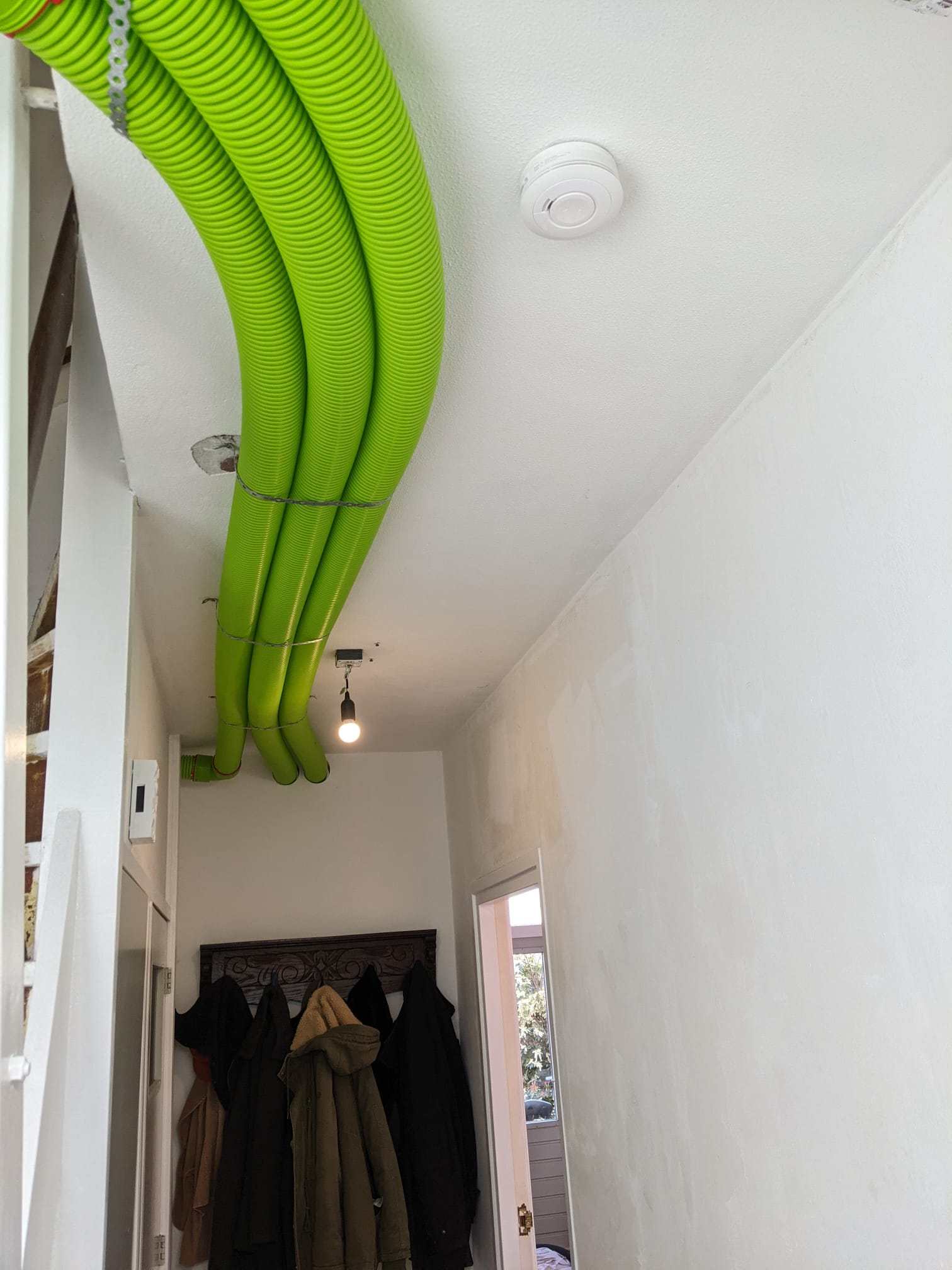
Thanks both for your replies! Very helpful. And well spotted, there is a gap in the wall where the stairs are, but there will be some pieces of wood coming down there in line with the wall, as the ducts run down the wall above the stairs and will need boxing in too. So my plan is to have some vertical battens beside the ducts. And at the end, connect above the front door. I've taken some more photos, if that helps clear things up!
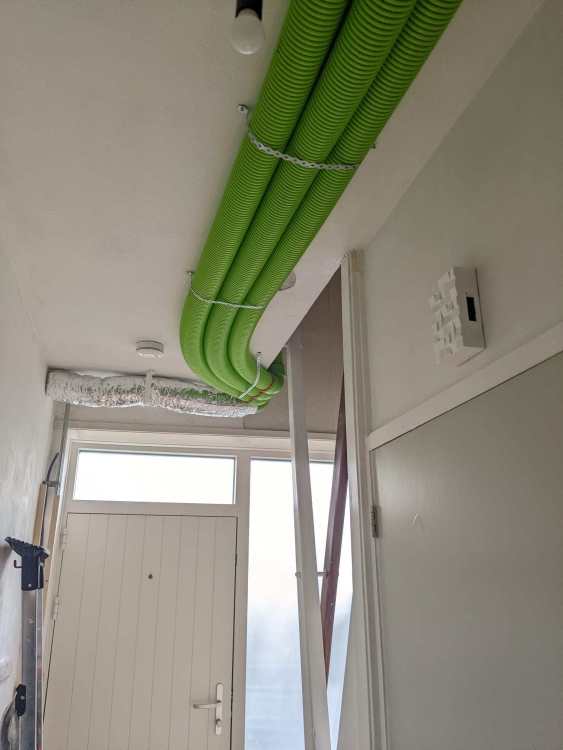
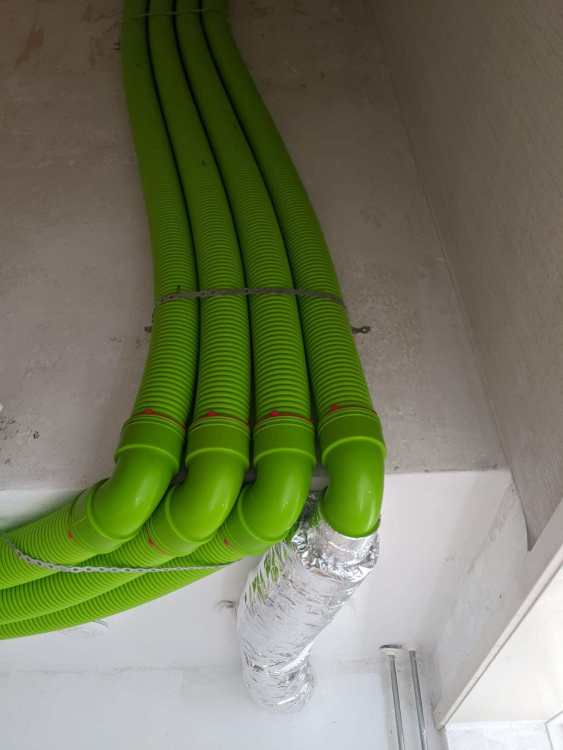

-
Now that my MVHR saga is finally over, I'm ready to box in the ductwork. Luckily I was able to route the ducts with minimal damage in the rooms themselves, as upstairs we had big enough ceiling voids, and downstairs all rooms connect off the hallway. But this does meain that the hallway has taken the brunt of the routing -- see photo! Now as this ceiling is pretty high (2m 60cm) I'm not worried about dropping it 15cm or so. It's also an opportunity to add better lighting (currently the only light is towards the back, it really needs one at both ends, or even three). The wall on the left side is wood, and the right side is brick (it's a load-bearing wall), but the ceiling is a bit of a mystery to me. It's either concrete or it might be a reinforced brick floor (1960s Dutch "Nehobo" floor, like a wall made of hollow bricks, with steel bars for strength, laid on its side). But whatever it is, it's a real pain to drill into. I've managed it here and there, but I've also managed to break at least two drill bits in the process! So ideally I'd like to get away with no (or minimal) drilling into the ceiling, if it can be avoided. Though if I have to, it's possible. However the hallway is only 1 metre wide, so my question is, do I even need to drill into the ceiling? If I put wooden battens along each side wall, then cross-battens across the span, will that suffice to hold a single-layer plasterboard ceiling? Or is a metal frame the better/easier option? Or do I really need some sort of support along the middle to prevent sagging? Thanks in advance!
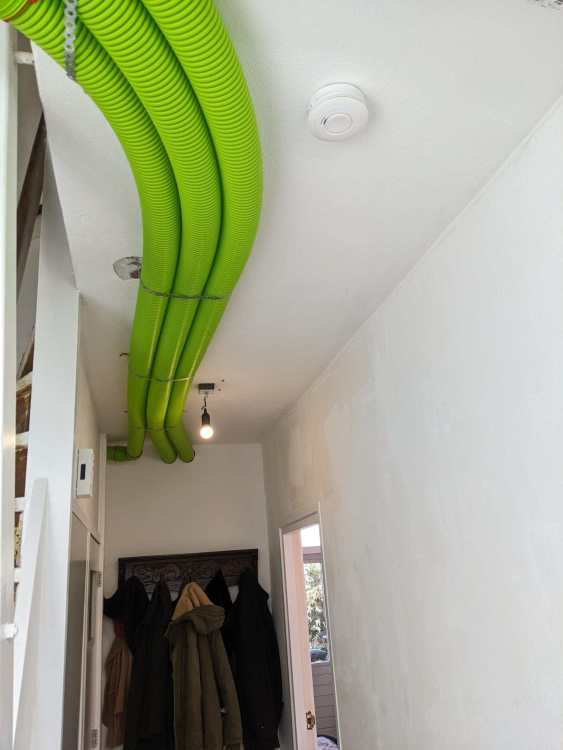
-
My faulty Brink Flair unit has now been returned, and I bought and installed a DucoBox Energy Comfort 325. All of the problems I attributed to the Flair have now gone away. This is as good a like-for-like test as you're going to get, everything is the same - same house, same ducting, same vents, only the main unit has changed. Just for completeness, I want to mention two additional (objective, measurable) tests I did on the Brink Flair in the last days we had it, using a CO2 and humidity monitor. Why didn't I think of this earlier!! I placed the monitor inside one of the supply vents, luckily we have two through-wall vents which are perfect for this (https://www.ventilationland.co.uk/en_GB/p/uniflexplus-wall-manifold-rear-connection-1x-o90-mm/9744/) so the whole monitor can sit in the incoming airflow. We then left it for a few minutes so the values could settle down and we could get a general background reading: the RH was about 55% and the CO2 was about 450ppm. First test was a humidity test: I boiled a kettle in the kitchen and let the steam be sucked into the extract valve. The RH jumped to 70%, then went back down again. I also showered, and again the RH shot up to 70% (see attached graph). Second test was a CO2 test: I disconnected the flexible noise dampener which is connected to the Flair's extract port, and breathed into it several times. The CO2 reading at the supply vent briefly increased, from about 450 to 485, then went down again. I tried this again with my partner, and the CO2 reading went up to about 540 PPM. (This one is difficult to show on the graph though, as the unit only logs every five minutes, so the brief peak isn't logged. It's difficult to keep breathing into the extract!) This can only be because there was a leak inside the unit. This does echo the results of my smell test, but is more objective and can't be written off as me having some sort of super-nose! I consider that to be proof that the Flair was faulty, despite Brink's inistence that it wasn't. The new Duco works as expected. I've done the same tests, and showering makes no difference at all to the moisture levels of the incoming air. It's been in for over a week now, and the RH in the house hovers around 44 to 54%. Even while boiling a big pan of potatoes there's no moisture on the kitchen window, whereas with the Flair it would be dripping wet. With the Brink Flair the humidity in the house was always high. The 55% mentioned above was only acheived because we had left the above-window vents open, and aired the house out every day by opening the windows for several minutes. Until we started doing that it was always above 60% and would jump to over 70% when cooking/showering. I must say I'm really disappointed with Brink. They showed little interest in the problem, I had to nag them constantly, and were almost totally unresponsive, and it seems they closed my 'case' several times. If I hadn't kept the pressure up they would never have responded. Which is a shame, as I really liked their products otherwise.

-
Recommendations (or warnings) for MVHR units
Jolo replied to Jolo's topic in Mechanical Ventilation with Heat Recovery (MVHR)
Thanks for the tips! The unit goes in a cupboard on the first floor, the difficult bit is the Dutch stairs, which can be more like ladders than anything that would be called "stairs" in Britain. (Though lots of people here have their washing machine in the bathroom which is usually upstairs, I've no idea how they manage it...) However, I went for a Duco Energy Comfort 325 in the end. It seems like a good choice, I like the programming menus, and as it's over-sized for our house we'll end up running it well below capacity, which should be good for efficiency and noise. Although I think I might be cursed -- the first one that arrived had been opened before, and the unit was covered in scratches and paint blobs... so they're bringing us a replacement tomorrow. This will be our fourth MVHR unit since August, hopefully the last! -
Recommendations (or warnings) for MVHR units
Jolo replied to Jolo's topic in Mechanical Ventilation with Heat Recovery (MVHR)
Oh that's interesting, I've heard differing opinions on the need for a pre-heater. It was one reason I went for the Flair instead of the Ease. We did have several days below zero this winter, but I thought the pre-heater was only really needed below -7 or something? There's a separate external pre-heater available for the Comfort, and there's version called the Premium which has one as an option. -
Recommendations (or warnings) for MVHR units
Jolo replied to Jolo's topic in Mechanical Ventilation with Heat Recovery (MVHR)
I think I will go for the DucoBox Energy Comfort 325 as it's available now, and is light and compact -- and as its capacity is so much bigger than our maximum, surely running it so slowly will get amazing heat recovery? Also what I wrote last night about the Duco wall-mounted controllers is incorrect, the three ventilation positions can be adjusted (I found it in a separate manual, which goes through all the options in detail). So that's good. Out of interest, I wonder what people's thoughts are on the Itho Daalderop HRU 200 ECO. It's an absolute bargan basement option, available for well under a grand in either Euros or Pounds. I'm amazed at the price! The volume setting is done via two potentiometers, one for low and one for high, the middle speed is just the average of the low and high. https://www.ventilationland.co.uk/en_GB/p/itho-daalderop-hru-200-eco-unit-e-rft-high-rise-200m3-h/9947/ -
Recommendations (or warnings) for MVHR units
Jolo replied to Jolo's topic in Mechanical Ventilation with Heat Recovery (MVHR)
One big reason for choosing enthalpy was the lack of a convenient condensate drain point, but I feel up to tackling that now I discovered the drain pipe saddle clamp things...


.jpeg.185e09f50c610074f54b830777f6936d.jpeg)