Jolo
-
Posts
70 -
Joined
-
Last visited
-
Days Won
1
Everything posted by Jolo
-

Ubbink - what are they like?
Jolo replied to lizzieuk1's topic in Mechanical Ventilation with Heat Recovery (MVHR)
Are you asking about their air distribution system or their MVHR units? Their Ubiflux Vigor units are rebranded Brink Flair units (as far as I know both companies are owned by Ariston, so they're sibling companies, and stuff is cross-branded in different countries -- the Ubbink ducting is branded Brink in France, for example). Like JohnMo I've also used their distribution duct (the green ribbed stuff, Air Excellent) and the grey foam main ducting (the weirdly spelled Aerfoam), along with their distribution boxes and vent terminal adaptors. I also used their wall and roof penetrations for the external connections, and everything fitted together neatly and easily. Had no issues with it (as a first-time self-installer), although the Air Excellent is difficult to undo if you want to make changes -- once they're connected, they're pretty solid! This is a good thing, of course. While it's possible to ease the plastic clip back out, it's tricky in confined spaces. (Funnily enough, if you look at photos of Air Excellent installations in Poland, they use a metal clip which goes around the adaptor, instead of a plastic one which goes inside. The metal one looks easier to remove, though I've never handled one so that's just a guess!) It sounds like you're having it installed by a third party though, so I doubt all that is much of a concern to you! It's solid stuff, and is very widely used as far as I can tell, so it's a sound choice IMO. -
It's a DEC International flexible silencer non-woven, Ø 100mm, 1m long. (Pretty cheap, about 25 quid?) I used Ubbink Air Excellent distribution box adaptors to connect the semi-flex ducting to the silencer, as I have several spares of these (I'd accidentally over-ordered when ordering the parts for the distribution boxes!). https://www.ubbink.com/int/products/ventilation/air-excellent-ventilation-ductwork/duct-adaptors/air-excellent-ae48c-dbox-adaptor/ The ducting clicks into it as designed, and I've used aluminium tape to attach the silencer onto the adaptor. I guess a cable-tie might also be a good idea, I might add one before I put the cupboard ceiling back on. The outer diameter of the adaptor matches the inner diameter of the silencer fairly well, so it fits together pretty neatly. At the vent end of the silencer I did the same thing in reverse, though this was only necessary because I have a Vent-Axia UniflexPlus wall vent in the bedroom, and the design of the ducting connector means it needs the semi-flex duct to be air-tight. If I'd used another brand of ducting at the bedroom (such as the Ubbink Air Excellent ones) then the end of the silencer would just slip over the vent adaptor and be taped on, as the air-tight design on those would allow that simpler connection.
-
I do have a multi saw which I love to use, as it happens That's definitely an option, although cutting the new floor is my 2nd choice, even though that might well be the easiest way to do it! It's probably because the floor is new, and the skirting boards are old, so they feel less valuable and fragile. (So that's more of a psychological issue than a DIY one!) The cornflake box cardboard trick is a genius move, thank you for that! I'd been wondering how we'd get a small but consistent gap, that's the perfect solution.
-
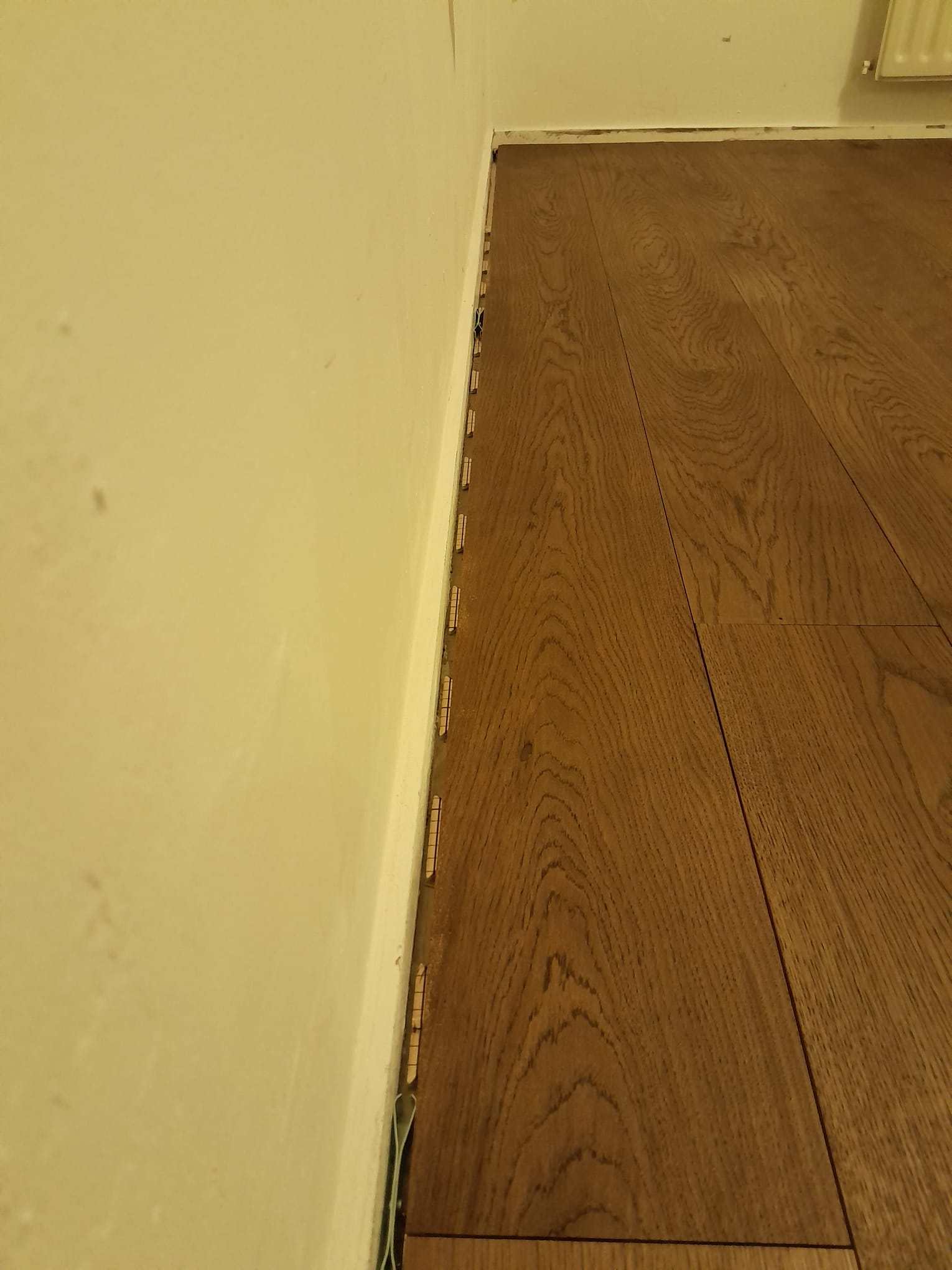
Directly opposite the gap is very generous -- maybe 20 to 25mm, because there's a wood and plasterboard build-out. The plasterboard doesn't go right down to the concrete floor, but stops about 20mm above it, so the floor tension springs are against the framing. Are you thinking that this gap might make up for the lack of a gap on the other side? (If I can get away without cutting, that would be wonderful!) Most of the room has about 15mm gap, which is a bit big, but I've got quarter-round to cover that.
-
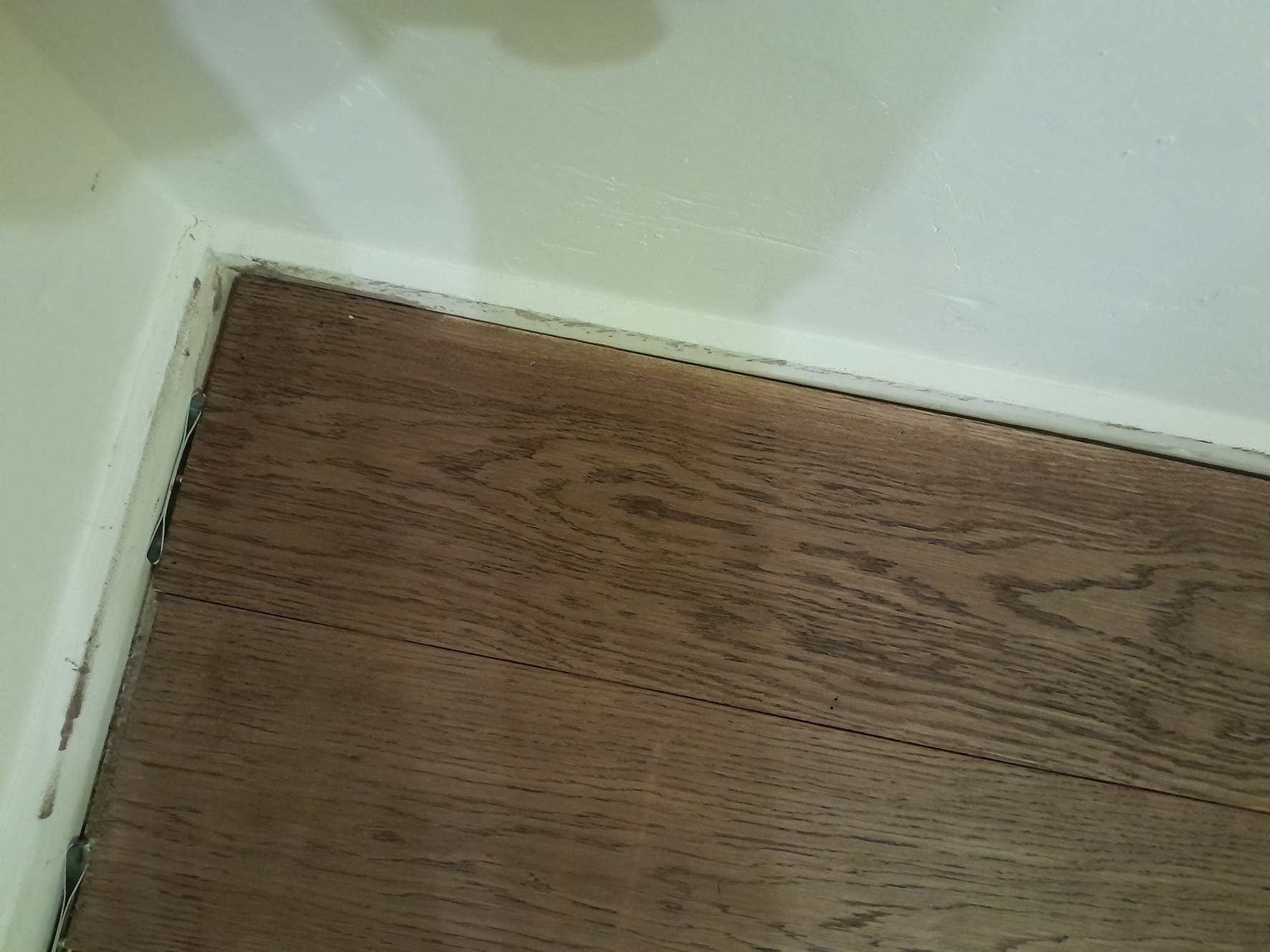
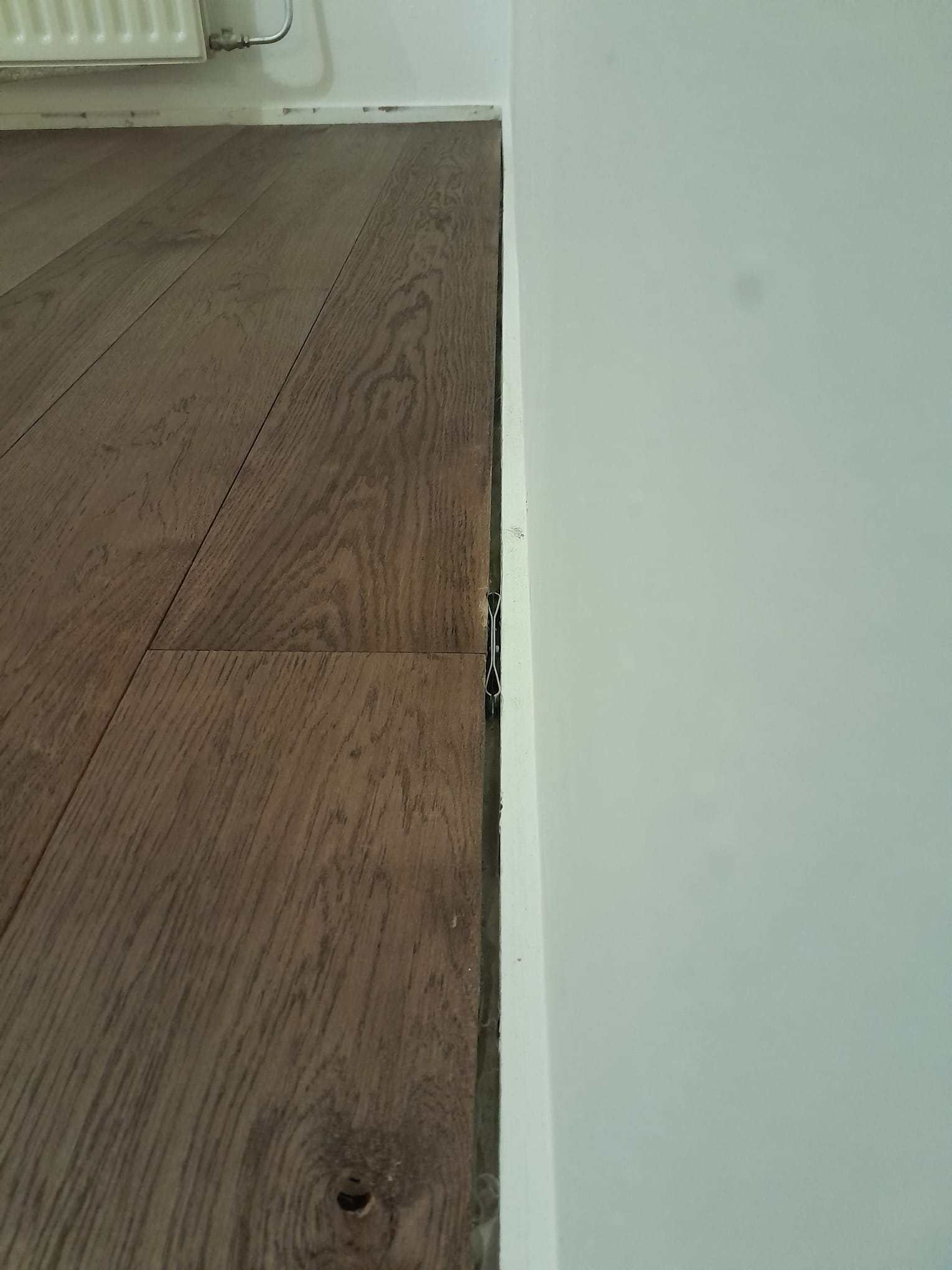
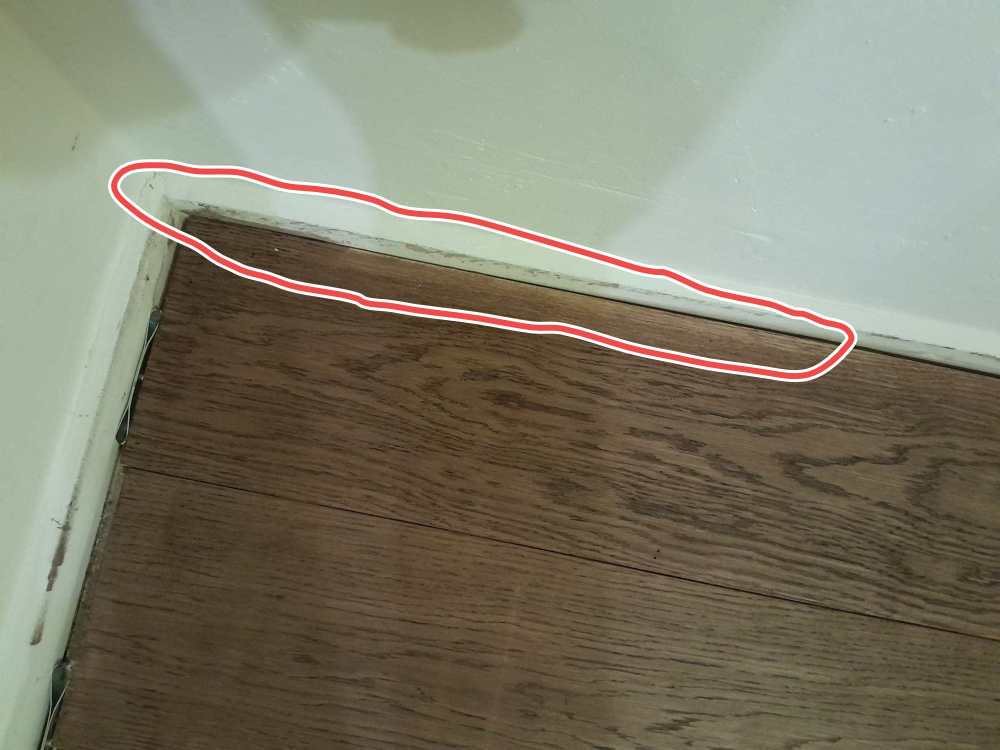
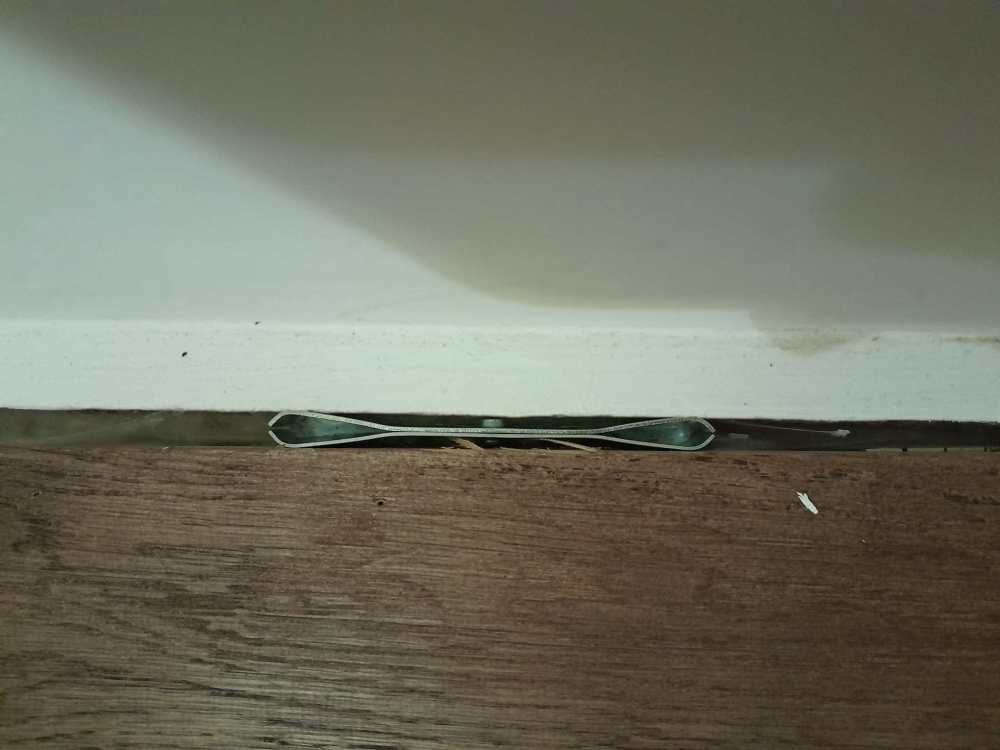
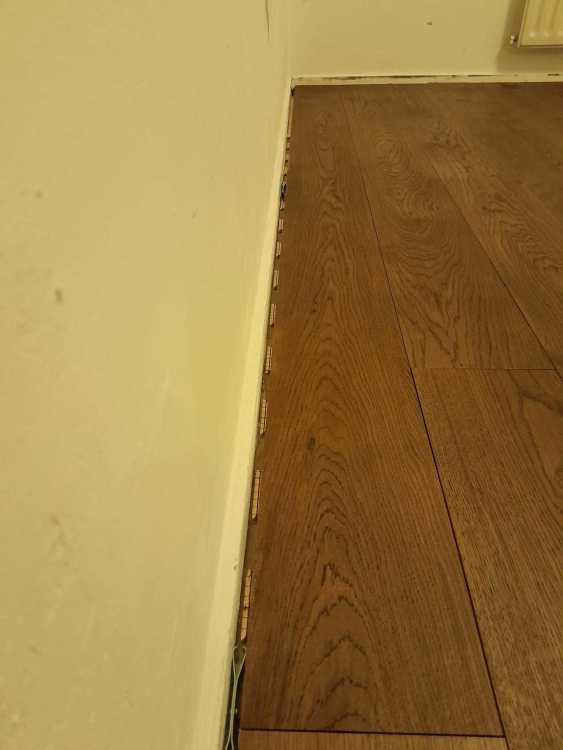
Thanks for the reassurance! But the section I'm concerned about is regarding the width of the plank -- I've highlighted it on this photo. The side of the plank is pretty much right up against the skirting board, maybe 1mm gap, if any. I think my only option is to try and cut off the skirting board. (Either that or trim the side of the plank.)
-
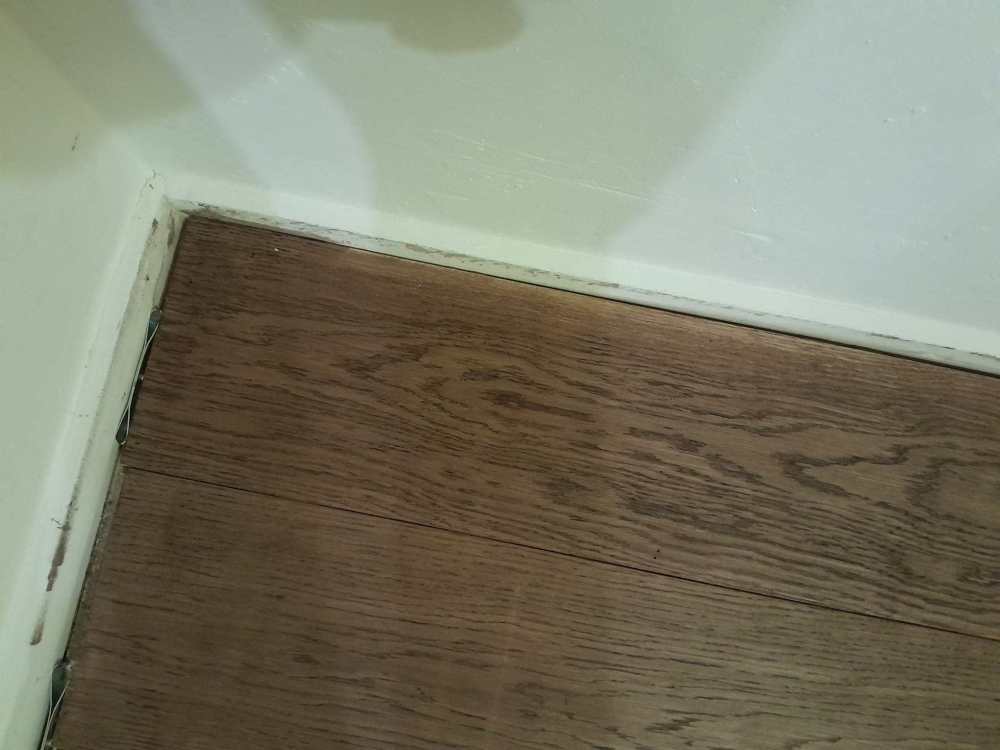
I quite like the look of quarter-round -- already bought some, in fact! (I did consider the cover-over skirting, but the expansion gaps are too wide for that, hence the quarter-round.) My question isn't about how to cover the expansion gaps that are there, it's about how best to deal with the one that isn't there! The top photo shows the plank touching the skirting board, with no gap.
-
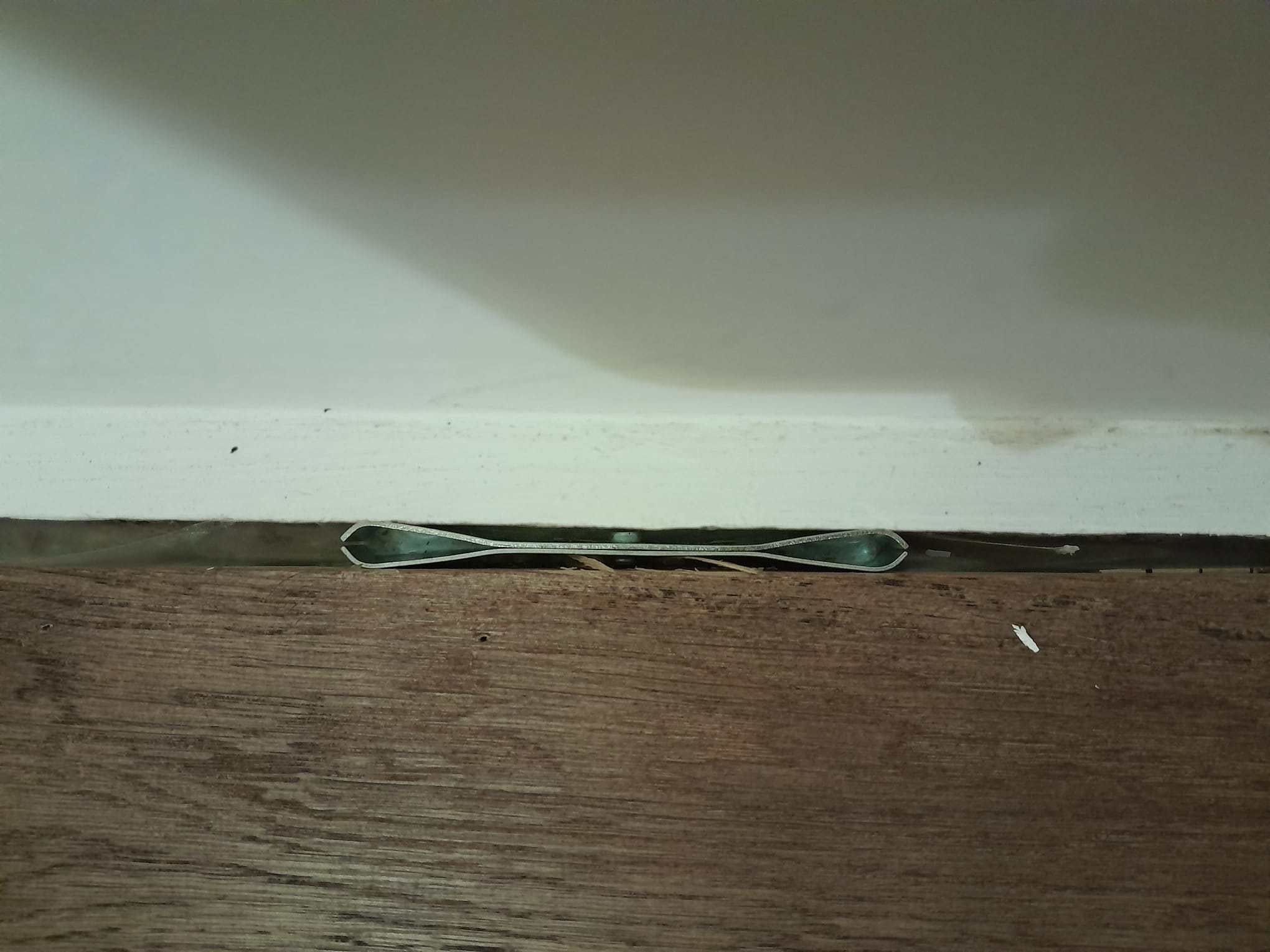
If I'd known as much about floating floors a week ago as I do now, I would indeed have considered removing the skirting boards! 😄 They did use temporary packers while laying it (though clearly not enough along that one section!) The springs are intended to stop the floor from separating as it expands and contracts.
-
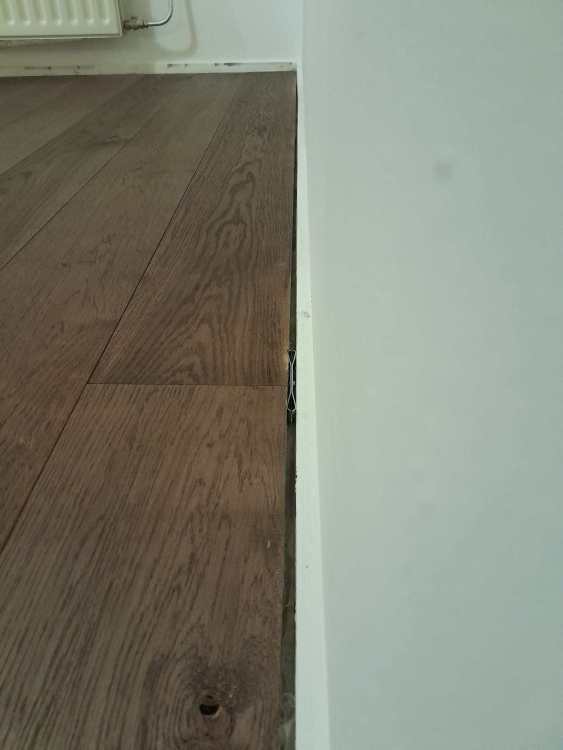
We recently had a company in who installed a floating solid oak floor. They seemed great to begin with, a small local family firm, but they got worse as time went on, to a point where they clearly just wanted to finish and get out of here. I think they'd grossly underestimated the time required, and were rushing by the end. I now suspect they mostly do laminate, and that a real wood floor isn't that common a job for them, due to the time miscalculation, and also the edge trim was the wrong sort and installed badly (and that's being very generous!). For the main part of the floor they did a nice enough job though, it's installed nice and straight and even. But we're now in the process of fixing some of the mistakes they made. I really don't want them back in here, as while they're not con-artists I just don't think they have the skill to do it right. At this stage I'm sure I can fix it better myself! So, the advice I seek... Along just one wall they don't seem to have left enough space for expansion. For some of the length there's no expansion spring as there's simply no space, and some of the ones that are there look fully compressed. This wall isn't totally straight, which is why I think they've had issues with it. There's an acceptable expansion gap further along the wall where it curves outwards slightly to make the room 1 or 2cm wider. (And everywhere else there's a decent expansion gap too. It's just this one wall.) So I assume this should be rectified, what are my options for fixing this myself? For a start I'm thinking of removing the over-compressed springs and replacing them with ones designed for a smaller gap, as the ones they've used are for quite a big gap, maybe 20mm, but I can buy some as narrow as 6mm. I can also either remove the existing skirting board, or maybe just try to just cut the bottom half of it to provide some expansion space. (They'll eventually be covered with quarter-round anyway, so I'm not worried about them.) Does that sound about right, or is there a better solution? (Also would anyone like to see the edging trim they installed, for a laugh?) Thanks in advance! (PS. Ignore the brown on the skirting boards -- that's floor oil, we were a bit slap-happy with the roller there!)
-
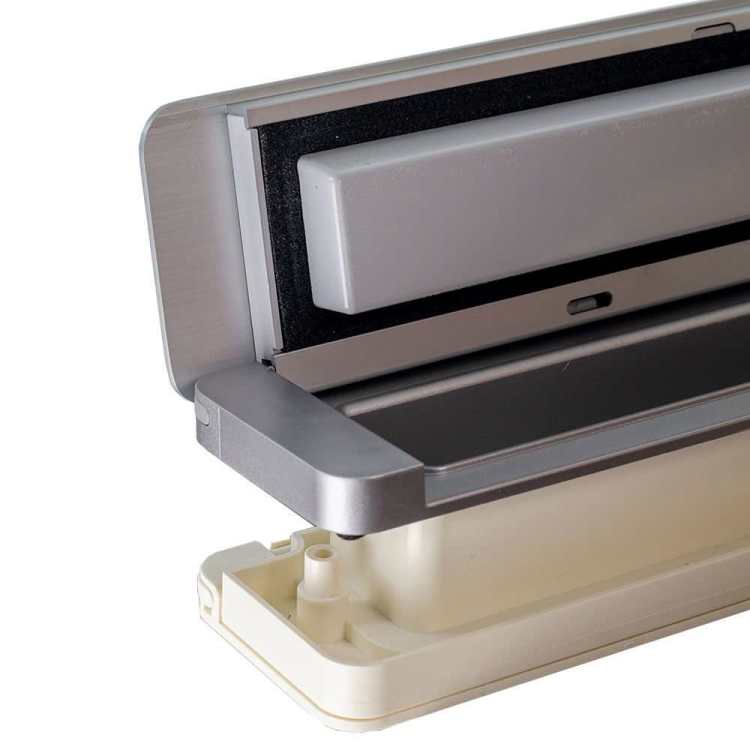
We went through the same conundrum here! But decided to go the other way, thinking we'd buy an insulated letterbox, something like the one in the photo. It claims a U-value of 1,23 W/m2, has a thick insulated front plate, and is supposed to be draught-free. It's not cheap though (about 150 - 200 quid) and if the inside plate has a strong spring on it we might still have the same dangling letters problem! Though having spent that amount of money on it, I think I'd definitely have a word with our postie...
-
I guess that's outside the house?
-
I should add for clarity, it was always silent in the bedroom on the lowest setting -- the audible hum was when turning it up in the summer, when we wanted to do to get as much cool night air in as possible, i.e. bypass mode on with no heat recovery. Adding the attenuator before the vent meant that we could increase the speed without adding any noise. I did wonder about that too, although the valve itself is 125mm internally, so although it adds a couple of extra bends, the speed within it should be fairly low. It doesn't seem to have added any extra noise, anyway. Even running on higher settings it's silent in the bedroom (even on boost it's only just audible) which was my main goal. With the 3-way valve set to "bedroom boost" we get about 40m3/h into the bedroom (which I think is what PH guidelines suggest), while the system remains set on the lowest speed.
-
We had a new front door installed earlier this year -- lovely 65mm thick thing with insulation inside, triple glazing in the frame as the side and above. A big improvement over the rotten old plank of wood with single-glazed windows we had before! One thing we pondered was the letter box. One option was to not have a letter box in the door, but instead have a lockable letter box outside. We decided against this partly because it didn't feel very secure (especially if we're away) and also because to get the post we'd have to open the door fully and go outside to open the external box -- which, while brief, would probably let in more cold winter air than a well-sealed letterbox in the door would! (Also didn't fancy having to go outside in my dressing gown every morning.) So we opted instead for a letterbox in the door, which we discovered has the strongest springs known to mankind. It really slaps itself shut! But this led to a problem, our postie will lift the outside flap, and push the letters in -- but the post isn't strong enough to open the inside flap, so the letters instead get left trapped dangling from the outside flap for anyone to take. (Call me paranoid...) While visiting friends earlier this year, I noticed that they had a new door too -- with the exact same letterbox! I asked them if they'd had problems with the postie leaving letters dangling and sure enough they had. So it must be a common letterbox that's causing issues wherever it's installed! As our new door was fitted in the spring, my temporary solution was just to remove the internal plate. But now that October is here I'm pondering better solutions. One option is to buy one of those letterboxes that has thick flaps (!) with insulation in them, but I wonder if we'll still have the problem with dangling letters. Another option is to add a post catcher on the inside, which I could even make myself and insulate well enough. (A third option is to tell the postie off, this is what our friends in England did! But I suspect the problem would just occur again every time a new postie did this route.) So, before I break out the wood and unfold the workbench, are there any ideas about how best to mitigate my letterbox problem? Thanks in advance!
-
Except when cooking/showering/toiletting, we generally keep it on the lowest setting which right now is 80m3/h. Our house is 200m3, so I think that 80m3/h might be a little higher than most people on here seem to have theirs set (I read a lot that people set the normal rate to 0.3ach, which for us would be 65m3/h). I think it's a bit higher because when we set it up in the summer, the house was stuffier and warmer, so wanted as much night-air bypass ventilation as we could. I've actually added a strange thing but one which I'm really happy with -- a night-time boost lever for the bedroom. It's a three-way valve which we can move so that overnight the bedroom gets air that would normally be going to the (empty) living room, doubling the output without increasing the fan speed. So this might mean that we can turn the normal speed down to 65m3/h. We do definitely need to get a CO2 monitor, this has been on my list for ages! (Right now we're dealing with a floor that's been bodged, the DIY is never done, even when you hire professionals...)
-
I also experienced a droning noise, but after buying a rectangular attenuator from Lindab (thanks to your photos and advice here @Nick Laslett and @Nickfromwales!) which didn't stop it, I determined that it wasn't coming from the main unit, but was being generated within the green ribbed Ubbink Air Excellent ducting. So for the bedroom I added a 1m flexible attenuator at the end, just before the vent, and it works great. To avoid adding too much more static pressure I went for one with a 100mm internal diameter (larger than the 75mm internal diameter of the ducting). It works really well, even on boost it's barely audible and at night we don't have it that high anyway, so it's totally silent. I since added another to one of the living room vents, and it's worked great there too. While this does work, is there anything I'm missing? Is there a reason I've never seen this recommended anywhere?
-
Great minds think alike, eh! I can't claim credit for the idea though, I saw it on a YouTube video where a guy in the US was replacing his MVHR unit and he happened to have a pre-filter box with a diagonal filter, which he also explained. The cloth you've used as a filter is interesting... I might try something like that instead of buying more G3 material. Though the stuff that my filter box came with is so thin, I doubt it causes too much pressure drop, the F7 in the main unit probably causes far more. Your box now has some serious insulation on it!!
-
Ubbink- Blauberg compatibility ?
Jolo replied to Post and beam's topic in Mechanical Ventilation with Heat Recovery (MVHR)
Thanks for the additional info, @Mike! Your advice about the correct sealing rings makes sense, although with the Vent-Axia vent adaptors the ring is inside the adaptor already, and is the same cross-section as the duct, which presses up tight against it, the ribs on the duct clipping into plastic hooks inside the mouth of the adaptor. That's probably the exception though, as everything else I've seen has some sort of ring that goes around the duct. Do you remember which brands you mixed, and in what way? -
Hi all, New member here. I read this thread with interest, as my new MVHR F7 filter became black with muck and flies in just a few weeks (ugh). After failing to find an insulated box for sale anywhere (I'd have thought they'd be popular!), I ended up buying a metal filter box from an online retailer (actually ended up with two, silly story) and, as expected, it became misty with condensation as soon as the outside temperature dropped. So thanks to @Nick Laslett's advice I bought a square metre of 19mm-thick Armaflex AF self-adhesive insulation and covered the box in that. It's not pretty but it does work really well, the outside of the insulation doesn't feel cold at all, even though the metal box inside is. One question I had for @Russdl while looking at the photo of the grime-covered filter was, have you considered putting it in the box at 45 degrees? From the photo it looks like nearly all the air flow across the mesh is through a circle which is against the duct that's behind it. But with the mesh at 45 degrees you'd have a much larger air flow surface area (the diagonal of the side of the box, by the width of the box) which should mean less pressure drop, and a longer time before it becomes clogged. (Just my 2p's worth - I wish I had space for such a big pre-filter!)
- 100 replies
-
- 2
-

-

-
- mvhr vents
- filter
- (and 1 more)
-
Hello! Not actually in the UK, but wanted to contribute anyway
Jolo replied to Jolo's topic in Introduce Yourself
Thank you, Mike! -
Ubbink- Blauberg compatibility ?
Jolo replied to Post and beam's topic in Mechanical Ventilation with Heat Recovery (MVHR)
I was very interested in this topic too, as I wanted to mix manufacturers in our MVHR self-install (we went all-Ubbink, except for two through-wall vents, which Ubbink don't make). So we successfully connected Ubbink 90mm (75mm internal) semi-flex ribbed green ducting to Vent-Axia UniflexPlus valve adaptors. The Ubbink duct just clicks into the Vent-Axia adaptor without problems, and there's no sign of air leakage. The end of the duct presses up tightly against the foam inserts inside the valve adaptor, which is what I assume prevents leakage. I strongly suspect that other brands are also interchangeable. There's a company here in the Netherlands which sells their own brand of ducting and fittings, but they look identical to the ones sold by Blauberg. (From the searching I did, I think they're actually made by a company in Ukraine.) Anyway, this Dutch firm claims compatibility with Ubbink, Heatpex, Hybalans, Zehnder, Vent-Axia, and Burgerhout, which is a good list of manufacturers! So I reckon it's likely that the ribbed semi-flex ducting from one brand is compatible with another brand's valve adaptors / plenums / etc. -
I grew up in England, but now live in the Netherlands, where my partner and I have a fixer-upper from the 1960s. One big task we recently completed was installing MVHR (previously it only had natural ventilation, which let in sounds in summer and cold in winter). This forum was a great resource during planning and installation, so I would like to thank everyone who has written here on that subject! Although I speak Dutch, and there are some great forums here which cover these same topics, it's much easier for me to quickly read posts in English. And MVHR is one thing that's not so different between countries, as the system we bought is one that's available in the UK too. I joined originally so I could answer a question in a thread which I would have found greatly useful (about compatibility between different brands semi-flex ducting and fittings), but there have also been times when I needed a sanity-check or could add my 2p's worth to a thread. So here I am!