


marmic
-
Posts
165 -
Joined
-
Last visited
-
Days Won
1
Everything posted by marmic
-
thank you. response from simply bamboo below - which is very much what I was expecting (but didn't answer about glue down section on website not showing anything. not sure how glued down product moves however - probably flexible adhesive, but imo can't then be bonded well). You’d need expansion gaps for any timber, no matter how its fitted. LVT may be best.
-
Architects have messed up. Next steps?
marmic replied to flanagaj's topic in General Self Build & DIY Discussion
Tpo map? -
Architects have messed up. Next steps?
marmic replied to flanagaj's topic in General Self Build & DIY Discussion
Fence doesn't always mean the boundary. You said originally hedge was neighbours. Assumption or has something changed? -
thank you Susie, have looked briefly online, few companies out there - may I ask who you've talked to please? found one with a glue down 'page' but no products listed!
-
😁 ah thank you, now i know another polite abbreviation! I thought maybe it was a brand or type!!! 😆 One floor company I called into did say this, but I wasn't convinced they knew what they were doing! others I have spoken with say you do - so who knows! also had contradictory info on suitability for bathroom etc
-
thank you - sounds interesting. what is the IIRC bit please? - nothing obvious appears on a google search.................
-
thanks John, tiles not right for us on this project as wanted to avoid grouted joints, & slippery for dogs, and cost too high for anything nice (which we had 2 houses ago - we cleared stock of a discontinued item and had a cracking deal!). Epoxy / micro cement - looks interesting, a very brief google search tells me market swamped with options! any pointers please? will have a proper look later...........
-
morning all, anything weird and wonderful I may have missed as an alternative to LVT but still affordable?! There are some cork based proucts out there for example but doubles the money! LVT seems at present to be the only option - and glue down to avoid expansion gaps at perimeters / doorways and keep watertight - currenty plan is keeping same everywhere. Limited to about 8-10mm thick. Don't want laminate flooring..... Any ideas beyond the obvious please would be very much appreciated I don't think there is anything, but may have missed something!?
-
Architects have messed up. Next steps?
marmic replied to flanagaj's topic in General Self Build & DIY Discussion
as i said previously: land registry plans don't always reflect accurately whats on the ground/history etc. Our previous house had a fenceline that was angled to the one side - but straight on land registry which would have given us a slightly larger garden - I asked solicitor and he said something along the lines of you've seen on the ground what you are buying, by disputing what the register indicates could open a can of worms, be expensive, and quite possibly not get you anywhere. boundaries can get messy - somebody I know bought a large plot, the vendor split the original title with a large hedgeline between fields being agreed as the boundary (I don't recall if there was a fence inside the hedge) - then proceeded to erect a fence on the side they had just sold (when the purchaser was away!). It went legal and the fence had to be taken down with all costs covered by vendor. They clearly wanted control of hedge as then applied for planning for multiple houses in the field they had retained, which was refused anyway. I've heard the term landcreep used......... correct or not I have no idea -
Architects have messed up. Next steps?
marmic replied to flanagaj's topic in General Self Build & DIY Discussion
good news it's not a ditch - is there not one on the other side? if there is potentially more good news! - curious as to where the raised bank to hedge is from - or does the ground level just step up where it's previously been levelled out perhaps? if the latter is the case you may need to think carefully about drainage here? regarding boundary and architect's responsibility they will probably throw this back over the net if they were working to details provided by you, or was establishing the boundary part of the brief? Agree talk to neighbour about boundary - but only once you are armed with the closest to facts/history/presumptions you can find. may also be worth looking for boundary markers - guessing extremely unlikely looking at photo but you never know. The land we bought was originally under one title with the vendors splitting it up. Wooden pegs were in the ground marking the split. We have replicated by digging a hole with post hole digger, ramming in deep a steel road pin and filled hole around pin with postmix. Now invisible but know where they are if we ever need. The stock fence we have erected is a fraction inside the legal boundary due to an error by fencing contractor. But in hindsight not a bad thing as to our advanatge should there ever be a future dispute with any new owners of adjacent land should our neightbours sell in the future - highly highly unlikely but it's covered for little effort and cost. -
Architects have messed up. Next steps?
marmic replied to flanagaj's topic in General Self Build & DIY Discussion
agree to be cautious before building. hopefully you have written evidence of where the boundary actually is? (and land registry plans don't always reflect accurately whats on the ground/history etc). if you don't have 100% evidence of boundary: Looks like a ditch in photo - or could be an optical illusion on photo where hedge banked up? In the event of a dispute the 'hedge and ditch presumption' could put the boundary on your side of ditch - if there is one? But hopfully you'll have something concrete to the contrary - talking of concrete, and if this is a ditch, hopefully your engineer has taken this into account + any water flow / roots. sorry to sound negative but all stuff to throw back at architect if not already covered - if applicable. Watercourses (even 'just ditches' are plotted on some maps) On a positive note however if there is a ditch on the other side (??) you might find the boundary is there. The way the hedge is banked up would indicate there is or was a ditch one side or the other. If blue on marked up image is a ditch the boundary could be the red - or the opposite if ditch is other side.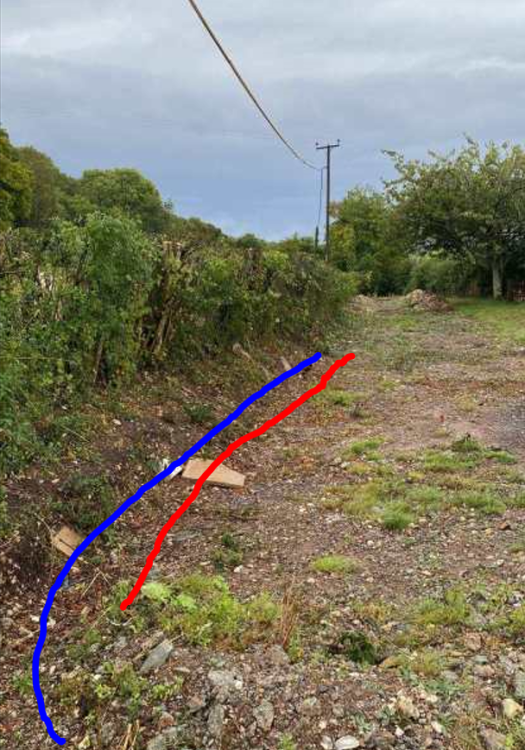
-
merci - I may be wrong but i think EWI is commonplace in central europe too probably with not as many issues? new build and refurb? But the climate is drier, hotter, and colder than here in UK..........
-
ps - if all boxes ticked so far and it's dry ensure installation correct to ensure rain/moisture can't get in behind - particularly at eaves/verge/reveals. also consider detailing at dpc, especially at corners. I don't know but I'd personally dig deeper to establish if thermal bridging at ground floor - wall connection level becomes an issue???? google 'ewi problems' - AI overview interesting I really will now be quiet!!
-
I'm no expert in EWI and not planning to research as wouldn't use! But IMO: very careful consideration needs to be given to structures on an individual basis. There will I am sure be plenty of companies out there full of BS so probably advisable to ensure very careful due diligence There will I am sure be good ones too - and if eveything taken into account and building suitable it's probably ok? If buildings are built to 'breath' - which many with solid walls are - sealing things up on the outside may not be a great idea. Assume walls should be dry before applying to avoid trapping moisture in - which can then only go one way And if vapour internally needs to be prevented from getting into the structure and staying there causing rot and mould etc stopping it is easer said than done on an existing building Additional ventilation may be required? - passive or mechanical? Localised thermal bridging I'm guessing could also be an issue? (eg window reveals)? Only my opinions/thoughts..................... briefly back to the cavity conversation - I find most people seem to forget and/or don't know the original reason for them, and is also a mystery why many think bricks and stone etc are waterproof! They aren't - which is why wall ties have drips and cavity trays are necessary at abutments etc. Porosity will vary significantly. (obviously render/coatings a different conversation). Somebody I was talking to years ago was told by a so called 'expert cavity insulation installer' they would seal up the holes made in bricks to ensure water didn't get in! There are other issues IMO with pumping insulation into cavities but I'll leave it there as don't have all day! Full fill cavity insulation on new builds is I believe subject to location / exposure (regs) and needs to be very carefully specified and installed to avoid moisture tracking across. But I don't believe anything is stated with regard to the porosity of the outer leaf(?) - problem is who would define?! The difference between a relatively impervious brick or sealed render/coating etc and a handmade stock brick or limestone is huge. I shall now get back into my pram and say no more. 😀
-
https://www.bbc.co.uk/news/articles/c3w965gz8zgo
-
Architects have messed up. Next steps?
marmic replied to flanagaj's topic in General Self Build & DIY Discussion
if there's a ditch too, or trace of one, look up 'hedge and ditch presumption' if there are boundary doubts/unknowns/disputes - but doesn't always apply either. Might be helpful? -
i've read some mortgage companies are starting to get twitchy about anything thats been filled - no idea if thats true or to what extent however. Personally wouldn't touch anything thats had cavities filled with anything!
-
solid............ cavity fill also becoming a problem as I predicted years ago!
-
be very careful you don't cause a damp problem.............
-
-
also depends on performance of house - if energy requirements are ridiculously low it's quite possible. time will tell but once we have completed our build (passivhaus) pretty sure the heating will rarely kick in.
-
if you draw off too much heat from the compost won't you risk the whole system stalling? Good point!
-
great idea - had I only thought sooner! Whilst building we've been doing this in the shed: https://humanurehandbook.com/ which would provide a constant free heat source and not take years to fill. And quite ok to use in a house too. Not sure what BCO/EA would have to say and how to complete part L docs etc - but could well be on the agenda to heat garden office when I finally get there - no regs!..............got to finish the house first though
-
hopefully not but be prepared for a possibilty it could be more complicated??? is it definitely a water authority pipeline? no idea if different to england - but if the same: water authority should be able to provide a map of their pipes. If it's private could be time to be nice and/or write a 'name your price' cheque to get a connection (which could even involve a sub meter with rates possibly by your neighbour, albeit not sure on latter) but make sure you spend even more (with solicitor) and get an easement in place (and pay your neighbours fees too) which stays on land registry even when your property sold I know of some pipes you would think are water authority but they are private, sometimes shared - even if before meter. Water companies generally won't or are reluctant to adopt these and as far as I know can't be forced. I knew somebody way back elsewhere in the country who didn't know they were responsible for about 1/2 mile or more of pipe - which leaked badly - they reported it then received a surprise enforcement notice to repair due to wasteage, but really needed replacing at enormous cost added to further as highways also involved. Lost touch so no idea what happened in end worst case scenario off grid RWH time perhaps..................
-
Help needed to improve a stupid roof design
marmic replied to Evigilo's topic in Roofing, Tiling & Slating
the problem could also be beyond the surface in cavities? I havent studied too closely but not immediately obvious looking bricks where you have them. If where you have roof abutment and stepped flashings there are cavities and there are trays in place they could be invisibly directing the water internally into that corner. Or spread more evenly if there aren't any............

