sgt_woulds
-
Posts
293 -
Joined
-
Last visited
-
Days Won
2
Everything posted by sgt_woulds
-
Not a chance. I used to work as ground crew on one of the Goodyear Blimps (considered the second most dangerous job in avaiation (after test pilot), as it is the only role where you are required to run towards a turning propellor!) The Zepellins NT and Airlander are a world away from the crappy old balloons we used, but they still have most of the same problems: Helium! this is a finate resource, and desperately needed for medical and manufacturing purposes. Won't be long until we have a world shortage. Airships (even modern ones) leak like a teabag and it get worse when they get older. The lightship (BC A-60+) we had was end of life (the ballon was condemned and patched with aviation duct tape all the time I worked on it) and it leaked more than 90m3 per day of Helium per day! Speed Unlike our blimp, Rigid and Semi-rigids like Airlander can make headway in higher wind conditions, but that ballon is a huge wetted area to drag through the sky and top speeds will always be limited. Think of it more like a seagoing vessal than and aircraft. Air lander is a lift-body design with better aerodynamic controls, but even they cannot fly in the same conditions as a standard aircraft. Handling/Landing Even the latest airships struggle in high winds, and once they are staionary they are effectively just kites. Zeppelins and Airlander cannot land in higher wind speeds, or gusty conditions, despite their vectored thrust nacelles. Unliked fixed wing aircraft, loading/unloading (or just removing engines for maintenance) is an issue and needs careful ballasting. Boyancy also changes with air pressure. Putting them 'on-shed' is easier with these, due to their mast vehicles, but is required every time you do major maintenance, unlike fixed wings. (Hands down one of the scariest things I've ever done in employment was try to put our blimp into the Friedrichshafen hanger) Airspace Airports shut when airships land due to the handling issues. They have priority over all other craft except for emergency landings. They have limited ceiling height due to gas expansion (around 300 feet), limited by lift, air density, and envelope strength so airspace and landing slots will be vastly reduced. I've seen concepts for giant solar powered airships proposing emmissions free travel. You'd still need to find a replacement for the Helium to make this true - nothing wrong with Hydrogen of course. It was the airframe and fabrics that burnt on the Hindenburg, not the gas! But try and convince the public of that... You'd also need vastly more efficient flexible PV panels and lightweight batteries. It won't happen in time to help with the climate emergency.
-
UK ‘built for climate that no longer exists’
sgt_woulds replied to SteamyTea's topic in Environmental Building Politics
I spent lots of time working on green roofs, commercial and domestic. From what I'v seen both domestic and managed commercial roofs, unless the sedums are on deep soil (intensive roof) they just get scorched and die. Even the best managed extensive roof will die unless you run sprinklers continualy. You end up with a brown mess and worse albedo than a reflective roof covering. The only sedums that seem able to cling on in these conditions are super fuggly. Not olives! Have you ever eaten a UK grown olive. Yeurgh... -
UK ‘built for climate that no longer exists’
sgt_woulds replied to SteamyTea's topic in Environmental Building Politics
Also make sure not to have doors that automatically lock when they close - lift to lock only. Although these don't always work easily single handed, they are still easier at waist height than yale lock handle combo. A single key for all locks is a boon as well. -
UK ‘built for climate that no longer exists’
sgt_woulds replied to SteamyTea's topic in Environmental Building Politics
Yes, that's what I was thinking! I should have put 'rather specific applications' in air quotes. I was once given a tour of one of those dodgy 'specific applications' (don't ask🤫) and they applied the most rigerous scientiffic approach I've seen outside of a lab! It was all chemical testing, clipboards and graphs... They had also had the most jerryrigged and terrifying electrical system I ever came accross (and I once worked on a house without a fusebox that was wired by Victorians, so that says something). Lengths of rebar rod wrapped in newspaper... -
Urban wind generator or waste of time/effort?
sgt_woulds replied to Bancroft's topic in Wind Generation
I remember a billion years ago there was a requirement for 5m distance from ground to blade tip (and from any windows) for building mounted units. Not sure about free standing rules. This will only be 3-400 watt max turbine. Noise will be zero unless you stand right under it. -
Urban wind generator or waste of time/effort?
sgt_woulds replied to Bancroft's topic in Wind Generation
What building regs requirements would apply to a lampost on a public throughfare? -
UK ‘built for climate that no longer exists’
sgt_woulds replied to SteamyTea's topic in Environmental Building Politics
Ah yes—when I finally move from the building works into the garden, the greenhouse will get some special attention. I’m thinking along the lines of compost heating, like the Victorians used for fruit houses—possibly even combining it with an outdoor composting toilet! I’m still not entirely convinced by the whole hydroponics approach. It seems to be most successful in rather specific applications, rather than as a broadly useful growing method. I was actually thinking more about changes on the house side of things. For example, I’ve incorporated more external greenery to create a kind of “cool island” around the house—the fruit and nut production is a nice bonus. -
Does the UK really have the most expensive electricity in Europe?
sgt_woulds replied to SteamyTea's topic in Boffin's Corner
Since that article is behind a paywall, could you provide a summary or link to an alternative source? -
UK ‘built for climate that no longer exists’
sgt_woulds replied to SteamyTea's topic in Environmental Building Politics
In light of current and future changes to UK environs, what other provisions should be looked at. I already considered these when building my extension and upgrading my house (unfortunately Covid restrictions meant that some of these were unavailable/unaffordable at the time of build) : Larger roof overhangs for better shading and and rain protection Larger gutters for higher rainfall (I went for deepflow, but I now think that was a mistake as we still get over flow, so may change to industrial or import some of the larger metal gutter systems they use as standard in Hungary Breathable and high decrement delay materials for roof insulation - along with an agressive roof ventilation stratagy to ensure that any moisture can wick away in winter / damp periods High Albedo roof coverings. (I wanted to buy white EPDM but this is unavailable in the UK and expensive to import from the EU. Now looking for reflective paint suitable for use with standard black EPDM) High maintenance 'green' roofs are probably not an alternave that is sustainable in the UK climate going forward As much rainwater storage as possible to allow for garden watering (and 'other' activities when the privitised water industry has sucked every last penny into shareholder accounts and bonuses and shuts down) Composting toilet for the same reason. Breathable (sorbative) insulation and high decrement delay wall materials wherever practicable House designed for level access and services suitable for old and infirm residents (raised socket hights, wide doorways, provision for stairlift or through floor lift) Plenty of fruit trees and bushes to provide shading, localised cooling, and dependable food supply External shades or shutters on South and West facing windows (Probably better make that steel shutters on all windows to deal with the innevitable civil unrest when the economy collapses...) No 'smart devices' whatsoever to go wrong/be held hostage to Sorry, that got a bit bleak at the end! I wan't to be a 'Positive Prepper' What else? -
Urban wind generator or waste of time/effort?
sgt_woulds replied to Bancroft's topic in Wind Generation
It's a street lamp. You can see the lamp above the solar panel (maybe it is self powering at night 🙂) -
Not just boilers. When I finished with the solar industry (which by then was was full of cowboys - shocking installs in the literal sense) I moved into stairlifts. It was supposed to be a temporary job but I ended up doing it for 5 years. The most depressing 5 years of my life. Anything to do with the elderly or infirm seems to be a licence to print money by unscrupulous salesmen and uncaring stairlift 'engineers'. If you thing BG is bad, try dealing with Acorn. I could tell you so many stories...
-
UK ‘built for climate that no longer exists’
sgt_woulds replied to SteamyTea's topic in Environmental Building Politics
Ah OK, I re read Part G and you are correct, it is 125 litres of 'wholesome water'. But we should never let the facts get in the way of a good discussion... 🙂 -
UK ‘built for climate that no longer exists’
sgt_woulds replied to SteamyTea's topic in Environmental Building Politics
Our Building regs assume up to 125l hot water per person per day. Presumably because we will all be washing the sweat off more often... 🙂 -
UK ‘built for climate that no longer exists’
sgt_woulds replied to SteamyTea's topic in Environmental Building Politics
Add that to the increased use of woodfibre insulation in French cities (Biogenic insulation is required by new regulations), increasing decrement delay, and there is a chance that they can make city living (and sleeping) bearable during ever increasing heatwaves in the next 50 years. Unfortunately, this won't happen in UK cities any time soon, and we all know that the next UK government will get rid of all the 'woke' crap. Like saving energy and lives... -
UK ‘built for climate that no longer exists’
sgt_woulds replied to SteamyTea's topic in Environmental Building Politics
Heat islanding is real and was an issue we encountered when installing solar (we had maps for heat islands within London and would reduce our predicted generation accordingly. We later made our own more accurate heat island maps based on actual generation figures.) Although each individual energy input is miniscule, collectively it has an exponential effect as Aircon has to work harder and harder to cool the same air. In a city there is no cool air to pull in due to all the Buildings / roads / concrete infrastructure transfering heat to it too Some studies suggest that large deployment of solar pv panels might actualy cool the air slighty, and it seems natural a no-brainer to install PV and Aircon together . Frontiers | Solar panels reduce both global warming and urban heat island -
Type 1 or recycled crushed for ground bearing slab?
sgt_woulds replied to flanagaj's topic in Concrete
Geocell recycled foamed glass agregate. That way you get insulation and hardcore in one product. 250mm depth = building regs slab insulation. Also does not need a membrane unless you are in a radon area as it does not wick moisture Not so cheap though. -
Personally, I think that would be a godsend 🙂
-
What battery drill should I buy? The choice is bewildering.
sgt_woulds replied to jimseng's topic in Tools & Equipment
The warranty on Lidl items is superb. 3 yaers cover, and swap or refund never an issue - as long as you keep the reciepts. -
What battery drill should I buy? The choice is bewildering.
sgt_woulds replied to jimseng's topic in Tools & Equipment
Don't buy a supermarket special unless it is from Lidl. Their powertools and batteries are actually pretty good and easily available. I know a couple of sparkies that are swapping out their tools for Parkside equivalents for everyday stuff. They have kept their DeWalts for SDS however... -
Integrated PV looks good. It looks like the panels sit right on the eaves - did you fit wider/deepflow gutters to account for the faster runoff and overshoot from the panels?
-
Could larger turbines fitted to existing bases not be fitted with radial anchor cable supports like communication masts? As for the blade recycling issue this is well wnown and is mainly due to the recycling facilities not being available rather than it not being possible. Some companies are experimenting with LVL blades, and the company I work for has also provided LVL and technical assistance for another experimental build with a wooden tower and nacelle too. We just need a paradigm shift in foundation design as well (for general building as well as large projects since most house foundations are vastly overspecced). But we are getting there. Of course the major plus point with renewables is that we can deal with any waste at leisure (except perhaps some solar panel components) - we don't have to carefully dismantal and lock the materials away for millions of years and trillions of quids 'World's first' wooden wind turbine blades installed in Germany
-
Just proving my point. Basic property maintenance doesn't seem to be a thing in the UK. SUDs is a functional componant, just like render, roof tiles, pointing, or any other part of a property that is willfully ignored by most here. My German colleagues find the state of UK properties shocking. They factor in maintenance as part of home ownership and as an extented part of 'spring cleaning'. Mind you, they also build everything properly in the first place...
-
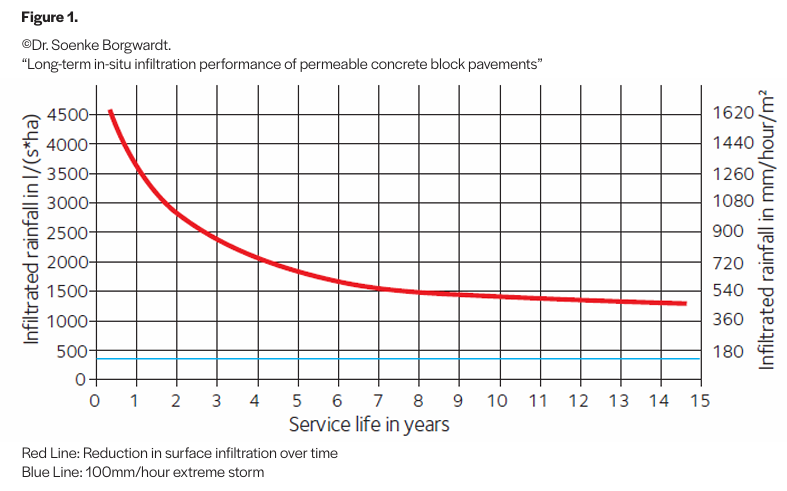
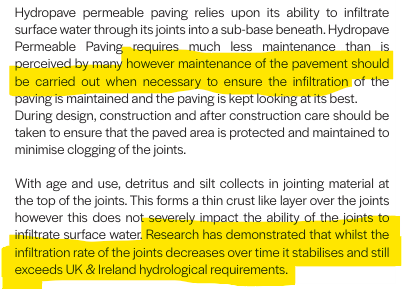
Like any functional part of a property, SUDS needs maintenance. It always amazes me that in the UK that people are prepared to spend a fortune on fancy products and materials but either don't consider - or actively begrudge - the small amount of money or personal time required to ensure longevity. Instead they moan about ticking boxes. tobermore-hydropave-permeable-paving-maintenance-guidelines-v1.0.pdf Where I live the properties on the other side of the road are all lower than their drives, which slope down towards the buildings. These were originally built in the 60's with concrete surfaces and experienced constant flooding. Most have now changed to permeable paving and no longer have to worry about weather forecasts. One is a tight-fisted old curmudgeon who jet washes his 4x4 every Sunday morning at 7am. He never once directs the jet wash at the mud on his driveway or brushes it off. His house flooded twice last year.
-
Not if you build a certified Passiv house and can prove that the indoor temperatures will meet regulation requirements. In practice, most Passiv builders fit a (very) small heating system 'just in case'. In the same way, we should fit EV chargers to new build - just in case the next owner (or even the current one) gets an EV. Your personal preference may be to wash in cold water, but a house built to building regulations isn't built specifically for your personal hygene arrangements 🙂
-
As set by the manufacturer. For our chargers at work this is every 6 months, domestic will probably be 12 monthly until the warranty expires. As with PV, (which should be checked at least once bi-annualy from my experience) the checks will mostly cover any screw connectors to ensure the neutrals are not working lose and causing resistance/arcing. You could do this yourself, (if competent) but it probably voids the warranty if the inspection schedule is not maintained. Newer installs have hopefully moved over to pushfit or Wago type connectons rather than screws (so there should be less issues), but, given the value of the item you are plugging into it, paying for a sparky to check the install once a year would seem like money well spent.