
TerryE
-
Posts
3806 -
Joined
-
Last visited
-
Days Won
30
Everything posted by TerryE
-
I ran the HW (a bath for visiting grandkids) to cold using this SunAmp for its salt to go through phase change to solid, and I then left it overnight to thoroughly cool, before disassembling / removing the OSB pressure plate and retaining frame. The cells were now solid and nicely cuboid, so reassembly was now straightforward. I will do my commissioning tests at midnight (when the Octopus price drops). I recall that some of our members have discussed issues with their UniQ series SunAmps having issues with sagging or split cells. The lesson is quite clear: Do not remove a side panel unless the unit is well below the phase change as the cells do not have internal bracing to retain their shape at operating temperature without the steel casing support in place. If you need to bring the SunAmp up to operating temperature with a side panel removed then you will need use some bracing formwork to retain the cell side shape.
-
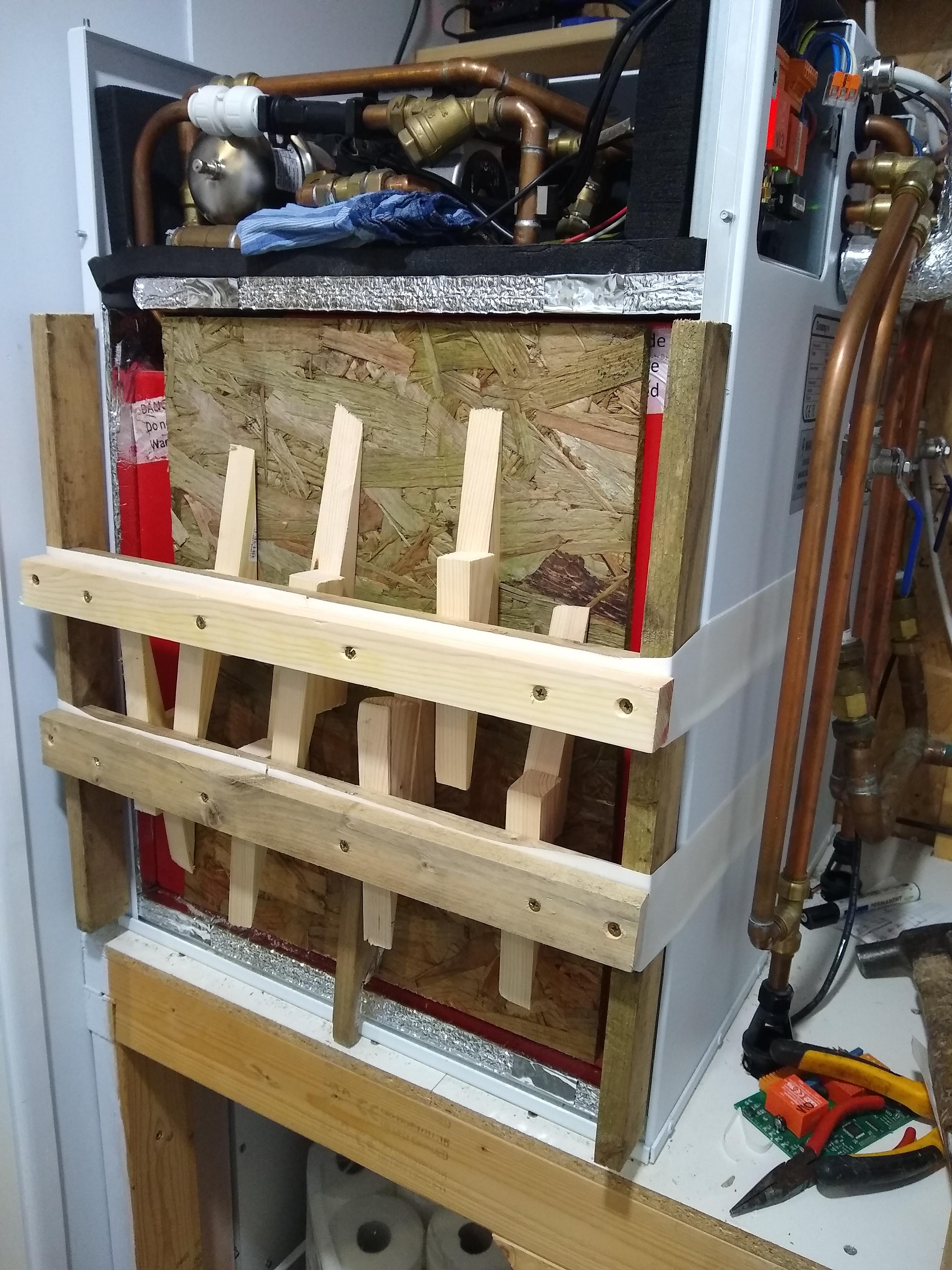
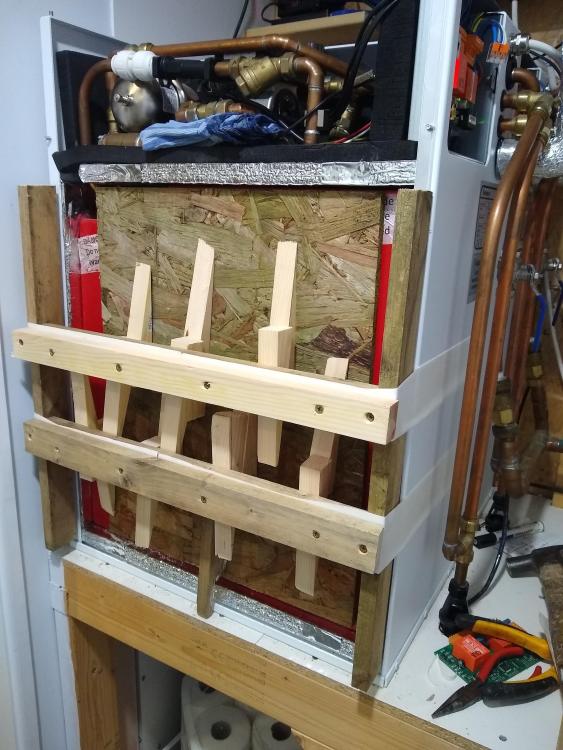
After some debate, Jan and I decided that we could press out the sag in the cells if I made a suitable jig, so I made up an H frame that is held against the side of the SunAmp by some tape strapping, and which could hold a pressing plate (a square of OSB3, and with two bars that allowed a set of folding wedges to apply the pressure. I then brought the SA to temperature and used the wedges to load up the pressing plate and push the cells back true. All that remains is to allow the cells to cool back to solid phase and then I can reassemble the SA. A bit Heath Robinson, but simple, very cheap and effective. Job done. Here is a pic (note that the wedges are pretty much at the end of their travel as the cells are back in shape and position :
-
@ProDave Dave, it is 6 years too late to cry about that. 🤣 BTW, The two PCM cells in each unit are roughly the size and shape of a Jerrycan. The internal plumbing is a mix of end-feed, standard compression, Pegler Tectile and John Guest Push fit. I can't understand the rationale here for this .
-
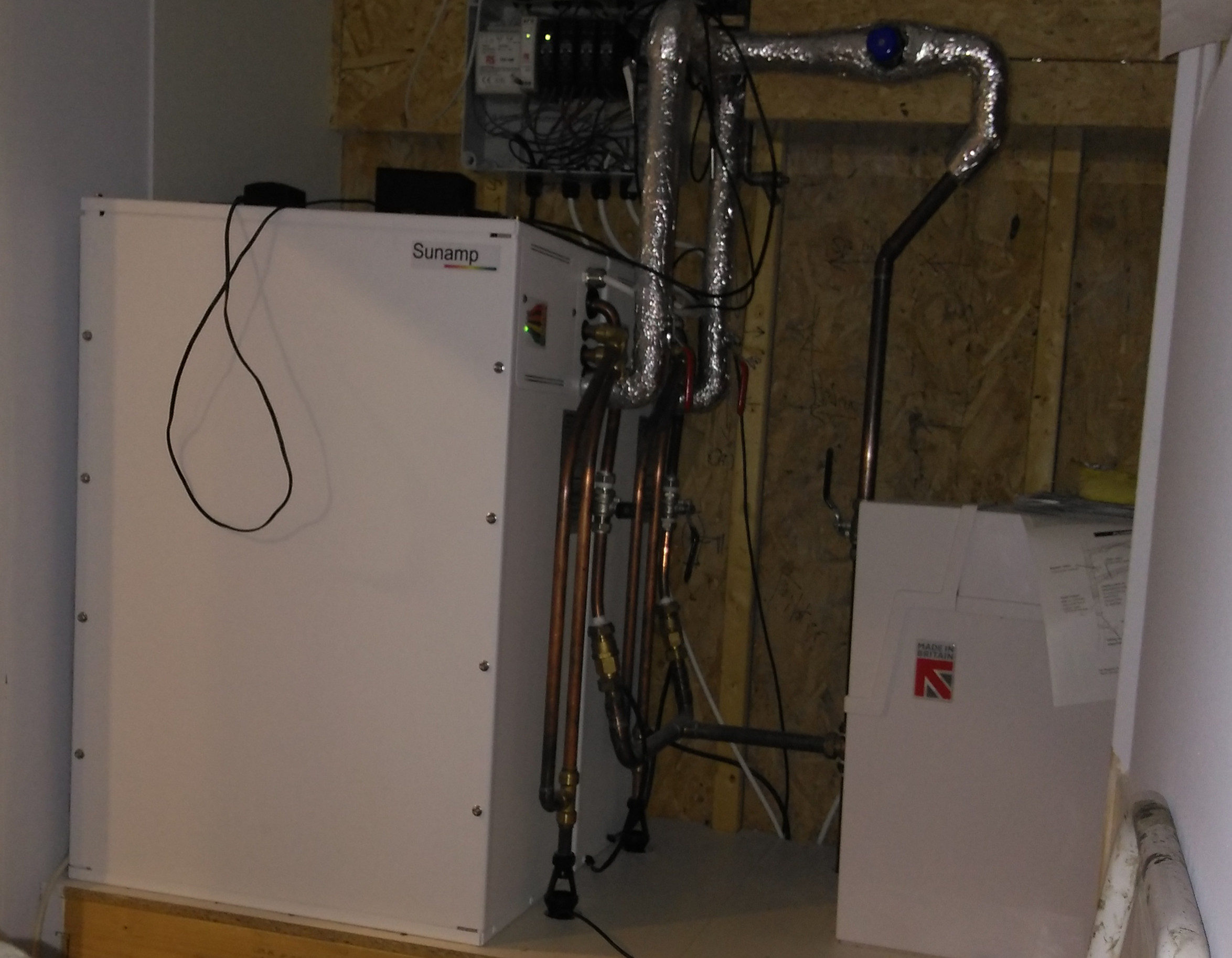
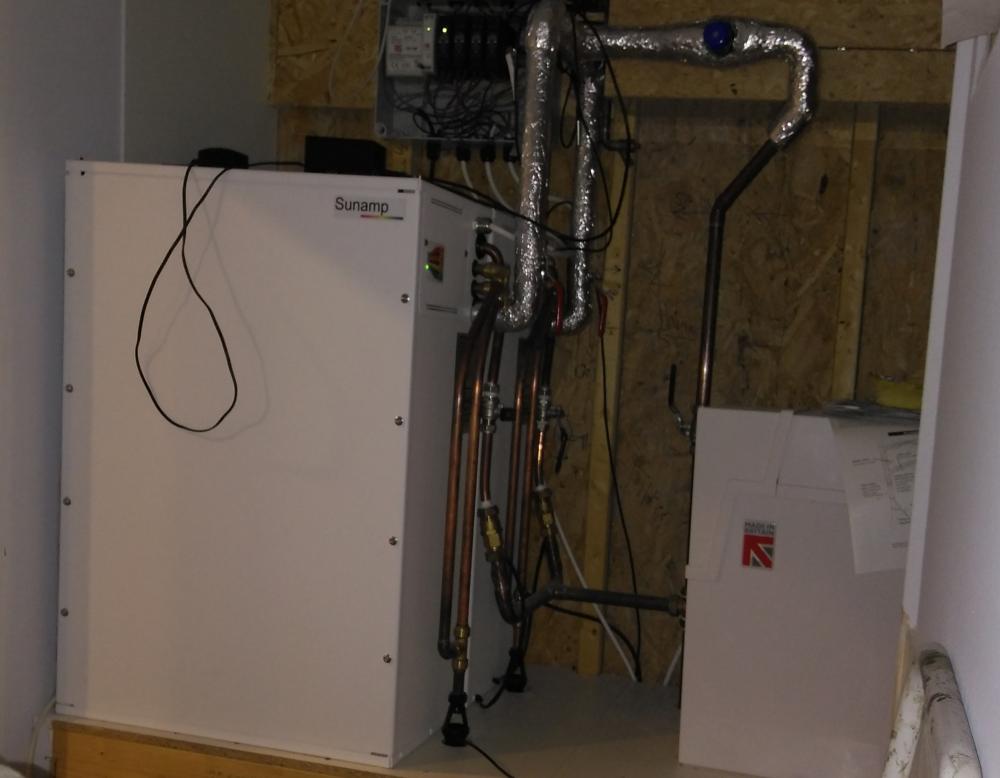
@Nickfromwales, I have just done a 101 cockup. 😪 The heater thermo hat tripped, so I took one side off to get at the heater and reset the trip. I then did a quick trial heat to see if everything was hunky-dorey. What I didn't do was to put the side back on first. Unfortunately the cells keep their shape because they are retained by the steel outer container, and with one side missing they started to slump slightly. By the time that I noticed the two cells had belled about 5mm -- not enough to cause permanent damage, but enough to pop the unsupported vacuum panel off and to stop me reassembling the unit. I am an idiot. So I now have a catch-22: the cells are still integral, but have sagged slightly, and I need to get them back to their constrained cuboid shape in order for me to be able to reassemble the unit. To do this i need to bring enough of the PCM salt past its phase change (at least 50%) of the contents into the liquid phase with the cell is a correctly sized box formwork for it to reset into correct shape. This is all entirely doable but just a total PITA to do. The unit is currently on a shelf ~1m off the desk and with each cell at ~40Kg weight, this is enough of a lifting hazard for an old fart like me to need a lifting aid(e.g. a pulley) but again thanks to my time in the Royal Engineers, this is something that I am familiar with. I will try chatting to a SunAmp engineer, but I am not hopeful. I suspect the answer will be: "sorry, but it's an out of warranty obsolete unit", with maybe an offer of a small discount on a replacement unit -- which would need me to replumb by HW runs and move my control panel 😞 So it's going to be a case of disconnecting and dismounting the SA (the front unit in the pic below, which as taken 6 years ago during commissioning), and then working on it in slow time. I still need to diagnose the root cause for the thermo tripping in the first place and fix that before I can recommission the unit. The moral of this story is that using a constrained space like this for services is a bit fraught with gotchas. I would have been better having the heavy kit on the deck and moving the manifolds up to the top shelf to leave room for the heavies below -- but this would have required me to have left 2m tails on the UFH loops before the slab pour -- something that I didn't even consider at the time. At least I have the isolation valves with compression fittings so breaking out the unit itself is straightforward.
-
Nah, it's more a Q of physics, and the algo isn't that too dissimilar to how I heat my slab, but in the context my " issue is with redoing it" comment, I was really talking about SunAmp doing it.
-
@MikeSharp01 that's why I like 2 off units. The PV units are quite compact (D x W x U): 530 x 300 x 740 mm so two side-by-side are a small footprint and one does use a day's HW so long as we don't want a big bath. They weigh 80 kg, so you really need a hoist and trolley to be one-man manoeuvrable. The Uniq series have a bigger footprint (W x D): 365 x 575 with height depending on capacity, so if we did decide to replace the PVs, I'd probably go for the 210e model (which is 870mm high), but I am loathed to replace the PVs after only 6 years use. And it the circuit board that is the Achilles' heel, and I really can't see what the issue is with redoing it.
-
@Nickfromwales I have just had one of my 2 PV units fail. In my case the heater is still measuring 17.8Ω which is what I'd expect for a 2.8kW heater. The obvious failure is that the thermal cutout on the heater has tripped, as I read zero continuity over it. What I am not sure about is why the heater overheated, but I need to reset it to diagnose why, and isolate the root cause. This is the next step. (All potable water goes through a Harvey Water Softener so we have almost no scaling in our pipework.) Overall, I like these PV modules, and because I can isolate either if it fails, and I still have HW even if one fails. They have two major design flaws: The control board is a crap design: there is no decent isolation of the 240V power circuits and their track dimensions are far too small. The main power relays are also too small. How got this CE certification amazes me. There is no customer / support engineer diagnostics facility. BTW, the same board is used on their Uniq product range. The gubbins as shown in @Novice pic above is squeezed into a tiny volume with no thought about access for maintainability. The package looks nice, but so what? I can now buy cheap ESP32 based boards with the necessary PWM output, and other I/Os, relays, etc. so my fallback alternative to replacement will be to do a complete refurb and possible replace the control with a stock alternative.
-
Logging OVO Actuals Data and Octopus Agile Half-hourly Prices
TerryE replied to TerryE's topic in Boffin's Corner
@SteamyTea Nick, your point is valid, but I can only take small steps. I'll update this in a week or so, when I have reworked by optimisation algos and got some initial results. -
Logging OVO Actuals Data and Octopus Agile Half-hourly Prices
TerryE replied to TerryE's topic in Boffin's Corner
@S2D2 Thanks but since I have to use the Octopus API for future calculation and monitoring this will be a 1-day issue. I will get the cost of that day when I reconcile my last and first days. I'll just average the previous and next days then scale to balance the cost, which is a one-time spreadsheet exercise. I've got to do my data models anyway to support half-hourly costing. -
Logging OVO Actuals Data and Octopus Agile Half-hourly Prices
TerryE replied to TerryE's topic in Boffin's Corner
I've collected half-hourly meter readings from OVO since we had our smart meter fitted in Jan 2018. OVO stopped recording these on the 6th but Octopus only started on the 8th, so it looks like I am going to have to backfill the lost data somehow at some point if I want a complete bumpless data set. 😱 More to the point, I now need to expedite my new algo though TBH even my old "do as much as possible 0-7AM" will still be over 20% cheaper than OVO at current prices. -
Logging OVO Actuals Data and Octopus Agile Half-hourly Prices
TerryE replied to TerryE's topic in Boffin's Corner
This comparison might be useful: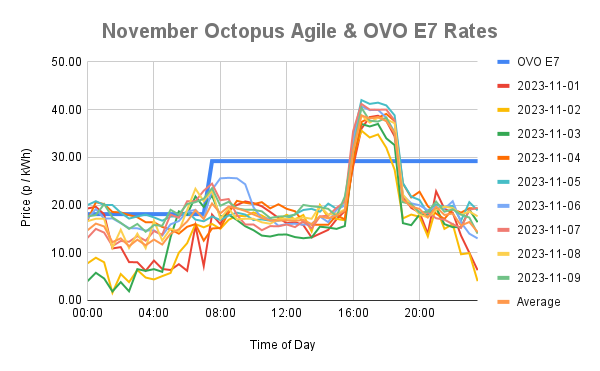
-
Logging OVO Actuals Data and Octopus Agile Half-hourly Prices
TerryE replied to TerryE's topic in Boffin's Corner
@Alan Ambrose Alan, the human-in-the-loop responses seem to take about 5 working days, and are a bit hit and miss, ATM. For example, I have asked for an account on the Octopus forum and am still waiting on a reply. In this case, I logged onto my Octopus Account and navigated to the request Agile form, and submitted a request to switch there. I got an "Oops something went wrong response, but also an automated email which included a custom link asking me to read and accept the Agile T&Cs which I then did. I then got the confirmation of the switch by return -- but note that I already have an Agile-supported smart meter (in my case a Secure Liberty 100 SMETS1 meter that OVO had already done the necessary firmware upgrade to). -
Logging OVO Actuals Data and Octopus Agile Half-hourly Prices
TerryE replied to TerryE's topic in Boffin's Corner
Well I've just switched to Octopus Agile. It proved relatively painless and far quicker than I expected: 4th Nov. I had to request an E7 tariff quote and accept this to get the process rolling. 5th Nov. Both OVO and Octopus confirmed that the switch was under way. I had to do an old fashion eyeball meter reading 8th Nov. First day of Octopus supply. 9th Nov. Octopus API access to my Secure SMETS1 meter confirmed, and half-hourly data being captured 9th Nov. Requested cut-over to Agile tariff. Confirmation of the switch by email return. My account details confirm that I am on the Agile tariff. So now I've got to make the changes to my heating algo to make use of the new ToD tariff, but this merits its own blog post. -
The HA automation language is quite rich and NodeRED even more so. I can chat offline. I've PMed you.
-
Yes, but why the scepticism? This is partly conservatism, that is with a small c, but an awful lot is because of the FUD propaganda in many sectors of the press and news. OK this is partly klick-bait driven, but a lot is it is funded by fossil fuel money.
-
Downloading OVO Smart Meter Data
TerryE commented on TerryE's blog entry in The House at the Bottom of the Garden
I was just looking at the blog entries and realised that I had never published this one, so I've unhidden it just in case anyone is interested. -
@SteamyTea, I like your first-cut analysis. It tells a tale. So ~£3Bn for 60 GWp generation and 500 GWh storage at ~£160Bn. I note that current LFP pack prices are around £100 / kWh at scale, or £100M / GWh, or £50bn for 0.5 TWh. Though at those sorts of volumes we'd probably be looking at Na based chemistries which are projecting to be nearer £50 / kWh, so maybe nearer £50Bn. There are also going to be other Engineering curve economies of scale at those sorts of volumes. We also need to factor in other storage technologies such as pumped hydro, ultra high temp heat batteries; and the flexibility of other non-combustion generation options: windfarm scaling, etc. and geographic spread using interconnectors. There are also games that you can play with overabundance (e.g. go for 3× or 180 GWp generation at an extra £6Bn which will create all sorts of business options for what you can do with the excess (e.g. green hydrogen 🤢). So yes, there are lots of cheaper options that we could develop with the international political will; ones that would make society better for our old age and our children's. The challenge is that we've got a lot of old and powerful men whose wealth is tied up in extraction/ mining, refining and burning stuff and who don't mind investing a little of it in lobbying, 'think tanks', etc.
-
We've got lots of suitable offshore for large wind farms, and just think of all of those acres used to grow biofuels (The last published ONC figure was 120,000 hectares in 2020) and could convert this to PV or agroPV (e.g. grazing livestock under the PV cover). With some battery and extra pumped hydro we could easily get over 80%.
-
Logging OVO Actuals Data and Octopus Agile Half-hourly Prices
TerryE replied to TerryE's topic in Boffin's Corner
I've also loaded the following into github as Gists: octopus_agile_download.pl octopus_price_comparison.pl -
Logging OVO Actuals Data and Octopus Agile Half-hourly Prices
TerryE replied to TerryE's topic in Boffin's Corner
Yes, the market is complicated. There are different rates, e.g. next day, and various N month rates where the distributor is offering fixed price contracts, say 1 year term, and it wants to lay off this risk onto the generators. There is also a half-hourly price, which is fixed 1 day ahead at Midnight UTC+1 (CET). Individual distributors and generators can also enter into supply contract which are priced by negotiation (e.g. if OVO wants to buy types of green electricity, though these negotiations are heavily influenced by the prevailing spot rate. What this does show is that the Octopus Agile prices track the spot rate far more than OVO does. My E7 peak rate averaged over this year from OVO has been 35p / kWh when the average spot rate is less than a third of that. -
@Gus Potter, both, but definitely saving money in two ways: first in upfront costs during the build: our complete CH system including the UFH pipework in the slab came in at under £4K and that's for a reasonable 4 bed detached house (3 of which have ensuites and they are all decent doubles). The CW and DHW also under £4K. Second in terms of maintenance and running costs, we don't have complex kit like UVCs, Gas boiler or ASHP or. expensive systems like Loxone that require a pricey annual maintenance contract with an approved maintainer. We keep our house at just over 22°C 24×7, and we can only do that because the heating system is optimised for the house. And yes I do get a kick out of the intellectual side of modelling and designing these, and documenting them on the forum for others to follow.
-
If you think about the heat flow in the house UFH, you have the UFH loops conducting with roughly semi-radial heat-flow so each metre of pipe warms 0.03m³ concrete which then reradiates from the surface into the living space. The rebar mesh improves the conductive spread, so this is a very effective store and radiate system. Your loops are quite long, say around 80m on average and you have 7 in parallel increasing the effective flow cross-section accordingly. If you get the effective power O/P of the ASHP and the average Δt out : return at the main manifold, then you can estimate your average flow rate. Ditto for the Summerhouse. I suspect that with 7 loops your flow vs head is with the tolerances to use a single circulating (?ASHP?) pump and no buffer. Does the SH only have 1 loop? Here it is relying on conductive transfer from the UFH runs to the wood flooring without mechanisms for lateral heat dispersion. Wood isn't a good insulator but it's a lot more of a one than concrete. It's just not going transer the heat from the UFH floor effectively. Without separate pumps, mixers and a LLH the main and SH circuits will see the same pump head and so the flow rate in the SH could also be a lot less than the main house. Given that the SH has an intrinsically low thermal mass, you could realistically heat it "when occupied", shifted maybe 30-60 min say to take out heating lags, so let's say 5×8 hours per week for maybe 6 months a year. I suspect that this is going to be a lot less than the amortised cost of trying to complicate the UFH systems. Though it is probably worth leaving it as-as for basic anti-frost / chill protection and using the heater to lift the temp that extra 8°C or so.
-
I've posted a couple of related topics in the Boffin's Forum: An Aug 2019 topic: IoT / microcontroller based power switching. And March 2020: Raspberry Pi based CH and HW control. Some of my household services need an availability on a par with external utilities such as our electricity, water supply and sewage: our central heating (CH) and direct hot water (DHW) just need to work and be available without hiccup: losing either of these systems would be a real hassle if the outage was greater than 24hrs. I use a HomeAssistant (HA) system to integrate and to automate other IoT goodies stuff: e.g running various lights and timed appliances, together with a bunch of temperature / humidity and motion sensors, and a few smart button to sequence some of these. However, for reasons discussed in the footnote HA is just too flaky for 24 × 365 service provision of critical services such as CH and DHW. In my view these require a separate dedicated and minimal system to run CH and DHW control. There are many ways to achieve this, but some six years ago I opted to use an RPi3B with battery backup and SSD running a simple Node-RED stack and my own custom code. This has performed flawlessly and non-stop for that time, and it still offers a lot of headroom for me to enhance the system. I would recommend this approach to any other self-builder, if you have some basic programming skills. However I am now about to switch to an Octopus Agile tariff (see this discussion), and this will require some changes that I will discuss in later posts in this topic. One of the fey functional changes to my CH system is that I now use 3 small oil-filled rads to supplement my UFH during the colder winter months. I used to control these from HA using Zigbee Smartplugs, but I can now remove this dependency on HA by switching to Athom Smartplugs with pre-installed Tasmota Firmware, as this will allow me to directly control and to monitor them directly from Node-RED using a couple of HTTP requests direct to each Smartplug. Again, I can provide more details if anyone is interested. Footnote: My View On Why HomeAssistant Is Just Too Flaky To Provide Critical Services When I used to use an RPi to host HA I three had HA+RPi hardware failures that required me to rebuild and reinstall the system. I ended up HA onto a VM hosted under Proxmox (an old laptop upgraded to 8Gb + SSD running closed) and this largely solved these sudden death events. The HA development team uses a monthly update cycle to minimise the delays in getting new functionality in use. This means that new functionality is often not fully test and sometimes introduces breaking changes to an integrations and add-on module, or even another unchanged module which has an interdependence, but this means that any upgrade is game of Russian roulette. At least the Proxmox functions to snapshot and restore VMs are a lifesaver as these take seconds to a minute to do, whereas a HA native restore takes a few hours. If the bug introduced by the upgrade is a subtle one then it might be too late to roll-back to the old version once the symptoms become apparent. For example, before we went on a long spring visit to Greece Jan went round turning off a lot of wall sockets — some of which were Smart plugs, acting as routers in my Zigbee mesh. Logging remotely I could see that most of my Zigbee devices were now unavailable, and the Zigbee HA Integration marked these as dead. No luck in reconnecting them when I got back. The advice on the HA forums for this failure mode was to do a complete clean install, I am annoyed but relaxed about all this because these devices are in the nice-to-have category, because we can always turn on and off lights the old-fashioned way. In principle I could do all of my house automation in HA, but my view HA as serious issues for "production" use.
-
@JohnMo, sorry but I don't know the details of your house. I can't recall any topic where you've given an overview of your house characteristics, but I suspect from your general posts that it is a well insulated low-energy build with a decent high thermal capacity slab. The summer house is well insulated but everything has extremely low thermal capacity so it going to be very different in terms of its response curves. By way of an example with our Warmslab, the UFH really heats up the concrete in the slab over say 5-7 hour heating period, then the warm floor transfers this heat into the house over the next 18 hours or so. If not identical then at least your main house UFH at least has 50 mm of concrete to act as a thermal buffer and spread the heat across the floor. However it sounds like you don't have any equivalent high-thermal capacity buffer in your summer house so its heating characteristics will be different in terms of ability to absorb and retransmit heat from the UFH loops to the room environment so hence the different in Δt for the two UFH setups. It's going to be hard to match the two systems and drive them from the same ASHP without adding a low loss header extra pump and using the manifold TRV on the main house to drop the circulating water temperature. @Nickfromwales you have a better idea of this sort of stuff.
-
Logging OVO Actuals Data and Octopus Agile Half-hourly Prices
TerryE replied to TerryE's topic in Boffin's Corner
@SteamyTea. No just my current OVO Simpler Energy - Economy 7 plan to the Octopus Agile Flex one.