lookseehear
-
Posts
166 -
Joined
-
Last visited
Everything posted by lookseehear
-
Did you get a specialist installer for any of the diathonite products? Did you find it easy to find someone competent? We're putting living space upstairs and have mostly vaulted ceilings, with the exception of one area which will house the MVHR system. It is above the utility room, so this shouldn't be too much of a problem noise-wise. I think we'll probably have 75% of the house connected to MVHR and the remainder will be hard to duct to, so will have decentralised systems installed. We've always been on oil in this house and hate the process of buying oil twice a year. Our road is fairly narrow, so we've recently had two companies take our money then several weeks later say they can't deliver. Our builder is fairly traditional and keeps talking about tanking stone walls, but I think I'm bringing him around to thinking about different possibilities, like lime based products.
-
Thanks for the detail here. We've ruled out EWI, at least for now. There are just too many moving parts of this job, but the main ones being the roof and windows. If we wanted to do EWI we would need to factor that into the roof design, and we're enlarging quite a few of the window openings as we go through the refurb, so we already have the issue of when we order windows to ensure they fit, but not actually having physical openings to measure. Factor EWI detailing into this with an uncertain timeline and it just didn't feel like the right thing to do. Maybe if our builder or architect were experienced in this area that would have made a difference but that's not the case. I would still consider diathonite internally, however finding a competent installer seems to be the bane of most 'eco tech' for buildings nowadays. My ideal solution for insulation and airtightness is something that is straightforwards enough for our builder to pick up, and using fairly common building materials, which is why I'm leaning towards a parge coat to the stone, with an insulated battened service void, using mineral wool or maybe wood fibre. I'm really going to lean into airtightness and MVHR design will need to come relatively soon. We will likely switch out from our oil boiler to ASHP at some point, so all radiators will be sized to accommodate low flow temperatures. It's good to hear that you are seeing benefits of the MVHR already. Have you measured your airtightness at all?
-
Thanks for this, but we're way past that point! We looked at it, but a rebuild at the ~200 sqm would have been in the region of £500-600k. We may as well just be moving house at that point.
-
Although I don't have a huge amount of practical experience, I've done a lot of research in this area because my house has similar construction for the most part. There are several schools of thought without much overlap, but in general the first question should probably be to ask why the wall is wet in the first place. Are all RWG in good working order? Is there a risk of a broken pipe somewhere nearby? You mention that it's an internal wall which would lend itself more to a problem at ground level or coming from within the wall above, rather than damp coming through the wall as you might expect if it was external. Is it on both sides of the internal wall? Is it limited to just one wall or to many walls? You mention the concrete floor appears dry. Do you have a sense of where the water table is relative to the levels of the house? While tanking will stop water physically moving from in the wall to into the room, if the wall is wet it is likely to remain colder and will be more of a heat sink. If you put PIR over the top it will make the wall colder still, and any moist warm air from in the house that manages to get behind the insulation will condense on the surface inboard of the tanking slurry, and potentially lead to mould growth on the wall. I'm sure tanking has a place when there are no other options, but the ideal solution would be to find a way to make the wall dry (or dryer than it is currently at least).
-
Conversion budget - where to begin?!
lookseehear replied to terrilorr's topic in Costing & Estimating
This seems fair. We're extending and fully refurbishing our 200m2 detached house and hoping to get it done for ~£300-320k -
how much weight can i put in a skip?
lookseehear replied to gaz_moose's topic in General Self Build & DIY Discussion
I wish we had such cheap skips around here! £280+vat for 6yard a few weeks ago. Loaded up with old broken concrete blocks, stone, old roof tiles etc. Twice had smaller lorries come and pick it up, drive down the road then come and drop it off complaining of being 1.5T over weight! -
I've emailed a couple of businesses selling tiles and pedestals, as well as asking kingspan what they would recommend. Kingspan suggested I talk to a structural engineer, one other business said 18mm osb would be fine and another hasn't got back to me. Ideally I'd lay single ply membrane directly onto PIR, then pedestals directly onto the membrane, but my suspicion is that an 18mm layer of osb under the single ply membrane would suffice.
-
I'm coming back to this and my worry at the moment is about how compression resistant PIR is. I assume I can't have PIR, with single ply over, with pedestals straight on top? Would I need an intermediate layer to support the load of the tiles plus people/furniture so as not to damage the insulation through compression (like another layer of OSB or ply)? A bit of research has shown me that you should ideally have 300kPa/m2 underneath the pedestals, but PIR appears to be in the 120-150kPa/m2 range. Edit - would adding a thin layer of XPS over the PIR allow me to get the load-spreading required? XPS seems to be in the 200 kPa range and higher.
-
Fine tuning my IWI Solid wall (Warm Batten) design
lookseehear replied to Annker's topic in Heat Insulation
Thanks for this - I think we're likely to use a combination of centralised and decentralised MVHR, as we can likely get ducting to 2/3 of the house relatively easily, but the final 1/3 will be more tricky. This definitely makes sense to me. -
Fine tuning my IWI Solid wall (Warm Batten) design
lookseehear replied to Annker's topic in Heat Insulation
Thanks for this. What attracted me to the method of parge for airtightness and rockwool/service void/plasterboard finish is that it decouples the airtightness from the services (no taping socket backboxes etc). It seems simpler from an execution perspective and I think this would work well with our builder and help me stay on top of the quality of the work. It isn't that I don't think he'll do a good job, but I think that we still have work to do when it comes to selling the importance of airtightness. I'm also wary that the more rigid the insulation board is, the less able it will be to match the uneven shape of the stone walls, and the more likely we are to have voids. If we were to use a parge coat of NHL 3.5, rockwool within a CLS timber 'batten' frame, Intello Membrane then Plasterboard (and I assume a skim of gypsum), does that mean that all sockets/holes need to be taped to the Intello membrane? Our project is a combination of extension, reorganisation and renovation, so anywhere we can create a simple solution will be big positive. -
Fine tuning my IWI Solid wall (Warm Batten) design
lookseehear replied to Annker's topic in Heat Insulation
Thanks - this all makes sense. What about window/door reveals? Maybe similar but thinner batts and thinner mineral wool insulation? -
Fine tuning my IWI Solid wall (Warm Batten) design
lookseehear replied to Annker's topic in Heat Insulation
This is incredibly helpful - thank you! I have a couple of questions about this method if that's OK. What would you do if the walls are uneven stone not solid brick. I'm imagining a parge over the rough surface, then battens create as flat a surface as possible for plasterboard, and mineral wool batts assumed to take up the uneven surface of the stone? In this method there's no airtighness attempted between the room and the parge coat, so moisture is free to get behind the plasterboard and insulation onto the parge coat which (given it's on the cold side of the mineral wool) will condense. Assuming I'm right in this, is the thinking that it's all vapour open enough to allow drying inwards aided by PIV/MVHR? Thanks in advance. -
Let's just say for a minute that I don't want huge radiators in all the bedrooms, what would the next best option be? How oversized is oversize? While space isn't massively at a premium, I feel that placement is incredibly important if you're putting in oversized rads so as not to be in the way of furniture. My brother in law and my in-laws have this, and both have said that it doesn't work as well as they'd hoped. If you don't have a regular daily routine (our weeks can be quite varied) then a timer doesn't work, and I'm imagining that it's slow to heat up and expensive to run. What's the real life experience like of using these? I like this idea - I'll try and factor this in. Can you explain in a little more detail? By parge do you mean brushed on? Do you then mean battens screwed directly to the wall, with mineral wool filling the whole gap between wall and plasterboard? If the airtight layer is the parge coat, doesn't this risk condensation behind the plasterboard on the wall? If walls are already plastered and in a good state of repair I assume battens directly to this, mineral wool fill and regular plasterboard on top? This would be cheap and easy. Any issues with the original walls being painted (from a breathability perspective)? Thanks for all the advice so far.
-
I love this! I can have a look back through your posts to see if there's anything relevant, but I'd love to hear in particular why you decided on hempcrete vs another type of insulation for the solid walls. Glad to hear this system is working well for you. Maybe we don't need 400L, but I'd rather put in a larger heat store than a smaller one. It would be more efficient in terms of heat losses because of smaller surface area to volume/mass ratio, and I'd rather not be hitting the max temp from solar on a regular basis if I can store it instead, although arguably on sunnier days with more solar gain we'd be more likely to use the solar energy to power some kind of cooling system. In terms of the calcs - 1kWh = 860litre-degrees which means that it takes 1kWh to raise a 400l tank by 2.17 degrees. We have a good orientation for solar PV and no shading, so my guess is that we'd generate between 5 and 30 kWh/day between a shady December day and a sunny July day, which would raise the temperature of a 400l tank between 10 and 60 degrees. Not that bad I think!
-
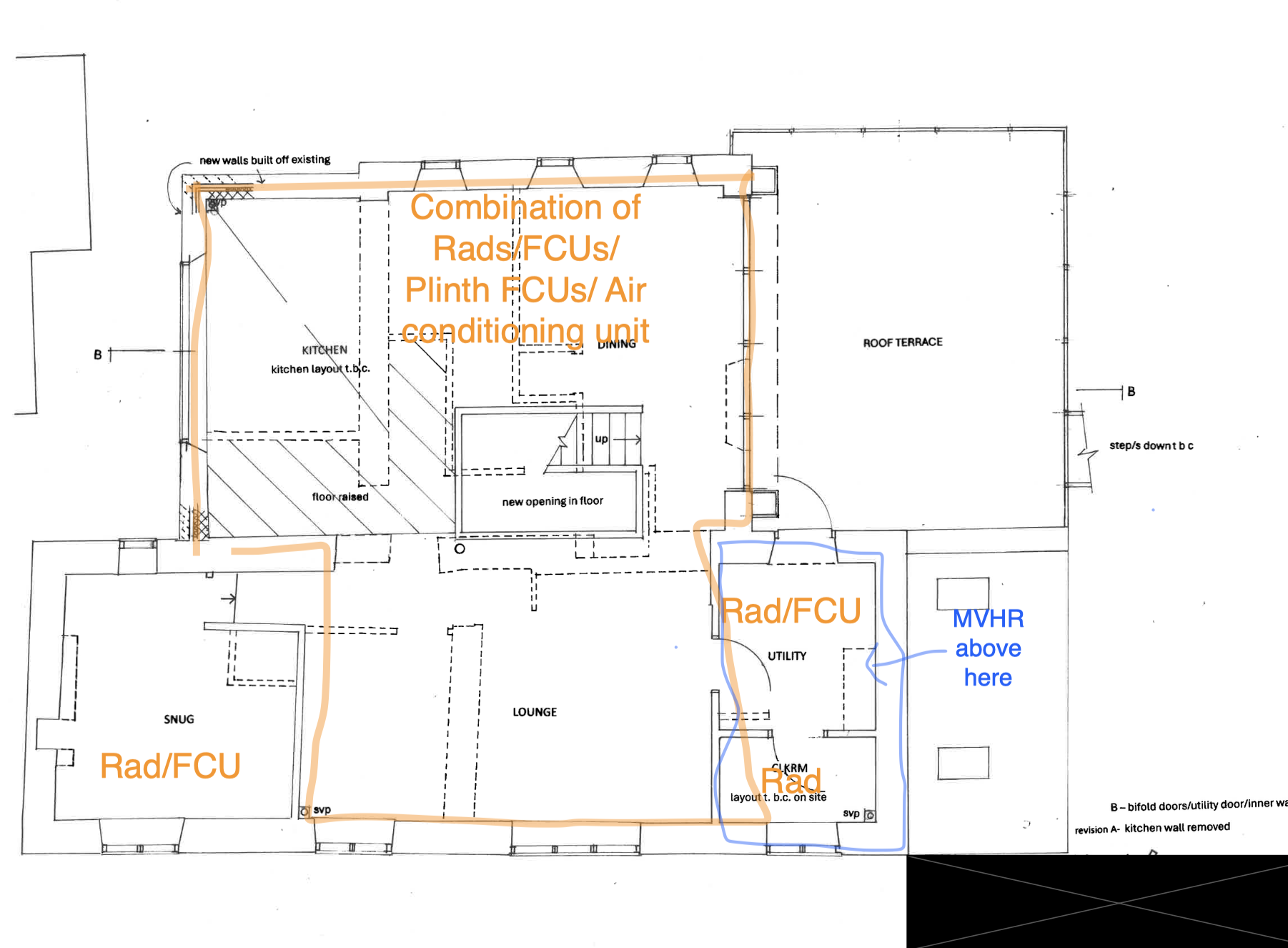
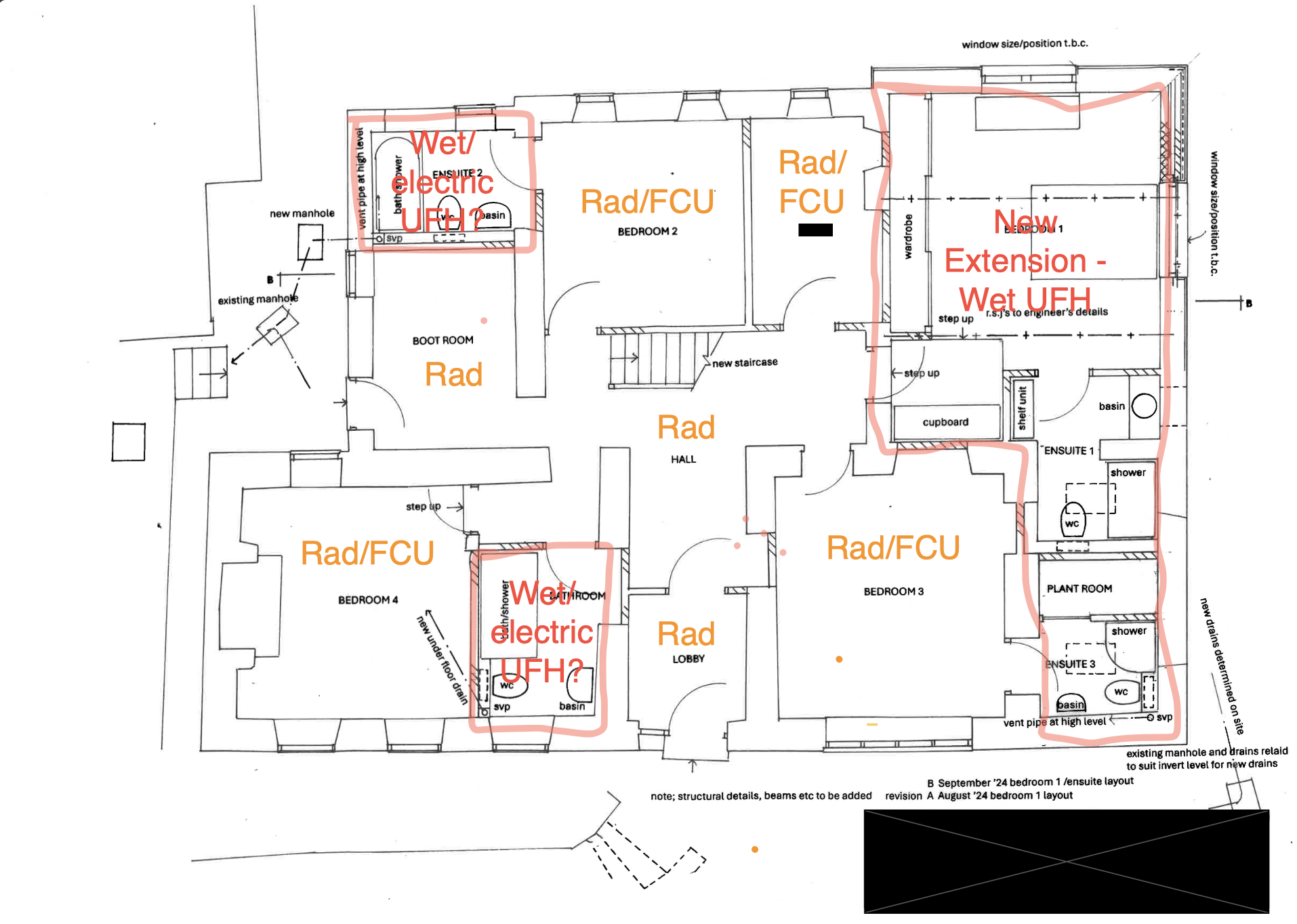
Thank you all for the incredibly helpful replies! I've come up with a rough plan, which still needs some development, but I'm feeling optimistic about it. The Plan: Thermal Store for Heating and Hot Water I'm considering installing a large thermal store (around 400-500L) to handle both heating and DHW while keeping the existing oil boiler. Solar PV Integration We’ll be installing solar PV, but likely without a battery for now. Excess solar energy can be diverted to the thermal store for heating and DHW. Electricity and Oil Cost Comparison We're on an EV electricity tariff, which gives us cheap electricity at 8.5p/kWh from 00:30 to 05:30. Currently, oil costs about 60p/litre, which contains 10.2 kWh of energy per litre. However, with the boiler’s 85% efficiency, the cost of heating from oil is around 7.5p/kWh. So, we can use cheap electricity to 'charge up' the thermal store overnight at roughly the same cost as heating with oil. Of course, this may change with fluctuating oil and electricity prices. Heating in Bedrooms We plan to install large radiators or FCUs in the bedrooms and avoid UFH in areas without insulation. Main Living Space In the upstairs living area, we’re thinking of large radiators, and perhaps plinth FCUs in the kitchen to provide an extra heating boost if needed. Bedroom in New Extension For the new extension, we’ll install wet UFH. However, instead of embedding it in screed, we might use an overlay system on top of a well-insulated slab. This would allow the room to cool overnight and heat up quickly when needed, making the UFH act more like a radiator - any pros/cons here? Bathrooms We have two downstairs bathrooms (en-suite and main bathroom) in the older part of the house. I’d like to install UFH for extra comfort underfoot. With 100mm of PIR insulation and 50mm of screed, head height shouldn't be too compromised. A wet overlay system over 100mm PIR might be the best option here. Additional Insulation 1970s Extension: Considering using EPS beads in the 50mm cavity. External Insulation: I’m tempted to install 150mm of EPS around the foundation downstand (about 600mm deep) to reduce heat loss through the floors over time. This wouldn’t go around the entire property but could cover about 50%. Internal Wall Insulation (IWI): For the external rubble limestone walls, we might use wood fibre or hemp insulation between studs/battens with lime plaster on top. If we decide to excavate back to the stone inside, this could be a practical option but I'm open to others. Airtightness and MVHR I’m learning more about airtightness and plan to incorporate this along with an MVHR system. Instead of an ASHP, we’ll invest in the MVHR. Ducting should be fairly straightforward as the MVHR unit would sit in an insulated roof space, with easy access to the plant room. Questions I Still Have: Fan Coil Units (FCUs) Noise: How noisy are FCUs compared to radiators? My wife is particularly sensitive to noise, so this is a concern for us. Radiators vs. FCUs: Are there any downsides to using FCUs over radiators? When would you choose a radiator if an FCU is smaller, quicker to heat a room and runs at a lower flow temp (therefore more efficient)? Heat Stores Compatibility: Do thermal stores work well with radiators, FCUs, and wet UFH systems? My assumption is that the oil boiler could act as a fallback (e.g., if the store drops below 60°C), and the solar PV could power the immersion heater when we have excess electricity. Combined with using off-peak electricity I'd hope we can reduce our oil usage to the point that we could downsize from the 1200l tank we have currently in the garden. Flexibility: Am I right in thinking that with a heat store, it would be just as easy to put an UFH loop as an FCU or radiator, assuming there would be a small manifold required too? Controllers Ease of Use: Are there controllers that work well with a mix of UFH, radiators, and FCUs? Ideally, the system should be simple enough for my wife, who prefers not to deal with complex controls, even though she’s very capable. Any other feedback on this as the basis of a solution? Thanks in advance. I've attached some floor plans for reference.
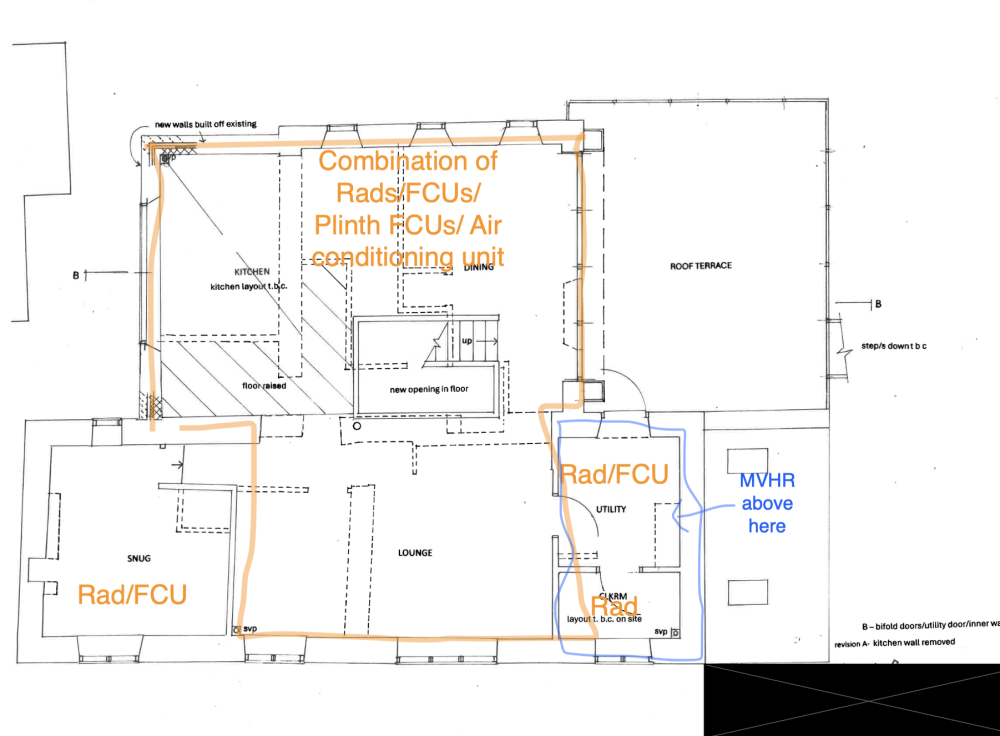
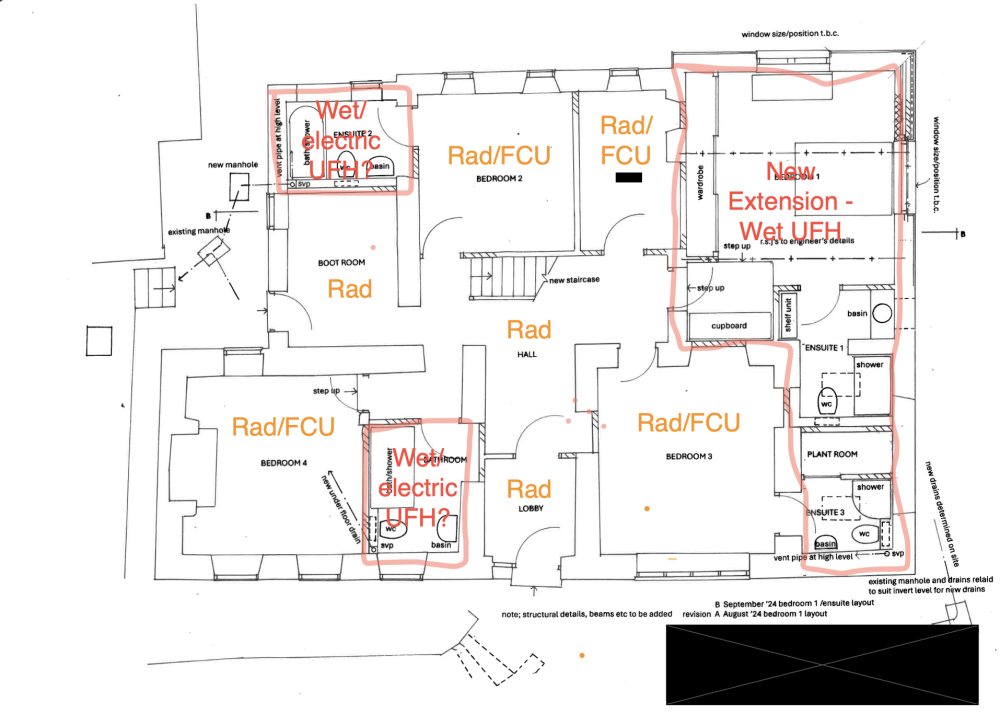
-
Good point about time of year - you're probably right. We haven't thought about where radiators would go, but that was part of the reason for wanting UFH, so that we didn't have that to think about. I'd need to go back to the plans and see where the best place would be in each room. One issue we have is that we are on heating oil, so we are more restricted vs even gas where you can lower flow temperatures to improve efficiency. I imagine that we might need some kind of thermal store/buffer to run the UFH in the main bedroom (which will be fully insulated) on oil, which means it isn't just reusing the boiler and hot water tank and sticking in some new radiators. I've seen some of the discussion about fancoil units but I assume they would also require a ASHP or thermal store? I like the idea of air heating because of how quickly you can change the temperature, which is why I was leaning towards having an air to air unit in the open plan living space. Is this method suitable for solid stone/rubble filled walls (sorry but I have to use the word 'breathable')? Is there more detail on what you're proposing? I'm not sure this is the case with oil boilers. The installer of ours said that downregulating the burner too much isn't good for it. Oil boiler tech seems a bit behind gas boiler tech in terms of regulating the power output. I like the idea of a thermal store to use excess solar for example (imagine guilt free long showers 😆) but I've been following the HeatGeek YouTube channel and they seem to believe that to have a really efficient ASHP system you need to have no buffer tank, just run weather compensation with no zoning, keeping the lowest flow temps with the highest uptime possible, so I don't want to buy into a system that if we do upgrade to ASHP in the future becomes redundant. You've got me fairly convinced on the idea of investing in insulation rather than UFH, however we still won't be putting in EWI for a variety of reasons, so I think we'll be putting EPS bead CWI in the existing extension (50mm cavity between blockwork) and I need to work out what we're going to do with the solid limestone walls. If we can avoid lime plaster that would work well with our builder, who says he 'likes to throw a handful of cement in just to make it go off', so I need to find a system that Doesn't wreck the 'breathability' of the walls Doesn't encroach too much into the room (the walls are already 500mm+ downstairs so I'd want to avoid making them significantly thicker) Ideally uses conventional plasterboard Can be worked into an airtightness strategy (answers on a postcard) I'm also nervous about IWI because of potential cold bridges in the void between ground floor ceiling and first floor floorboards. So much to learn and investigate and so many potential pitfalls!
-
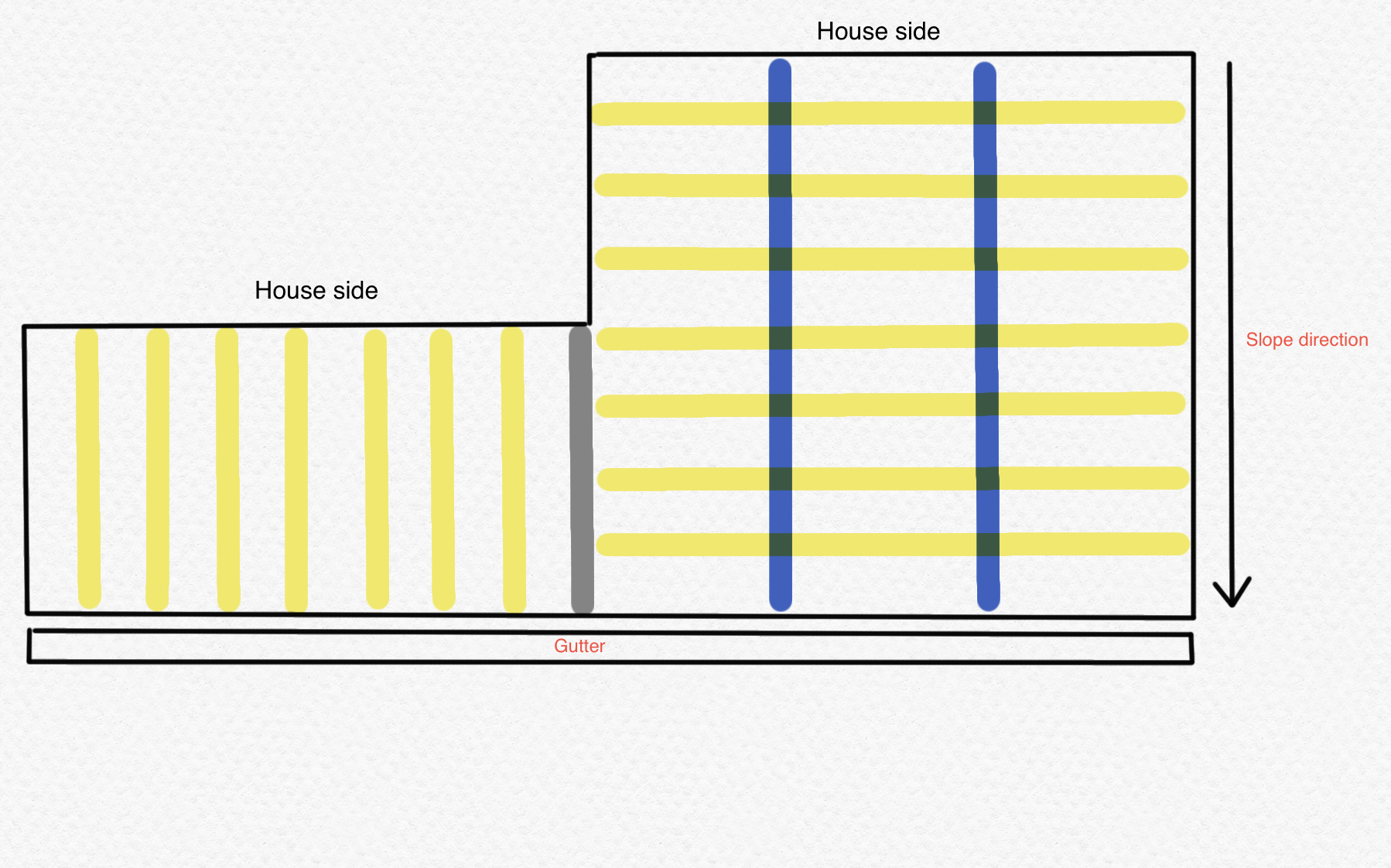
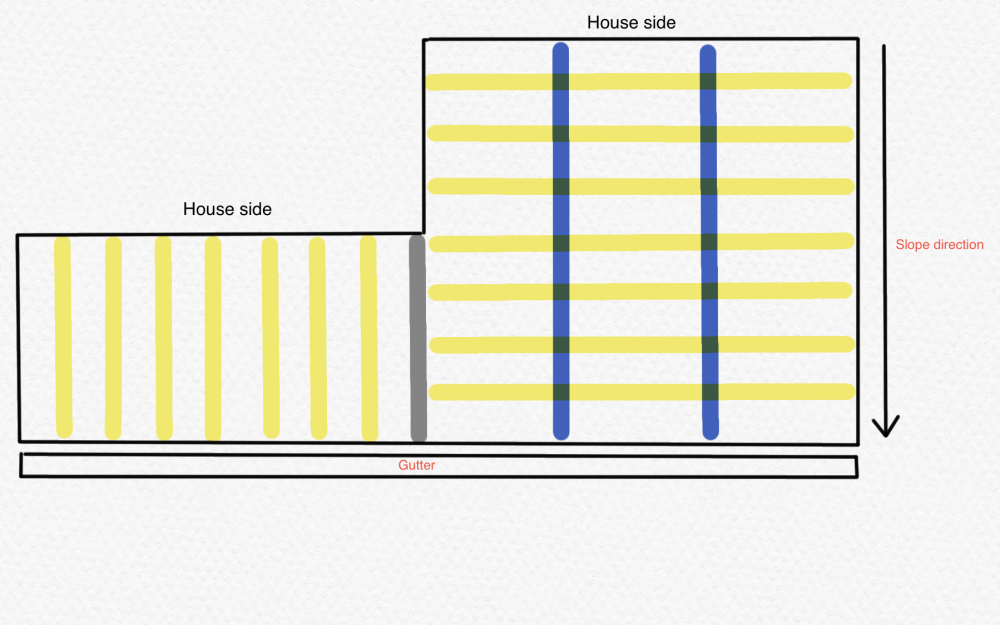
This makes sense but the problem is that the joists will be going the wrong direction relative to the slope of the roof (see crappy drawing below). (Grey is an internal block wall, blue is structural steels and yellow is joists). I was expecting the OSB to go above the joists, firring strips to go on top creating the slope away from the house, then another deck for PIR to sit on. Re your point about VCL, I assumed I would be connecting this into a VCL behind the plasterboard inside the inner skin of the block wall. If it's above the OSB (under the PIR) how am I creating a barrier to moisture at the sides of the roof? Is there a detail somewhere that would help? On this point the builder wasn't planning on having a parapet. I'm indifferent but they seem quite popular with warm rooves from what I've seen. Are there merits or disadvantages of parapets? Good point re the compression of PIR and pedestals. I've emailed a supplier to get their feedback, but I assume that OSB over PIR will distribute load enough to allow us to use the pedestals.
-
We're speccing a new warm roof for our ground floor extension/roof terrace. Builder wanted to just insulate above the firring strips, but ideally I'd like to do 150mm PIR above and 80mm PIR between the joists. The builder pointed out that there would be a void between the 150mm and the deck because of the firring strips which isn't desirable. Should I just put the 150mm on top and leave between the joists? Seems a waste given we have 200mm joists and don't need much of that for services. Buildup would be: Tiles on pedestals EPDM membrane 150mm PIR 18mm OSB Firring strips 18mm OSB 200mm joists with 80mm PIR pushed up against the deck VCL Plasterboard
-
We're weighing up options for our roof terrace. We initially assumed we'd use timber decking but there's no way I can be bothered to clean and re-treat/paint every year, so durability must win out. We then moved to the idea of hardwood (Ipe) decking tiles, but given we don't have a lot of thickness to work with I'm now leaning towards tiles (porcelain maybe?) on pedestals. I like how quickly they go down and how easy they are to remove if it's ever required. This will be going on top of a warm roof with EPDM, so my concern is the pedestals damaging the membrane. Has anyone ever used them? Do the tiles feel and sound solid on top of the pedestals or do they just sound hollow and feel wobbly? Any issues using them over EPDM?
-
What did you decide on this? Weighing up a similar decision albeit on a roof terrace.
-
It seems that anecdotally people with low profile UFH heating systems with not much insulation still really like them, despite the idea that they increase heating costs. Maybe the backlash will come in a year or two as it feels like low profile UFH is still relatively new to market. I've seen calculations referenced multiple times on BH that even with 300mm of EPS, 10% of heat from UFH is lost through the floor. This seems high to me and (I believe) is based on the assumption that the ground is always at 8 degrees C, which it will be if you go low enough, but I suspect is not the case directly under a floor slab. These things are complex and trying to navigate a path between the science and the experience of people who live with the systems is difficult without going insane!
-
You've got me thinking about internal insulation again, but given that the walls of the old part of the house are solid/rubble filled limestone I'm a little nervous due to condensation risks. It would also change the thermal mass of the building somewhat, as we'd only be heating internal air and furniture etc vs now having some thermal mass in the walls. I wouldn't try to get the best U value from these walls, as I understand going below 0.3 is where the highest risks are for interstitial condensation, so improving to something like 0.4-0.6 might be sensible with some breathable internal insulation which also wouldn't take up too much floor space. The overwhelming reason for wanting UFH though is because we currently wear slippers from September to April/May due to cold floors, and for both my wife and I it would be a huge improvement to thermal comfort to have warm feet, particularly in bathrooms, but bedrooms would be lovely too. Although quite a lot of heat would be lost through the floor, warming the bedrooms in the morning would mean that heat would move upwards through the house into the living space during the day, which reduces the heat requirement of the living space fairly significantly (I would imagine).
-
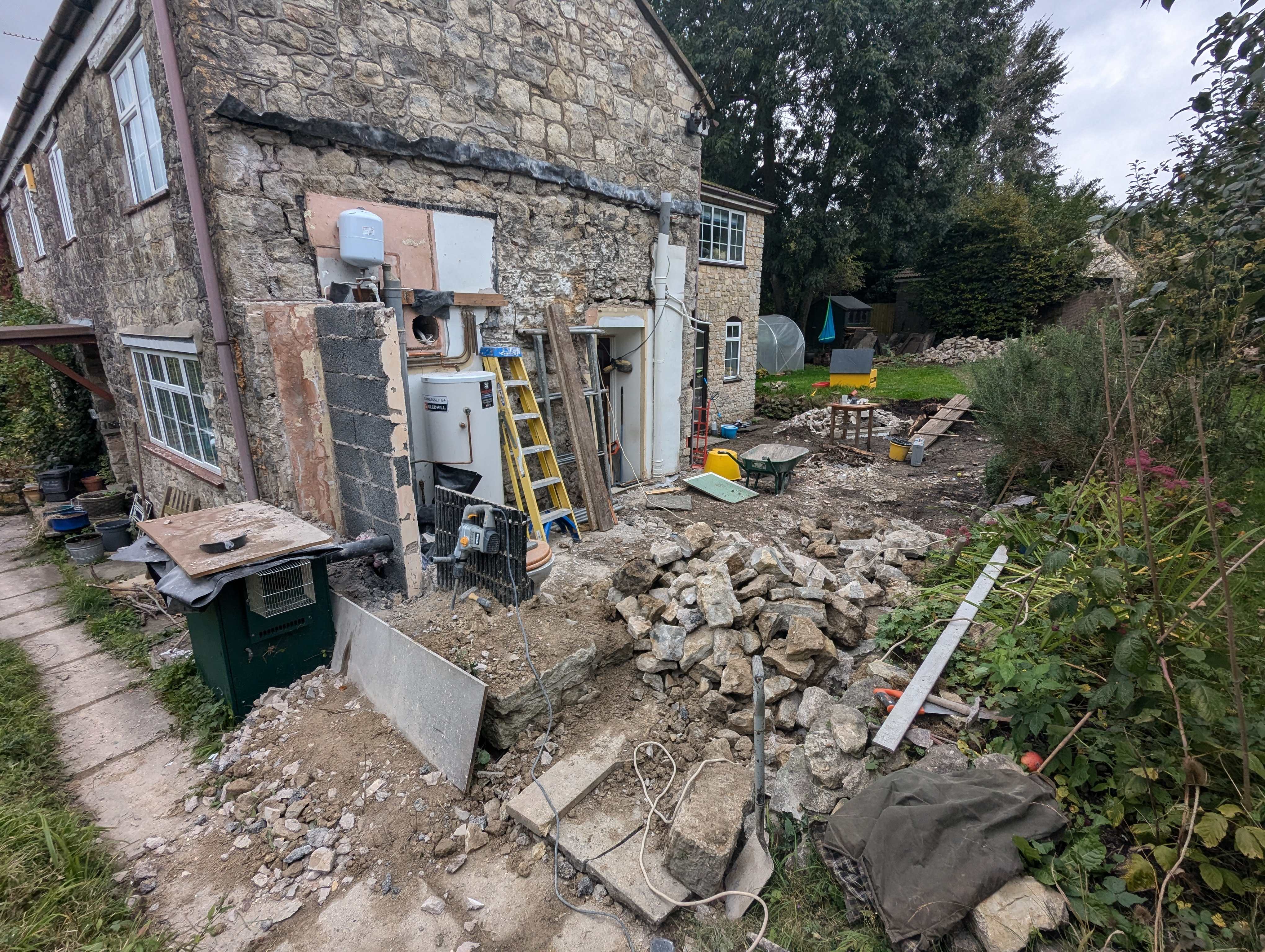
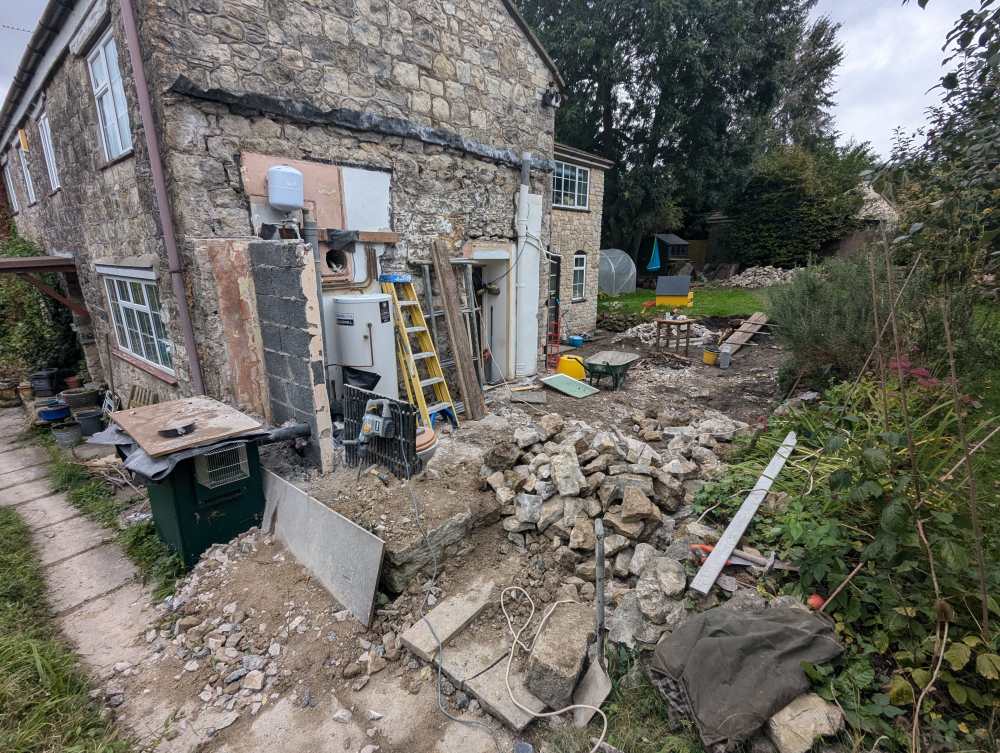
This is due an update I feel. We've commenced work under a building notice, after a builder that our architect has worked with many times before became free at relatively short notice. We've yet to finalise all the plans, but are getting started on the first discrete part of the build which is the single storey extension which will become the master bedroom and will have the roof terrace on top. We had planned to renovate the current utility room and excavate the floor to bring level with the neighbouring rooms but realised quickly that it has no foundation (built on clay) and was likely an external WC which was connected to the rest of the house at minimum cost. We've decided therefore to take it down and incorporate that into the new extension construction. Here's the current state a couple of weeks in with the utility demolished and patio cleared ready to start digging the foundations. Our current quandries are about the flat roof buildup for the terrace due to limited thickness to work with, and what the larger plan for heating/insulation is going to be (I've posted topics on both of these recently). Since I previously posted we've also had some structural calcs done, and we're going to put in a new roof with ridge beams so that we can vault the ceilings and insulate at rafter level, because the existing rafters are only 70mm deep unfortunately. As much as I'd like to have a 'full' plan to work off at this point, I can see this one is going to evolve over time, which is the benefit of working with our builder who charges a day rate and is happy to work to a changing set of plans.
-
Sorry - completely missed this! We have actually ditched the idea of EWI for now, so haven't pursued any installers or quotes but the difficulties in getting a trusted installer is one of the reasons we're leaving it for now. The main reason is that we are making a lot of other fabric upgrades, so we'll wait and see how that pans out before putting in any EWI which would be a big chunk of budget (I assume).
-
Hi all, hoping for a nudge in the right direction. Our house was two 1800ish miners' cottages which were knocked together with limestone/rubble filled 500mm thick walls. It was extended in the 1970s to the rear with a block cavity wall, albeit only a 50mm cavity, and faced with limestone. The roof has poor/negligible insulation currently and the floors are mostly solid/uninsulated concrete. We put in a worcester bosch external oil boiler with an unvented cylinder about 3 years ago because the old boiler was 30+ years old and we couldn't keep it going any longer. The windows are mostly blown aluminium DGUs which are draughty, and in general it's a draughty house. When we put in the new boiler I also put in a Wiser heating control system with smart TRVs which has helped keep heating bills down because we only heat the rooms we need when we need them, but in general it's a cold house. We've just started an extensive extension/renovation which will result in some big changes. We're going 'upside down' with bedrooms downstairs and living space upstairs to take advantage of better views increase ceiling height and natural light with vaulted ceilings/roof lights and allow us to open up the living space more easily We'll replace all windows with new TGUs and all doors will be replaced We're replacing the roof, so will insulate to building regs (0.15 U value) We're having a new ground floor extension which will have our bedroom in, which we will put wet underfloor heating in as we'll be insulating floor, walls and ceiling to modern standards We're replacing kitchen and bathrooms I'm in a bit of a bind about what to do with the heating at the moment. My ideal solution would be an ASHP driving wet UFH throughout the downstairs, but this means we would need to dig out and replace the floors to add insulation. I'd like to use an air to air heat pump upstairs to heat the open plan living space, and also provide cooling in the summer. If we decide not to dig up the floors, that means putting rads in the other rooms downstairs or using an overlay wet UFH heating system, but if we're keeping radiators, maybe we also keep the boiler given it's only a few years old. I know that the improvements we're making will make a huge difference to the heating performance in the house, but I'm still unsure what the best option is, and what the second best might be if the best option proves too costly. Based on the estimates on the heatgeek website, a heat requirement of 50W/m2 would seem reasonable, which would mean we need roughly 5.5kw for downstairs and 4.5kw upstairs. Probably some kind of heat loss calculation would be helpful, but I'm not really sure where to go for this, or how accurate it would be given the renovations are evolving and not set in stone. Should we just keep it simple and stick with rads everywhere but in the new extension which is fully insulated? I'd rather not do this if possible, as we'd like to move to an ASHP and get rid of the boiler, and like the idea of UFH in bedrooms and bathrooms. Another option is to insulate the solid stone walls, and we had looked at EWI but decided against it for now due to the cost, change of appearance and apparent risks involved with getting it right. Literally any thoughts and opinions are valid here, other than about the layout, which we're very set on at this point.