


G and J
-
Posts
1977 -
Joined
-
Last visited
-
Days Won
8
Everything posted by G and J
-
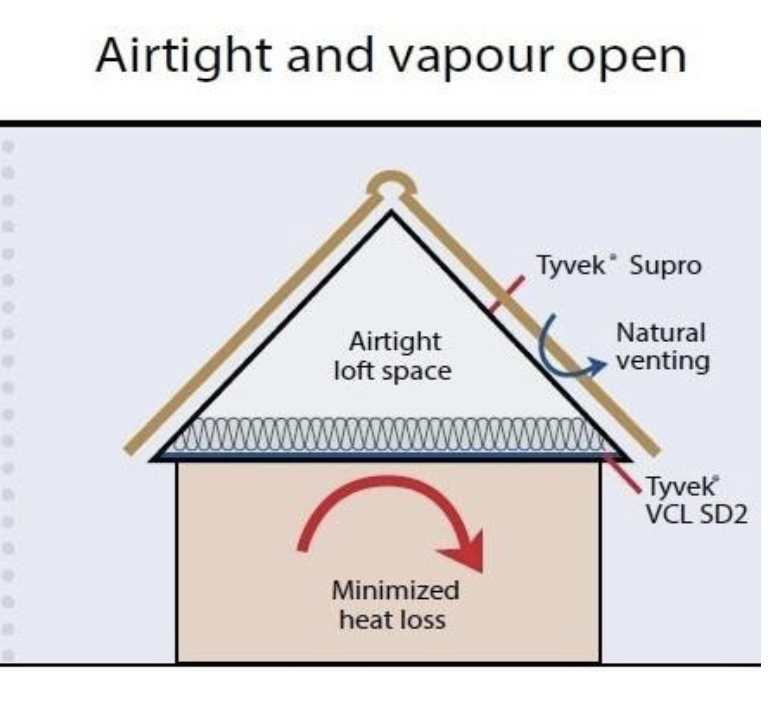
The plan is to have an airtight membrane above our upstairs ceilings, so minimal water vapour gets from the house into the loft. That will have oodles of insulation just above the ceilings. I really like the idea of NOT ventilating the loft, (like in the diagram), instead using breathable (water vapour permeable) membrane under the tiles to control/limit humidity in the loft space. Our architect has expressed concerns that condensation will form when the roofing membrane freezes. I think he’s not factored in the airtightness preventing steam filling the loft. Am I likely to have a problem?
-
We have three Clearview stoves, an 8kW connected to a 6’ insulated flue, a 5kW connected to an 6’ insulated flue, and another 5kW connected to am 8’ clay liner (this installation would not be allowed now). All work exactly the same, the control on the fires set how they work as long as they have a decent draft. When the fires are burning properly the flow rate is very small, which is what delivers their efficiency. We had a Dovre previously that simply couldn’t work like that and asa result used twice the wood. So I assume that the flue temperatures are much lower with my current fires than they would have been with an open fire or an inefficient stove. I think that means that whatever size liner you have if burning properly they won’t get that hot, so I see no issue in continuing with your 8’ flue. That’s certainly what I’d do in your position.
-
Would it have been more appropriate if I had started a new thread?
-
Hmmm, so that’s less than 6% of your budget… How much would a cock up cost?
-
Please tell me I don’t have to fit one of these on each of my bath and all the showers! We’re looking at a nice big hot water cylinder which can be heated to circa 50c to be nice and efficient for the heat pump.
-
Interesting discussion with our architect yesterday. I expressed my intention to have a cold but sealed roof à la @Iceverge. Reasoning: Loft to be non-habitable, cheapest fink truss based, very limited use for storage. Cold loft with insulation above plasterboard is cheapest and quickest solution. Hate insecty lofts, with a passion (as I’m now sitting underneath one, humph). Improved thermal performance. Fits nicely with airtight strategy as I’ll put a VCL directly above plasterboard ceilings. Yes I’ll need to faff around sealing round wires and MVHR ducts but I’m happy with that. So, the architect then mentioned a drawback: it transpires that he’s heard of cases of condensation forming under specific circumstances on the inside of the ‘roofing felt’ (I’m a wrinkly, I know it’s technically breathable tile underlay but everyone knows where roofing felt sits!). The circumstances are that it’s freezing conditions, roofing felt freezes and becomes vapour impenetrable, condensation forms. Hmmmmmm. Don’t like the sound of that. Now one of my less positive attributes is that I think very slowly, and hours later I realised that this may be a symptom of the architect not being as used to working with airtight house designs as they could be. My thinking is that if I achieve an airtight ceiling then little water vapour will reach the loft and thus little or no condensation will form. So, is that a safe assumption? Will a sealed cold loft above an airtight house have running water?
-

Amazing what you notice when you start looking
G and J replied to Nick Thomas's topic in General Structural Issues
You can park two Citroen Amis in there. So it’s a double garage. What more do you want? -
Pre-Filter for Log Burner Smells
G and J replied to benben5555's topic in Mechanical Ventilation with Heat Recovery (MVHR)
When I discussed this issue with my preferred MVHR supplier they suggested that the carbon filter be placed after the unit, so the cheap filter in the unit reduces the build up of crap on the expensive carbon filter, but also said leave room for it to be installed inline but leave it to see if it’s needed, as it isn’t actually needed that often. That works for me. And @Duncan62, I looked up that link, it says it’s a 420 filter. Are there lots of very relaxed people around your place? 😉 -
Amazing what you notice when you start looking
G and J replied to Nick Thomas's topic in General Structural Issues
I reckon it sagged. They put the thin ply up and chucked stuff on it then panicked when they saw how it drooped between the rafters, hence the micro joists with half fitted hangers, a diddy ‘L’ bracket would have done. Would have been cheaper to buy a sensible thickness of ply in the first place. -
Fan Coil Units for use with a (cooling) ASHP
G and J replied to ProDave's topic in Air Source Heat Pumps (ASHP)
But I agree with you re the comfopost. Feels to me like a bit of kit that sounds brill on the tick list and can bump up the invoice for a disreputable outfit but actually delivers little benefit to most houses. Interesting that the companies I’m talking to re MVHR kit have both strongly suggested not to bother with one, so full marks to each of them. -
Fan Coil Units for use with a (cooling) ASHP
G and J replied to ProDave's topic in Air Source Heat Pumps (ASHP)
I don’t know the answers to those questions. So I’m going to try to allow for all eventualities where I can without wasting tons of money. I’m putting a Fancoil into our bedroom, with a drain and also insulated pipes to the manifold and room to allow isolation valves and a volumiser (that really is a word that should be confined to hair product adverts!) so that if the ‘above dew point’ approach isn’t enough we can reconfigure without ripping out walls. So, no immediate need but a bit of bet hedging. -
Alternatives to Ecology Building Society?
G and J replied to FelixtheHousecat's topic in Self Build Mortgages
Not applied, but have spoken to Hanley Economic. They were very helpful, but would be worth looking at their website as they detail what type of property they'll lend on.....our planning design of timber frame with more that 50% timber cladding did not meet their guidelines. -
Just a cautionary tale from an oldie .....our first time round in the 90's we bought a plot with outline planning, when we went to full design it turned out that highways had not responded first time round, when they got the opportunity again they tried to stop the development, similarly this time round the consultation period was rerun and a couple of consultees who did't reply first time finally got their responses in, in the second window, all was ok in both cases but......it maybe worth checking that all the consultees did actually respond and what those responses were.
-
As most self builders only self build once, it comes down to a leap of faith. Air tight I get, because if my ‘91 built house wasn’t a wind tunnel it would be very cosy, but U values are harder to invest in and trust, emotionally.
-
Can that be done into a steel and concrete beam? I guess the SE will decide.
-
Legal Agreement to Self-Build
G and J replied to Paul K's topic in Party Wall & Property Legal Issues
I suggest it would be safe to assume that the CIL process should be followed meticulously just like any other self build. Rather expensive if it turns out later it was needed, and it’s just a few simple forms. -
Each time I’ve seen pics of an ICF house there’s always steel rods sticking up out of the slab to fit the polystyrene over. I get that they are great for basements but isn’t it too late to do ICF with AdTee’s foundations?
-
So, a sheet of 140mm PIR costs about £53. Gapotape to line it costs £36. Ouch. That means I’ll spend about £2.5k on gapotape on our build on just the walls. That’s a lot of Smarties. I think I need to research alternatives, I’ll start a new thread if I can’t find it covered elsewhere.
-
Legal Agreement to Self-Build
G and J replied to Paul K's topic in Party Wall & Property Legal Issues
Good grief that’s odd. Is there even a legal definition of ‘self build’? -
So it’s ‘squeeze-o-tape’. Invented by Wallace one assumes!
-
Don’t know about the need to protect the b&b but to me, with focus and a kind autumn weather wise I would be tempted to go for a watertight timber frame well before Xmas (but then, as my old Irish farmer friend used to say, I am like a cock at a gooseberry!). You are almost out of the ground so things could happen pretty quickly, funds allowing, especially as you’ve already got an SE engaged and invested. Go for it! And take no prisoners.
-
So you have already built a strip foundation designed to support the build up in your first diagram. And in effect you need a retaining wall outside of this to prevent bits of next door sliding towards you? Your second diagram seems to be using a block outer skin as a retaining wall. Doesn’t that mean your timber frame is a support for said retaining wall? If so that doesn’t sound like a good idea. In your shoes I’d pay an SE to design you a solution. I’d be too concerned at the risk of building something unsafe, or needing significant remedial work.
-
My apologies if I’ve misunderstood but aren’t you effectively building a partial basement without basement suitable methods?
-
Can’t imagine what you are trying to achieve. Are you wanting to partially hide the dolly course?
-
So does gapotape then expand to fill any gaps round the PIR?

