G and J
-
Posts
1977 -
Joined
-
Last visited
-
Days Won
8
Everything posted by G and J
-

Protect TF200 Thermo & VC Foil Ultra
G and J replied to G and J's topic in General Construction Issues
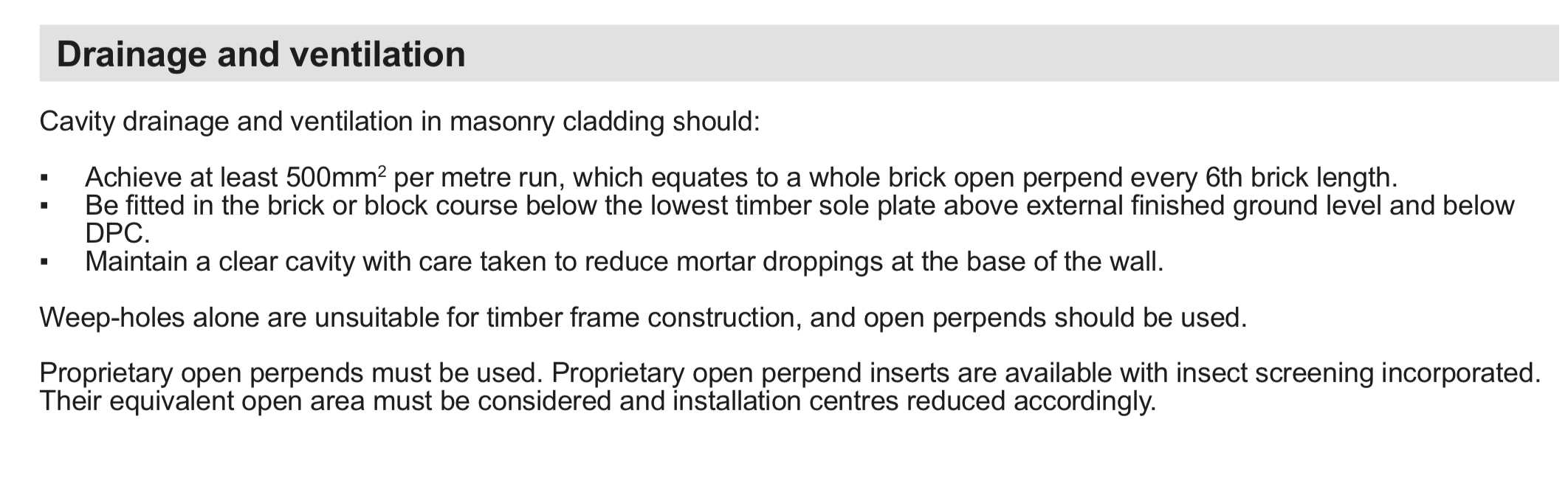
From the LABC manual…. of course it might help if I knew what a ‘perpend’ was. 😕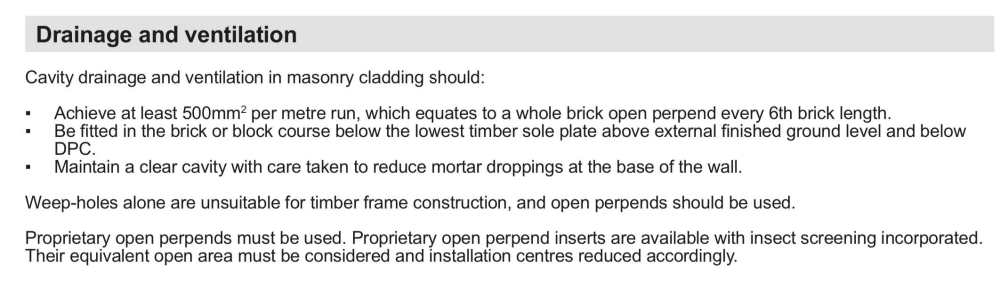
-
I’m busy contrasting lots of different wall build ups, some of which worry me from a danger of plasterboard fixing popping point of view. We have history. 20 years ago we had builders put a room above our garage, they used battens with PIR in between, and they nailed the plasterboard on, and we got a good few pops, which still occasionally happen even now. I have wondered whether it’s caused by the combination of batten shrinking/expanding with moisture content making the PIR push the plasterboard - to start with they appeared the same thickness. It is possible I might replicate that scenario in some places - 140mm PIR in a 140mm frame then VCL then plasterboard. In many areas we are likely to put another layer of PIR on the frame, and/or a service void. But is 140mm PIR in a 140mm frame asking for trouble? Do I need to put a slightly smaller thickness of PIR in there?
-
Protect TF200 Thermo & VC Foil Ultra
G and J replied to G and J's topic in General Construction Issues
And I’m guessing that a stiff and chilly breeze blowing over the shiny breather membrane nicely cools it and therefore almost completely negates the insulative effect. Reading the LABC manual re ventilation required I understand it to require ventilation openings in the plinth equivalent to the size of a whole brick every six bricks. Assuming corresponding openings at the top that’s got to make the cavity a mini wind tunnel. -
Protect TF200 Thermo & VC Foil Ultra
G and J replied to G and J's topic in General Construction Issues
Ta. But I was totally correct of course. I really did show my ignorance as that is b obvious lol -
Protect TF200 Thermo & VC Foil Ultra
G and J replied to G and J's topic in General Construction Issues
I’m thinking back to school physics - yep, literally half a century ago. I remember that dark materials both radiate and absorb heat radiation more than light ones, so could it be bidirectional? I get the need for an air gap as otherwise conduction would occur, and ventilation would mean convection would occur, either undermining the insulative effect. -
Protect TF200 Thermo & VC Foil Ultra
G and J replied to G and J's topic in General Construction Issues
Ok I’m really going to show my ignorance now…. What are MIs? -
Protect TF200 Thermo & VC Foil Ultra
G and J replied to G and J's topic in General Construction Issues
[Sound of penny dropping] So the VC foil works when inside a service void at reflecting heat back into the house if the reflective side faces in. It had never occurred to me that a substance of composite could have different u values for different directions. More study required. -
Protect TF200 Thermo & VC Foil Ultra
G and J replied to G and J's topic in General Construction Issues
Ubakus DIY? Is that the paid version? -
Protect TF200 Thermo & VC Foil Ultra
G and J replied to G and J's topic in General Construction Issues
Now why couldn’t I find that - I thought that was the case but I couldn’t find it definitively. The LABC manual says in one place that 50mm empty cavity is needed but elsewhere it talks about insulation in the cavity - of course they may mean partly filling a bigger cavity. Where did you manage to find that about not fully filling a timber frame/masonry cavity? -
Protect TF200 Thermo & VC Foil Ultra
G and J replied to G and J's topic in General Construction Issues
I suspect the difference lies in the ‘rot’ of the inner skin. A block inner skin won’t rot but a wood one might. -
Protect TF200 Thermo & VC Foil Ultra
G and J replied to G and J's topic in General Construction Issues
Is that block -cavity -block? I know that one can fully fill the cavity in a block built house. Trying to find guidance re timber frame/block skin is boiling my head! -
Protect TF200 Thermo & VC Foil Ultra
G and J replied to G and J's topic in General Construction Issues
I’ve been trying to research this, and the LABC manual does refer to cavity insulation but it’s not clear whether the clear 50mm void needs to be maintained. So if it does I might as well have the extra layer inside the frame and leave the frame to breath as much as possible. -
We’ve decided to try and change our design to make our house more easily mortgageable and insurable. We are hoping to obtain permission to reduce the percentage of the house covered in timber cladding, increasing the amount of render to just over 50%. The other change we won’t need the planners to agree, we are going to have a block skin for the outer leaf wherever we have render, which is most of the ground floor. Ours is a narrow site so the wall thickness has always been limited, which is why we are looking at these two products. The build up we are thinking of from inside to outside is: 1. Skim (3mm) 2. Plasterboard (12.5mm) 3. PIR (25mm - this will be channeled where needed for cables) 4. VC Foil Ultra 5. 140mm frame filled with 140mm PIR 6. 9mm OSB 7. TF200 Thermo 8. 50mm cavity 9. 75mm block skin 10. Cement render (15mm?) If I’ve understood correctly the VC Foil Ultra has an R value of 0.78, which helps. But the TF200 Thermo I’m not so sure about, it might be 0.77. I believe we have to have a 50mm void between frame/breather membrane and the block skin. What I’m unsure about is what level of ventilation the cavity needs, and whether that will be enough to undermine the thermal characteristics of the TF200 Thermo. I also don’t know how the cavity drains, in case of condensation on the inside of the blocks or rain ingress. Here’s the data sheet for the foil: https://glidevaleprotect.com/app/uploads/2021/09/VC-Foil-Ultra_FINALAPPROVED_0624_Screen.pdf and here’s the data sheet for the breather: https://static.prod.cmostores.com/uploads/attachments/4/protect-tf200-thermo-data-sheet.pdf In theory if the cavity isn’t really ventilated then the above wall build up gets me to a U value of circa 0.13, which we can live with. Am I wasting money? Are there better products? I’d appreciate any comments/corrections/better ideas/etc.
-
Need a copy of paperwork to submit to dno for panels
G and J replied to CalvinHobbes's topic in Photovoltaics (PV)
That looks rather brilliant. Well done. -
Goodness. So the moral is…. decide what you want before you start. We are mulling over making a change to our design so methinks I’m going to call the nice peeps at CIL tomorrow for some guidance.
-
Ummm, that is unexpected, not heard of that at all. The CIL guys are interested in the square meterage that will be created (less maybe existing and recently used square meterage) but they seem to just accept the approved plans. You are worrying me now - where have you seen this scenario in action?
-
Need a copy of paperwork to submit to dno for panels
G and J replied to CalvinHobbes's topic in Photovoltaics (PV)
Except I’ll not have a dc connection to the battery. -
Need a copy of paperwork to submit to dno for panels
G and J replied to CalvinHobbes's topic in Photovoltaics (PV)
That looks fab. I like Victron stuff, have used such in our vans and have great respect for it. Will research…. But in the face of it that Victron unit will fit perfectly in my scheme! -
Thank you. Rather than fire tons of questions at you I’m going to try and work out as much of that as I can first. Then I’m going to fire tons of questions at you, but at least I’ll have tried lol
-
A word of caution, that’s the stuff from our local authority, but other authorities may have different interpretations. I suspect the guys at the CIL office are a bit like the guys at HMRC, in that they are used to being moaned at and despised. But call them with a smile, and honestly and openly seek their guidance, and they turn out to be lovely and helpful people. So why not call em and make friends?
-
[WARNING - DUMB QUESTION ALERT!] As I understand it, a passive slab foundation is basically a big lump of concrete cast inside a polystyrene tray. I think such can have a good u value as the polystyrene can be nice and thick, and thick edges to the tray help reduce cold bridging at the bottom corners. I suspect they are also effective for a passive house due to the simple large size of said slab. We haven’t got room for the tray and we probably haven’t got the budget, but I can’t see why I can’t get close to the key attributes with a strip foundation, beam and block floor, and enough insulation in the right places. Have I missed something fundamental?
-
I agree with that. There appears to be no downside to telling CIL that you are starting, even if it’s long before you are starting in any real sense. We consulted our local CIL team to ask and they were wonderfully helpful. They sent us this extract but they also pointed out that it’s ok to tell immediately us we are starting just to make sure we’ve done it before actually starting. “…commencement of the development is one of the following: (a)any work of construction in the course of the erection of a building; (aa)any work of demolition of a building; (b)the digging of a trench which is to contain the foundations, or part of the foundations, of a building; (c)the laying of any underground main or pipe to the foundations, or part of the foundations, of a building or to any such trench as is mentioned in paragraph (b); (d)any operation in the course of laying out or constructing a road or part of a road; (e)any change in the use of any land which constitutes material development. Some gardening and clearance works will not necessarily constitute commencement, but you can submit your commencement notice in relation to those works for the purposes of CIL.”
-
White Haus (timber frames from the passive purple people)
G and J replied to WisteriaMews's topic in Timber Frame
Ah, ours aren’t. I got the impression that there are passive house consultants who do their bit (design audits/certification/etc) alongside an architect and I’m thinking about having a chat with one. I strongly suspect passive house certification is not financially sensible for us but I’m also working on the assumption that passivehouse design thinking may be partly applicable and may improve our design, so I’m keen to explore that. Is anyone on here working with such a consultant? -
You star. 🙂
-
That made me laugh. I’d still love to understand your system at a very detailed level, mind, but it still made me laugh.