


zzPaulzz
-
Posts
227 -
Joined
-
Last visited
Everything posted by zzPaulzz
-
Ah right. I guess you are speaking as a builder? As a domestic client I don't want to mess with the PD role as it seems fundamental to the new HSE approach to safety by design. For the PC I'm aiming to structure the scope of works for each contractor to minimise overlap so that they each become the default PC when they take over on site. Does that make sense?
-
Which role?
-
@Kevin Dawson About to embark down the same road as you. Two story new build in Suffolk with a TFA of 180m2. I’m struggling to make a choice between MBC Twin Wall, their Hi Performance, or a KTS Ultima/TEK system. KTS Ultima wins on price, but seems have thermal bridging issues around windows. MBC Twin Wall is about £30k more but has excellent performance all around. MBC High Performance has the same thermal bridging issues as KTS but is not much less than the Passive Frame once extra costs to get to the passive air tightness standard. How did you make your decision?
-
2.1 CDM PRINCIPAL DESIGNER (CDM-PD) To act as Principal Designer for the above proposed works in accordance with Construction (Design and Management) Regulations 2015, as follows: 2.1.1 Plan, manage and monitor the Pre-construction Phase (Regulation 11(1)) 2.1.2 Co-ordinate matters relating to health and safety during Pre-construction Phase taking into account General Principles of Prevention, contents of any Construction Phase Plan and Health and Safety File – in particular during planning and developing project timescales (Regulation 11(2)) 2.1.3 Identify, eliminate or control, so far as is reasonably practicable, (in planning, managing and monitoring the pre-construction phase) foreseeable health and safety risks during construction, maintenance, cleaning and use as a workplace (Regulation 11(3)) 2.1.4 Ensure all Designers comply with their duties (Regulation 11(4)) 2.1.5 Ensure all involved in pre-construction phase co-ordinate and co-operate with each other (Regulation 11(5)) 2.1.6 Prepare Pre-construction Information (Regulation 11(6)a)) 2.1.7 Provide Pre-construction Information to every designer and contractor (appointed or prospective) (Regulation 11(6)b)) 2.1.8 For the duration of Principal Designer appointment, liaise with Principal Contractor and share information about construction phase and co-ordination of health and safety matters (Regulation 11(7)) 2.1.9 Provide Pre-construction Information and any information received from the Designers to the Principal Contractor (Regulation 12(3)) 2.1.10 Preparing a Health and Safety File during the pre-construction phase and reviewing, updating and revising regularly (Regulation 12(5 and 6)). Printing of any hardcopies is not included.
-
It’s odd that the timber frame company is willing to take on the PD role, as that’s supposed to span the whole life of the project - from what I understand the role is to ensure that safety is ‘designed in’ from the start to the finish, and considers the life of the building after completion: the TF company’s scope seems incompatible. I’m contracting a company called SafeScope to take on the PD role; approx £1k for the project. Again, from what I’ve read, as a domestic client we aren’t deemed competent to to be the PC, so that role falls to the contractor whether they accept it or not. However, the accountability gets messy if more than one contractor is active on the site at the same time. They can’t both be the PC, so then HSE have to decided who is most accountable between the contractors and us as the domestic client: I’m not sure how to cover that risk other than educate myself on safe practice.. Someone more knowledgeable will hopefully put right anything I’ve misunderstood.
-
I resisted for a long time but found I was struggling to assess the value vs performance. PHPP 10 is a beast of a spreadsheet and some the terminology is unfamiliar, but I feel I’m through the worst of the learning curve and starting to get sensible answers out of it.
-
That makes sense. My modelling (amateur trying the PHPP model) says I’ll have a similar heat demand so I’m going with a small ASHP with UFH in slab. That way I can power it off my PV and battery, offsetting in winter to keep the cost down to gas equivalent or less. No gas to the house.
-
If your solar PV system is small (e.g., a typical residential system up to 3.68 kW), only G98 applies. If it's larger, you'll need to follow the G99 process. You wouldn't need both for the same system, but rather one or the other, depending on your system size, and more importantly, your system’s capacity to export to the grid, usually determined by your inverter output.
-
Wow.. did you install UFH and just not turn it on, or decide early on you didn't need it.
-
I hear you. The two TF companies I'm considering won't do the building regs design. I'm still hesitating though. Is £8.5k plus VAT good value for this lot? RIBA Stage 4 - Technical Design Production of Building Regulation Compliant Drawings & Notes. GA Floor Plans - 1:50 (Below Ground, Ground Floor, First Floor & Roof); GA Elevations - 1:50; GA Sections - 1:50; Building Details - 1:10/1:5; Site Plan - 1:100; Building Regulation Notes; Additional construction details; & Electrical layouts (based on clients specification). Planning conditions submission, including liaising with external consultants Co-ordination with Structural Engineer and other consultants (Civils, Ecologist, Ecology Lighting Consultant & Party Wall etc) Preparing, monitoring & submitting Building Regulation Application. Preparing, submitting & monitoring Discharge of Condition Applications at various stages.
-
@garrymartin I'm still using mine for Stage 4. For sure they aren't cheap, but I'd be a hypocrite if I refused to pay for expert advice considering that's how I make my living (also in technology). I know enough about building houses to know I don't know enough...
-
A year on, I’ve read a lot of discussion but I’m still confused, sorry. My situation is this. I know which timber frame company I want. I’ve a fair idea who will do the SE and groundworks for me. My architect will take me through building regs design, and is happy to work with the other parties. But no one wants to step up to the Principle Designer or Principle Contractor roles. I’m trying to get a project manager to pull the threads together for me but so far no one is interested (they’d prefer to be main contractor and take their cut). I feel able to talk on the PM work myself. Bad idea?
-
I was quite disappointed with our architect’s designs: lots of wasted space and awkward flow. In the end I strongly steered them towards the end. We like the house but it’s not a hugely inspiring design which is just as well as the planning process was painfully restrictive -as the architect had warned us it would be. However, after seeing the list of things they aren’t covering in their Stage 4 quote I’m considering my options for the next stage. .
-
I suspect you have a point, but for me, I remember my dad being sued by a contractor he’d employed dig a trench. The chap hit a power cable and was electrocuted. My dad almost lost his house because he ignored the risks.
-
Seems this question is proving harder than most to answer! None of the contractors I've spoken to or my architect want to be 'principle contractor' or 'principle designer' as defined under CDM2015. I'm being steered towards employing a main contractor instead. The only project manager locally who might have taken on the job is moving away so can't do it now. I don't have a problem with the coordination and contracting side but I can't be on site every day to manage the H&S. Perhaps I need a site manager, not a PM?
-
We’ve spent 10k+vat to get to full planning approval (RIBA stage 0-3) which included two major iterations of the design to satisfy the planners. They are asking for £8.5k plus VAT to do the RIBA stage 4 design work, alongside our SE and the timber frame company. They won’t take on the Principle Designer role. After reading the comments here I think that sounds ok for our 180m2 new build in Suffolk. Thoughts?
-
That’s a helpful explanation, thanks. In my case, the presence of clay and tree roots must mean the ground itself is quite ‘squashy’ - and its degree of squashiness will change through the seasons. I fear the solution for me is going to be expensive!
-
Hi. We are just fresh out of the planning stage so hoping to break ground on our timber frame home soon. Guess two years is not normal for ICF foundation to first fix?
-
Yep, theory only get us so far. You will hopefully find all is well in reality.
-
Would you say an air tightness membrane within the suspended slab with lapping to the walls is essential as part of the whole fabric design?
-
@FarmerN I’m struggling with the dream-to- reality transition too. Did you lose any thermal performance or have to accept cold bridges with that design? I have block and beam in my current house and can feel air movement from under the house into the walls: definitely want to avoid that!
-
Thank you Gus for your insights and reassurance. I’m also talking to TSD, along with a few local SEs. I agree with you about the trees though sadly I’ve had to take out a lot to make way for the house.
-
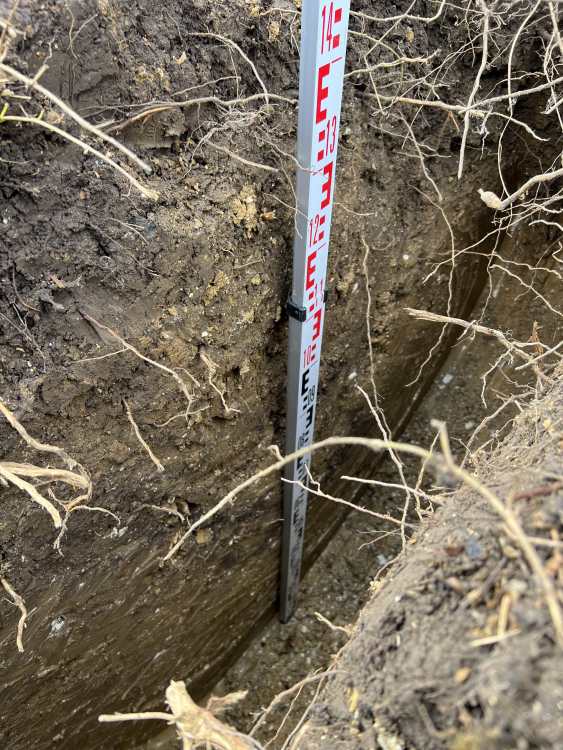
I dug a deeper hole. Sharing for your enjoyment if you like that kind of thing.
-
Nice! Who did the design for you?
-
I’m keen to have a passive foundation with in-slab UFH pipes. My ground conditions are boulder clay over sand & gravel, and the site has lots of trees. Does anyone know if these conditions are likely to make a passive foundation anymore expensive than other methods? Thanks.

