Mike
-
Posts
1484 -
Joined
-
Last visited
-
Days Won
8
Everything posted by Mike
-
My PHPP version is ancient, so I can't take that as a guide, but I wonder what data their current climate files are based on. Is it still a historic analysis, or a forward projection? The projected climate of the 2050's will look shockingly different to historic data from the 1990's. I think that PHPP uses EnergyPlus weather files (.epw); if so then I'd suggest using the University of Bath forecast data; see my post here:
-
It's also susceptible to cracking & edge damage if something heavy gets dropped on it. I have seen a couple of negative posts about it in France - impact damage and surface scratching. There's no perfect worktop, but honed dark granites come the closest, though expensive.
-
Unfortunately the chances are that this won't work well when you most need it. Passive stack ventilation is driven by the difference between indoor and outdoor temperatures; on a hot summer day that difference can be small, resulting in very little stack effect - so very little cooling. In fact the outside temperature may exceed the internal temperature, causing the stack to operate in reverse and drawing in warmer air. For it to have a chance of working you'd also need to crack open some vents or windows, so that the air you hope will go out the Velux has somewhere to come from. I'd strongly suggest a chilled slab or aircon instead. If choosing the former then, as @JohnMo says, don't over chill the slab; in France the regs say that floor surface should go no lower than 18°C to avoid condensation.
-
X3 Immersion heaters on a single radial
Mike replied to RedSpottedSev's topic in Consumer Units, RCDs, MCBOs
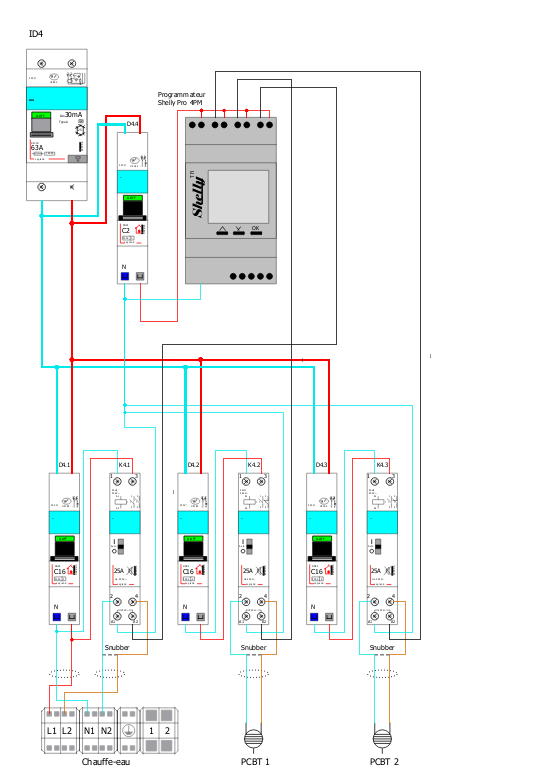
@RedSpottedSev I should have mentioned another safety point on this topic, if you choose to go down this route. The wires held by screw terminals on contactors (as well as RCBOs and the like) must be the same size, so that they are properly secured in place. So, if you were to use 1mm² contractor control wires (black in my image above), you'd need to solder short stubs of 1mm² wire to the end of the contactor leads before applying the heat shrink (unless they're already 1mm² - I can't remember). It's interesting how this is viewed in the reverse direction in France. Here the wiring regs don't allow the mixing of 230V and ELV wiring in a domestic consumer unit so, as new installations have to certified by an independent inspectorate, all the control gear needs to be 230V! I'll be adding the patch cable to the Shelly afterwards. -
X3 Immersion heaters on a single radial
Mike replied to RedSpottedSev's topic in Consumer Units, RCDs, MCBOs
It's good in principle, however by using a contactor you bypass that function - it will only tell how how much power the contactor itself is using, not how much power is passing through the contactor... -
X3 Immersion heaters on a single radial
Mike replied to RedSpottedSev's topic in Consumer Units, RCDs, MCBOs
As @JohnMo says, if you can use a time switch that's the easy and cheap option. For the Shelly solutions, the main practical difference between the Pro 1PM and the 4PM is that you need 1 x 1PM for each device (heater, in your case) that you want to control. The 4PM can control 4 devices (and has manual controls in addition to smart controls) and would work out cheaper. Here's a diagram (modified from my installation to cut out some bits) that shows the wiring; your electrician may prefer to use RCBOs instead of the breakers & RCCB shown here. The latest version of the 4PM has a single live supply terminal, not 4. I'll be wiring the snubbers directly across the contactor terminals, as shown. The one Shelly sells has bare leads, which would need covering in heat shrink sleeving for safety. I don't know the T-Smart, but if it only works over WiFi and by using their proprietary app, then it wouldn't be my choice - that's all their brochure mentions.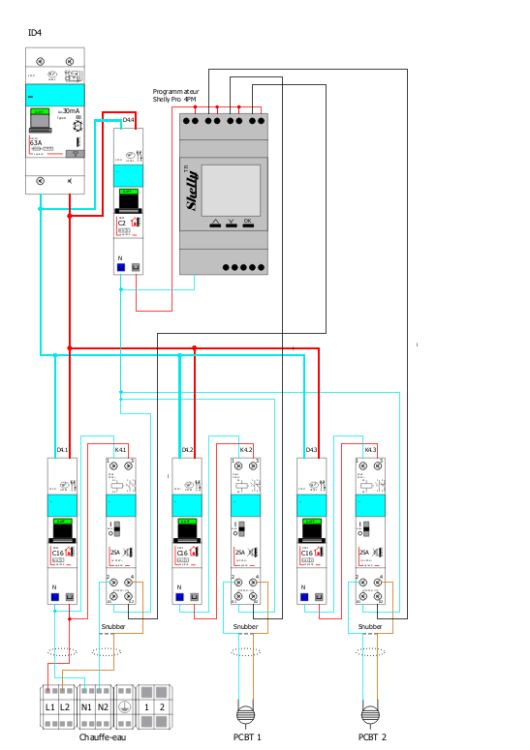
-
France certainly can't build them cheaply. Flamanville 3 was due to be completed in 2012 for €3.3 billion. It opened at the end of 2024 and cost €19.1 billion (in French). In Finland, Olkiluoto 3 was expected to open in 2009 for €3 billion, but opened in 2024 for an estimated € 11 billion.
-
I prefer the 4th one you posted, which seems to be a pale blue on my monitor, for a little more contrast.
-
Not structural. Most likely the relic of a 1970's renovation.
-
Jointly awarded the Nobel Prize in Physics 2022 "for experiments with entangled photons, establishing the violation of Bell inequalities and pioneering quantum information science". Clearly not an expert in climate science then. Then there's: Alexis Carrel - Awarded the Nobel Prize in Physiology or Medicine 1912 "in recognition of his work on vascular sutures and the transplantation of blood vessels and organs". Believed in telepathy and eugenics. Richard Smalley - Jointly awarded the Nobel Prize for Chemistry 1996 "for their discovery of fullerenes" Believed that evolution could not have occurred. There are others...
-
A very good point. Since maintaining vapour-permiability will be essential following my current renovation, I'll be inscribing that, together with a few other key points, on a metal plate that will be screwed next to my MVHR unit for posterity - it may be worth considering. In theory I shouldn't need to do that here in France because a mandatory 'house manual' is now required as part of the conveyancing process. It has to include, in detail (product names, technical characteristics, serial numbers, etc.), all the materials and equipment related to insulation, thermal performance, energy use & generation, etc., from initial build (if built after the law came in) through all subsequent modifications. It must also contain instruction manuals, servicing requirements & maintenance details - for example the need to use vapour-permiable paints.
-
Science is a process. Over time, through repeated experimentation, testing, review and criticism it develops explanations of reality, often based in mathematics, that best fit the currently available evidence. If new evidence is gathered and/or better explanations are developed, then the consensus best explanation of reality eventually changes. Opinions are subjective personal judgements. Individual scientists may hold them, but that doesn't turn opinions into science, nor science into opinions.
-
If you have a cavity that's certainly the best solution.
-
I briefly mentioned using cork as a spacer earlier; I'd use continuous strips, not just spacers every 600mm; without that kind of firm support 45x45 would be too flimsy. Personally I'd increase it to 45x75 if I was using timber.
-
Yes, it will be a big help Installing MVHR, would help too. It keeps internal humidity lower than it would otherwise be, cutting the moisture entering the structure in winter and allowing it to dry out quicker in spring. Making the building airtight should also be a key priority and to accompany that you need an effective ventilation strategy, be it MVHR or otherwise. There are several threads on here about both topics.
-
Nor me, and £86 million is certainly worthwhile. Just a shame that their parent company isn't British too - their turnover was €17.3 billion (the 4th biggest company in Denmark).
-
Welcome! There are some exceptions in Part L of the Building Regulations for 'listed buildings, buildings in conservation areas and scheduled monuments' and for 'historic and traditional dwellings'. However they only apply when the work would 'unacceptably alter the dwelling’s character or appearance' - in which case 'the work should comply with standards in this approved document to the extent that it is reasonably practicable'. In theory you might qualify under the first of these, but in practice it's unlikely to help; it's more for when insulating internally and externally are both ruled out for heritage reasons, or double glazing can't be retrofitted to historic windows. In theory the second case wouldn't apply as it's a barn, not an existing dwelling, but the Local Authority may be flexible on that if they want to see it put to use as a house. Don't use PIR. Vapour-permiable options are readily available and advisable - you'll find some topics on this forum. In a renovation there are provisions for when the the full insulation standards can't be met but, from memory, they wouldn't normally apply in a conversion. Is unlikely to be financially viable outside the World's major cities, where the property value /m² of floor area gained exceeds the cost of Aerogel. That's not an argument that will fly; you'll need to use clever design to maximise the space that is available. Sounds like you need to find yourself a local architect experienced in restoring / converting old buildings.
-
Which is good - but they're owned by Vestas Wind Systems A/S - who are Danish.
-
It used to, but most of that was closed down. It now holds 12 days maximum. https://www.dw.com/en/why-uk-gas-storage-levels-are-concerningly-low/a-71281361
-
Last time I checked Denmark was still the World's 2nd largest manufacturer of wind turbines - it was they who developed the technology in the '80s. Of course the UK could have done the same, but why do that when the North Sea was full of oil and gas? Though, in view the current headlines, maybe Denmark should have invested in nuclear weapons instead...
-
They’re best avoided - the problem is that they tend to push moisture-laiden internal air through gaps in the building, leading to condensation within the structure. MEV avoids this risk. Choose either a central central unit, or decentralised dMEV. If you're not going to DIY it, then yes, you need to find a contractor to propose a solution. You can post their proposal here for feedback.
-
X3 Immersion heaters on a single radial
Mike replied to RedSpottedSev's topic in Consumer Units, RCDs, MCBOs
It doesn't, so I'll get myself some more; thanks for the heads-up! Yes, there is a recommendation to use no more than 2 adjacent contactors unless there's a gap between them for cooling. I'm populating the row with alternating breakers & contactors, which should help. -
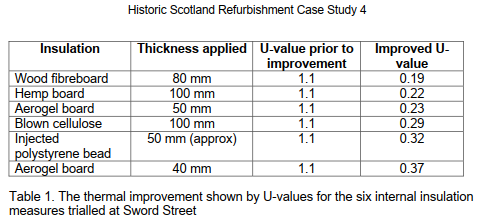
It depends. If the external wall is in good condition, free from penetrating rain and not very exposed, and provided the DPC is doing its job, then it's generally accepted that it's safe to apply internal wall insulation to a solid wall if the resulting wall u-value is at or above 0.5 W/m².K, pretty much irrespective of the method used. However there is significant research such as the Historic Scotland Refurbishment Case Study 4 where they went down to between 0.37 and 0.19 by using vapour-periable materials (important!) without using a vapour barrier, and without any concerns during their 18-month initial study (AFAIK they never published their promised follow-up report); it's worth downloading a copy. Since most of the research is on insulating solid walls I don't recall seeing anything about upgrading insulated cavity walls. Ideally you'd find someone to model the risk with software such as WUFI (though it isn't without problems - best to model the entire building, not just the walls). As mentioned in one of my earlier posts above, remove any gypsum plaster if there's a risk of any condensation against the existing wall - many materials can tolerate some moisture in winter temperatures provided they dry out again quickly enough in spring (so a Glaser analysis using a tool such as Ubakus isn't very useful), but gypsum holds the moisture and turns to slurry. For more reading, see the link to the other thread I posted above. You'll see there that I chose hemp insulation for my own IWI due to its good moisture handling abilities (plus good decrement delay). I wouldn't have been at all comfortable going as low with my u-values using mineral wool, or using a vapour-impermeable build-up. I'd probably choose cork.
-
X3 Immersion heaters on a single radial
Mike replied to RedSpottedSev's topic in Consumer Units, RCDs, MCBOs
That is a lot! Double checked my contactors and they seem to be 0.8 to 1.8 W. Mine claim to be good for 100,000 to 150,000 switching cycles so until your post I wasn't too worried about that - but maybe I should be? The only snubber at the moment is for the circulation pump.