


Beelbeebub
-
Posts
1521 -
Joined
-
Last visited
-
Days Won
11
Everything posted by Beelbeebub
-
aroTHERM Plus DHW Flow Temperature
Beelbeebub replied to Dan F's topic in Air Source Heat Pumps (ASHP)
The cylinders would need to be sold as "for HP only" with a big warning sticker, basically as a package with the HP (which we all know installers *love* to do! 😁). This would also solve the "only certain HP" argument. The hypothetical G3-free cylinders would be packaged by the HP manufacturer as part of the system for retrofit. The bonus would be the installer wouldn't need a G3 ticket and the cylinder wouldn't need annual inspection. Yes, someone could stick an external immersion on despite the warning sticker, but then that same someone could cap the PRV vent or some other stupid thing. So "someone might do the stupid thing theya rare watens not to do" is a general and not specific argument. -
aroTHERM Plus DHW Flow Temperature
Beelbeebub replied to Dan F's topic in Air Source Heat Pumps (ASHP)
Sorry, I meant comparing TS to storage cylinder. Unless you have your theoretically perfect PHX thermal store, a TS will always produce less hot water from the same volume of water at the same temp. If you have lots of space then just have a bigger TS volume. If you don't mind the small hit in efficiency the use a higher temp. -
aroTHERM Plus DHW Flow Temperature
Beelbeebub replied to Dan F's topic in Air Source Heat Pumps (ASHP)
Yes, but you need a very efficient PHX running as a counterflow HX so your outgoing DHW is at the same temp your incoming TS water is and vice versa. You also need very careful control of the pump speed. Too fast and your exit TS water is warmer than 15C (wasted capacity!) Too slow and your DHW is lower than your TS temp. So theoretically a PHX system would allow you to get the same volume of DHW from a TS as a storage cylinder, but in reality you'd fall somewhat short -
aroTHERM Plus DHW Flow Temperature
Beelbeebub replied to Dan F's topic in Air Source Heat Pumps (ASHP)
Yes, if an immersion (in fact, *especially* if an immersion is fitted) you need the full weight of the G3 regulations. Immersion heaters can and do fail on (I've dealt with 2). But you don't actually need an immersion heater. A HP can achive the tank temps required for pasteurization on it's own but cannot achieve the temperatures required to boil a cylinder. It would be possible to burst a tank and have a hot water leak - though a HP fed tank would normally (outside of legionella cycle) be at a much lower temp than gas fired tanks typically store at. But it would be impossible to cause the type of explosion that the regulators are worried about. -
aroTHERM Plus DHW Flow Temperature
Beelbeebub replied to Dan F's topic in Air Source Heat Pumps (ASHP)
My worry about Thermal Stores is this. Say you have a 100l cylinder at mains temp (say 10C) and you want 45c water (let's ignore blending valves) You heat it to 45C. You now have 100l of 45C water to draw on. If you have a TS you have well below 100l of 45C hot water. The moment the max temp of your store drops below 45C you can no longer achieve 45C water at all. To achieve a good volume of 45C water, you need to either store your water at a higher temp or have more water. A PHX system with a variable speed pump might do better, but at the cost of complexity. The unvented store has the merit of high efficency and simplicity. The one problem is the G3 regs. It would be useful if that could be disregarded when connected *only* to a HP as there is absolutely no chance of it ever boiling. Therefore the risk of explosion is zero. The other option is a vented cylinder with a booster pump for pressure. very simple thermally and a small amount of complexity (off the shelf booster) -
Gas boiler lobby obstructing heatpumps
Beelbeebub replied to Beelbeebub's topic in Air Source Heat Pumps (ASHP)
At a guess, there was a transient (eg water pump and/or compressor speeds changed) at that point, that confused the heat meter. it doesn't affect the total heat quantity delivered because the spike is relatively short, but does muck up the instantaneous reading. -
Another reason for switching to HPs nationally
Beelbeebub replied to Beelbeebub's topic in Air Source Heat Pumps (ASHP)
I mean that the total amount if gas the country burns to keep warm falls. Sadly overall cost is likely to go up for many -
Another reason for switching to HPs nationally
Beelbeebub replied to Beelbeebub's topic in Air Source Heat Pumps (ASHP)
I think there is no reason the units can't be optimised for heating efficiency. It's just a question of world wide demand, with cooling being the bigger market. -
Another reason for switching to HPs nationally
Beelbeebub replied to Beelbeebub's topic in Air Source Heat Pumps (ASHP)
The other ones to consider are the "through the wall" individual units. Only 1 or 2 kw, but retrofit could be easier in some circumstances (external walls available and especially high properties like flats) with little external visual impact. A really clever design would double as MHRV Currently I think they are a bit too expensive - no cheaper than a single split system with less efficency and power. If they could be got down to the £500 for a 2kw unit range, they would be very viable. -
Another reason for switching to HPs nationally
Beelbeebub replied to Beelbeebub's topic in Air Source Heat Pumps (ASHP)
This is what I mean by ecosystem. If they sold a "manifold", basically a large shoe box with a water pump small expansion vessel and a PHX plus ports for refrigerant and a hydraulic flow/return, then you could connect whatever system you wanted to your outdoor unit. UFH, few rads, whatever. The UFH bit is important as I think, with it's very low flow temps, it's about the most efficient emitter system you can get, but there is no way to use it with refrigerant directly. -
Gas boiler lobby obstructing heatpumps
Beelbeebub replied to Beelbeebub's topic in Air Source Heat Pumps (ASHP)
My guess is that the pump was unable to eject enough heat to the cylinder at the deltaT between the 75C flow and cylinder temp, which would have led to an unacceptably high system temp and pressure. So it modulated it's speed down so the power output was lower with the same flow temp IE lower water flow rate. This allowed it to continue operating, but at a lower COP. All a bit of guesswork tho. -
Another reason for switching to HPs nationally
Beelbeebub replied to Beelbeebub's topic in Air Source Heat Pumps (ASHP)
Yeah. Minisplits, possibly r290, would be a great solution, especially if we could sort the ecosystem installers, planning, interoperability, end of life, user familiarity etc. However we do seem to like our wet systems in the UK (and I can see the attraction) -
Another reason for switching to HPs nationally
Beelbeebub replied to Beelbeebub's topic in Air Source Heat Pumps (ASHP)
People say "we can't switch over quickly" - yet ignore the fact we we phased out coal in a decade. -
Another reason for switching to HPs nationally
Beelbeebub replied to Beelbeebub's topic in Air Source Heat Pumps (ASHP)
You are right, if we snapped out fingers and transformed every boiler into a HP, there would be an issue with electrical generation capacity. This is a common objection. I'm not sure it is valid. Rough estimates put the heat value of gas burned for space heating as about twice the current electrical power generation of the UK. If all of that were to be swapped for fleet of HPs with an average SCOP of 2.5 we would need to add about 80% of current capacity. If we hit an ambitious average of 3 it's only 65% So how do we do it? Gas power stations. Specifically Combined Cycle stations. These take around 3 years to build (and that could be shortened if we get into the swing of things) and are more efficent than steam plants. 200MW costs about £100m Let's say we need to double output, leave a bit left over for the electric cars. We need another 75,000MW which is about 375 plants which would be £38bn. Time taken would be the bigger issue, every plant would provide enough elec to heat about 50k homes with HPs. The gov needs to go for 600k a year, so 12 new plants a year (£1.2bn) Yes we are building fossil fuel plants, but the overall gas demand of the country falls. Any renewables we build (which we should still be doing! At pace!) Would just mean we fewer new build CCGT plants. In the future as we build out more renewables, the new CCGT plants would remain as the "cold, dark, still" backup option, maybe running a few weeks.of the year. -
Another reason for switching to HPs nationally
Beelbeebub replied to Beelbeebub's topic in Air Source Heat Pumps (ASHP)
There are, catalysts and recirculation technologies for example. But that does add to the cost (and physical size and maintenance) of boilers and needs to be factored in. A HP moves the combustion out of the point of use (to a power station) where it isless problematic (in terms of air quality) and can be delt with more economically. -
Tenuously connected to HPs but https://www.theguardian.com/environment/2023/aug/06/ulez-just-the-start-and-similar-scheme-needed-for-buildings-experts-warn The gist is nitrogen oxide pollution from building heating is going to be an increasing issue in urban areas as the pollution from vehicles falls away. Nitrogen oxide pollution is a (near) unavoidable side effect of combustion. In fact the more efficient your device, the higher the combustion temps and more nitrogen oxides you put out. The only way to avoid these pollutants is to use electric, which means heat pumps*. *I suppose the calculation has to be the additional cost of a heatpump system over a direct electric system Vs the additional cost of the extra power generation required.for a direct electric system.
-
Gas boiler lobby obstructing heatpumps
Beelbeebub replied to Beelbeebub's topic in Air Source Heat Pumps (ASHP)
Just on the topic of HP's and undersized cylinder coils. Came across this plot of an Arotherm+ (r290) system. It's doing a legionella cycle and the outside air temp is 10-15C over the cycle. As you can see it tops out at 75C where the CoP is a little under 2. At this point it's about on parity with a gas boiler for primary energy (gas burned) efficency. But running at 65C the CoP is 2.4, very much ahead of a gas boiler. Clearly this is a well set up system and the cylinder probably a fairly big coil. But if we had a smaller coil and had to run at high temps throughout the cycle it would be possible.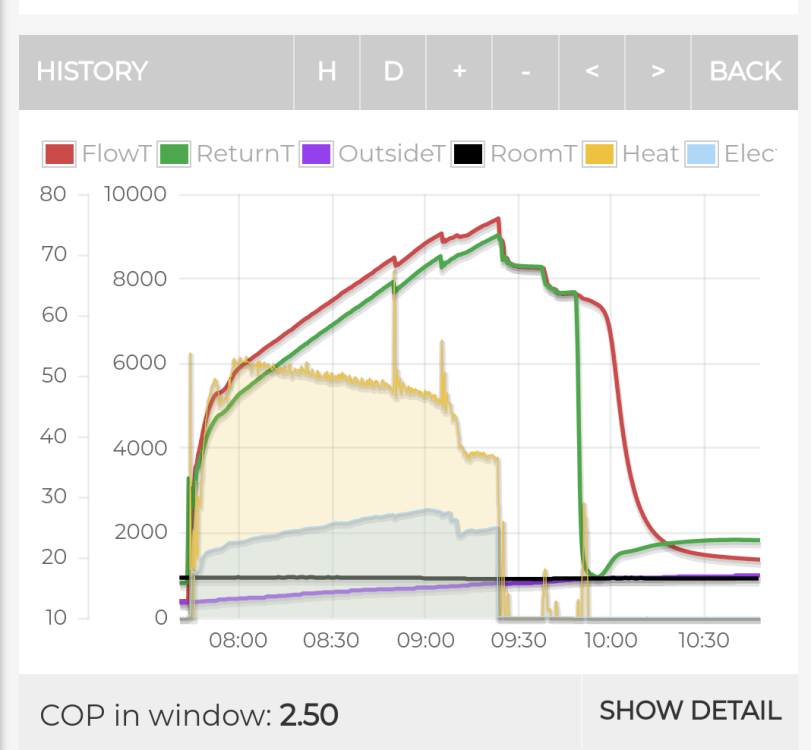
-
Gas boiler lobby obstructing heatpumps
Beelbeebub replied to Beelbeebub's topic in Air Source Heat Pumps (ASHP)
Daikin do the hot water cylinder that acts as a head unit I think. That might be very interesting, especially if it could be added later. I have looked at some courses, how much were you quoted if you don't mind me asking? -
Gas boiler lobby obstructing heatpumps
Beelbeebub replied to Beelbeebub's topic in Air Source Heat Pumps (ASHP)
Yes,.but I meant the "head" units - for air 2 water those are UFH, radiators, maybe fan coils and can be swapped out with other brands, types etc If your one of your Daikin XYZ2GHP7J2PX (my god the model number system is opaque!) indoor unit dies, I don't want to have to replace it,.the other indoor units and the outdoor unit because getting a compatible replacement is tricky Especially if the outdoor unit is hard to access. -
Gas boiler lobby obstructing heatpumps
Beelbeebub replied to Beelbeebub's topic in Air Source Heat Pumps (ASHP)
That's what worries me. I don't mind so much if it was "just swap out the broken unit", but it seems swapping everything is the norm? Still need access for swapping. Working at height can turn a 1 hour job into all day. -
Gas boiler lobby obstructing heatpumps
Beelbeebub replied to Beelbeebub's topic in Air Source Heat Pumps (ASHP)
It's the visual aspect that's the problem, particularly for flats. The servicing issue when they are 7 floors up is not trivial either. If the flats have balconys (as quite a lot of purpose built do, then that might be an option. In the block I look after there are two stariwells next to each other with a party wall (was a Victorian spa, apparently they had seperate mirror wings for men and women including lobby and stairs!)I have wondered about placing the units in the stairwells (they are huge) with one stairwell "intake" and the other "exhaust". Would be very convenient for flats and servicing, no planning either. Noise would be an issue, plus one stairwell would be warm and the other cold! -
Gas boiler lobby obstructing heatpumps
Beelbeebub replied to Beelbeebub's topic in Air Source Heat Pumps (ASHP)
Planning would need to change so sticking a (certified) box on the wall is totally allowed. The certified boxes would have already met noise standards etc.aybe lock off the cooling function to high 20's to prevent extra consumption form people running cooling too much. Need to get aesthetic options out there, eg offer case colour options other than white (or just make them easy to spray paint, provide masks in the box for grilles etc). -
Gas boiler lobby obstructing heatpumps
Beelbeebub replied to Beelbeebub's topic in Air Source Heat Pumps (ASHP)
LPG I think. If they just added it as an add on for gas safe qualified, like £100, an online course with a few videos and questions at the end. Would be an easy way to "train up" the workforce. -
Gas boiler lobby obstructing heatpumps
Beelbeebub replied to Beelbeebub's topic in Air Source Heat Pumps (ASHP)
The development of a really easy to DIY/handyman level ecosystem for A2A would be crucial. If you could get trained on fitting a unit on a.£200nday course, the equipment was a few hundred £ and the units were £2-3k, plus relaxed planning. It would take off. The priority would be for electric only properties, you would get an instant cost saving and you can leave the DHW as is for later. Maybe when the appropriate cylinders become available. That's a big market. -
Gas boiler lobby obstructing heatpumps
Beelbeebub replied to Beelbeebub's topic in Air Source Heat Pumps (ASHP)
A2A has real potential if a few hurdles can be overcome. FGas certification - we need either low cost, effort certification so ordinary plumbers can add it to their offering with minimal outlay. Or we need DIYable systems. The issue is wemeither have FGasses like r32 where the problem will be DIYers venting it left right and center or hydrocarbons like r290.wjere there may be issues with safety. That said, r290.has been used been used in Chinese and Indian markets for a decade and I don't think there has been a major issue. R744 (CO2) has potential but I don't think anyone makes A2A splits. Not suremif it's a technical thing or a demand thing.

