


Beelbeebub
-
Posts
1521 -
Joined
-
Last visited
-
Days Won
11
Everything posted by Beelbeebub
-
I'm not sure. It is a company but is it one of those weird ones where the Gov is 50.1% share holder?
-
@LnP I don't disagree with the idea that the high elec price is an issue or that we could do with some sort of reform to bring it down. And pricing intermittently into the renewables price would effectively take the place of the marginal auctions now, though it might help by better ammortising the intermittent gas stations costs with the renewables cost. But I do quibble with a few things.... Yes, better storage would be good but the "long term gas... North Sea" bit is (potentially) a bit more of an issue. The core point of this thread is that UK North Sea gas is running out - even the Norwegians are seeing production falling, albeit at a slower rate than us. So if by "long term gas... North Sea" you mean drilling more to get more gas - nope. I can see (ha!) a potential for drilling new gas fields specifically for providing gas to power stations when they are needed as backup for renewables (sort of storage except we never put the gas in), but that only works of the fields are vertically integrated with the power stations. The UK peak is now down closer to 35GW and we have nowhere near 120GW of renewables capacity (though your point about having to have a greater "nameplate" capacity to peak demand ratio for renewables vs thermal is very true) I would point out that solar can be extremely close to the consumer ie on their roof. This is visible in current data when the national consumption diverge from the transmission load as more LV solar supplies the demand without having to travel long distances.
-
The EU has rules around government involvement but I don't think they are absolute - the NHS wouldn't have been able to exist otherwise. I agree there could be some market distortions but I'm not sure it would stop people joining unless the government had so much capacity that nobody else was ever needed to generate - but at that point, by definition, we wouldn't need the extra capacity so the problem is moot!😁 Maybe if the government built and owned the storage facilities? Eg pumped hydro and battery. That way they would be creating an additional market for the excess power. Big long term infa like pumped hydro is more suited to government ownership rather than quarter to quarter shareholders. And building big battery farms (or providing lots of domestic batteries) would provide a "prime the pump" investment for UK based battery manufacturing...
-
Possibly. No. I mean the government build and operate the facilities themselves. They may (prob will) use private companies to do that but the asset will remain the property of the government and be operated by the government. We used to do it. We used to build and operate national railways, hospitals, schools, even power stations. Whilst there are pitfalls in this approach, it would be hard to argue that the privatisation model eg railways, water, hospitals has been a success on all fronts. Edit: I don't mean PFI or similar - I've been involved in hospital and school PFI schemes and they are often really shit for the tax payer. Not only is the build quality really low, the contractual conditions of the "landlord" are terrible. The power facilities are going to be big enough and around long enough for a corps of efficient government employees to form to operate them.
-
I do get the logic behind the marginal price auction system and it should be pointed out that the CFD system of strike prices basically negates some of that by effectively fixing the price for renewables over a long period. I don't quite know how it feeds into the price we pay as consumers or if the over/under just goes the treasury. However, it would be nice if the cost savings from renewables could be passed on more. The flip side is the profits to be made from putting in renewables does encourage more to be put in. Of course it would be nice if the gov, who can borrow money nice and cheaply (relative to companies) borrowed, built and operated some windfarms and solar parks to sell the power to the grid at a low cost.
-
A fair point except the climate example misses the fundamental difference between climate and weather. In this case I'm showing that renewables are cheap. The rise in electricity prices track the rise and fall of gas prices not the rise and rise of renewables. Renewables have steadily risen in last decade But electricity has tracked gas prices. The fact electricity is more expensive now is despite our increace in renewables not because of.
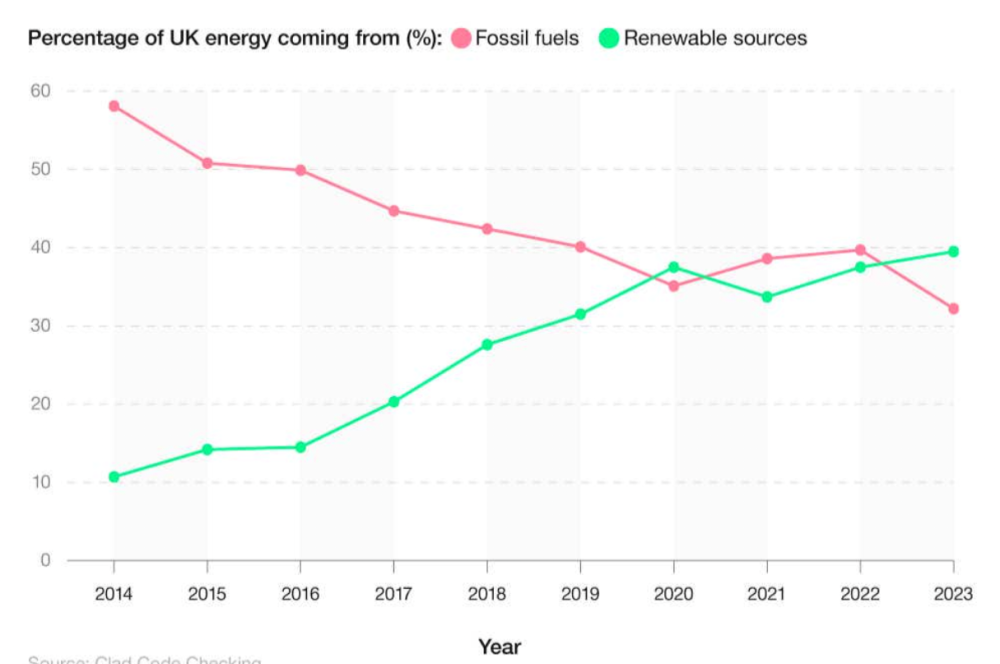
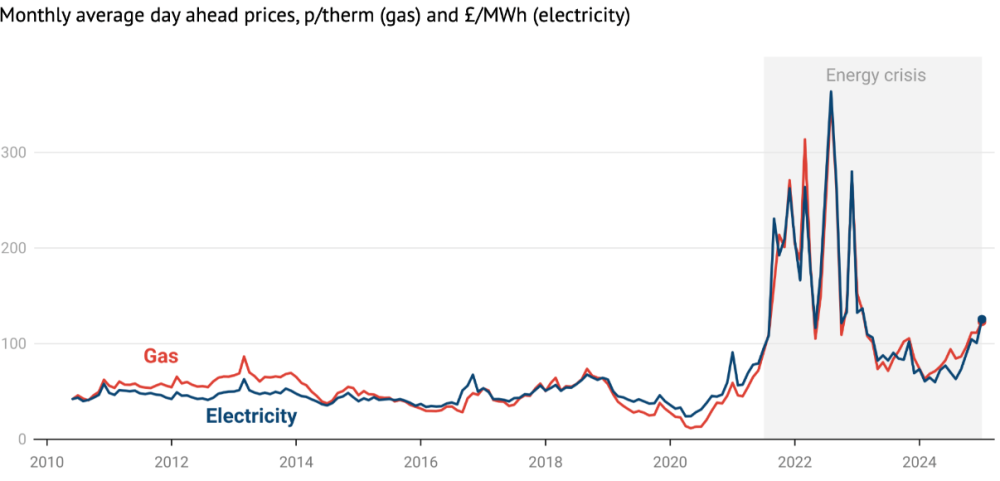
-
"bUt rENeWabLes arE maKiNg elEcTrIcitY mOrE ExPeNsIvE!!...."
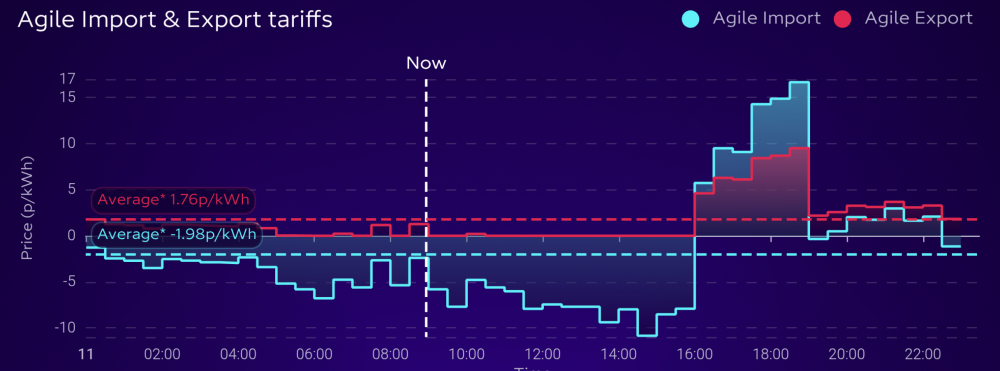
-
But what does the fee contribute to? AFAIK, you apply, the system operator looks up what your connection can take and that's it. The form is electronic and has drop down menus for all the applicable fields. The whole thing could be almost automated - especially for the "default" 3.6kw connection. I can understand maybe some engineer time if you want to ask for more than 3.6kw as someone might need to dig into some records and do some calculations. If the system meeds upgrading to cope with the extra input that is the dno's responsibility anyway and £200 isn't going to go far when it comes to replacing cables or transformers. I can see it may be neccesary/prudent to just have 3.6kw (or maybe a lower figure) as the default that everyone can export and then charge for higher levels. The current "first come first serve" allocation is a little unfair as some early adopters have huge limits and then late comers get very little.
-
Renewable energy news
Beelbeebub replied to saveasteading's topic in Environmental Building Politics
I'm sure I saw at one point the gas contribution was less than the amount we were exporting ie the only reason we were burning gas was for export. -
Lowest profile flat roof ballasted system
Beelbeebub replied to Mattg4321's topic in Photovoltaics (PV)
How. Much headroom do you have below the 4x2 joists? -
The crux for me is that these systems have been working away in Europe for several years now. Unless there is some fundamental difference between our systems and European ones - maybe the fact we use ring mains or something - I can't seen there being a problem, beyond regulations and paperwork.
-
I'm frequently wrong Show me some evidence and I'll happily change my mind (I still think we need to stop burning fossil fuels from a climate PoV, but i'll accept that the energy security facet will move from "a reason to stop burning fossil fuels" to "a reason we might need to keep churning fossil fuels"). I'll point out that the ones in this debate who are clinging to the idea we can "drill" our way to energy security despite the evidence to the contrary are the ones displaying the "can't be wrong ever" attitude...
-
Brilliant - we should look to mining that. Probably not with steam pumps and kids though... 😁
-
When have I misrepresented your position? I merely mentioned there seems to be a nostalgia streak and desire to find any alternative to renewables even coal.
-
You bring some good arguments to the table and I'll happily change my mind. The orginal premise of the thread was to highlight that there was no realistic possibility of improving UK energy security by increacing oil and gas production (and that the best route was a package of policies broadly in line with "Net zero") To support my position I referenced several studies and reports, including from the oil industry itself, showing the impracticallity of "drill baby drill" To my knowledge nobody has rebutted that other than insisting I'm wrong and there is tons of oil just waiting to be found.
-
None of the old coal plants are any use right now because none of them are working nor could any be brought back in to service in any real aitch timescale or budget. I looked up estimates for repowering a typical ccgt plant, not exactly the same but likely to be ball park, about £900m. Life extention was less but very dependent on the depth of the overhaul needed. Ivve agreed that if we had any plants running today and scheduled for imminent closure, we would be wise to look at keep them running for a bit longer. But that isn't the case
-
I have an old tractor, really tiny - uses a 2hp sidevalve B&S motor that is knackered. I was thinking of replacing it with a 2kw scooter motor from ebay and a 5kWh Lfp battery. Would be useful for little jobs our (slightly) bigger diesel one is currently overkill for. I'd replace diesel one except it is so bloody reliable and sips fuel it s not worth it.
-
If we are going down the speculative route I would propose Amonia production from spare electric. Relatively easy to store at normal pressures and temperatures. It is toxic so the stores would need careful positioning. It can be burned as a fuel for turbines but also converted to hydrogen for high temperature industrial and chemical uses. It is also an important precursor chemical for fertiliser production.... As you point out the synthesis may be inefficient, possibly more than just to H2 but if we are talking summer excess elec that we wouldn't be using anyway then the efficency is moot. This is the point of overbuilding our capacity. My solar array is way oversized. It punts out over 10kw on a sunny day. And after I have filled my 10kwh battery by mid morning I'm limited to 3.6kw export. But it does mean that even on a fairly overcast day like today I'm still generating over 1kw, which is plenty for my house and trickle charging my battery for overnight. If I could figure out a way of using the summer excess, even if it was inefficent it would be great. If I could store that excess for winter use, even at 50% or less round trip efficency, I could probably never need the grid.
-
Good point.
-
As long as thr unit cannot output more than 800w (about 3a) will it be able to cause much damage to the grid. If it tried to distort the waveform by being put of phase it wouldn't be able to "overwhelm" the natural grid waveform. I wonder if that is why the plug in limit is so low. The biggest issues will be islanding but that would be covered by the prongs not being live whan unplugged, which would surely be covered by thr CE marking. That said, it would be sensible if the approval for being put on sale in the UK included some basic specs that make it suitible for grid connection. Eg can only be put on sale if the inverter is listed in the g98 list.
-
The problem is and always will be storage of the amounts of H2 required. Just doing a quick calculation (may be wrong so here's the working) A large LNG carrier has around 250,000 m3 of LNG 1m3 of LNG is about 6.8Mwh thermal which equates to about 2.7Mwh electric (roughly 40% efficient). So a very large LNG carrier has 250,000 x 2.7Mwh = 680,000Mwh or 680Gwh of electricity. The UK uses around 22,000 Gwh in a cold month (and that's before we electrify heating and transport!). Which is about 700 Gwh a day. So we would need about 14 LNG tankers of storage for a fortnight. The problem is H2 is much harder to store cryogenically - it needs to be at - 250C or so. But if it was, it's energy density is 2.7mwh thermal per m3 so roughly 40% of LNG, that meany ou now need to store about 35 liquid H2 carriers holding H2 at -250C. If we store it as a compressed gas, the figures are even worse.

-
If any coal stations were currently operational it would be wise not to shut them down. As I mentioned RoS was extended because of high gas prices. But my point is, they are shut down so it's water under the bridge. Two points to note are that the % of our total generation that used to be coal 30-40% in the late 00's early 10's is now supplied by renewables. So we have, in a sense, already replaced them. Secondly, coal prices are not immune to the current situation, so electricity from coal would be subject to the same price linkage as gas and oil. As for China. They are in a different situation from thr UK, their power demands are still growing. They are having to add more generation. Ideally all of this and more would be from renewables. Instead it is mostly (in the 4/5 range) from renewables and crucially the renewable addition is greater than the growth, so the proportion of coal is falling. It's not perfect but it is pretty good. Again they install more wind capacity that the entire UK grid every quarter. It's mind boggling - it also gives lie to the claim that renewables are a Chinese plot to cripple western industry....
-
I would say the gas should be peaker/backup load not any kind of base load.
-
The carbon capture brigade neglect to mention that capturing the carbon from a combustion process intrinsically requires energy. You burn about 25% more fuel per Mwh running a carbon capture plant as you do a "normal" plant. Of course this is a win/win for the fossil fuel providers, not only do they get to keep selling their product, but demand actually goes up....
-
My bet is commercial fusion before green hydrogen boilers and clean coal.....



