Beelbeebub
-
Posts
1508 -
Joined
-
Last visited
-
Days Won
10
1 Follower

Beelbeebub's Achievements

Advanced Member (5/5)
369
Reputation
-
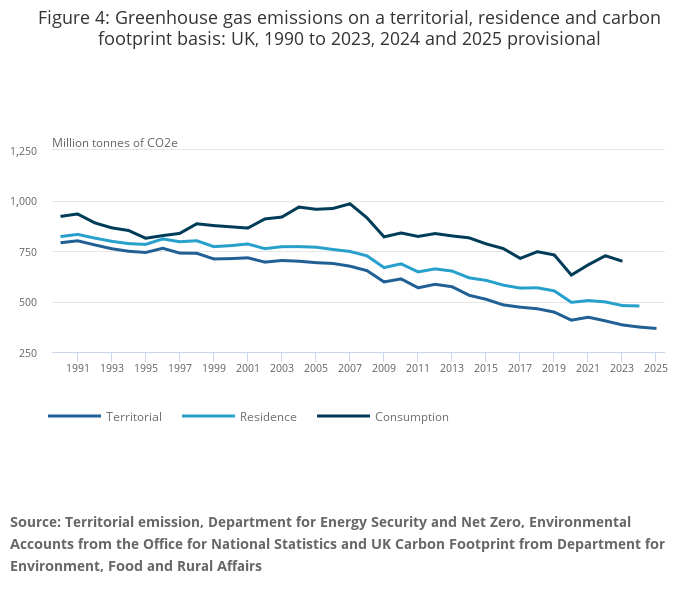
This one. Territorial is CO2 from within our borders -so consuming stuff from abroad changes that figure alot. But Footprint includes that stuff and has still gone down - albeit not by as much. The footprint is very dependent on the CO2 output of the producer nations we import from (cough china cough).
-
Agree. Our Territorial emissions have fallen by alot more than our footprint (roughly 50% and 25% fall iirc) Ah yes, I would argue we have been successful at the generation end of decarbonisation - mainly building wind though solar and nuclear have been less successful. But the other, demand end, has been much more lackluster. Both in the deployment of heat pumps, definitely the upgrading of housing, transitioning to BEVs is only now starting to pick up. And for industry there has maybe been less success. Our high energy prices are largely driven by high oil and gas prices since 2022, though policy has very much made the spark gap wider. Ironically those same high energy prices are also driving some of the decarbonisation! On the whole I think we agree, though I think you are maybe a little to harsh on us given our pretty impressive decarbonisation of electricity generation but I agree we could do better at the other side of the equation.
-
Decarbonising doesn't mean stopping - merely removing (where possible - see pt 2). There are plenty of industries which burn gas and sometimes oinnthat can switch. Paper making, brewing, wood work and countless others use steam. Often generated by a gas boiler. Those processes can be replaced by electric heating - they can even be replaced by heat pumps in some situations. Secondly, there will always be some processes that just require gas (or oil or coal) normally because they are being used as much as a chemical feedstock as for heat (or even entirely as a feedstock). These processes will have to remain as fossil fuel consumers - it is net zero not absolute zero. Aviation is a classic example. I cannot see long haul aviation get away from fossil fuels for quite some time. We would need to have a significant surplus of electricity to begin to start making sufficient quantities of synthetic fuels (I don't think bio fuels from current farm practices will cut it). But my point was that industry changes all the time due to different pressures. Energy prices are part of the mix but probably don't affect a bespoke sports car maker as much as skilled labour and parts availability. I don't think Burberry and Mulberry are as bothered by the price of electricity as they are the availability if leather and skilled leather workers (and probably most importantly the whims of international fashion)
-
And they still do. https://alvancebritishaluminium.com/ The problem is it can only produce about 50,000 tons a year whilst the UK demand is around 1.2 million tons a year - so about 4%. So we either have to build another 24 such plants, decrease UK industry until demand is 4% of current, import from abroad (ideally, Norway and Canada as they use a lot of hydro for their smelting) Again, though I fully support the Scottish plant, it doesn't make a huge difference to the prices of our aluminum or the security. It, again, is a question of relative scale - which the British public seem to be bad at grasping i.e. £350 million a week sounds like a huge amount of money - except in the scale of a government that spent £14,000 million a week (2.5%)
-
The problem is the reason we should drop the policies is that "they cost too much and we should use the vast reeves or North sea gas and oil to make ourselves energy independent" Which is all bollocks. But sticks in certain minds alongside "we are being invaded" and "the most pressing issue facing our nation is where somebody takes a piss"
-
The best solution would be a heat pump and possibly a battery EPC regs don't reward that (zero for batteries and a heatpump yields a couple of points over the existing storage heaters). Plus there are planning and install issues (5 stories, conservation area, AONB). The best solution. The one we are going with is to swap the heaters for new HHR storage heaters. If I can get solar fitted I will - and probably a battery. As for the gas properties the issue is not making it more expensive for the tenants (plus the EPC issue). Right now I can't make the bus case stack up despite trying many permutations. Again solar is the current front runner.
-
Why? Why is the domestic industry mix of UK 2025 inferior to 2000? Or 1975? Or 1950 or 1850? Name a country that has had the same industrial mix that it did in 2000? Certain people have nostalgia for manufacturing but the fact is the UK was always going to have to transition away from labour intensive industry because the world marches on. If we still built cars the way we did in 1970 the cars would be more expensive and poorer quality than competitors who used modern, lower labour, plants. Arguably it's part of the reason out motor industry failed - not modernising. China's industrial mix has massively changed. Has their policy failed? A far better measure is the impact on the economy and living standards of decarbonisation. This is going to be hard to disentangle from the other things that have happened over the last 2 decades that have also impacted out economy and living standards. 2008 crash Brexit COVID Ukraine invasion Hormuz
-
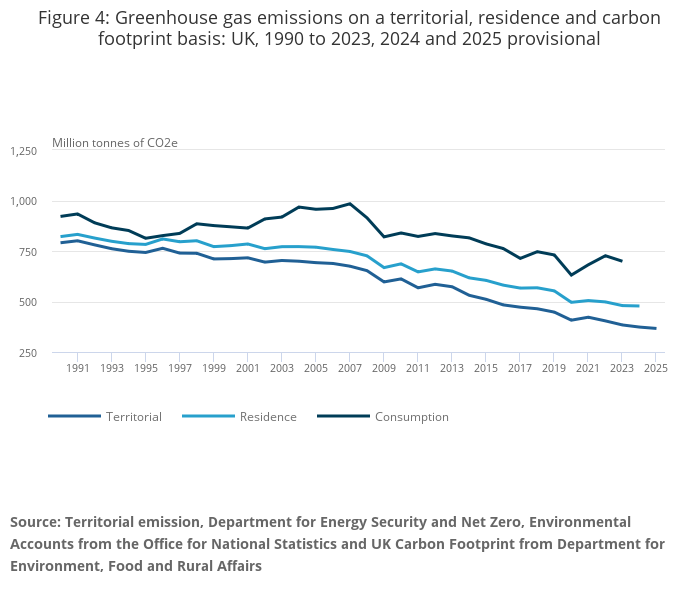
Here is the serious analysis It is true that upto 2005 the idea that we were merely exporting emissions was mostly true, but since then even our footprint emissions (which includes the footprint of stuff made abroad) have fallen. I'd be very interested to see which "international forums". The UK is generally considered to be a leader in the field of transition policy (at least regarding generation).
-
I do give a chuff - though this thread is specifically about the non-climate related reasons for needing net zero policies. But the idea of comparative advantage extends to carbon as well. There are some items that can be produced and shipped for less CO2 than being produced here. Aluminium from Canada being an example that springs to mind. For jackdaw gas Vs LNG gas the difference is relatively small - about 0.3% of UK emissions and even smaller if the gas is sourced from Norwegian pipeline (which it will be this winter as LNG from Quatar is not available)
-
I have about 30 properties to install them in and assume about £10k per property. 30 x 10 = 300
-
The economic theory of comparitive advantage says otherwise. Easy for you to say, but when it will cost upwards of £300k, be extremely hard to physically achieve and you will see zero financial payback it's a harder question. Again, 2% will make zero difference to the price or energy security. As I have repeated, it makes no difference to our prices or energy security if we do or don't licence Rosebank/Jackdaw. There is a narrative pushed by some parties that going all in on the North sea will solve all of the UKs energy issues and obviate the need for "stupid net zero". People need to understand our problems (and need to transition away from oil and gas) will not disappear or even slacken one iota if we licence them. In one sense it is good of they are licences because it will end the discussion, except I worry the next stage - when the promised rewards don't appear - will be to argue "ah, that's because we didn't do a proper job! We need to go even further!". We have seen this tactic for the exact same parties in other areas.
-
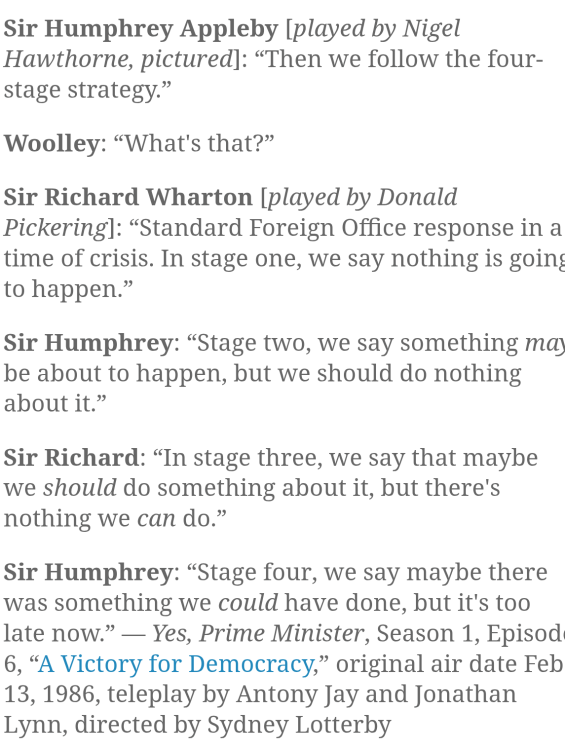
As a side note the "it's green washing - all we've done is shoo emissions abroad and decimated our industry" is straight up FUD from the fossil fuel industry. It sits alongside "the UK is only 1% so nothing we do makes a difference" It is in the fossil fuel industry's interes to make us think we cannot achieve anything so it's not even worth trying. It's stage 3 of the 4 stages
-
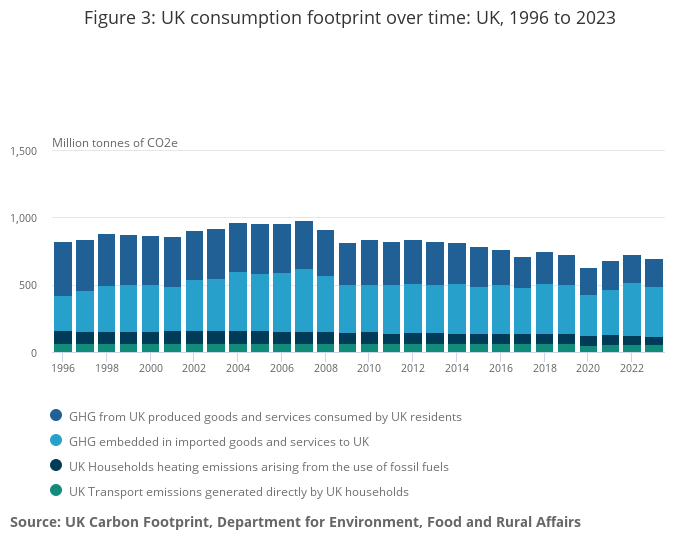
If we are going to tackle a global issue we need to work with other countries. It's really hard to encourage other countries to cut emissions or not start more fossil fuel exploration when we are granting drilling licences - it's not a good look. And as for the argument "we are just green washing, by importing everything that look CO2, oil, gas, bricks, most out goods come from other countries..." It s true that the 50% fall in our "Territorial" emissions measure excludes goods and services from abroad, But our "footprint" emissions which includes that, plus aviation and shipping and pretty much everything else has also fallen albeit not by as much- but still over 20% down from the peak (just under 1bn to just over 750bn). Given you describe 2% as a "good proportion" what would you describe +20% as? "Very good proportion", "Bloody good proportion"?
-
The direct jobs are not substantial - 27 according the the owners. A further 250 or so will be more secure at the hub. Again the issue with jackdaw is that it doesn't do much either way. It's a sideshow. Whilst I think it would be better if we didn't licence it and spent our efforts elsewhere (transitioning) I'm not that bothered of we do - part of me thinks it might be a good idea because it will shut up all the idiots who think it'll sort all out problems and the UK will become the Saudi Arabia of Europe. It does if you mostly type on a screen. What unit do you think I am describing when I say "an average home uses 10 kwh a day"? Unless it genuinely causing you to think of another unit it's just pedantry. Says it all! It says that,like the majority of the country, my houses use gas. I'm trying to electrify but am being stymied by regulations, cost and the biggest issue is I don't want to spend money to make it more expensive for my tenants. Ideally an air to air alongside the current gas system would be the safest but I won't get a grant, I need planning for the outdoor units and in the case of all electric flats I get fewer points than swapping to modern storage heaters. All of the above doesn't invalidate my arguments any more than you being on mians water prevents you from complaint about water companies Only if you define 2% (at best) as a "good proportion". If you got a 2% bonus would you describe that as "a good proportion of my salary"? If you lose 2% of your body weight would that be "a good proportion of my bodyweight"? This is the point I keep trying to drive home. Jackdaw (and Rosebank) will make no discernable difference to: - energy prices - energy security - job figures - CO2 emissions* - tax revenues** It does send the wrong message though. It will make i harder for the UK to pressure other countries to live up to their commitments. *This is a point that can be used to justify licencing despite the climate situation. ** I would like to see what the net tax revenue situation actually is. Hopefully it is positive but I have a suspicion that once tax deductions are included the net position will be much smaller than trumpeted and possibly even negative
-
If you have a battery and smart tariff you don't even need a spark gap of 2, and that's without taking into account the boilers efficiency of around 85% and gas standing charge. Our current tariff (runs out in October) we only pay 10p for electricity per kWh, taking into account standing charge and boiler efficiency we only need a CoP of just over 1 to break even. But the press don't talk about that. 100%