


Crofter
-
Posts
3484 -
Joined
-
Last visited
-
Days Won
11
Everything posted by Crofter
-
Could you replace the screws?
-
 For an off grid system the order is disconnect panels before batteries. I've killed an MPPT by getting that one wrong.
 -
I'd expect so. Same as the asylum housing costs- a lot of that is companies like Serco taking on tired old hotels and then charging out rooms to the government at ludicrous rates. We get angry about the wrong things in this country.
-
If you've never claimed it, and don't even know what it is, maybe you should think twice before blaming the country's financial problems on it. I've been a JSA claimant twice in my life. I was only successful once. Honestly the most degrading and miserable thing I've ever done. And this was years ago before things were tightened up. I didn't have to face sanctions like they do today. I went in to the experience expecting to feel slightly guilty that I was getting 'money for nothing'. But they make you work so hard to jump through all the hoops- especially as a newcomer to the system- that in the end I felt that I had earned every single miserable hard won penny. These days it's much worse. And disability benefits are even more demeaning. I have a friend who was a waitress. She suffered a stroke and was unable to go back to work. Every six months the DWP pay for her to go to Inverness where she meets an assessor who has been flown there and put up in a hotel, just so that he can say yes, you're still paralysed down one side. It's not about saving money. It's about making people feel worthless.
-
CAD software recommendations?
Crofter replied to Great_scot_selfbuild's topic in New House & Self Build Design
This sounds promising, I'll check it out, thanks. -
CAD software recommendations?
Crofter replied to Great_scot_selfbuild's topic in New House & Self Build Design
I'm planning on doing the build myself (same as last time) but there might be details that I'll need to pass on to the sparky or plumber. I'm also hopefully not reinventing the wheel, and presenting detailing that BCO is unfamiliar with. -
CAD software recommendations?
Crofter replied to Great_scot_selfbuild's topic in New House & Self Build Design
On the last build, I ended up doing the elevations etc for planning by hand. It was quite enjoyable really. I think that if I'm going to stand a chance of doing my own building warrant designs, it will be worth doing them in CAD to add an air of professionalism... -
CAD software recommendations?
Crofter replied to Great_scot_selfbuild's topic in New House & Self Build Design
Just resurrecting this thread because I'm also looking for recommendations for a CAD package. I used to be fairly fluent with SketchUp, which I will use for the 3D stuff, but I also need to produce dimensioned 2D drawings and AFAIK that isn't possible with SketchUp. I've got very basic needs really- this is for BCO/Planning drawings. I'm going to be tinkering with this for several months/years so free trials aren't really going to work for me. I'll have time to get my head around a program but I'd like to keep things nice and simple. Don't mind paying a reasonable one off cost (sub £50, say). -
Well if somebody who owns more than 22 properties isn't rich, who is???
-
Have you ever claimed JSA yourself?
-
Advice as I start budgeting - can I afford to self build?
Crofter replied to four_candles's topic in Costing & Estimating
Mine doesn't have an app. I'm not sure how complicated a fan in a box needs to be 🤷♂️ -
We did a self built at the same time as having a baby... not sure which one caused more stress...
-
Advice as I start budgeting - can I afford to self build?
Crofter replied to four_candles's topic in Costing & Estimating
And the 'tech' he wants to avoid is a fan. -
Yes, I was expecting that. Yup Quick glance suggests this can be found for around £150? So not too bad. I think a lot of us would have our heads so deep in to our projects that we could reel off the u value of every piece of the build. But I don't know how turn that in to a SAP value or EPC. Interesting. I'd imagine when the time comes, I'd feel pretty aggrieved paying hundreds for somebody to tape a fan to my door and run it for a few minutes. Seems common, yes. So you think this would be at the discretion of the BCO? If the plans I submit are structurally sound, is the onus on them to satisfy themselves of that, or do I have to 'show my working' or, even worse, will they not accept it unless a chartered engineer has signed it off? Doesn't this come in to the SAP? Where does this requirement come from? Is it an occupier's liability thing? I didn't have any insurance on my last build but then again I was outside most of the regs.
-
Advice as I start budgeting - can I afford to self build?
Crofter replied to four_candles's topic in Costing & Estimating
Agree with this. Perhaps unusually, our build came in almost bang on budget. There was a bit of luck involved in that. I'd phoned up the local builders merchant to get list price for different materials, but when I actually placed the order I shopped around between suppliers and got a hefty discount. So that put my budget in credit. I bought all my kitchen appliances secondhand- again, under budget. I'd tried to apply a bit of margin on my pricing when I did my little QS exercise, and it stood me in good stead. All of the above pretty much cancelled out the areas where costs grew, and we came in within a couple of thousand of the original number. But the time... hmmm... I'd say we were about 50% over on that aspect. You can't have it all. -
Pondering this question a bit more... For somebody with no actual qualifications, what's the maximum amount of DIY that you could possibly do whilst remaining legal and following all the rules and regs? Or to put it another way, which parts of a build must be done by a qualified person? E.g. anybody can draw a house and submit a planning application. Anybody can hire a mini digger and have a crack at levelling the site. Etc etc. Electrics have to be signed off though. What about structural calculations? If your numbers are correct, will they be accepted even if you aren't a SE yourself? Does your blower door test have to be done by an independent party and if so, do they have to have some sort of qualification? (I did my own perc tests and was surprised that the council didn't need me to get a 3rd part in- I could easily have fudged the numbers in order to get away with a cheaper system. I didn't, because I'm not an idiot). This is largely a hypothetical question but as I limber up for self build no.2 it's of genuine interest. I built my last house almost entirely by myself, but I was exempt from regs for that one. I'm wondering how different things will have to be this time around, as I look at a more conventional build route.
-
Everybody will have a different balance point where the DIY vs GSI makes sense. If you have a decent job (i.e. earning more per hour than a tradesman) it probably makes sense to go to work and get someone else to build your house. I was in the position where I had a seasonal, summer only job for two years, followed by a year as stay at home parent with a newborn. So rather than try to find a job over the winter (not easy up here) I got stuck in to building the house. Carrying on the build whilst looking after a baby was certainly interesting. Thank goodness for wireless baby monitors...
-
I'm pretty sure I count as a self builder. It's much easier to list the things I didn't do, than the things I did. I looked for an existing design but found nothing suitable. So I drew my own in SketchUp. Then I got an old A3 drawing board and hand drew the planning drawings. Borrowed a dumpy level and staff and surveyed the site. Dug holes and did perc tests. Once I had planning, I did get a plant guy in to break a lot of rock and create a driveway and parking area. He didn't need to level the site though, because the house is up on pillars. I dug the holes for the pillars... with a spade. Got in a volumetric concrete lorry to do the pour, and paid a couple of neighbours to help on the barrows. Then I made up shuttering and site batched the rest of the pillars. Bought a big pile of wood, some power tools, and turned it in to a house. Got a couple of mates to help raise them. Insulation, VCL, plasterboard, windows, cladding, roof, were all done by me. I got a plasterer in, and a sparky. I laboured for both. Plumber did the UVC, I did the rest. I painted the whole place, which seemed like it would never end. I tried to get someone in to do the second fix but no joy, so I ended up also laying the flooring, doing the entire bathroom, all the tiling, kitchen, and wood burner. And that is how you take three years to build a 50m² house.
-
I'm a bit late finding this but I'll reply anyway. Your description of the boards blackening at the bottom is a bit strange. It's not something I've experienced myself. Are you saying that the water isn't dripping off the bottom of the boards? On my build I used a relatively cheap Barretine product, I can't remember exactly what it was, some sort of oil that I brushed on. It was possibly for decking. It seems to have worked, and I don't have any blackening or water retention. I'm on Skye, so not exactly a dry climate. I do also have a much bigger drop below the boards than you do. From memory, best practise is to have 6" between the bottom of the boards and the ground, to avoid splashback. I wouldn't use yacht varnish for a number of reasons. It's very expensive, and you'll be lucky to get 2yrs out of it before the UV makes it peel. It's designed to provide a protective coating on top of the wood, so works best on a smooth surface, not rough sawn boards. And it will trap moisture behind it, leading to blackening. An oil doesn't suffer from any of these problems.
-
It would be more helpful if you explained why you don't like it. Personally, I found it a useful intro. If your introduction to self build is Grand Designs then the HBB is good at bringing you back down to earth. I don't grudge the £10 I spent on it.
-
Who are 'they'? Who's to say the OP isn't going to do the stick build himself? I did.
-
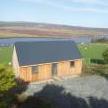
That house design seems like a good starting point for a budget build. It's nearly square, and it doesn't have any costly features like stairs, dormers, bay windows, or a chimney. You might find it useful to pick up a copy of 'The Housebuilder's Bible'. I'm not sure how up to date the current version is, but the one I used was pretty no nonsense. Just for reference, the house I built (see profile pic) cost me £40k. That's the full build minus land. It's small (50m²) and was built between 2015-2018, so pre inflation. In your position, I would look to play to your strengths. Are you handy with woodwork, or can you lay blocks? Do you have friends or family with skills, who would do you a favour? The various build methods and materials all have pros and cons. I found that timber frame with timber cladding and a sheet steel roof was very cost effective and DIY friendly. Good luck 🙂
-
Examples of Building Warrant drawings?
Crofter replied to Crofter's topic in General Self Build & DIY Discussion
Thanks, that's really helpful. The last build we did (see my profile pic) was exempt from building regs. I'm just starting to get a feel for how what I missed out on last time Next time round we want to go slightly bigger and with an upstairs, so the regs exempt route won't work for us. We'll get our VAT back which should help offset some of the higher costs though. -
Self build house - is MVHR worth cost?
Crofter replied to Wadrian's topic in Mechanical Ventilation with Heat Recovery (MVHR)
On my very small (43m² internal) house I spent about £700 on the smallest MVHR I could find. It's just got one supply, in the open plan kitchen/diner, and one extract, in the bathroom. It's absolutely been worth it. Even when the house is empty for a few days and the temperature drops, it remains completely free of damp, and feels very comfortable and pleasant. There's never any dust anywhere. Couldn't imagine building a new house and not fitting MVHR. -
Examples of Building Warrant drawings?
Crofter posted a topic in General Self Build & DIY Discussion
I'm sure everybody on here has, like me, spent hours poring over other people's planning applications and drawing inspiration from them. Building warrant drawings don't appear to be in the public domain though. It would be really helpful to see how certain details are laid out, especially with low energy building methods. I presume these drawings are copyright to the people who drew them up and only made available to the customer and the relevant bodies. Any suggestions? I'm not even looking for specific details at this stage, but I'd like to see a building warrant application to see what's actually expected.

