


Crofter
-
Posts
3484 -
Joined
-
Last visited
-
Days Won
11
Everything posted by Crofter
-
Wouldn't there be a risk in using somebody outside the UK, that they are not familiar with the relevant regs?
-
New Build In Scotland & totally confused on building control
Crofter replied to Andrew Jones's topic in Scotland
Well firstly, you may already be aware that planning and building control are separate. Sorry if this is all stuff you already know. The planners want to know what the building will look like and what it will be used for. It's all about the impact on the surroundings. So appearance, number of bedrooms, etc. Building control want to know the technical details of how it's actually constructed, to make sure that it won't fall down or fail to meet standards on things like disabled access and energy efficiency. The idea is to ensure that the supply of housing is off suitable standard, seeing as most houses will outlive the people who build them. -
I screwed all my battens. I like to know that I've actually hit the stud/rafter which I found impossible to tell with a nail gun. Long screws can be pricey, I watched the specials on Screwfix/Toolstation for weeks and managed to pick up some bargains. Note- I was exempt from building regs so I don't know if my approach would pass muster with a BCO.
-
I had to add some temporary support to my wool when installing from below. I had a big roll of polythene warning tape left over from doing the electrical supply, so just used a staple gun to tack on a couple of runs of that. It might confuse and alarm anybody who ever has to open up the roof in the future I suppose 😂
-
@Rishardare you going to build that from the top down? I e. osb on the inside, and then add the insulation layers from the top? My roof was osb sarking outside with breather felt, then wool between rafters installed from underneath (fun! Somebody needs to invent lighter than air mineral wool!), then 100mm PIR boards forming a complete layer on the inside, and VCL after that. I was mostly working on my own and adding the wool and VCL was one of the worst bits of the whole build. If I'd have been braver I'd have installed the wool from above but I wasn't certain I could get it done quickly enough to do it in dry weather.
-
First sketch of new house project
Crofter replied to Crofter's topic in New House & Self Build Design
Thanks. So, could that be MOE windows? -
First sketch of new house project
Crofter replied to Crofter's topic in New House & Self Build Design
Just revisiting this point. I'm not sure this is a BR requirement. Do you know otherwise? -
Upstairs, there's a lot of space given over to the hallway. Mostly in order to access that bottom left bedroom. Maybe that's a feature you want but it might be possible to tinker with things to make a more efficient use of space.
-
I don't have anything against the house itself tbh, I'm just curious about the legalities of building something like that.
-
I heard one of the finalists was in my neck of the woods (Skye) so I looked it up on iPlayer: https://www.bbc.co.uk/iplayer/episode/m002ckqg/scotlands-home-of-the-year-series-7-5-highlands-and-islands What I'm wondering about is what regs this building has to comply with. Does it really comply with normal building regs? No downstairs bedroom, no balustrade on the stairs, I'm sure there are other issues. However it doesn't comply with the caravan/portable definition either, because that would force a 10ft ceiling height limit. I suppose there is 'hutting', but again it doesn't comply because it's a permanent residence. Thoughts?
-
Galvanised gutter with timber cladding
Crofter replied to bluebellcottage's topic in Rainwater, Guttering & SuDS
I spent a total of about £200 on the guttering on the cottage. Childsplay to install. It's been up about eight years now and I can't detect any fading. I suppose it will eventually succumb to UV damage. But then again I'm the sort of person who buys all my kitchen appliances secondhand... -
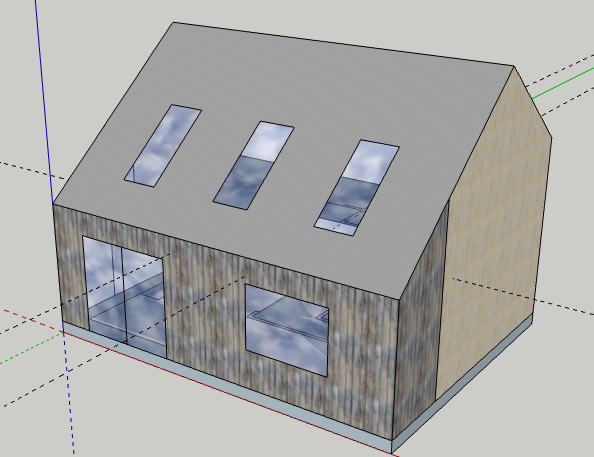
In order to create two different colours on the walls, we're going to use larch plus another lighter coloured material. In the attached sketch, I'm talking about the light brown section of the wall (I was just using the closest approximation I could find in SketchUp) At the moment I'm penciling in corrugated steel, because I've worked with it before and it's easy, cheap, and durable. I am a tiny bit concerned that a white or cream colour (which is what we want, and will likely be required by planning anyway) will show up every last speck of rust. Not that we expect that to be a significant problem as the plastic coated galv stuff has something like a 20yr guarantee. SWMBO isn't sold on the idea, she is fine using it for the roof but not convinced about using it on walls. What other options are out there? Essentially we want it to look like white painted rendered blockwork from a distance. So smooth and white is the goal. I don't really want to use blockwork as I'll be doing all the labour myself and I'm a pretty slow brickie. It just seems like a lot of work and cost for what is in effect a rain screen. @ProDaveused some form of rigid insulation board as his cladding, that sounds interesting. Another option might include fibre cement. Budget is pretty limited... last time I checked, corrugated steel was about £10/m² so I'm going to need some persuasion to spend too much on this...
-
Galvanised gutter with timber cladding
Crofter replied to bluebellcottage's topic in Rainwater, Guttering & SuDS
Can somebody explain to me why you would use anything other than plastic? It's cheap, it's easy, it's idiot proof. Agree on the point made above about galv nails in larch- I've seen this a few times and it looks awful. Stainless all the way. -
First sketch of new house project
Crofter replied to Crofter's topic in New House & Self Build Design
Thanks! Forgot about that. I had a play around with OnShape before I managed to get SketchUp to run, and I've thing I liked about it was the dimensions automatically appear on your drawings. So I might use that for floorplans. -
First sketch of new house project
Crofter replied to Crofter's topic in New House & Self Build Design
I thought it was a BR rule that you must have a downstairs bedroom, plus a non en-suite downstairs WC. I'm a bit rusty on all these requirements though, and will need to refamiliarise myself with them. But yes this is likely to be where we end up in our dotage, although that's a pretty long way away (we're still in our early/mid 40s). I expect that we may end up making the house a little bigger, this is very much an exercise in minimum viable product design. The master bedroom at the top of the stairs is, as drawn, only 3.1 x 4.3m, with partial coombed ceiling. The other bedrooms aren't even that big. Both the WC and upstairs bath/shower room are pretty pokey. I have used a 450mm external wall thickness for now so it's possible that I can slim that down a little when I start getting in to the details of the buildup and u values. -
First sketch of new house project
Crofter replied to Crofter's topic in New House & Self Build Design
Is this a hard and fast rule? A fire safety thing maybe? Or is it more about cooking smells etc? In practise, you'd come and go from the back door, at the kitchen. But it would be easy enough to have a patio door in the front of the house too. In fact I've indicated that in the sketch. Good spot. So we'll need that patio door. The WC needs to retain the option of becoming a jack and Jill with the downstairs bedroom, and will also need to have the option of adding a shower. I think that whole space (under the stairs, between the bedroom and kitchen) has lots of room for optimisation. AFAIK there's no actual rule against using the WC opening off the kitchen. It doesn't really bother us personally, we're used to living in a small space (we've spent the last 4yrs living on a boat so this house is going to feel palatial). Thanks for the feedback, appreciate it 👍 -
First sketch of new house project
Crofter replied to Crofter's topic in New House & Self Build Design
For some reason the floor plans have come out at different scales- the length (L-R as viewed) should be the same on both, but the upstairs is more like 9x5m and the downstairs in 9x7m. -
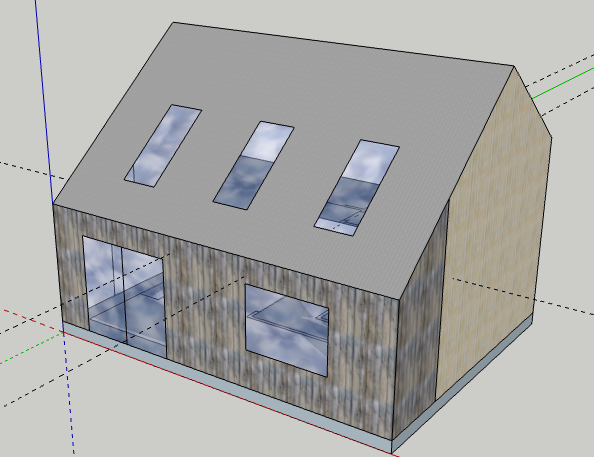
This is very rough. I realised after I had downloaded and cropped the pictures that I'd not left enough space for a door at the bottom of the staircase into bed 1. Oops. Basic outline: 9x7m footprint, with an asymmetric pitched roof. Roof will be corrugated steel, slate blue. Walls will be mostly cream or off-white corrugated steel (I like the stuff, OK) and the front section will be larch, board on board. Some rooms upstairs, with some vaulted space at the front. Not shown, there will be an extensive car port out the back, with most utility room functions housed there in a small separate building. This will have PV panels as its roof. I've only shown a few windows on the front elevation. There will of course be other windows, tbd. For context, the site is a fairly steep east facing slope. The east/front (larch clad) elevation has the sea view. There is a neighbour close by on the south side. Site will have to be dug back in to the hill a bit, so the car port will go in that sheltered area at the back of the house. Any feedback welcome!
.png.404d71e6f5ef9de9692aa0f380192af1.png)
.png.bc644fb1726bc662b5895cc6b31c297e.png)
.png.3c824e527296935be8f6f763b659f928.png)
-
Quick online quotes for pitched roof windows?
Crofter replied to Crofter's topic in Windows & Glazing
It's relatively economical to obtain big sealed glazing units. E.g. a 3G unit 900x2200 is under £350, with a claimed Ug of 0.7. I'm hoping to find a company that can produce fixed roof lights using this sort of unit, without the cost getting out of hand. -
Quick online quotes for pitched roof windows?
Crofter replied to Crofter's topic in Windows & Glazing
Fairly limited selection there from what I can see. Do you happen to know offhand how big you can go with a basic non opening roof window, before prices go silly? -
Quick online quotes for pitched roof windows?
Crofter replied to Crofter's topic in Windows & Glazing
Vaulted celling. I'm just doing preliminary sketches at the moment but it would be nice to know what the size limits are on readily available units. -
I gave a go-to website for standard uPVC windows and doors where I can easily and quickly check the cost of a basic 3G unit. They don't supply Velux type units for pitched roofs though. Any suggestions? I'm looking for cheap and cheerful, not high end stuff. At this stage this is just for quick cost estimates and as a check on what is actually available- no point designing my new house around window sizes that aren't actually available to buy.
-
The current sketches are for a box 9x7m, with an asymmetric pitched roof. It's a fairly straightforward shape really. I'll stick some pictures up once I've tweaked a few details in my SketchUp model.
-
I had a go with Onshape, but it was a bit frustrating. It looks like a good product if you invest the time. However after a bit of googling I discovered that a common problem running the web version of SketchUp is that it won't work unless you have at least 4Gb of free space on your HDD. I deleted a few things and voila, back in business! First draft of my new house project incoming...
-
Or in my case, just materials and tools. I never employed a joiner last time and I don't expect to this time either. This is what I'm concerned about. Last time, being exempt from regs, I could just build it the way I thought would work best. I already had a fair amount of knowledge about TF design and just applied those principles, but there weren't a lot of calculations involved. It was a very small house (50m² footprint) and I used 6*2 studs and rafters primarily for insulation depth so I was confident that it was plenty strong enough. We have a local guy who I've already approached, and he had a good reputation, but he says he's moving away next year and my project might not go fast enough for him.

.png.404d71e6f5ef9de9692aa0f380192af1.png)
.png.bc644fb1726bc662b5895cc6b31c297e.png)
.png.3c824e527296935be8f6f763b659f928.png)
