SilverShadow
-
Posts
185 -
Joined
-
Last visited
Everything posted by SilverShadow
-
Thanks for the heads up 😀 Those look like they could do the job, so I'll see if I can find some find mesh to fit inside 👍
-
Natural wood after stripping off gloss paint
SilverShadow replied to SilverShadow's topic in Decorating
Thanks for the replies 😉 I shall consider the solvent option, but was concerned about the H&S aspect. Looks like it's best to do with protective gear & not hungover 😉 I'll have a look for nitro mors, but did see this peelaway as a potential one? https://www.peelaway.co.uk/130/1868/peelaway-1 -
Hey all, A quick post from me to all you DIY gurus out there 😉 We're looking to strip our landing banister of several layers of old gloss. We were wondering if: a) a heat gun would be the easiest route to remove the bulk of gloss? b) when removed do we need to treat the wood before applying a wax or stain? c) any other problems or concerns when removing gloss to leave a natural wood finish? Many thanks for your time Shadow
-
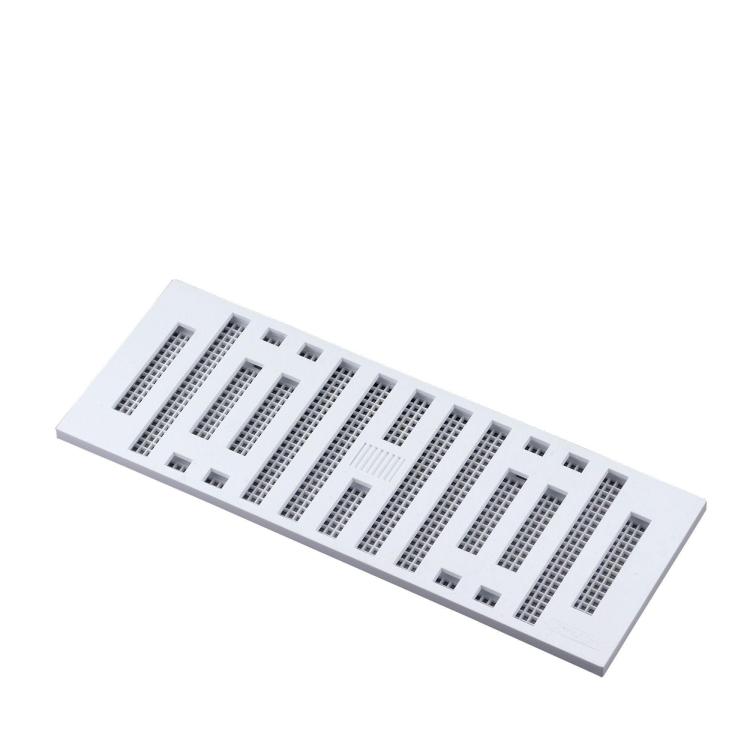
Hey there, Just a quick bit of advice from you gurus please 😀 I'm in the process of doing a bit of light renovation around the house, and was wondering if anyone knew whether I could buy this sort of air vent with a metal finish? Hoping to get something in brushed steel, identical to this (vent & mesh) Does anyone know of some good brands/suppliers to try please? in addition, it looks like these are simple pull/push fit, as there are no screws I can see. Is that correct? many thanks for your time 😀 Shadow
-
Which method of drains rectification?
SilverShadow replied to SilverShadow's topic in Waste & Sewerage
Thanks for the suggestions guys. In the end we opted not to go ahead with the house purchase & won't need to worry about it Have a great Xmas all 😁 -
Which method of drains rectification?
SilverShadow replied to SilverShadow's topic in Waste & Sewerage
I did see Homeserve do something similar. Just wasn't sure if it includes waste drains outside the property -
Which method of drains rectification?
SilverShadow replied to SilverShadow's topic in Waste & Sewerage
Thanks again MarkC for your sound advice 😁 May I ask, what the £800-1000 estimate represents please? (a small length, 7m, or the full length 14m) -
Which method of drains rectification?
SilverShadow replied to SilverShadow's topic in Waste & Sewerage
Cheers Dave 👍 we're hoping not to exceed the £2-3k mark, to get the 14m drains replaced Depth of the pipe is up to 1.1m, if that makes a difference, as to whether to go via excavation/ trenchless 🤷♂️ Our approach may depend on whether we have to rip the porch down tbh -
Which method of drains rectification?
SilverShadow replied to SilverShadow's topic in Waste & Sewerage
Thanks MarkC - appreciate it's hard to know without seeing it 1st hand Tbh, I think we'll have to excavate around the connections, regardless of resolution. What would be your 'gut instinct' as regards very approx price? I'd read online, that moling might be possibly £800-£1200, for this sort of job? 🤷♂️ Would that be for drag buster or full excavation? -
Hi there, Here to gather valuable insights from you gurus & those 'in the know' 😁 A CCTV survey has shown the 110mm clay waste drain (running adjacent to the house) has failed at several areas along it's 14m length between manholes (offset joints, up to 1x pipe diameter thickness). The drain is private, 7m of which lies under a concrete pathway, upon which is also a 2m side-porch. It has 2 pipes joining for kitchen/bathroom drainage (under concrete path) Seems like there are a number of options available: • Replace: excavate & re-lay • Repair: drain sleeve lining patch • Replace: trenchless (eg: moling, pipe bursting) • any other suggestions Ideally prefer not to rip up the concrete pathway / porch, unless the costs & merits of doing it really make sense Does anyone have any clues as to cost £/metre, which would give the greatest longevity? I'd love to know your thoughts / experiences / costs for trenchless work, as this seems least intrusive (unless it costs a bomb) Many thanks
-
General structural advice needed please
SilverShadow replied to SilverShadow's topic in General Structural Issues
Absolutely understand and many thanks. Tbh, a chat with their technical team will probably be a good start. Depending on their answer will see where we go. But sales team alone will not cut it for us -
General structural advice needed please
SilverShadow replied to SilverShadow's topic in General Structural Issues
Thanks for the great insights As I understand (from theirs and other websites) they drill boreholes several metres down, at regular intervals (1 metre apart is the norm). Then with a long nozzle they pump the resin at high pressure, which seeps through the soil filling gaps. Once inside the resin permeates the soil, expands and sets. The resin itself (I think I read) is hydrophobic (if that's the correct term?), so all treated ground isn't liable to heave or shrinkage. I share your concern about what happens to the soil underneath, but the company we found have approval by the BBA regarding treating clay soil with resin injection https://www.bbacerts.co.uk/ On an earlier post I uploaded their report, endorsing this company for such work. So I'm hoping it's fairly legit & above board 🤷♂️ -
General structural advice needed please
SilverShadow replied to SilverShadow's topic in General Structural Issues
Hey again, Sorry for another post - I don't seem able to keep off this thread! May I ask: in order to ensure the foundation method is suitable & all work compliant, what would the recommended process be for selection & any sign off of work? (I'm thinking in terms of having the right paperwork & assurances to reduce insurance snags or resale worries) Can we just go to a reputable structural foundation company and say 'fix it' & use their surveyors/engineers, or does it really need additional SE to dictate the approach, oversee/review the work for full assurances? Such a huge minefield....🤔 -
General structural advice needed please
SilverShadow replied to SilverShadow's topic in General Structural Issues
Hey Dave - what do you think the mini piling figures should be? And do you think the others seem fairly accurate? -
General structural advice needed please
SilverShadow replied to SilverShadow's topic in General Structural Issues
I have seen this approximate guide - not entirely sure, but i think the sidewall is probably 7m long, so likely to be around £15k for 1 wall.... Although saying that, at £1200/m2, kinda implies they will go 1-2m further than the wall itself? (it's the only way i can fathom £10.8k for a 5m wall 🤔)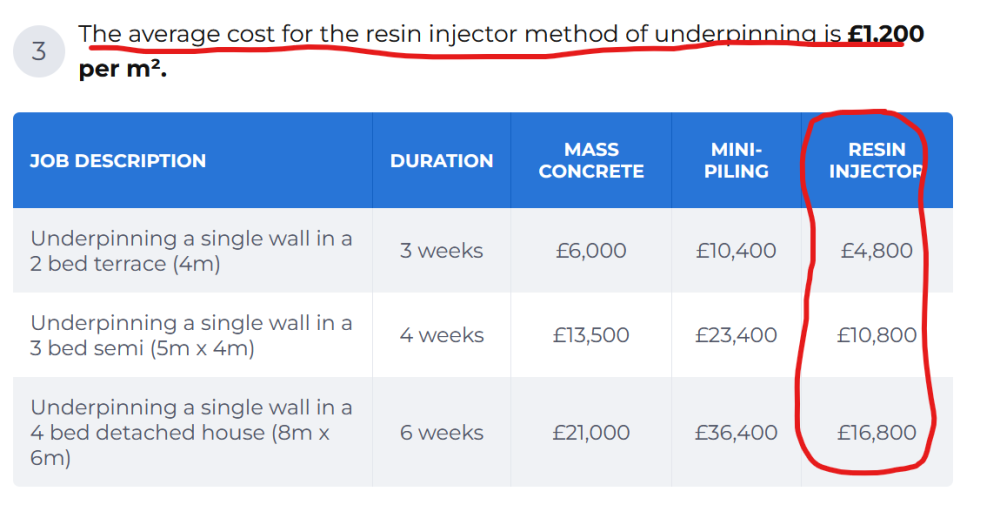
-
General structural advice needed please
SilverShadow replied to SilverShadow's topic in General Structural Issues
Thanks again guys for your insightful advice To summise - as the house is a 1930's semi detached with shallow foundations on a hill in a clay-soil area, it is likely to be suffering from seasonal swell/shrinkage of the soil. The main issues of concern are adjacent to broken waste/rainwater drains running along the side of the house (perhaps this is causing 'heave' in the clay and actually lifting the house rather than erosion?) The SE report indicated the house is structurally sound, and that the foundation cracking/concerns are likely to be a mixture of thermal movement, settlement, and the broken drains leaking water in the surrounding ground Last evening, i read an article with concerns about the effectiveness of using resin injection on clay with shallow foundations, so it does sound like it is an unsuitable remedy. Likewise the BBA published a paper outlining how resin injection can be suitably used on reactive soils like clay (so i'd expect their opinion to have some gravitas). So it seems there are contradicting verdicts So it seems like resin injection may work on clay soils or shallow foundations, but the question i have is 'will it work on both clay AND shallow foundations?' I guess i'll need a SE to analyse the problem, so we can glean advice on the method of underpinning suitable. If we owned the house it'd be different, but as we're buying one i not sure we have the time/money/inclination to do this Thanks again for all your help, and do please add more if you can find any insightful info around resin injection (pros & cons, relating to shallow foundations / reactive soil) Mark industry-voice-treatment-of-clay-shrinkage-via-non-disruptive-expansive-geopolymer-injection-final2.pdf -
General structural advice needed please
SilverShadow replied to SilverShadow's topic in General Structural Issues
Thanks for sharing your experience, MarkC - i'm not sure, but definitely something i need to consider. As regards lifespan, from what i gather these resins are guaranteed for 10-20years (depending on manufacturer), and read somewhere they last around 100 years (stability tested up to 60 years). ......according to their blurb, of course! -
General structural advice needed please
SilverShadow replied to SilverShadow's topic in General Structural Issues
Thanks guys - enough food for thought to give me indigestion! All comments are highly valued, and i hope me challenging your opinions is not perceived as undervaluing your experience. I probably haven't articulated my question very well earlier, so it may have come across as 'bias'. What i was really after is: "why not to choose geopolymer/resin injection, based on others experience/knowledge of using it" rather than "Why traditional underpinning is option to choose" Apologies for not making myself clearer earlier.... -
General structural advice needed please
SilverShadow replied to SilverShadow's topic in General Structural Issues
Good question, and i'm only basing on my understanding (though i could probably apply for a salesman job at this rate! 😅) The resin is injected into the ground at high pressure - this seeks out the gaps/fissures in the soil voids and fills up. Once in there the resin expands, effectively lifting the base of the house close to it's original level, and sets solid in a matter of hours. The whole process is meant to take a few days, and by all accounts has been used on a number of commercial applications (motorways, airports, railways, commercial building, judging by their testimonials), and i would imagine in those cases some of those may have unstable ground with minimal foundations. Once raised 'the theory is' the cracks have reduced, but will still need repairing, just like i'd imagine they would with concrete underpinning? 🤷♂️ As i understand, it's well known that concrete underpinning is more expensive, takes longer, more intrusive & can carry a 'resale' stigma according to mortgage providers/estate agents. Apologies guys - i am probably too hung up on this structural option. If it is unfeasible we simply won't purchase the property -
General structural advice needed please
SilverShadow replied to SilverShadow's topic in General Structural Issues
Thanks guys - it is great to gather a consensus of opinions....😉 May i ask, for those with reservations about geopolymer/resin injection, is there anything substantial to base your hesitancy on please? It's not that i doubt per se, but would like to know how a multinational company like this can operate successfully for so many years, if their product is essentially inferior? When i've read several independent articles they all mention this technique as a viable/cheaper alternative to underpinning, so i must be missing something fundamental in terms of why it is a non-starter.... Is there a fundamental flaw in my understanding, or are folks reservations based on it being a relative unknown? 🤔 Apologies for labouring the point - it is the preferred method we'd like to adopt (if we buy the property at all), so wanted to really get into understanding the reasons why this is so unsuitable Thanks all Mark -
General structural advice needed please
SilverShadow replied to SilverShadow's topic in General Structural Issues
Thanks again for your input all 😀 I would perhaps hazard a guess that some folks may not have come across this groundwork technique before, and so rightly cautious as to its suitability? If we go ahead with the purchase I think it'll be the method of choice, as I'd much rather it than digging under the house while propping it up 😬 Many thanks for your time - please feel free to contribute further, as I will keep an eye on the thread a while longer Huge thanks Mark Ps - i'm interested in hearing from anyone who has experienced using geoploymers on their property or commercial buildings, to gather their thoughts -
General structural advice needed please
SilverShadow replied to SilverShadow's topic in General Structural Issues
Our concern is that asking for £75k off, the buyer would probably just go via 'We buy any house'? 🤔 We agreed the price in Aug/Sept, while the market was more buoyant, so thought £37k seemed reasonable, although in hindsight it is probably expensive now (although prices in that area are holding up and typically £40-60k more, for what seem to be houses in better repair). The vendor is keen for a quick sale, due to financial concerns (house unoccupied & paying rent till the sale goes through to provide money for their new house), and so won't spend months trying to have this sorted We have our mortgage secured, as it is small enough to not matter (we have informed them of the potential for this work). Our insurance may well be a concern (we may have to get insurance that doesn't cover subsidence, or pay a premium to include this). Our basis that this resin injection seems to tick the boxes for main concerns regarding resale/insurance, etc (as per bottom of this weblink): https://www.geobear.co.uk/subsidence-repair/ Although that of course doesn't take cost into account. It is my theory that the house is still undergoing movement - perhaps it is the factor of 'taking in more on a second viewing', but i believe some cracks are still opening (there was a 2 month gap between viewings) We love the house & the locality, but the structural aspects & vendor are our main reason for hesitancy. Looking on Rightmove, we know we wouldn't find anything as good in that location for that price Seems like most folks would give this a wide berth, which is probably what we'd have already done, if it weren't for the our love of the property & its situation. Eternally grateful for all your thoughts -
General structural advice needed please
SilverShadow replied to SilverShadow's topic in General Structural Issues
Many thanks again. The vendor did get their insurers to hire a SE company to perform a report, based on a visit. Their report highlighted the following: External: The cracks observed appear to be due to thermal movement, settlement of foundations and potentially defective underground drainage. Kitchen/Bathroom floors (bathroom is above the kitchen): The sloping and uneven floors appears to be due to historic and/or active settlement and timber creep General: The property appears to be structurally stable but is in below average condition Underpinning, Geobear or similar works will be required, if cracks re-appear after helical bar installation. A CCTV is recommended to check the condition of the underground drainage system Sloping/uneven floors can be removed and replaced once any cause of drainage failure/subsidence has been rectified The drain CCTV did identify places where the clay pipes had moved to expose a few clear gaps for water to leech into the soil, so we envisage this will be a main factor, though have no expertise as to how much a leaking drain would feasibly create holes big enough for the foundations to sink. Overall, our budget for shoring up the foundations is around £15-30k(ish), which we'd hope would cover most if not all of the rework along various points of the 8m house sidewall. Our surveyor costed £17k on other items identified in the survey, and as mentioned we've also allocated up to £33k for structural rework, but overall wary of whether a repair budget of £35-50k would typically cover enough to make it viable. We are very much on the fence with the house - it's not a ramshackled heap of bricks by any means & we're not afraid to find problems, but also quite aware it hasn't been 'loved' for many years & appreciate it might need lots of work in several key areas -
General structural advice needed please
SilverShadow replied to SilverShadow's topic in General Structural Issues
Thanks again guys - all very invaluable I feel with Geobear, they are only just coming onto the radar of doing residential properties (normally it is large scale projects). I think many do not recommend them, as they are not well known. But we picked up on it when the vendors SE report mentioned them as an alternative to traditional underpinning (which we are keen to avoid, due to the stigma it carries for buyers). We are hoping the house will hold value though, as subsidence in that region is not mainstream yet not unheard of either However, i think the idea of a SE to either give initial analysis / review and sign off the ground resin/underpinning seems like sound advice. There are long cracks in probably half the rooms in the house (some the length of the ceiling, but most only 1mm or so wide), which i'm convinced are the result of the foundations, rather the roof bowing Here's a bit more of an idea of the cracking we see inside (and we also noted the front upvc door is 'sticking' - another sure sign of subsidence). This pic shows one of the worst plaster surface, and most cracks are around 2mm wide (some slightly smaller, some wider). I've left one encircles in A, so you an see them 1st hand PS - does anyone have any good SE recommendations around East Mids, or know where i can find some (perhaps there is somewhere on here....🤔)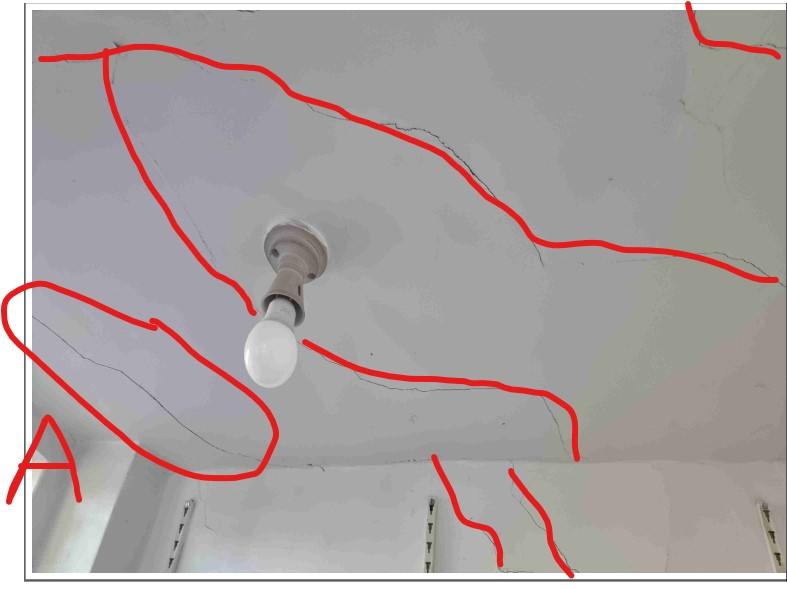
-
General structural advice needed please
SilverShadow replied to SilverShadow's topic in General Structural Issues
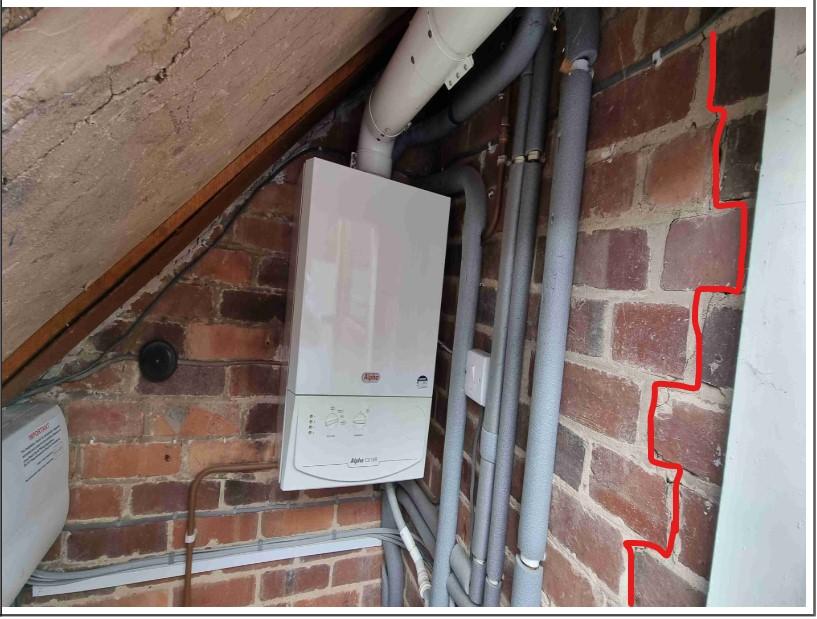
Hey guys - many thanks for your sage suggestions 😁 To clarify a little further - we do envisage this to be a 'do-er upper' project, as it'll hopefully be our forever house. We've negotiated £37k off the original price (and have a total budget of £50k), so hopefully should have enough in reserve to address the main issues. Our survey highlighted around £17k of things to remedy, and we managed a further £20k off, to cover the structural side. The survey report was 100 pages, and although this has the making of a 'money pit' has hopefully identified the lions share of fundamental aspects We opted for the mantra of 'buy the worst house in the best street', as we feel it's the best way to get our dream house for the right price (in the long run) I perhaps described the sewer incorrectly - it is a private (100mm pipe?) drain for waste (sink, toilet, etc), rather than shared, and old clay pipes almost 100 years old. The house is a 1930's 2 storey semi, and most likely has shallower shale foundations, which on a hill is potentially why we see these structural issues. It also explains why there are 4 or 4 failures along a 6 meter strip along the house. The brickwork cracks are about 4 or 5 ft, as shown in the pic below - we are hoping resin injection will help close this and then repoint/helibar to resolve the problem Regarding Geobear - i'm a little surprised more people haven't used a company like this. They seem fairly legit (have good reviews on Trustpilot) & are a multi-national company running for 40 years that undertake many industry/commercial projects (airports, trainlines, etc), so i'd expect the product to be up to the job. The product is designed to last 100 yrs, and guaranteed for 10yrs. We may opt for a private SE to oversee this, but they seem to imply they will take care of everything their side, so wasn't sure if it was extra unnecessary cost. We also weren't sure what we'd need in terms of sign off/assurance to ensure all regs are compliant and we have no insurance/resale issues (should we later move) Out of interest, can anyone recommend a good SE around the East Midlands, and what sort of rate £/day would we expect if we opt to employ one while the work is undertaken? Many thanks again - happy to post more if folks wish Mark