Iceverge
-
Posts
4387 -
Joined
-
Last visited
-
Days Won
31
Everything posted by Iceverge
-

MVHR installers or alternatives?
Iceverge replied to Swampy's topic in Mechanical Ventilation with Heat Recovery (MVHR)
I think Aereco had the original design. As I understood it it's just a strip of nylon that expands and contracts with humidity. 20Pa really isn't that much. 100000Pa is 1 Bar or about 14psi. -
MVHR installers or alternatives?
Iceverge replied to Swampy's topic in Mechanical Ventilation with Heat Recovery (MVHR)
Yes, humidity sensitive vents. https://store.beamcentralsystems.ie/products/dcv-intake-air-valves?srsltid=AfmBOopO9UvLROCeVYnm2p6C6nY5d6-wDWRsDgu2zj1VFhr6o6XYlf0p They're not cheap though and would go a lot of the way towards a full MVHR system. You may find it acceptable with just well set passive vents. You could start there and upgrade them if you found them too drafty. -
Can you get an accurate split for your DHW vs Space heating? What are your motivations, cost or environmental or tinkering?! All are valid but it might help to frame an answer. Have you considered an ASHP to do "baseload" heating and "free" cooling in summer on PV? It might tick all 3 boxes.
-
MVHR installers or alternatives?
Iceverge replied to Swampy's topic in Mechanical Ventilation with Heat Recovery (MVHR)
A point people miss with airtightness is the role it plays in keeping damp air out of your walls and ceilings with the knock on effects of interstatial condensation etc. If you want a durable building you must control the air leakage through the structure. This is of course in addition to it's comfort benefits and energy savings. Regarding ventilation theres essentially only two types. 1. Holes in the wall and hope for the best. Be prepared to be overventilated in gale and underventilate otherwise. 2. Continuous mechanical ventilation, with or without heat recovery. MVHR is the most comfortable, uses least energy. It's not cheaper than other forms once you take filters and servicing into account. PIV,dMEV,MEV,DCV are all the same thing with little nuances. Just sucking or blowing air in/out. All will give you adequate quality air if set it up correctly. Unfortunately unlike MVHR you still need holes in the wall which may be drafty on windy days. @Eastfield have a look on search for @Thedreamer who heats their house with a stove and uses an ESHP for DHW and ventilation. An elegant solution I thought. -
Top class.
-
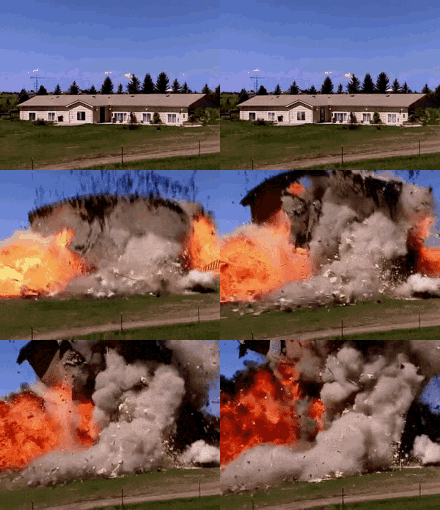
Welcome, welcome. A A 1960's house. May I kindly suggest you make the below alteration to it as a starting point.......
-
HURRAY FOR EPS!!! I'm so glad you avoided PIR in the walls. As a geek I would love some pics of wall insulation and VCL of you get a chance. Also props on the Scooby, a proper car. Towbar and all.
-
Would EWI be an option?
-
I sprayed our house top to bottom with white trade paint after first fix wiring. The only thing I had to mask was the windows and the stairs but that still took ages. I used a hire machine. One tip is to make sure it has a new/serviceable nozzle. The one used wasn't and I had to buy an extra half dozen buckets of paint as it went on too thick.
-
Fitting heavy triple glazed windows safely on new buildings
Iceverge replied to Simmon's topic in Windows & Glazing
I would sit them on a precast sill on the outer leaf. Preferably one with no more than a 25mm upstand for thermal bridging. Plenty of flexible sealant for the brickwork to window connection. Strap and tape the window to the inner leaf for security and efficiency purposes -
Thus far the count is exactly precisely zero since inredid my new build with Hep2O. 4 years is a drop in the ocean though. I'm still living with both excellent and average decisions from 1950-1960 on the farm from my grandfather. I reckon you could plumb a house for 100 years+ if you were clever. Imagine the satisfaction from the afterlife when your great great grandsprog says under his/her/it's/their breath: "Wasn't great old grand Nick a clever C*nt." Floor drains with U bends that take a basin or shower in the side are more robust than airless traps in my opinion. Merry spannering.
-
Can you run the MVHR on supply only. As a kind of PIV with the windows on the latch it'll push lots of dampness outside that way.
-
You're dead right. Loads of manufacturers selectively use data to make their wares appear better. That said this number kept coming up. Egger, Partel, Sign etc all have the same number. My best guess is it's a DIN standard but it's behind a paywall. I didn't tape the staples in our ceiling membranes unless I could see a rip/tear. We blew a 0.31Ach50 so I'm not sure it's 100% needed.
-
As you're DIYing for DHW I would recommend using Hep2O push fit. I thought it was excellent. A radial layout from the tank. 10mm pipe for everything except the showers, bath and kitchen/utility taps. Keep the UVC as close as possible to the kitchen tap. I preheated the hot manifold by convection by positioning it directly above the UVC. I'd have liked to have included a floor drain in every room with a pipe joint or a tap just in case of a leak. Next house.......
-
Sounds like a top spec build. Good luck with it. I think someone here built an MBC twinwall over a basement. The name escapes me. It may be an option for you.
-
That number I used was from Siga's website. I don't think BS defines it unless you have more insight than me? To @Rick734s question. Something like this would be fine. https://insulation4less.co.uk/products/vc2-air-leakage-vapour-control-layer-1-5m-x-50m-75m2-roll To connect the membrane to the brick I would use an airtightsealant. Orcan F is the one that popped up first. https://www.earthwiseconstruction.co.uk/product/airtightness/adhesives-primers/orcon-f-airtight-sealant-adhesive/?attribute_pa_orcon-f-size=310ml-cartridge&gad_source=1&gad_campaignid=21761028231&gbraid=0AAAAADqL4zA7HZs48ZWRJyFGMUuzu-U3k&gclid=CjwKCAiAu67KBhAkEiwAY0jAlZBJ-cvv1xqU3kk-2xm2BrsDsiiC-IiArhamJDFKawbitr-HRg56cRoCRbgQAvD_BwE I would always be in favor of a service cavity to avoid puncturing the airtight layer. If you have enough space 50*50mm battens work nicely for 50mm mineral wool to insulate and boost the U value a bit. Maybe Santa will bring some, I think I can hear him rattling around up on the roof.🎅
-
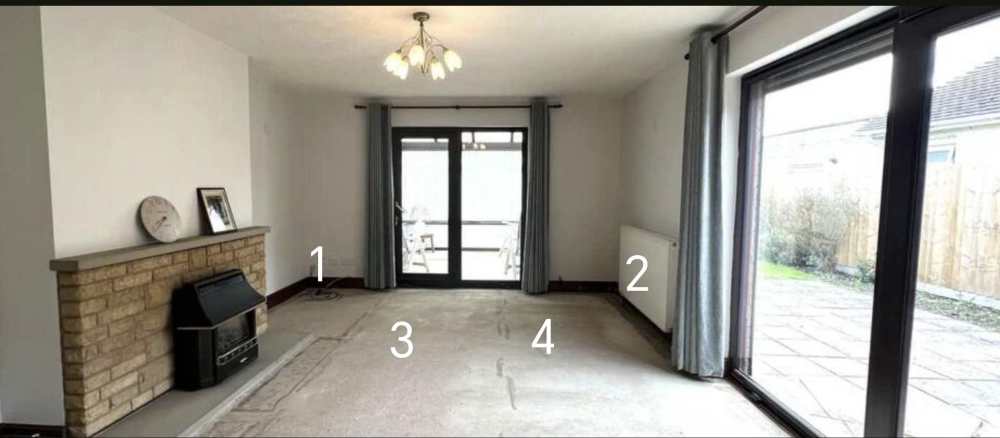
Reflections from the windows ruin many a good TV room. TV needs to be on the same wall as the windows, not opposite. I reckon the top of the TV should be no higher than your head when sitting. TVs above the fireplace are for massicists. The Fireplace will get a bag of logs at Christmas probably and the rest of the time you'll heat the house ussing common sence so I wouldn't compromise the audio visual experience for the sake of moving the sofa once a year. Sofa at 1. TV at 2. Two nice light arm chairs at 3 and 4 that can be turned to watch the TV or spin them around to sit facing the fire
-
TLDR: 1. DRYING MUST EXCEED WETTING 2. Forget about the microscopic holes (diffusion)!!.Worry about the big ones (airtightness) !! 3. Some moisture will always get in, just ensure it can get out again. Low Sd materials are king here. Merry Christmas!
-
Try playing with the numbers, there's always truth there. I'm sure @SteamyTea will concur. All the formulas are online or there's also chatgpt. Take your 11mm OSB. It has an Sd value of 2.5m which is quite vapour open. A house with an internal RH of 60% at 20deg will exert a vapour pressure towards the outside on a winter's day. Assume it's 5deg and 90% outside. Over an hour about 0.18g will diffuse through 1m² into your wall. Now put a 1cm x 1cm hole in the OSB and exert a 50Pa pressure difference on the wall representing a strong breeze blowing on the wall of the house. Over an hour an extra 7g of moisture will end up in the wall. In short a 1cm² hole will loose as much moisture into the structure as 40m² of very vapour open wall on a typical February day.
-
Got it in one. In layman's terms all that matters is that "drying exceeds wetting". Vapour barriers will in theory have less diffused moisture making its way into a structure than Vapour control layers. However they have such terrible drying qualities that in practice the trade off is they result in wetter walls than VCLs. In any case moisture diffusion is the hill that too many people die on unnecessarily. Holes in imperfect airtight layers are massively more significant. Often carrying hundreds if not thousands of times more moisture into a structure.
-
Sd value above 100m is a barrier. Barrier will be worse. It won't allow construction moisture to dry back to the inside. In practice there will be holes and imperfect sealing of any membrane. Any moisture ingress will dry over time through a lower Sd material and won't through a Vapour Barrier.
-
It's gaping air leaks to worry about not diffusion. OSB will be adequate for your purposes if you tape it diligently, however a vcl may be faster. Beware the difference between a vapour barrier and a vapour control layer. With a barrier you'll always run a higher risk of Interstatial condensation.
-
Hi everyone! Planning a bungalow conversion near Guildford area
Iceverge replied to Bob88's topic in Introduce Yourself
Marvellous. The most important thing when renovating an old bungalow is to immediately bulldoze it. -
Looks like the party is over....
Iceverge replied to Beelbeebub's topic in Air Source Heat Pumps (ASHP)
My day job isn't climbing scaffold or screeding concrete so barring any disastrous health problems I expect I could do it until at least then. -
Looks like the party is over....
Iceverge replied to Beelbeebub's topic in Air Source Heat Pumps (ASHP)
At brief glance I reckon they're inline with most other European economies? Exemptions being the Nordics with good hydro and nuclear and Hungary and Turkey with government price controls? On the other hand I think private enterprise short termism is a bad fit for vital public services like transport, energy, water etc . The likes of EDF and Thames Water should be trading only in decades long bonds to force them to take a long view rather than normal shares and dividends.