Nick Thomas
-
Posts
383 -
Joined
-
Last visited
Everything posted by Nick Thomas
-
@marvin from the detail in your post, i'm perfectly happy to put you in the "rich" category. You're welcome to fill in https://ifs.org.uk/tools_and_resources/where_do_you_fit_in (and an equivalent for household wealth if needed) if you disagree. Curious how blind people can be to their own financial position. If you're spending, I dunno, 8K on solar and 10-50K on an EV, the chances of an extra £300 in admin fees dissuading you from going ahead on those purchases are basically nil.
-
Almost nobody installs solar. It's something like 2% of domestic households - and almost invariably the richer ones. I've not looked it up, but I imagine very few of those who do install solar need or want more than you can sensibly put onto a 3.6kW inverter (say, up to 6kWp of panels). So almost everyone who does, or might want to, is well served by the free G98 process. The "deterrent" effect of a £300 fee to the thin slice of rich households that do want it can best be described as insignificant.
-

Insulate internal door *and* put a cat door in?
Nick Thomas replied to Garald's topic in Doors & Door Frames
https://www.thepetflap.com/passivhaus-pet-door/ -
OSB with formaldehyde or Sterling board without?
Nick Thomas replied to Warrentdo's topic in Building Materials
I paid extra for the non-formaldehyde boards when boarding my loft (cold roof, that one). Logic at the time was that even if I'm not up there much, I'd be cutting and fiddling around with the boards plenty during the installation. Still, it's probably mostly marketing. -
Changing inverter - implications for MCS and G98?
Nick Thomas replied to Nick Thomas's topic in Photovoltaics (PV)
Weirdly, looking at the MCS certificate my, uh, friend, has, it lists each individual roof hook and panel, but doesn't list the inverter explicitly. It does say that the "total installed generation capacity" is 3kW, though, despite listing 3.6kW of panels. -
Let's say someone had, uh, theoretically, changed from a 3kW inverter to a 3.6kW inverter. The initial install was all MCS certified (so good for getting paid for export), properly notified to the DNO via a G98, etc, etc. Does swapping out the inverter invalidate the MCS certificate? Does a new G98 need to be made? *cough* asking for a friend, obvs *cough*. And to extend into a hypothetical theoretical future, how about adding another 2.4kW of solar panels to the inverter later? Does that have any MCS implications? (I'm sure it wouldn't affect the G98, as it's all DC-side)
-
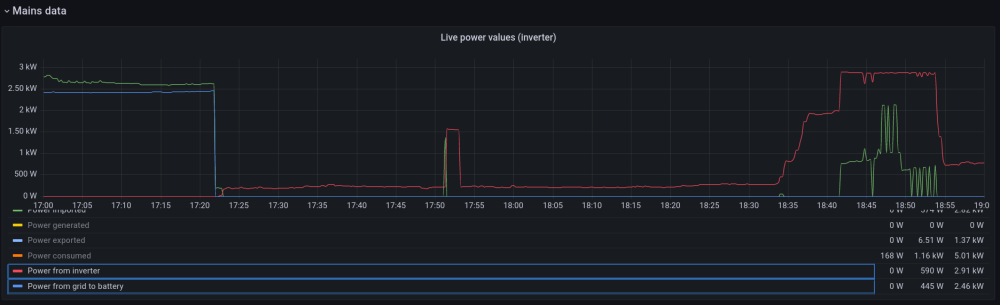
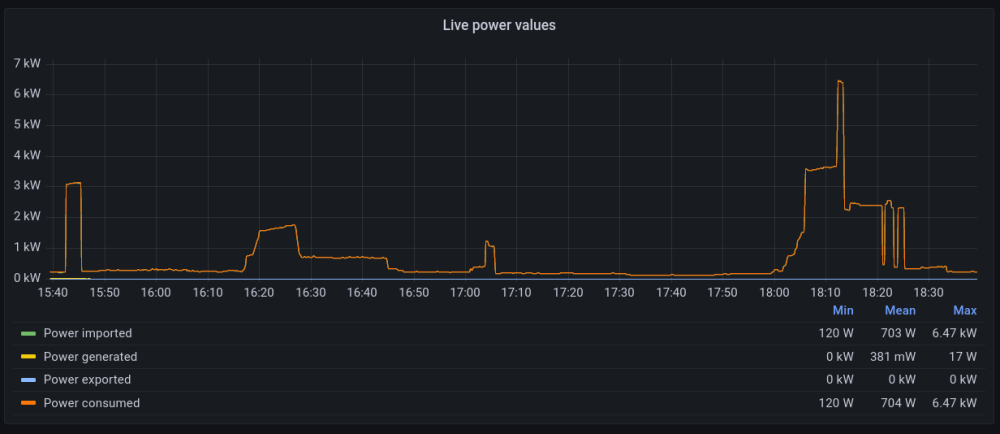
Yeah, I'm keeping up with it myself. They're starting to come thick and fast now - another one today, wonder if they'll become a near-daily occurrence. Between the second and third sessions, I got a 3.2kWh battery installed, so the third looked like... Charged it up to 100% from the mains just before, let it discharge back down to 50% from there (I'm keeping half of it back in case of power cuts). That one import spike was microwaving the baby's dinner - I guess the inverter couldn't respond quite fast enough. It does have a setting for faster responses, but I'm a bit leery of fiddling with it. So, whatever the baseline is, I'll have achieved a 99% reduction. I'd turned the heat pump off but left everything else untouched; thermostat dropped from 20°C to 19.5°C. I might just leave it on for today's session, see how the battery manages. 1.6kWh is plenty for us to coast for an hour.
-
I think they're interested in what the inverter is capable of, rather than what it's configured to do, but I'm not certain. There's also a G100 scheme which is about capped export, but I've never had occasion to dig into it.
-
The new dryers with built-in heat pump are pretty efficient; https://www.energy-stats.uk/are-heat-pump-tumble-dryers-cheaper-to-run/ measured 0.78kWh for a load of washing. They're still loud, though, and need to be kept somewhere relatively warm, or they get damaged. We've moved ours from garage to kitchen this week and it's pretty annoying. Dehumidifiers aren't exactly silent either, though.
-
Anything grid-connected above 3.6kW requires a G99 application: https://connections.nationalgrid.co.uk/g99-connection-procedures . It costs to apply, and they may just say no.
-
Does anybody remember the game SimCity2000?
Nick Thomas replied to Adsibob's topic in General Alternative Energy Issues
.cn is working on this too: https://www.globaltimes.cn/page/202206/1268326.shtml . LEO test in 2028 if all goes well. -
It does, but today was 7°C outside so I don't think it was on. Peaks at ~200W when it is on. There's also a "keep the circulating water above freezing" mode that I *hope* is turned off, because we've got antifreeze in the circuit. I'll just turn the heat pump off half an hour early next time.
-
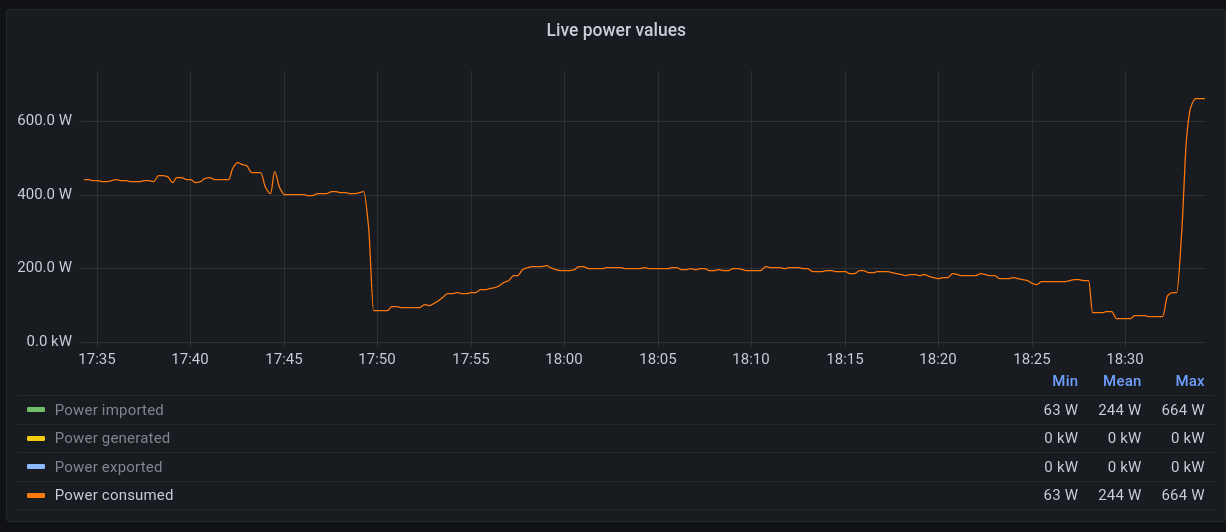
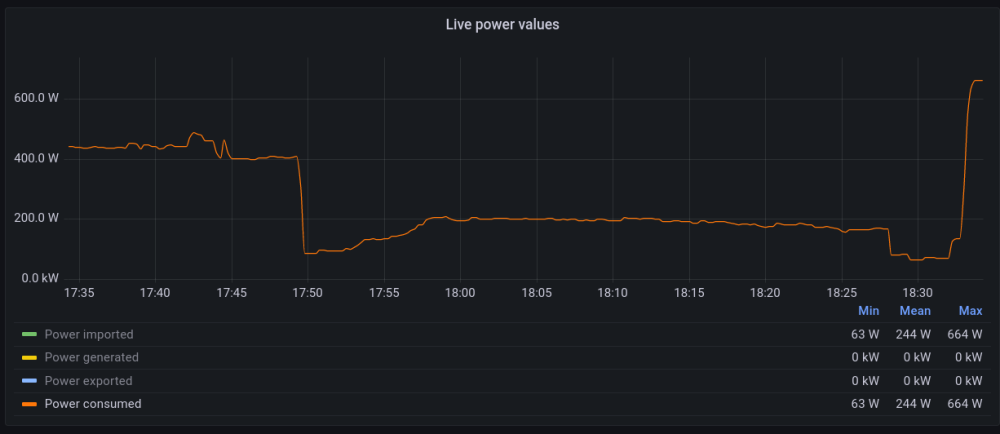
Power use was pretty stubborn this time: I just couldn't get that 400W to go away. The heat pump was silent, but I suspect it was using the power somehow - if not, then the fridge-freezer has to take the blame. Curiously resistant to flicking the power on either of them to check. The heat pump has been working over the past week - we even had a 3°C day - and I usually cook 6-6:30ish but refrained today, so the baseline may be more attractive than the previous session. New door is in, and I think it did make a difference to heat loss from the thermostat's point of view, but now I've got a million other tiny air leaks to track down 😅. Managed to get the TV off this time as well, and it was nice to sit and play with the baby for an hour without cbeebies droning on in the background.
-
We always bought from firewoodcentre.co.uk - they always forgot to charge extra for delivery - but they seem to have put their prices up and run out of stock for now.
-
I prefer the kiln-dried logs, but I'd probably be buying the heat logs. The savings were pretty hard to argue with ^^. If it's occasional burning for pleasure, rather than your sole source of heating, the kiln-dried are definitely the way to go - they burn a lot prettier.
-
We tried these, kiln-dried logs, and peat, at our house up in Shetland (the wood stove was our only source of heat for several years). The heat logs did work out to be more heat for less money than the kiln-dried logs, but they were quite messy to store and handle. They break apart into small disks with a lot of dust if treated with any kind of force. They also suck up humidity and go banana-shaped, before again breaking up into those small disks, if you leave them outside of their plastic coating for more than a few days. We were paying ~36p/kg for the heat logs, and maybe double that for the kiln-dried logs, but we were buying by the tonne. The peat was a local thing, with hindsight I wouldn't have used it.
-
Eight octopoints to the penny, 12 pennies to the shilling, 20 shillings to the pound. 21 to a guinea, obvs.
-
Better than I thought, anyway: It'll all go towards paying for the battery.

-
In this case, ~200K people with octopus, plus however many with the other suppliers. Call it a million, tentatively. If they average a turndown of 1kW each, it means 1GW of plant can be left off, which isn't bad considering total generation right now is 39GW. Even half of that is not to be sneezed at. I just think the incentives are skewiff. Rewarding the most gluttonous for being slightly less gluttonous on occasion is... not ideal.
-
House temperature dropped by <0.2°C if the thermostat is to be believed, we do get some losses through draughts. It might have been vaguely uncomfortable if the session had been 3 hours long. Replacement front door will hopefully help with that, it's coming thu//fri.
-
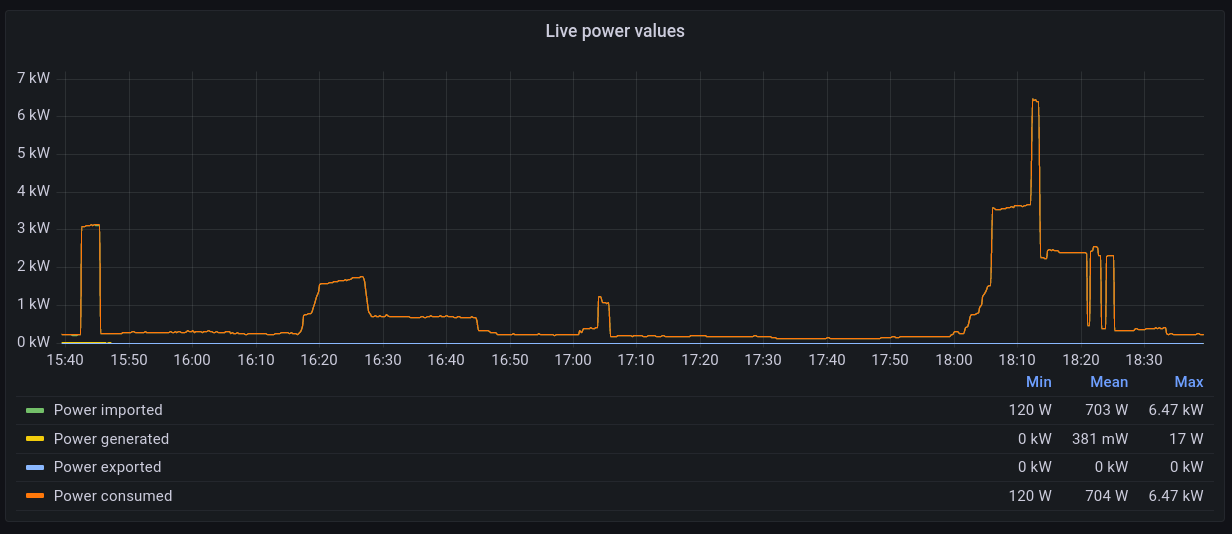
~120-180W throughout, except for that bit where I came downstairs to turn off the heat pump and discovered the toaster was on. Left the TV alone but did turn off the mains to the laptops and made do with a single screen for the final hour of work, which got me 30W or so. Had no interest in turning off the fridge or the vampire loads. Will see what octopus makes of it within a few days, I suppose.
-
Same here, my weekdays for that period are ~0.1-0.5kWh. Then there's the bonus for being a TOP SAVER and the PRIZE DRAW to be allocated randomly. Sigh. I've signed up for it anyway, but the only special effort I'll make is to turn off the heat pump for the period. Won't make a huge difference.
-
Heat Pump vs Gas Boiler: Relative Climate Impact
Nick Thomas replied to Green Power's topic in Air Source Heat Pumps (ASHP)
No. Table 5 shows what the insulation measures achieve by themselves; the final column tells us what percentage of houses still need a heat pump with > 1kW input to meet space heating needs after the measure is applied (DHW is excluded throughout). The UK's existing housing stock is *so bad* that a ~60-80% reduction through adding insulation really isn't all that incredible. No particular reason not to do both the refit *and* the heat pump, of course. They compose very nicely. -
I had a... 350W Herschel 'Select' FIR panel above the bed in the last house, which was basically the only heating at night until we got the A2A heat pump installed (never fancied keeping the stove going overnight). You could definitely tell when it was on, as long as the covers were pulled back, but it was a bit underwhelming overall. Also seemed to generate a lot of heat at roof level that *wasn't* directed downwards.
-
Heat Pump vs Gas Boiler: Relative Climate Impact
Nick Thomas replied to Green Power's topic in Air Source Heat Pumps (ASHP)
https://journals.sagepub.com/doi/full/10.1177/0143624420975707 > A whole house retrofit in-line with current Building Regulations reduces the heating demand and emissions by 65%, and lowers the input electrical demand for the heat pump to under 1 kW Not bad going, honestly.