


Redbeard
-
Posts
1560 -
Joined
-
Last visited
Everything posted by Redbeard
-
Internal wall insulation upgrade during refurbishment (Part L)
Redbeard replied to Mos's topic in Heat Insulation
Welcome, Until I read your last line I had a couple of thoughts as to what you might do, but the fact that you have already got 37.5mm board on (and for clarification, that's 25mm PIR, isn't it?) could weaken your bargaining position. The one experience I had with trying to argue the 'not-a-15-year payback' thing was that BCO insisted on a SAP assessment which, even 17 years ago, was not cheap. In that particular case it was complicated much further by the SAP assessor managing to 'prove' that it *would* give a 15-year payback (it wouldn't), leaving us with no option but to increase the depth of insulation! As regards the party wall, whether you can make the 'it's free heat from next-door' argument (and whether they can too!) may depend on the BCO's opinion. On the other hand it is not an external wall so I would ask the BCO to point out the specific section of the regs which requires party walls to be insulated as per external walls. As a 'negotiating stance' you may be minded to offer 'cloaking of a potential bridge' by returning the IWI onto the party wall for, say, 1m at each return. That will help your heat-loss a bit. Don't forget to cut back the plasterboard off the external wall IWI otherwise you have just built in another, albeit smaller, thermal bridge. -
EPDM grommets
-
Yes, it probably would - an interesting thought to those who don't want to use trickle vents. More expensive, though, and one more 'moving part' (another - PIV - fan). (And come to think of it, surely one of the 'advantages' suggested for PIV is that you can just sit it in the loft, blow down onto the landing and then it finds the gaps on the gr floor? If you need to duct to dry rooms you may be getting as 'complicated' (in the eye of some 'beholders') as MVHR).
-
Are you sure it is not condensation? Hypothesis: Cold wall, cold (impervious) membrane - condensation on membrane; droplets run down and permeate both the surface of the concrete and 'pool' within the depth of the slab where the membrane has pulled away.
-
+1. I prefer dMEV but some prefer PIV. It is a personal choice. Swot up on the alleged advantages and disadvantages before you commit, and form your judgement based on te best info you can get.
-
Week 18 - Progress on many fronts
Redbeard commented on Benpointer's blog entry in Contemporary build in north Dorset
"Tom from Wessex Metal Roofing came back to fit the down pies" Meat, potato and ...feathers? (Sorry! Couldn't resist it!)- 4 comments
-
- 1
-

-
- insulation
- first fix
- (and 3 more)
-
Wondered about that!
-
Insulation Query for Detached garage Conversion
Redbeard replied to Yorkshireman's topic in Garage & Cellar Conversions
If it's 4 inch you might get a U value of a bit over 0.2W/m2K. I wonder whether you would need to comply with the values in tale 4.2 or 4.3. That governs whether you need 0.3 or 0.18W/m2K. It depends whether it gets classed as improvement of an existing dwelling (it isn't one) or as a 'new fabric element in an existing dwelling' (well, it isn't one of those either!! I'd still go for a 0.18 or better target. It'll cost less to run. You could get the U value down with a little bit of IWI, but consider a condensation risk assessment first. -
What's the price of an extension?
Redbeard replied to luke a157's topic in House Extensions & Conservatories
Can you do some of the work yourself? That's the real thing that helps keep costs down. -
Insulation Query for Detached garage Conversion
Redbeard replied to Yorkshireman's topic in Garage & Cellar Conversions
Do external insulation if you can!! Does mean you have a cavity, or is it just 9" (225mm) brick? If it's cavity then you'd want to fill the cavity first (preferably with graphite EPS beads) before you externally insulated, in case of air movement within the cavity. If doing IWI get an interstitial condensation risk analysis done, and consider breathable materials such as wood-fibre or cork rather than PIR. Crudely, you can insulate externally to about half the U value (twice the insulation) that you'd get ('safely' - from a moisture point of view) with IWI. -
Work to a Perlin roof without notifying us
Redbeard replied to Andy62's topic in Roofing, Tiling & Slating
If you go for retrospective BC approval ('Regularisation', which used to cost 130 or 150% of the normal fee - can't remember which - as a sort of minor 'slap' for not doing it right 1st time) I think 2 Qs might be raised: 1. Is all the additional timberwork structurally sound? (You may need a structural engineer for that) 2. Did the roofer install any insulation at all? Since the 2010 revision of Part L, when insulation upon re-roofing 'became a thing', the 'norm' for areas over sloping ceilings (such as you have at the lower part of your roof) was (assuming 75mm rafters) 25mm vent path under slates/membrane and 50mm PIR friction-fitted between rafters. The gov't Best Practice Guidance (2021 or 2022, I think) now suggests a 50mm ventilation gap, which in the scenario above would give room only for 25mm PIR. As far as I can tell from your posts the roofer may have put in none at all, which is a pity, but on a practical level you might be able to 'offer' silly-deep (400, 500mm-ish) amounts of insulation on the flat ceilings to compensate. -
Apologies! I had my eye off the ball for over a week. @marmic & others' suggestion of Compacfoam with the threshold sat on it is good, and almost exactly what I'll be using in a retrofit context for my external door following EWI.
-
What's the price of an extension?
Redbeard replied to luke a157's topic in House Extensions & Conservatories
I guess the extension is where the drain run is, at present (?). Assume that isn't too much of an issue unless it is shared with next door. I assume also that where the 9m arrow is is your land - to re-run the drain in...(??? ) -
Biggest problem I can see is that for your repair (unless the original contractor has the remnants of the coloured render they used) you could need: 25kg base-coat and a 25 ltr tub of top-coat (and thoretically some primer too!)
-
Hello. End of Terrace Renovation + Extension + Loft Conversion
Redbeard replied to Stupot85's topic in Introduce Yourself
Welcome! How deep are your joists in the loft? I would expect the ground and first floor joists to be 150-175mm, but I would expect those in the loft (supporting only the loft insulation) to be 75mm-ish. If this is the case then your readiness to lose 112.5mm off the FF ceiling height might mean the top of the joists in the loft being pretty well exactly where they were before, not lower, giving you more headroom. *I realise now that I should not really have replied in detail here! (Otherwise 'intro posts' become detailed tech posts!) -
Structural warranty - fire damage
Redbeard replied to A_G_G's topic in New House & Structural Warranties
Is the plan that everything bears onto the original wall, or that the original wall is in effect a 'fancy wrapping' around an entirely new structure? If the latter, then what you are building *is* (arguably) a new-build. You would have to have the ear of someone who is actually interested, though, insofar as the 'outside' of the 'new-build' would not be the actual outside face of the final building. -
Will red flags stop me getting buildings insurance?
Redbeard replied to YorkieSelfBuild's topic in Self Build Insurance
Why not ask the developer if they are aware of insurers used for any other houses on the development (if there are any)? Or if they do not have those details knock on some doors and see what experience other buyers had? -
Work to a Perlin roof without notifying us
Redbeard replied to Andy62's topic in Roofing, Tiling & Slating
No, the 'truss' I meant is 2 to the right - the big timbers bolted at the top of the inverted 'V' -
Work to a Perlin roof without notifying us
Redbeard replied to Andy62's topic in Roofing, Tiling & Slating
Surely, in the end we can see of the 'upward view' it is not fixed to the truss and isn't transferring any load?? Or am I reading it wrongly? How big, out of interest, is the roof (measured on the slopes)? -
Architect won’t sign Completion Notice Form
Redbeard replied to Oceanjules's topic in Building Regulations
Did your planning (note small 'p') include designating duty-holders under the Bldg Regs and Building Safety Act? There should have, AFAIK, been a Principal Designer at the outset and if, at any stage that person withdrew, there should be a trail stating to whom the PD role has been passed. That ('legacy') person is the one to sign off, and the person taking that role has to be able to prove that they have the required experience and competences. -
Any thoughts, anyone?
-
This surely depends on the ground conditions? If it is really firm soil then the soil itself will 'shutter', no? Are you looking to avoid 'boundary creep' (or whatever one might call it)? If so, seems there are 2 options: 1. If it's really firm ground: Dig straight and true. Fill. 2. If it's not firm ground: Set up shuttering (N.B. This could well involved excavation on your side in order to ensure solidity - are you 'geared up' for that?): Fill.
-
I think we need a sketch or drawing, including the insulation detailing in the slab. Assuming the walls to rise from the slab (if not FFL) what stops thermal bridging straight through to the screed, level access or no level access? It sounds as if you need a thermal break, which has not been designed yet. I may have misunderstood, but a pic would be good. Something like Compacfoam (load-bearing insulation) springs to mind, but without a dwg I cannot suggest where or how you place it yet.
-
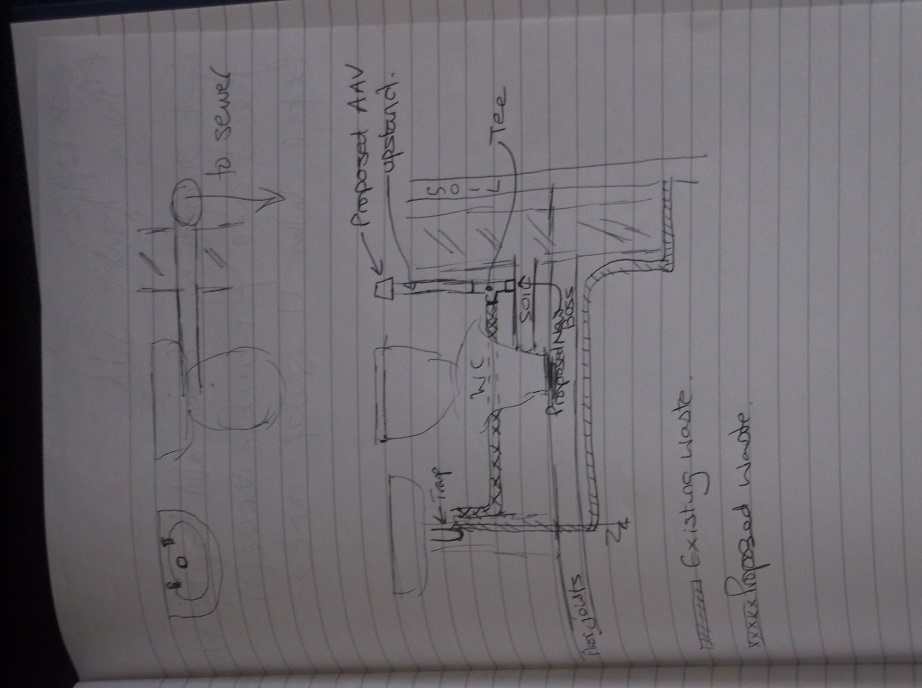
My bathroom wash-hand basin waste (which has worked pretty well for the last 2 years with only the odd ‘plunge’) seems to be air-locking. I have had most of it apart and it all seems clear but once I put it back together again it does not run away. The waste pipe currently runs down through the bathroom floor, horizontally along above a false ceiling in the room below and then down the wall a little further via one ‘down’ and one ‘out’ elbow, to the SVP. I don't really know what the problem is that I'm trying to cure, but I wonder whether I could simplify it by running the waste to the short spur of horizontal soil pipe running from the WC to the SVP In the bathroom. I suspect I would also need an AAV, and if so is that OK to go on a T just before the connection to the horizontal soil pipe? Inept sketch attached. Any advice gratefully received.
-
The (external) doors I want to deal with do not have sufficient clearance to allow me to use self-adhesive D/S, so I need something with a 'ground' which either tack or screws on. I prefer the screw-on variety as they tend to have oval holes, allowing you to 'nip them up' with the d/strip touching the door, then you can tap to adjust of the door is at all bent. Many options come with a brush-pile or semi-rigid rubber d/s. I would prefer something with more 'give' than the hard rubber and less tendency to leak than the brush pile - say quite 'squidgy' silicone 'rubber'. Any suggestions? Thanks in anticipation.