Garald
-
Posts
1113 -
Joined
-
Last visited
Everything posted by Garald
-
From Dr.T.H.G. Megson, in Structural and Stress Analysis (Third Edition), 2014 - looks like fun. The more maths/physics there is, the more readable it will be for me.
-
Very good - recommendations welcome! Assume the reader is a mathematician who remembers some physics and would love to learn some more (the last course I took back in the day was quantum mechanics, which I didn't really learn, but did teach me how important and natural Hilbert spaces, normal operators and spectra really are - lesson to be learned here). I imagine that, for this little project, it will all be timber, with perhaps a few steel components involved at a crucial place or two. > It is very accessible but uses the published tables. Behind it is much more complex maths which you will find if you want, but it is the stuff of academics and not used as everyday. Well, that's likely to be the interesting part, isn't it.
-
This is all good advice. Don't worry, I'll spend my time on my actual job - I think I've already learned enough about insulation thanks to the good people in this forum. At the same time, - there have to be at least mildly interesting mathematics involved in SE (certainly compared to insulation or even the Carnot cycle!) - after all, Euler and one of the Bernoullis were involved. I see this as a bit of a general-culture thing. - I'd like to: * decide which SE to hire, be able to make suggestions before and during the work on the project, etc. * know what to want. A good SE will be able to tell me whether a structure is possible and safe, but will they tell me whether it makes sense to want a certain kind of structure? All my perspective right now comes from what I know about insulation, really basic geometry (keeping a surface small and the volume large), solar exposure, cross-ventilation (note: I don't actually know enough about that - I'd love to learn to model it and gain some intuition), really vague notions of architecture - so it's an unbalanced perspective, in that structural engineering is missing. So, I thought that, while I should obviously focus on my papers and my book (not least because I need to wait a bit to earn the money necessary to change the structure of the roof) I would also learn some of the maths involved. Of course I risk annoying an SE by 'double-guessing', but OTOH I completely agree with your philosophy: > Find and pay for an SE that likes doing the things you are trying to achieve [my emphasis] and my intuition is that a structural engineer that would actually like this project would also be unlikely to dislike working with me in the way sketched above (I'd hope).
-
Sorry, I mistyped. I meant: if the heat-pump installers took apart *the old boiler* themselves (and have RGE certification, which they should have), you get much more in the way of subsidies. No reason not to get 4K+ in free money (a completely justified subsidy if you ask me). Or more like 1.5K if you didn't know that silly rule and somebody else took apart the old boiler (that was my situation; I went through an, um, eventful renovation, initially led by someone who pretended to be an architect but wasn't - not exactly an unknown occurrence in France, as it turns out).
-
Welcome. I replaced an old boiler by a Mitsubishi Zubadan air-water heat pump a year and a half ago. The help of the good people of this forum was invaluable for doing the calculations. I imagine you have radiators rather than under-floor heating? - The key to efficiency is low flow temperature. - I imagine the heat-pump is auto-adaptative? In that case you are best off letting it do its thing rather than dictate strictly what it is supposed to do. Just provide a starting curve in accordance with your calculations. - Old-fashioned thermostatic valves on the radiators are your friends. Remember that the valve in the room you have the (portable?) thermostat in should be fully open. If you plan not to move the thermostat, you could keep it in the naturally coldest room in the house and just install a regular valve there, as opposed to a thermostatic valve; again, keep it fully open. PS. I live in the Paris area. I imagine you had the heat-pump installers take apart the heat-pump themselves? Otherwise you lose most of the installation subsidies. PPS. I'm a semi-newbie, and am very glad to be corrected by experienced people in this forum on anything.
-
Right - I should have no trouble going to the library of the architecture school that is two blocks from my office (in fact I've already been there). I hope they have the right engineering books - otherwise, that's another sign that I should keep the company of civil engineers and not that of architects!
-
To return to my question: J. E. Gordon recommends several books at the end of The New Science of Strong Materials, but he says: "Equally, it is not possible to interpret many of one’s observations without the aid of books and, unfortunately, it is not a subject particularly well served by books which are not excessively specialized and mathematical. However, the following books are open to anybody with a knowledge of elementary algebra." I need the opposite - a couple of books for people who most likely know the maths they will need and find it a natural language. Someone recommended a standard textbook to me (Hibbeler) but, while it seems very accessible, it reminds me of the book I was given to teach ODE to first-year or second-year engineering students twenty years ago - prolix, colorful and more than 900 pages long. (I've also heard it said, fairly or not, that it tends to skip the reasons behind the formulas.) Surely there has to be an espresso version?
-
In principle, yes, though the copro is tiny and the only people who ever vote are the president and the secretary. One of them is one of a couple of very nice retirees and the other one is me. I actually forget who is which one right now.
-
Seeing things strictly from a Loi Carrez perspective (... which is a bit crude from some real estate agents' perspective, but it does give you a main term): The current width of the loi Carrez area in the attic is about 160cm (well, a bit more because of the skylights, even once you discount the stairs, I think; also, these measurements are from the faketitecht's plans - I should verify them myself). The house minus outside walls is about 825cm wide. a) Under the asymmetric plans we started to discuss, the total loi Carrez width would be 825/2 + 160/2 = 492.5cm b) If the attic were scrapped and made into a place with straight walls (not so likely; wouldn't slanted walls from a lighter material be better?), the total loi Carrez width would be 825. Hence we are looking at a ratio of (825/2-160/2)/(825-160) = 1/2. Hah, we could have also got that without computing anything, just given that the house is symmetric. In other words, from a crude Loi Carrez perspective, the 'sophisticated solution' a) is preferable to b) if its cost is half or less of the cost of scrapping and redoing everything. In reality, it's probably rational to prefer b) (if done well) for 60k eur to a) for 100k eur (both figures may be optimistic - and both require me to wait some time to save first). One also needs to add 10k+ to redo the roof insulation no matter what. Either plan puts me above 150m^2, which probably means an architect needs to be involved - bummer. The solution, I guess, is to find a good engineer who works at architectural studio, so that someone in the order of architects could sign off on the thing. There's such a thing as engineer-architects or architect-engineers in France (apparently there's a difference), but Wikipedia tells me they are rare.
-
Right, same in France (pretending to be an architect is actually a crime, yet, to judge from news items, fake architects are very much a thing.) The doctorate issue is confused by: (a) use of the doctor title by academics is actually older than among physicians (some academics will insist, correctly if obnoxiously, that a doctorate in medicine is actually one of the "little doctorates", like a doctorate in law - it doesn't require original research); (b) (UK, Switzerland, etc.) "Prof." is restricted to what Americans would call full professors, and so 'Dr.' becomes shorthand for "I am an academic who is not a full professor (yet)" (c) UK surgeons actually insist on being called Mr. Actually, what is the difference between civil engineering and structural engineering? In the earthquake-prone zones of South America, we just assume that civil engineers have been trained to build earthquake-resistant structures. (Actually, that would seem to be the main thing that they learn, given that the large majority of Chilean, Peruvian, etc., engineers would seem to not even know that there is such a thing as thermal efficiency.)
-
Sounds good to me. I'm not going to let a bad reception on reddit sour me on engineers anywhere, obviously. What I meant was (a) the attitude in reddit was not great, (b) I just learned that there's no chartering or licensing for engineering in France like there is in the UK or Germany; a French engineer is just a French engineering graduate. Not to harp on the same story, but I think I scared the bad old pseudoarchitect (note that architects *are* in an Order in France; she wasn't, as it turns out) when I mumbled something about Hammurabi's Code.
-
Right, the vertical side or the very steep side would clearly not be tile. And yes, had just thought of guttering. In fact I have to do something related to guttering on that side at some point. I don't know whether I mentioned it here, but during my recent birthday party, someone rung the door during dinner - no, it wasn't a late guest, it was a random person who informed us that hot water was pouring out of my apartment over passersby like herself. A few days later, the plumber came, and told me it was no biggie - I just have the same illegal plumbing as about 1/4 of the population of Paris: the water leaving the kitchen doesn't go to sewage as it should - it joins the eavestrough. The joints in the eavestrough were not watertight - in fact, the plumber said, they are not even meant to be watertight. The eavestrough got clogged with leaves and other random roof stuff, with the result that the output from unusually massive dishwashing flooded onto the street. The plumber just unclogged the eavestrough with a little vacuum pump of sorts, and told me to just make the plumbing legal the next time I "break my kitchen" (an unromantic expression for that modern vice, kitchen renovations).
-
I know - I just opened my mouth on reddit asking for pointers to structural-engineering resources that would be useful to a mathematician, and all I got was an amusing pile-on by disgruntled engineers who detest 'arrogant STEM people' (... I thought E was for engineering?). Speaking of which, can I ask exactly that question here, viz., what to read up? J. E. Gordon is a world of fun but he tries to keep the maths to a minimum (though not lower). The one useful recommendation on reddit was a textbook (Hibbeler's Mechanics of Materials) that looks like what I imagined a good textbook for first- or second-year engineering undergraduates would be like - an easy read, full of pictures, apparently short on theory, and 900 pages long. Surely there has to be an "espresso" book for mathematicians and physicists who want to become less ignorant, aren't scared of maths, want to know the underlying ideas, are used to terse exposition...? Not that I am remotely pooh-poohing real-world experience (or engineers) or believe that maths gives me super-powers. BTW folks on reddit's structural_engineering (Americans I take) were shocked, *shocked*, that engineers haven't formed a holy coven (of people who have to be held in awe) in France; an engineer in France is just a graduate from an engineering program. I didn't tell them that the top engineering programs are particularly prestigious in France (to the point that people on the bus resent Polytechnique graduates a little). I'll probably be best off asking colleagues who have taught in or graduated from ENS Saclay (was: ENS Cachan) whether they know anybody good from the civil engineering program there who would find this little project to be fun. The fact that the selection to get there is maths-heavy probably helps.
-
I already read that (excellent) book, and I have its by now half-read sequel (Structures, or why things don't fall down) by my bedside. Now it would make sense for me to get a crash course with maths in it (which I expect to be easy, but might be interesting for all that I know).
-
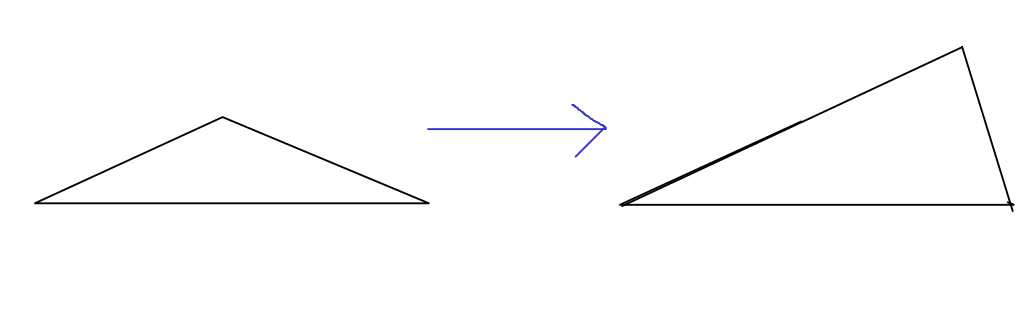
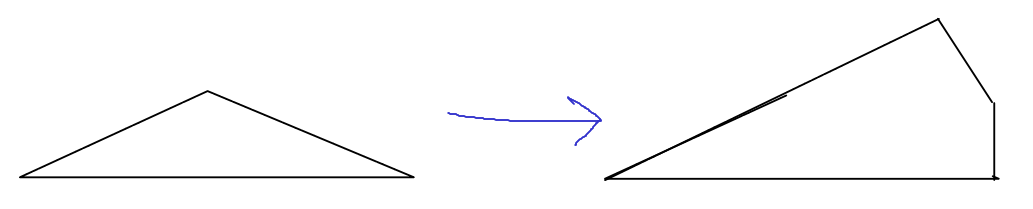
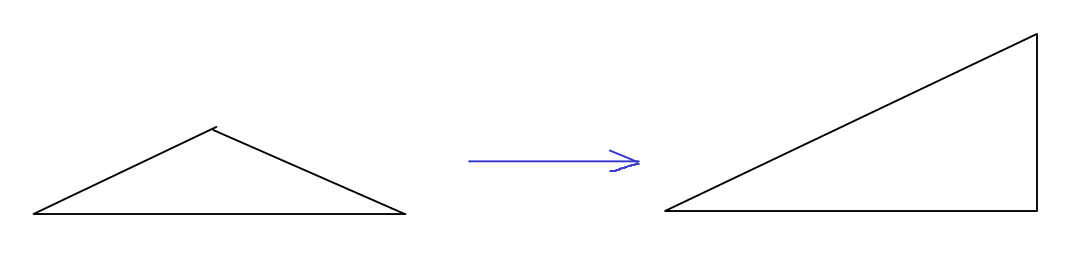
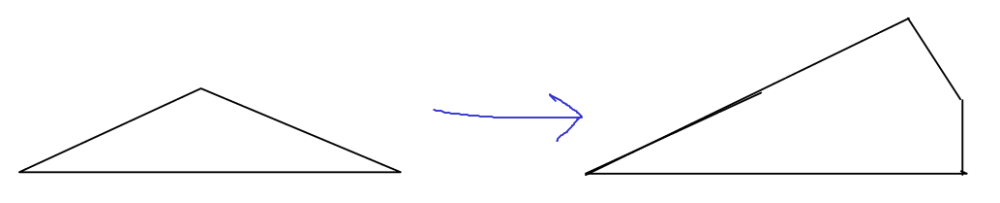
Another possibility (thinking of the ground-floor neighbors on the other side of the backyard, who may lose some light if my wall just becomes 4.5m higher, though windows would help): Is this sort of thing ever done? Is it feasible? Alternatively:
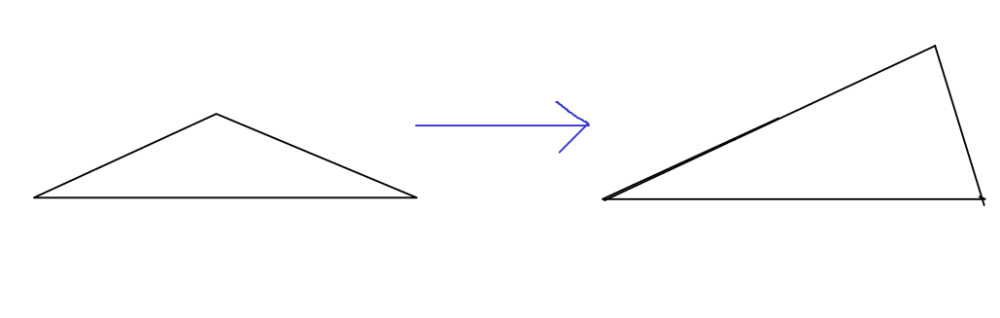
-
Maybe these photographs give a clearer idea:
-
I don’t think there are any load-bearing walls in the attic other than the (short) side walls; the whole rest of the structure consists of wooden beams (and one metal plate and bolt). In the floors under the attic, there’s a long load-bearing wall down the middle of the house, and that’s it, other than outside walls (also masonry). Right now I just have PIV. Two MVHR companies will visit in January. The room layout might improve, if anything (it would still be open, but the fundamental group would become non-trivial).
-
Sure - the people from town hall visited a few months ago, and now I have to engage in some back and forth over trivialities (a door was not as drawn in the pseudo architect’s sketches, we didn’t add shutters and instead added a second layer of windows, etc.) so I can ask. I’d certainly have to be pretty sure I’d get approval before hiring anybody. This entire house project has ended up being about learning things that I hope will never be useful to me in later life (i.e., I hope never to renovate a place again) but learning a bit of engineering would be neither time consuming not useless; for one thing, it could be a source of interesting examples if I ever teach undergrads again (something one should also not necessarily hope for).
-
Oh, what I’m lacking is any real-world experience and common sense about materials: isn’t wood (as opposed to masonry) ok in tension and not just in compression? The existing beams are wood, except for a bit that was replaced by metal back when the attic was made inhabitable (this is visible in one of the photographs, I think).
-
So the main issue would be to learn enough structural engineering to (a) know what are the possibilities (b) know whether I'm hiring a good structural engineering (and hopefully get a reasonable rate in return for having already done much of their work for them). What sort of quick in-depth introduction would you recommend for a maths person (who knows a bit of physics, taught ODEs to civil engineering students twenty years ago, etc.)? Other things to keep in mind: cross-ventilation (it gets hot in the summer up there, though that's no doubt mainly due to the substandard roof insulation), solar gain (... though given that it's generally a bit pitiful in winter and a nuisance in summer, I think it would be best to have large windows on the north side and not go much wilder with the skylights than I already have, no?).
-
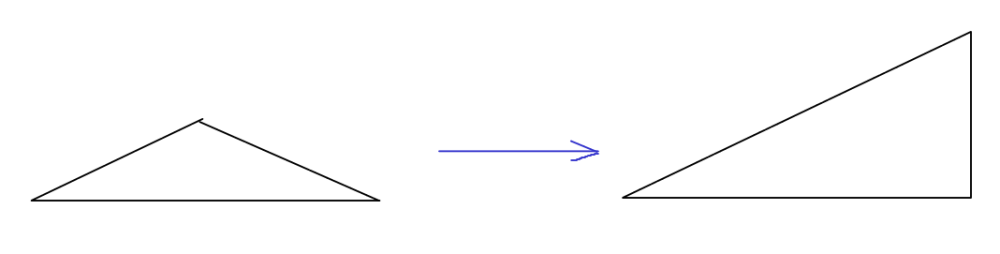
Right. Well, then one could do a straight line, if structurally possible; perhaps one can even add a mezzanine. If the roof insulation is brought up to standards (or beyond; I think I should use wood fibre rather than rock wool - better for the summer) and one uses a mixture of double- or triple-glazed windows and well-insulated wall on the new vertical edge, then the place should be easier to heat (let alone keep cool) than now. What the co-op and townhall would think of so much added height on the courtyard side - that's an open question and a different matter. Is there some obvious structural reason why a straight line would be bad?
-
Advantage of an induction hob.
Garald replied to SteamyTea's topic in Kitchen & Household Appliances
I have been a happy induction user since 2010. I now have a Bosch induction stovetop with five spots. -
Are you referring to the half that would be left relatively untouched (except for having its insulation redone)? 1. If yes, why would the pitch need to change? I'd imagine one can leave the ceiling at its current height and add insulation by putting it above, and then laying the current clay tile on top again, no? Or is this naïve? Note the solar panels are on top of the clay tile - they weren't installed in replacement of tile. 2. If you are referring to the other half, that would be greatly changed in plan b - right, if we were to have a lower pitch on that half as in my sketch, one would need a different roofing material (wouldn't clay pantile do?). I sketched things that way in order not to create a large unnecessary volume (4.50m high on the north end) and to allow for one more degree of freedom ( = we could choose the pitch that makes most sense structurally, whatever that is), but you are right that there is a natural limit to the pitch; I doubt town-hall would approve a roof that is half clay and half tile. It may be simpler to just choose one pitch, if structurally possible:
-
I should add that I rather like my attic - it would likely be my favourite place in the house if it were not for the mediocre roof insulation and the constant risk of hitting one’s head against the beams. It was recently renovated to current standards (except of course for the roof insulation, which was only improved in the spaces around the new skylights). Hence my reluctance to scrap it entirely
-
Sure, resale price and taxes depend mainly on Loi Carrez area. That’s one reason why I was suggesting the second option, with half the roof being lifted, rather than the first one: all of the northern half would become loi Carrez. The resulting space would already be more than large enough given my foreseeable usage (and it would arguably be nicer than something very standard). The big question is whether I could do that at about half or not much more than half what it would cost to scrap the entire attic and build a new structure. Also, in either case, can new skylights be reused?