Garald
-
Posts
1113 -
Joined
-
Last visited
Everything posted by Garald
-
Roof insulation on the inside - quotes - discussion
Garald replied to Garald's topic in Heat Insulation
Right, I've thought about that. Is there any solution to that? (In a future society, maybe windows would be surrounded by a layer of vacuum insulation, but I doubt a random insulation person who is trying to charge me twice what he should would agree to it.) -
Roof insulation on the inside - quotes - discussion
Garald replied to Garald's topic in Heat Insulation
Oh, I solved my first-floor noise problem (expensively!) by having a new set of sliding windows (heavy single glazing, high transparency) installed 15cm away from existing double-glazed windows (which had good specs, but were not top-of-the-line; the fake architect got in the way of that, unfortunately). So: outer set sliding sideways, inner set opening inwards. But that's not what I meant! These are skylights, which open by tilting. Aha? What do you mean? I can share pictures (and a plan) if that helps. -
Roof insulation on the inside - quotes - discussion
Garald replied to Garald's topic in Heat Insulation
Ah sorry, meant 15cm! Test for what - for the look? -
Roof insulation on the inside - quotes - discussion
Garald replied to Garald's topic in Heat Insulation
I suppose the alternative is to get new, triple-glazed Velux for the three southern-facing skylights, and move those three double-glazed Velux to create new skylights on the southern side, thereby giving me a nice view from my desk... but I'm starting to think that most people here are not friends of having lots of skylights. -
Roof insulation on the inside - quotes - discussion
Garald replied to Garald's topic in Heat Insulation
In fact, why shouldn't one be able to paste an extra layer of heavy, high-transparency plexiglass 6cm away from the skylight's glass? There's an indentation that makes this very tempting. I suppose that the inside could get very hot. I guess that indentation is there to accomodate Velux's own blinds, but I don't see anything noise-reducing in their product line.
-
Roof insulation on the inside - quotes - discussion
Garald replied to Garald's topic in Heat Insulation
Right - and sound is not like heat; the weakest point will matter a lot. Might eventually need some sort of inside sliding doors (whatever would be the name for them?) on the south-side windows (notice there are only three of them, on purpose). I could easily handcraft something temporary out of wood and cork to see if that makes a difference. I doubt the windows are the weakest point right now - I suspect it's the entire structure that is transmitting noise. (What *is* the density of high-density plasterboard? I'm still think of whether I would be best off with two layers of that, or with a layer of that plus a 15cm layer of decorative cork.) -
Roof insulation on the inside - quotes - discussion
Garald replied to Garald's topic in Heat Insulation
While we are on the subject - what about blocking sound from the outside? I face a busy street, and my attic is actually noticeably noisier than my first floor (... which is insulated with some 18cm of BioFib Trio and has not just good, new sound-reduction double glazing *and* an additional layer of thick single glazing in its rather large windows). I know cork is better than wood fibre - but could I ask the insulators to, say, drop a layer of mass-loaded vinyl somewhere in the ceiling? Where - above or below the insulation? -
Didn't we have a thread on this? Ah yes, both you and I posted on it. It's when incoming air first goes through pipe (lots of it: 30m to 60m is typical) laid fairly deep underground (2m to 6m), thus cooling the air in summer and warming it in winter. Apparently the inside gets coated in silver salts so that it doesn't become a colony for fungi and bacteria: https://www.fiabitat.com/les-precautions-sanitaires/ Also, consult your friendly neighborhood radon map.
-
MVHR ? Who needs it? I don't.
Garald replied to ToughButterCup's topic in Mechanical Ventilation with Heat Recovery (MVHR)
Just learned that the way Canadian wells are rated in France for energy-rating purposes is 'pretend the user has MVHR'. (What do they do if someone has both? Report him as an overachiever?) -
Ah, before I forget. There's another possibility for the long term (5-10 years): a Canadian well - could be an option if the coop decides that we'll redo our courtyard (currently concrete, and bearing 90 years' worth of scars). Apparently there's an old, unused septic tank down there. - Could dig that up and use that for a Canadian well instead, no? - I guess Canadian wells should in principle be compatible with both PIV and MVHR? In the current French DPE calculation method (dating from 2021), the instructions for rating a place with a Canadian well are 'rate it as if it had MVHR' - I guess they would consider that someone who has both is overdoing it and deserves no extra points. But at this stage there are more pressing issues. I was typing in the dark.
-
Ah yes. It's one of those things where you ask yourself 'am I making a standard mistake here?' but it's too early in the morning.
-
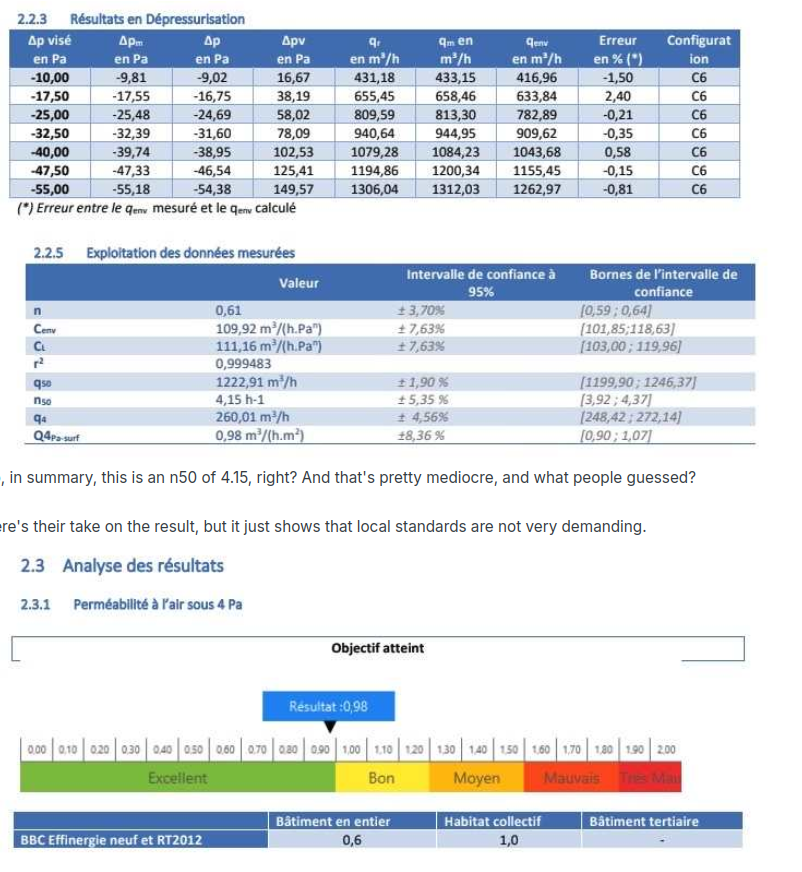
Current state of affairs Tests Energy consumption: estimated at 100 kW/m^2/year at the end of the first stage of renovation, in the summer of 2023 (energy rating B for French standards). Airtightness: measured at Q4Pa-surf in m3/(h.m2) : 0,98 in November 2024. I've put into practice all recommendations in the report; the testers say that, if I have done everything correctly, I should now be around 0,7. Insulation My place is most of a townhouse with ground floor, first floor and attic. (Most of the ground floor is not mine - it's a GP's office.) Southern side (south-east-south; street side): insulation from the inside by BioFib Trio, up to code (R>4). Western side (grouchy neighbour's garden): insulation from the inside by BioFib Trio, up to code (R>4). Could hypothetically insulate from the outside some day; would need to get to know said grouchy neighbor. The main reason would be to regain 20cm of space, but it's probably not worth it, even though that's 7*0.2 = 1.4m^2 space to recover. I take it can be insulated from the outside decades from now, once standards rise and insulation decays. Northern side: insulation by a combination of BioFib Trio (5cm) and a reflective insulation with more vegetables on the back. Up to code (R well above 4) if you believe in reflective insulation. Thermal-camera pictures show it's not too bad. Condensation may be a long-term issue, according to Ubakus. Some thermal bridging likely; ground-floor corners very cold. For what it is worth, the general builder says he wanted to insulate from the outside to begin with, but the person he still hasn't accepted is no architect would not let him. Eastern side: most of it is covered by a ghost kitchen next door, but we insulated anyhow (the building next door is low - its roof is lower than my first-floor ceiling), with the same arrangement as the northern side. As a result, the staircase going to the attic is very narrow. Attic: This is the weakest part of the entire insulation. The short sides (murs pignons) are now insulated in the vegetable/reflective/vegetable combination. You can see some of the metal framing with a thermal camera. The bits before the eaves (combles perdues) are now insulated with cellulose. The low walls are disappointingly cold according to the thermal camera, though that may just be a function of how air circulates. I don't think the general builders used any kind of membrane. The worst part is most likely the ceiling. It was the *only* bit that was insulated when I bought the place - the owners before the previous ones got that bit done with fibreglass 15 years ago. That's still there, though bits around the skylights were replaced by rockwool by the general contractor. One can really feel that insulation in the attic is not to the same standard as elsewhere, particularly during the summer. (Outside shades on the skylights have helped a great deal.) Ventilation PIV. Has some sort of radiator going around the input (hidden inside a box), fed by the heat pump. It barely seems to reach the attic (which may be too airtight to begin with; I can open the handlebars in the skylights to let air through, but I can't leave them open - rain would come through and ruin the hardwood). It may ventilate the first floor Green power generation Some solar panels (3kW peak). Could install many more. Plans Short term (a) Fix the plumbing in the kitchen and under the house (there was a leak); the new plumbing under the sinks makes plumbers wince because of its amateurishness, but I suppose I'll let it be for the while being. (b) Get a quote for insulating whichever bits of the heating/hot water pipes can be insulated without ripping things apart (the fake architect was very much against insulating the pipes for whatever reason). (c) If I get a reasonable quote, insulate the attic ceiling properly, with a material with good thermal inertia (either wood fibre or a mixture of wood fibre and cork). Just got two quotes - we are discussing them in a thread. In the long term (>5 years), I can consider: (i) insulating the northern wall from the outside; this is something that needs to be decided by the coop as a whole, but it's a tiny coop - a couple and I are the only ones who ever show up to meetings) and we are all leaning that way. Of course outside appearance will improve, looking from the courtyard (the other building in the coop is not looking great). (ii) if I have money, money, O!, I could 'raise the roof', i.e., recreate the attic as a space in most of which I could actually stand. That would of course involve destroying at least half of the current roof, and probably losing all the money invested in (c) above (companies are loath to reuse insulation material installed by other companies). OTOH it would increase the value of the property a great deal. (Prices around here are determined mainly by the number of m2 in which a 180cm-tall person can stand.) (iii) it's probably best if I consider installing MVHR only if and when I do (ii). One company says it's not worth it right now, but could probably do it for 8k-ish if the attic gets completely rebuilt, as then matters would be simpler. Another company would be ready to install MVHR right now, but for a huge amount (20.5k). This general plan would seem to make sense, though at the same time I don't know how to escape the dilemma between (c) and (ii). The coop will probably be ready to do (i) in about 5 years (we will start setting money aside now). Perhaps (ii) and (iii) should be postponed indefinitely, except that it would make sense to do (ii) at the same time as (i). Oh well.
-
This is neither an intro nor an outro. Rather, this is an account that I've given before in a piecemeal fashion. I told the entire story in one go late at night yesterday in a thread, and have decided to share it here for ease of reference. Got into a major renovation project in 2022, never having done any house renovation before - this is the first time I own. Before you call me foolhardy, recall that (a) pretty much anything in the Paris area gets sold needing work, (b) someone who I trusted at the time recommended to me his supposedly genius architect (henceforth called by her initials, EB). EB talked a good talk but seemed to have an iffy grasp of physics. She brought in a general builder who did a bit of everything. At that point I found this forum (thank goodness). People here taught me a great deal. I managed to get EB to accept some input in the choice of insulation materials, though for reasons that were not apparent to myself or the general builder, she absolutely refused to consider insulating from the outside (even though losing m^2 of indoors space in the Paris area means losing lots of money). EB had bizarre prejudices against heat pumps. She also didn't think I should aim at getting anything higher than an energy rating of D (we started out at F), her argument being that D was the average result of a renovation. That was a very strange argument - why not aim at being much better than average? EB had a strange plan on how to install a heat pump. No installer wanted to accept it. I asked for a sketch and posted it here. People were soon ROTFL and explained well why it would be a total disaster. Explained everything firmly and politely to EB, whose already nasty manner became worse. She started asking for more and more money, including for things she hadn't done yet. She also started showing up hours late to meetings, or failed to show up. At some point, she asked for more money than had ever been agreed upon. I made clear things couldn't go on like that, and she just left. The contractor was in a terrible mood but stayed until the end to finish the job. At around that time, I was telling all of the above to a friend, who asked a question that should have been obvious in retrospect: have you checked that she's really an architect? Guess what - it was quite easy to verify that she was not a member of the Order of Architects and hence had no right to call herself one. It took quite a bit more time and effort to verify that she had never had an architecture diploma. Over time, the picture has become clearer: she took classes in interior design in the 90s (but apparently never finished), got an internship in an architecture studio run by one of her lecturers, was an assistant in an architecture project in the late 90s (she made the architects in the project believe that she was an architecture student), then had some sort of job at another architecture studio, then got some sort of cheap master's (Saturdays only) on urban planning in the late 2000s, and set out on her own career as a fake architect. But all of that I learned over time. In 2023, my focus was on finishing the renovation. Did all heat losses computations myself with the help of the trusty Buildhub spreadsheet, and convinced the general builder that old cast iron radiators can work perfectly well with a heat pump running at medium-low temperatures. (When it comes to understanding heat-pumps - many thanks are due both to Buildhub and to Feynman for one of his first-year lectures on physics: if you read it backwards (well, reversing the direction of the arrows), you understand everything.) Got an energy rating of B in 2023. Since then, I've been improving things here and there: while it is my impression that the general builder was reasonably honest and mostly competent, he did some things much better than others. By now, I know a good plumber, a good hardwood person, etc. It is clear that I will have to fix some things that should have been fixed while the renovation was ongoing (e.g., the plumbing in the kitchen is not just malfunctioning but illegal; the plumber implies I should not worry too much about the last bit, as half of the plumbing in Paris is illegal, and the rest is mostly substandard - but of course I'll get it fixed). OK, enough for the human side of the story. Let me summarize where things stand technically, and how I see possible further work in terms of cost/benefit.
-
Huge MVHR quote
Garald replied to Garald's topic in Mechanical Ventilation with Heat Recovery (MVHR)
Hm, that summary turned pretty epic - I'm almost tempted to make it into its own thread for easy reference. But what category would it fall into? "Summary of personal building journey"? -
Huge MVHR quote
Garald replied to Garald's topic in Mechanical Ventilation with Heat Recovery (MVHR)
At this price point that would be the case. See one of my other topics - I had an fan test done. (Of course the ventilation bits at the top of the windows got taped over before the test.) I got a score of Q4Pa-surf in m3/(h.m2) : 0,98 I got a long list of small things to fix, which I did fix. The guys who did the test eyeball that it's probably around 0.7 now (if I did everything right). Here's the summary of the story (I think some folks here have already heard it more than once). Got into a major renovation project, never having done any house renovation before - this is the first time I own. Before you call me foolhardy, recall that (a) pretty much anything in the Paris area gets sold needing work, (b) someone who I trusted at the time recommended to me his supposedly genius architect (henceforth called by her initials, EB). EB talked a good talk but seemed to have an iffy grasp of physics. She brought in a general builder who did a bit of everything. At that point I found this forum (thank goodness). People here taught me a great deal. I managed to get EB to accept some input in the choice of insulation materials, though for reasons that were not apparent to myself or the general builder, she absolutely refused to consider insulating from the outside (even though losing m^2 of indoors space in the Paris area means losing lots of money). EB had bizarre prejudices against heat pumps. She also didn't think I should aim at getting anything higher than an energy rating of D (we started out at F), her argument being that D was the average result of a renovation. That was a very strange argument - why not aim at being much better than average? EB had a strange plan on how to install a heat pump. No installer wanted to accept it. I asked for a sketch and posted it here. People were soon ROTFL and explained well why it would be a total disaster. Explained everything firmly and politely to EB, whose already nasty manner became worse. She started asking for more and more money, including for things she hadn't done yet. She also started showing up hours late to meetings, or failed to show up. At some point, she asked for more money than had ever been agreed upon. I made clear things couldn't go on like that, and she just left. The contractor was in a terrible mood but stayed until the end to finish the job. At around that time, I was telling all of the above to a friend, who asked a question that should have been obvious in retrospect: have you checked that she's really an architect? Guess what - it was quite easy to verify that she was not a member of the Order of Architects and hence had no right to call herself one. It took quite a bit more time and effort to verify that she had never had an architecture diploma. Over time, the picture has become clearer: she took classes in interior design in the 90s (but apparently never finished), got an internship in an architecture studio run by one of her lecturers, was an assistant in an architecture project in the late 90s (she made the architects in the project believe that she was an architecture student), then had some sort of job at another architecture studio, then got some sort of cheap master's (Saturdays only) on urban planning in the late 2000s, and set out on her own career as a fake architect. But all of that I learned over time. In 2023, my focus was on finishing the renovation. Did all heat losses computations myself with the help of the trusty Buildhub spreadsheet, and convinced the general builder that old cast iron radiators can work perfectly well with a heat pump running at medium-low temperatures. (When it comes to understanding heat-pumps - many thanks are due both to Buildhub and to Feynman for one of his first-year lectures on physics: if you read it backwards (well, reversing the direction of the arrows), you understand everything.) Got an energy rating of B in 2023. Since then, I've been improving things here and there: while it is my impression that the general builder was reasonably honest and mostly competent, he did some things much better than others. By now, I know a good plumber, a good hardwood person, etc. It is clear that I will have to fix some things that should have been fixed while the renovation was ongoing (e.g., the plumbing in the kitchen is not just malfunctioning but illegal; the plumber implies I should not worry too much about the last bit, as half of the plumbing in Paris is illegal, and the rest is mostly substandard). The question now is when to stop. (Here the fact that I don't have much money left right now helps.) What I am leaning towards is: in the short term, (a) fix the plumbing in the kitchen; let amateurish plumbing elsewhere be for the while being; (b) get a quote for insulating whichever bits of the heating/hot water pipes can be insulated without ripping things apart (the fake architect was very much against insulating the pipes for whatever reason) (c) if I get a reasonable quote, insulate the attic ceiling properly. This is the weakest part of the entire insulation (it was the *only* bit that was insulated when I bought the place - the owners before the previous ones got that bit done with fibreglass 15 years ago) and one can really feel it, particularly during the summer. *Of course* I should have got it done before the attic got painted, but then it would have been done by the general contractor, and I don't know whether he'd have done it well or badly. And there's also another factor at play - see below. Oh, and also get a (real) lawyer, but I've already done that. I also found where in the provinces EB is hiding (she left Paris). In the long term (>5 years), I can consider: (i) insulating the northern wall from the outside; this is something that needs to be decided by the coop as a whole, but it's a tiny coop - a couple and I are the only ones who ever show up to meetings) and we are all leaning that way. (The northern wall was insulated from the inside using a mixture of reflective insulation and insulation that actually works (the fake architect just put two things together; I don't know whether will ever be condensation.) (ii) if I have money, money, O!, I could 'raise the roof', i.e., recreate the attic as a space in most of which I could actually stand. That would of course involve destroying at least half of the current roof, and probably losing all the money invested in (c) above (companies are loath to reuse insulation material installed by other companies). OTOH it would increase the value of the property a great deal. (Prices around here are determined mainly by the number of m2 in which a 180cm-tall person can stand.) (iii) MVHR is probably best left to this stage (redoing the entire attic would simplify matters, or at least that was the position of one of the two companies I consulted), but I'll get a third quote. Note the other company is of the opinion they can install MVHR without ripping too many things apart, but they are the ones asking for lots and lots of money. This general plan would seem to make sense, though at the same time I don't know how to escape the (c) vs (ii) dilemma. And, of course, if I got a reasonable quote for installing MVHR now, that would change matters (I'm not optimistic). There's also the matter that the coop will probably be ready to do (i) in about 5 years (we'll probably get all courtyard-facing walls insulated in one go); perhaps (ii) and (iii) should be postponed indefinitely, except that it would make sense to do (ii) at the same time as (i). Oh well.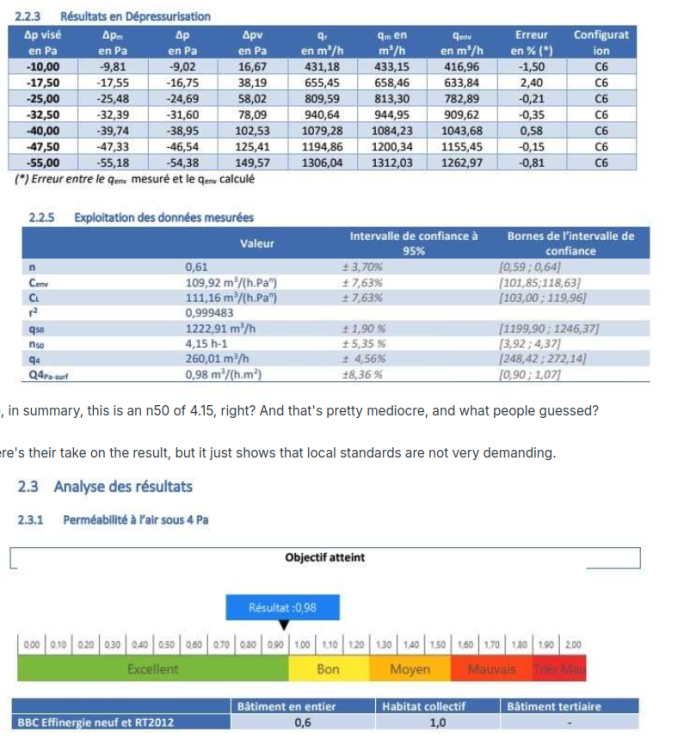
-
Huge MVHR quote
Garald replied to Garald's topic in Mechanical Ventilation with Heat Recovery (MVHR)
The verbal quote of 8k was not for now, but an estimate of how much it would cost to fit a MVHR system if I scrapped the entire attic and built an extra floor instead (since then there would be much less finagling around). Given that, it would be difficult to get a firm commitment. Let me try to get a third quote. -
Roof insulation on the inside - quotes - discussion
Garald replied to Garald's topic in Heat Insulation
Ah thanks - just replied. Wonder why the system didn't notify me... -
Huge MVHR quote
Garald replied to Garald's topic in Mechanical Ventilation with Heat Recovery (MVHR)
So, I guess I should look for a third company? Or follow the other fellows' advice and wait for the hypothetical day (won't happen in the next 10 years I think, certainly not in the next 5 years) in which I raise the roof? -
Roof insulation on the inside - quotes - discussion
Garald replied to Garald's topic in Heat Insulation
Look at the quote I got for MVHR! -
Roof insulation on the inside - quotes - discussion
Garald replied to Garald's topic in Heat Insulation
Aha. Yes, comprensibility is why Isoveo demurs - but why should it be impossible to mix cork and fibre, using cork down the middle and fibre for edges, nooks and crannies? Does the much higher density of cork mean it would all fall apart somehow? Of course cork is pricey, but given how much I seem to be about to get charged for nonsense, it may make sense to pay a bit more for the insulation material (which right now is only 35% of the total cost). -
Had two MVHR companies visit two months ago or so. - The technician in company 1 said: this would be in the 10k-15k range, and heat recovery is something of which I am somehow skeptical, and you already have PIV. Le jeux ne vaut pas la chandelle (i.e., It's not worth it). If at some point you raise the roof, as you say is a long-term plan you are contemplate it, it could make more sense - then it would be more in the 8k range. - The folks from company 2 were more enthusiastic, though they were quite frank that their MVHR recovers only about 30% of heat in practice (considerably less than the manufacturer claims, they said). Then they took forever to get back to me. Just got a quote from company 2. Guess what - it's huge! Le jeux ne vaut pas cette chandelle! Comments? Can you see anything funny? (My immediate reaction is not to get MVHR for now, and rather wait until the next time I do truly major work (such as "raising the roof", which consists in "raising it" only in the sense that a caterpillar becomes butterfly - in fact the caterpillar mostly dies and the butterfly develops from cells that feed on the rest of the caterpillar), in the hope that the ca. 8k verbal quote from the first technician will be trueish modulo inflation, and that French technicians work with Passivhaus-standard MVHR by then.) VMC DOUBLE FLUX HELFGOTT_Dossier.pdf Devis_020012278_HELFGOTT_Harald FOURNITURE ET POSE SYSTEME DE VMC DOUBLE FLUX LOGEMENT R+3.pdf
-
Roof insulation on the inside - quotes - discussion
Garald replied to Garald's topic in Heat Insulation
Hah! The MVHR company I just contacted has sent me an apology and a quote - which is huge! My reaction has to be: le jeux ne vaut pas la chandelle! Separate thread for that. -
Roof insulation on the inside - quotes - discussion
Garald replied to Garald's topic in Heat Insulation
Is there a good reason to prefer BioFib Trio or Chanvre to Steico wood fibre (036 or 038) or cork? The lambda seems to be always in the same range (around 0.038, though with cork it depends on the source) and the thermal inertia of Steico 038 seems to be about 15% higher than that of BioFib (and the thermal inertia of cork should be much higher, no?). -
Roof insulation on the inside - quotes - discussion
Garald replied to Garald's topic in Heat Insulation
I wouldn't rely on it. Two teams of ventilation people came to visit. One of them said that le jeu ne vaut pas la chandelle (i.e., MVHR wouldn't be worth the insulation cost right now - maybe if at some point I raise the roof). The other team was more optimistic (even though they said that, in all honesty, the MVHR systems they work with recover only 30% of heat, whatever the manufacturer says - is this normal? are MVHR systems in France backwards? are French MVHR installers pathologically upright?) and promised to send me a quote... and then they never did, though I've reminded them. Time to give them a ring. Ah, funny - I could swear the ISOVEO guys mentioned that verbally. Somehow it hasn't made it to their quote or their model - will ask. Or I could put plasterboard and then a layer of decorative cork (which comes in widths ranging from 3cm to 15cm), which would in effect not just be decorative but also help with everything you say (besides being safer for my head than plasterboard). At the price SMCI wants to charge for painting, I could put gold leaf on the ceiling if I wanted to. I imagine decorative cork can be put directly on unprepared plasterboard without further ado, or not? I love Biofib Trio - have it on my southern first-floor wall, which faces a busy street. How do wood fibre and cork compare in terms of noise reduction? -
Roof insulation on the inside - quotes - discussion
Garald replied to Garald's topic in Heat Insulation
No, all roof lights (except for one) are new, from 2 years ago - double-glazed, not triple glazed, but with good specs (U = 1ish if I remember correctly). That is, half of the roof lights were already there, but I had the windows remplaced entirely. I also put retractable outside shades on all of them (that made a very big difference - as far as summers are concerned obviously). It's not 30-50% glass, it just looks that way (on purpose ). It's about 21% glass. A very pleasant space in mid-season (I'm sitting there right now).